
Key Takeaways
Incentivizing a sales team means using financial and non-financial rewards to steer sellers toward the results the business needs while keeping them motivated to stay.
Start with motivation, achievable goals, a balanced reward mix and tiered pay, because every contest or badge sits inside that frame.
Rewards should scale with achievement: accelerators pay a rep at 175% of quota far more than one at 125%, while a flat bonus pays them the same.
Fast, specific recognition is one of the cheapest incentives, and Gallup found well-recognized employees were 45% less likely to leave within two years.
Measure every incentive against the behavior it was meant to change, and retire the ones that only add cost.
Here is how to incentivize a sales team: find out what actually motivates each rep, set goals they believe they can hit, pay more for exceeding target than for meeting it, and back cash with fast recognition, coaching, contests and growth. The 12 strategies below show how to do each one, with a cost and speed comparison so you can start with the moves that pay back fastest.
Incentivizing a sales team means using financial and non-financial rewards to steer sellers toward the results and behaviors the business needs, while keeping them motivated enough to stay. The sales profession comes with demanding challenges, from frequent rejection to high-pressure conversations that can quickly drain people. Well-planned incentives and ongoing support keep performance up and turnover down without straining company resources.
Why sales teams need more than a commission check
Commission pays for results at the end of a cycle, but most of what decides those results happens in the weeks before. Sellers today are under heavy pressure and have little time to sell, so the work to motivate sales reps has to be continuous, not once a quarter.
The data shows how stretched teams are. The Ebsta and Pavilion 2025 GTM benchmark report found 78% of sellers missed quota. Salesforce's 2026 State of Sales research found sellers spend only 40% of their time selling and 46% rarely get feedback on their sales conversations. And in the Bridge Group's 2025 SDR report, median SDR attrition reached 40%.
78%
of sellers missed quota
Ebsta and Pavilion, 2025
46%
of sellers rarely get feedback on calls
Salesforce, 2026
40%
median SDR attrition
Bridge Group, 2025
45%
less likely to leave after two years
well-recognized employees, Gallup, 2024
The motivation gap that sales incentive strategies need to close
The good news is that the fixes are well understood. Pay structure, recognition, coaching and visibility all move these numbers, and most of them cost less than raising commission rates.
Give every rep a live view of what they earn
Show earnings, rank and the distance to the next slab as deals close.
Talk to our ExpertTrusted by 5,000+ companies
How to incentivize a sales team: 12 effective strategies
These 12 sales incentive strategies run from foundation to measurement. Start with the first four, because motivation, goals, reward mix and pay structure set the frame that every contest, badge or training budget sits inside.
1. Understand what motivates each rep
The first step to incentivizing a sales team correctly is to understand what drives each person. Most organizations default to financial incentives, but money is not always what a rep needs most. People have emotional, social and personal needs at work too, such as recognition, mastery, flexibility and a sense of progress.
Ask rather than guess. A short survey or a one-on-one conversation at the start of each year can cover three questions: which rewards matter most to you, how do you like to be recognized, and what would make you stay another two years? Companies that account for these needs stand out in attracting and keeping top talent. For a rep-by-rep view of what drives sellers to leave, see these sales team retention strategies.
2. Set clear and achievable sales goals
Unrealistically high goals overwhelm salespeople and make them feel set up to fail. When that happens repeatedly, the company pays for it in turnover and recruitment costs. Quota setting is hard even for large firms: in the Alexander Group 2025 Sales Compensation Trends Survey, 44% of firms named setting accurate quotas as a top sales compensation challenge.
As a rule of thumb, every goal should be SMART: specific, measurable, achievable, relevant and time-bound. Base targets on territory potential and past results, not a top-down number split evenly. Also link team goals to personal goals, such as learning a new product or moving into an enterprise role, because helping people reach their own goals builds loyalty and makes them stay longer.
3. Mix financial and non-financial incentives
There is more to motivating a sales team than bonuses and pay rises. The best way to incentivize sales teams is a balanced mix of financial and non-financial rewards. Commissions and profit sharing are always part of the answer, but they work best alongside recognition, awards, development and promotion paths.
Reward value has limits. The Incentive Research Foundation's 2025 study of 500 reward-eligible employees and channel partners found that willingness to put in extra effort rises with reward value only up to a threshold, and that clear objectives, personalization and reward choice also make a program more appealing. Non-monetary sales incentives that work well include:
- Public recognition: A shout-out from leadership on the company feed or in the sales kickoff.
- Experiences: Travel, event tickets, a spa day or a team dinner.
- Time: An extra day off after a record month.
- Growth: A seat in a leadership program, a mentor or a stretch account.
- Choice: Reward points redeemable for what the rep actually wants.
For a full list of incentive types and ideas, read this guide to sales team incentives.
4. Use tiered and performance-based pay
Tiered compensation motivates reps to exceed targets, not just meet them. Because the rate rises as attainment rises, each extra deal is worth more than the last, which encourages people to push for their best result. Performance-based incentives also keep the stakes beyond the guaranteed salary, which helps avoid complacency.
Accelerators above 100% of quota are the most common tool, sometimes paired with decelerators below a threshold. Communicate the rules and rewards clearly and fairly so everyone knows what is on the line. For the full range of structures, from straight commission to draws and residuals, see these sales commission and incentive plans.
5. Give real-time feedback and recognition
Many leaders assume a carrot-and-stick approach is the best motivator, but that is a misconception. According to Abraham Maslow's well-known theory, once basic needs are met, people seek higher needs such as belonging, appreciation and achievement. Money is a great start, but people can become complacent about it if it is the only positive they get from their job.
Recognition is how you meet those higher needs. Gallup's 2024 research with Workhuman found well-recognized employees were 45% less likely to have left after two years. In sales, the best recognition is fast and specific: name the deal, the behavior and the impact on the day it happens, rather than waiting for the quarterly review.
6. Run sales contests and challenges
Healthy competition is one of the best incentives for sales teams. Give people at the same level a common goal and a short window, and you add energy to routine work. Recognize winners publicly so others want to push their limits next time.
Three rules make contests fair. Communicate the rules, metrics and prizes clearly before launch. Track performance transparently from CRM data so there is no suspicion of bias. And size the prize to the effort the contest asks for. For ready-made formats and a contest planner, see these sales gamification ideas.
7. Invest in sales training and development
Ongoing training and skill development make salespeople better at their jobs and more likely to stay. Many reps say they do not get enough practice: Salesforce's 2026 research found 47% of sellers do not get enough roleplay opportunities before customer calls. Run in-house coaching, bring in outside mentors or fund certifications and courses.
Turn learning into an incentive in its own right. Award certificates, badges or points for completing training, and recognize reps who apply a new skill to win a deal. Development opportunities are one of the most valued non-monetary sales incentives, especially for early-career sellers who want a path to account executive or management roles.
8. Bring gamification into the daily routine
Game mechanics make daily sales work more engaging. Leaderboards, badges, streaks and point systems turn progress into something visible, and they work best when they reward activities that build pipeline as well as closed deals.
Scope leaderboards to similar peers, such as the same role or region, so the middle of the team has a realistic chance of ranking. Celebrate winners with recognition and rewards, and rotate the metric every few weeks so the same top performers do not win every time. If you are comparing tools, this review of sales gamification software covers the options.
9. Open feedback and collaboration channels
Even a well-incentivized team can be unhappy if policies are implemented badly or the company has misread what motivates people. Build clear channels for open, two-way feedback, including an anonymous option so people can speak freely. When negative feedback comes in, adjust the policy and say what you changed.
Regular team meetings and brainstorming sessions also improve collaboration. A welcoming environment encourages reps to share what works on calls, which spreads good practice faster than any training deck.
10. Make incentives data-driven and fair
A reward system that pays all positive performers the same may seem fair, but it feels unjust in practice. If one rep beats target by 25% and another by 75%, and both get the same bonus, the result is counterproductive. Rewards should scale with achievement, which is what accelerators are for.
| Calculation | Rep A (125% of quota) | Rep B (175% of quota) |
|---|---|---|
| Target incentive at 100% of quota | $5,000 | $5,000 |
| Attainment from 100% to 150% (paid at 1.5x) | 25% of target: $1,875 | 50% of target: $3,750 |
| Attainment above 150% (paid at 2x) | $0 | 25% of target: $2,500 |
| Total with accelerators | $6,875 | $11,250 |
| Total with a flat $1,000 bonus for beating quota | $6,000 | $6,000 |
Use analytics to spot top performers and consistent improvers, and reward both. This guide on how to calculate sales incentives shows the formulas behind accelerators, multipliers and weighted KPIs.
11. Stay flexible and personalize rewards
Rewards should keep up with what people value. Many employees now care about fitness and wellbeing, so a retreat or a year-long membership to their favorite gym can land better than a pricier reward with no personal relevance. Personalized, relevant incentives tend to have more impact than generic ones.
Match rewards to role and seniority too. A certificate may be a worthy recognition for a new SDR but feel thin for a sales director. Incentive policies should be dynamic: gather feedback from the team on what works and change it as needed.
12. Measure the impact of every incentive
Define how you will judge each incentive before you launch it. Track quantitative data, such as attainment rates, revenue per rep, win rates and incentive cost as a share of revenue, alongside qualitative feedback from reps and managers. Review the results every cycle and tweak or retire what is not working.
A simple test: if an incentive did not change behavior, it was a cost, not an incentive. For a step-by-step method to design and review a full program, read how to create a sales incentive program.
Sales team incentive ideas compared by cost and speed
Not every strategy needs a budget increase, and some show results within weeks. Use this comparison to pick two or three strategies to start with this quarter, based on what is broken in your team today.
| Strategy | Cost | Time to impact | Best when |
|---|---|---|---|
| Understand motivation | Low | Weeks | Rewards are not landing |
| Clear, achievable goals | Low | Next cycle | Most reps miss quota |
| Mixed financial and non-financial rewards | Medium | One quarter | Cash alone has stopped working |
| Tiered and performance-based pay | Medium to high | Next plan year | Top performers plateau at 100% |
| Real-time recognition | Low | Days | Morale is low between payouts |
| Contests and challenges | Low to medium | Days | Pipeline or activity is slow |
| Training and development | Medium | One to two quarters | Win rates are falling |
| Gamification | Low to medium | Weeks | The middle of the team is disengaged |
| Feedback channels | Low | Weeks | Turnover is rising |
| Data-driven fair rewards | Medium | Next cycle | Reps feel rewards are unfair |
| Flexible, personalized rewards | Low to medium | One quarter | The team is diverse in age and role |
| Measurement | Low | Ongoing | You cannot say what incentives return |
Common mistakes when incentivizing a sales team
Most incentive problems come from a handful of repeated design errors. Avoid these four and the strategies above have room to work:
- Rewarding only the top 10%: If only a few people can realistically win, everyone else stops trying. Use milestones and scoped leaderboards.
- Paying late or getting it wrong: Payout errors and delays break trust faster than any plan design can rebuild it. See why it pays to automate the sales commission process.
- Changing rules mid-cycle without warning: Agree in advance when and how targets can change.
- Rewarding the wrong behavior: Paying only on revenue can push discounting and poor-fit deals. Read about the cost of a bad sales incentive plan.
How Empuls helps you incentivize your sales team
Empuls brings sales incentives, gamification and recognition onto one platform, so the strategies above run on the same data. Admins build commission, target and milestone plans in a no-code builder, and calculations run automatically from CRM, ERP and HRMS data.
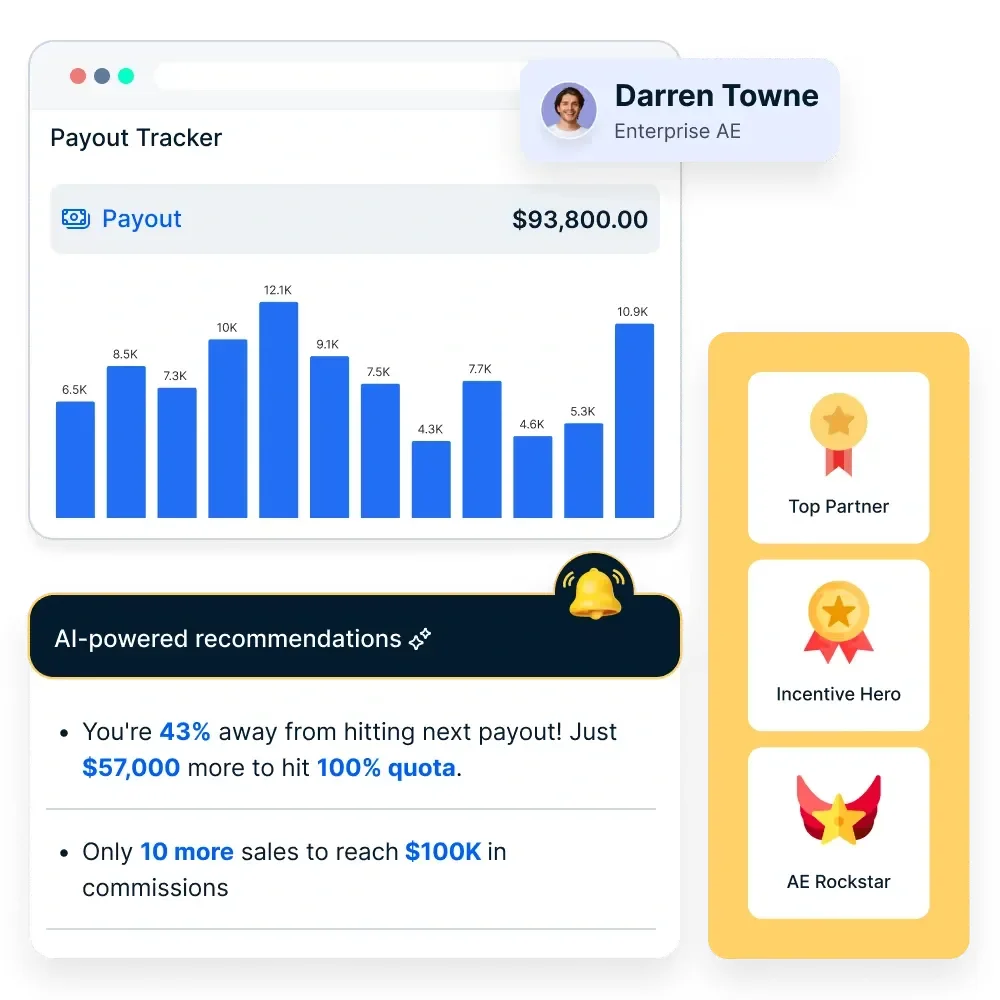
Sales professionals see a KPI scorecard, an earnings estimator, their leaderboard rank and nudges on how far the next slab is, while live leaderboards, SPIFs, contests, badges and streaks keep the whole team competing between payouts. Approved incentives can be paid through payroll, bank transfer, UPI or rewards. Chaipoint used it to give 120+ sales users real-time incentive visibility and saw a 115% increase in incentive qualifiers, as covered in the Chaipoint case study.
Explore Empuls sales incentives, sales gamification, AI for incentive management and peer-to-peer recognition.
Keep incentives fair, visible and personal
Without consistent, well-designed incentives, a sales team loses motivation and good sellers start looking elsewhere. Build transparent, fair reward systems that are easy to track, mix cash with recognition and growth, and match rewards to what each rep values.
Then review the program every cycle against the goals you set. When an incentive is not producing the behavior you wanted, change it quickly and tell the team why.
Book your Empuls demo
Frequently asked questions
The best way is a balanced mix: a clear commission or bonus plan with accelerators above quota, plus fast recognition, short contests and development opportunities. Base targets on real territory potential so most reps can reach them, give everyone live visibility of earnings, and ask reps what rewards they value instead of guessing.
Use recognition, growth and choice. Publicly celebrate specific wins, offer mentoring, training and stretch accounts, give extra time off after a record month, and let reps pick rewards that matter to them. Leaderboards and badges scoped to similar peers also motivate, because they show progress and give the middle of the team something to chase.
The most common sales incentives are commissions, quota bonuses, accelerators for exceeding target, SPIFs for specific products or deals, contests with cash or non-cash prizes, incentive travel and recognition awards such as President's Club. Many companies add reward points, gift cards and development opportunities to reach reps who are not motivated by cash alone.
Recognize wins as they happen, run short contests or SPIFs every few weeks and pay commissions monthly or quarterly. The faster the link between a behavior and its reward, the stronger the motivation. Annual awards and incentive trips work well as long-term goals, but they should not be the only rewards a rep sees all year.
Most teams need both. Individual incentives drive personal accountability for quota, while team incentives build collaboration on complex deals and stop reps from competing for the same accounts. A common approach is an individual commission plan with a smaller team bonus or shared contest that rewards everyone when the region hits its target.
Give them reachable milestones and coaching rather than a target that feels impossible. Milestone rewards and badges for progress, leaderboards scoped to similar peers and weekly goals create early wins. Pair that with specific feedback on calls and pipeline, and use a structured improvement plan only when coaching does not change results over time.
Compare attainment rates, revenue per rep, win rates and the behavior the incentive targeted before and after launch, and track incentive cost as a share of revenue. Add rep feedback and retention of top performers. If the targeted behavior did not change, the incentive was a cost rather than a motivator and should be redesigned.





































































































































































































































































































































































































































































































































































