
Key Takeaways
An employee rewards program formally recognizes contributions with something of value, combining recognition with monetary and non-monetary rewards.
Gallup's 2024 research found well-recognized employees were 45% less likely to leave within two years, while replacing a leader can cost about 200% of salary.
Effective rewards are timely, frequent, specific, visible and tied to company values.
Design reward tiers from everyday thanks to annual honors, each with clear criteria and approval rules, and build the budget bottom-up from those tiers.
Letting employees choose their rewards raises satisfaction, and annual reviews keep the program relevant as needs change.
An employee rewards program works when it rewards the right behaviors, in the right mix of reward types, at a cost you can sustain all year. To build one, set goals, decide who is eligible, design reward tiers, set a budget, give employees a say in what they receive, then communicate, measure and review. This step-by-step guide covers each stage, with a reward tier template and a comparison of reward types by cost and effort.
An employee rewards program is a formal company initiative that recognizes employees' achievements and contributions with something of value, from points and gift cards to experiences, time off and development opportunities. It can celebrate daily effort, major milestones and important personal events. In plain terms, it is a pat on the back (recognition) with a high five (reward).
Organizations face two pressures at once: they want employees to perform at their best, and they want to keep their best people. In August 2026, Gallup found 53% of US employees were open to leaving their organization, so keeping talent remains hard. A meaningful rewards program is one of the most direct levers you control, and it starts with understanding what effective rewarding means.
What an employee rewards program includes
A rewards program typically combines recognition and rewards. Recognition acknowledges achievements, big or small, through public praise, a mention in a company newsletter or a peer-to-peer recognition platform. Rewards are tangible incentives for meeting goals, exceeding expectations or showing desired behaviors.
Rewards can be monetary, such as bonuses and gift cards, or non-monetary, such as extra time off or professional development. When the program is well structured, HR teams see higher motivation, better performance, lower turnover and a stronger sense of community. For the recognition side in depth, read the complete employee recognition guide.
Why employee rewarding matters
Rewarding employees is not only about gifts or bonuses. It is about recognizing effort, reinforcing positive behaviors and building emotional loyalty, and it pays off in four ways that build on each other:
- Motivation: Think back to a time a teacher praised your work in front of the class. The fact that you still remember it shows how much value people attach to being appreciated. That craving does not disappear at work, and rewards make recognition tangible and memorable.
- Productivity: What gets rewarded gets repeated. When you consistently reward the behaviors that matter, people do more of them, and productivity follows.
- Satisfaction: Rewarded employees are more satisfied with their jobs and their workplace. Unsatisfied employees become clock-watchers, and that shows up in customer experience. Take care of your employees and they will take care of your customers.
- Retention: Replacing an employee means job ads, screening, interviews, onboarding and lost productivity while the team absorbs extra work. Rewards and recognition help people stay.
45%
less likely to leave within two years
Well-recognized employees, Gallup 2024
40%
of salary to replace a frontline worker
80% for technical roles, 200% for leaders
23%
higher profitability
Top versus bottom quartile engagement, Gallup 2024
Sources: Gallup recognition research (September 2024) and Gallup Q12 meta-analysis (2024)
The first two figures come from Gallup's 2024 study of nearly 3,500 employees, which put replacement costs at about 40% of salary for frontline workers, 80% for technical roles and 200% for leaders and managers. The third comes from Gallup's 2024 meta-analysis of 183,806 business units, which also found 18% higher sales productivity in highly engaged units. For the full business case, see why employee rewards and recognition matter.
Myths around employee rewards programs
Some business leaders remain skeptical about rewards programs, usually because of a few persistent myths. Debunking these four is worth doing before you start building, and the first is the most common.
- Only money motivates employees: Pay matters, but once basic needs are met, people want respect and recognition. Status and appreciation can motivate as strongly as cash, which is why awards, titles and public recognition work alongside pay.
- Rewards programs eat up your time: Manual programs do, with store runs for gift cards and handwritten tracking. Modern rewards platforms integrate with existing tools, automate fulfillment and charge only for redeemed rewards, which makes rewarding low-effort and low-waste.
- Rewards programs have an unreliable ROI: The returns are real, as the Gallup data above shows, but they build over time as a culture of recognition takes root. Track the right metrics from the start and the return becomes visible.
- A reward is an IOU: Rewards should not feel like a transaction. Psychologist Paul White has explained that when employees believe management uses recognition only to raise productivity, it breeds distrust and makes praise feel fake. Rewards work when the appreciation behind them is sincere.
More misconceptions are covered in these employee recognition myths.
Set the foundation for your employee rewards program
Every great strategy begins with a strong foundation. Before committing to a design, settle three things: the business case, the team that will run the program and a shared understanding of what makes a reward effective.
Create a case for rewards
Establish a business case and make sure it aligns with your desired outcomes. List how rewarding employees contributes to business objectives and show leadership that the benefits outweigh the costs.
Make the hidden costs of manual programs visible too. Buying gift cards for a team of five and handwriting notes seems manageable at first, but as you grow, manual programs become unwieldy and inconsistent. Rewards platforms integrate with existing tools, automate fulfillment and manage budgets far more efficiently.
Build a team of enthusiasts
Once leadership approves, build a team to conceptualize, promote, communicate, implement and reinforce the program. Look for people who are genuinely interested in it, believe in its benefits, understand rewards, can prioritize and adapt the program as needs change and have a track record of getting things done.
Employee rewards program best practices
Everyone involved should understand what makes a reward effective. These five qualities separate rewards people remember from rewards they forget:
- Timely: The link between a contribution and its reward weakens over time, so reward as soon as the reason is clear.
- Frequent: Do not wait for the biggest achievements. A Gallup study of more than 20,000 workers found 61% of employees who get feedback and recognition from their manager at least weekly are engaged, compared with 38% of those who get weekly feedback but less frequent recognition.
- Specific: Name the action and its impact so people know what to repeat. A routine thank-you risks sounding insincere.
- Visible: Private thanks is good, but public rewards magnify the impact and earn respect from peers. Respect individual preferences, since some people prefer quieter recognition.
- Value-based: Reward behavior that reflects your values. If humane service is your guiding principle, the employee who went the extra mile for a customer deserves a reward more than the one who simply closed the most tickets.
Designing reward tiers for a growing team?
See how Empuls handles points, budgets, approvals and a global rewards catalog so you can run every tier from one place.
Talk to our ExpertTrusted by 5,000+ companies
How to build an employee rewards program in 9 steps
With the foundation in place, these nine steps take you from goals to an annual review. Steps 1 and 5, goals and budget, shape every other decision, so spend the most time there. For the launch timeline and rollout plan, use the guides to planning and implementing a rewards and recognition program.
1. Set the right goals
Start with clarity about why you want to reward employees, written so leadership, managers and employees can all understand it. Make sure your goals align with your mission and vision, and decide which business drivers the program should move. Common goals include:
- Improve employee engagement.
- Create and instill a culture of recognition.
- Consolidate scattered recognition efforts into one focused strategy.
- Align employees with your mission, goals and values.
- Recognize and reinforce desired behaviors.
- Recognize and drive desired performance results.
- Motivate individual and team performance.
2. Translate your goals into measurable objectives
You need to know when you can call the program successful. Set measures and targets, with target dates, for each objective, and separate quantitative measures (such as participation rate) from qualitative ones (such as how employees describe recognition in surveys). A simple scorecard keeps everyone honest:
| Goal | Objective | Measure | Example target |
|---|---|---|---|
| Create a culture of recognition | Most employees recognized regularly | Share of employees recognized in the last 90 days | 80% within the first year |
| Improve engagement | Higher scores on recognition items | Pulse survey item: I receive recognition for good work | Up 10 points in 12 months |
| Reinforce values | Recognition tied to company values | Share of awards tagged to a value | Over 70% of awards |
| Improve retention | Lower regretted turnover | Turnover of recognized versus unrecognized employees | Gap narrows each quarter |
3. Define your program participants
Decide early who is eligible and who can earn tangible rewards. Work through these questions:
- Who must take part to achieve your goals?
- Is this an enterprise-wide program or for a specific department or location?
- Should anyone be excluded, such as people serving notice or under disciplinary action?
- Are there limits on who can earn tangible rewards? Some companies exclude certain management levels from specific awards.
- Should contractors, gig and other non-permanent workers be included?
4. Fix your program period and reward cycles
Rewarding is an ongoing process, and a rewards culture takes time to take root, often several years. Set a program period with annual reviews and build reward cycles inside it: everyday recognition, monthly or quarterly awards and annual honors. Keep the design flexible enough to adapt to changing needs and reward trends.
5. Determine the budget and reward tiers
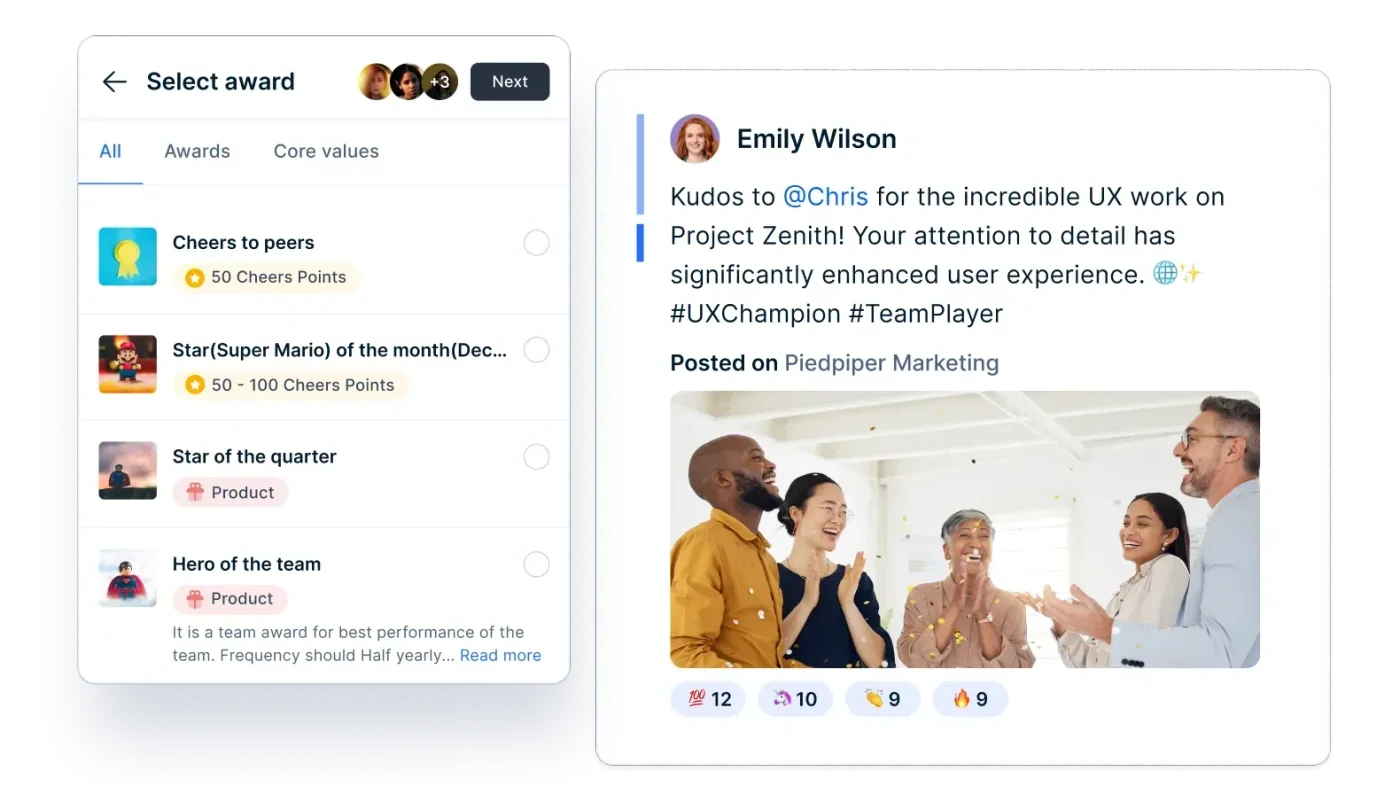
Budget can make or break a program, and every company's means differ, so there is no single right number. Build the budget bottom-up from headcount and the reward tiers you design, and remember that participation and spending usually grow as the program matures, so next year's budget should not be based only on this year's actual spend.
| Tier | What it rewards | Example rewards | Who approves |
|---|---|---|---|
| 1. Everyday | Helping a colleague, living a value | Thank-you message, small points award | No approval |
| 2. Spot | A clear win or extra effort | Points for a gift card, lunch, small experience | Manager, within budget |
| 3. Milestone | Work anniversaries, project completions | Points scaled by tenure, personalized gift | Automated by rule |
| 4. Quarterly | Sustained high performance | Larger points award, extra day off | Nomination and panel |
| 5. Annual | Exceptional impact on goals or culture | Experience, trip, development budget | Leadership panel |
Mix monetary and non-monetary rewards to keep the culture alive all year without stretching the budget. Check tax rules early too: in the US, the IRS treats cash and cash equivalents such as gift cards as taxable wages that can never count as de minimis fringe benefits, whatever the amount.
6. Give your employees a voice
If rewards do not resonate with employees, the program will never take off. Run a short survey to learn which rewards rank highest on their wish list, and repeat it each year.
Giving employees a say in redemption increases interest and makes rewards more satisfying. Gift cards and points catalogs help here because people choose what they want, when they want it. Preferences matter more than many leaders assume: O.C. Tanner's 2026 State of Employee Recognition report found the odds of thriving at work fall by 89% when employees feel their leaders do not know their recognition preferences.
7. Make the program visible
Out of sight is out of mind. Make sure employees at every level know about the program by using the channels each group prefers. Plant workers may rely on kiosks or shared screens, field teams on mobile apps and office staff on email or chat. A social feed where rewards are celebrated publicly keeps the program in view every day.
8. Measure the effectiveness of your rewards program
A well-run rewards program improves performance, productivity and retention. Track it with surveys, feedback sessions and program data, and compare results against your scorecard. The same data also shows which teams work in silos, who needs a motivation boost and why some employees are not participating.
The guide on how to measure employee recognition programs covers the metrics, formulas and an ROI method.
9. Review and refresh regularly
No rewards program satisfies everyone. Some people will find the rewards unexciting and others will question the criteria, so aim for a program most employees value. Collect employee feedback regularly to learn what the program means to them, and leadership feedback to see whether it is improving performance and business outcomes. Then adjust rewards, criteria and budgets at least once a year.
Employee rewards program ideas by type, cost and effort
The strongest programs mix several reward types so every tier has options. This comparison shows six types side by side, and points-based choice usually works best as the backbone because it scales across locations and lets each person pick what they value.
| Reward type | Examples | Cost | Admin effort | Best fit |
|---|---|---|---|---|
| Points and choice catalogs | Points redeemable for gift cards, merchandise, donations | Flexible | Low with a platform | Distributed and global teams |
| Experiences | Concert tickets, classes, travel, team outings | Medium to high | Medium | Quarterly and annual awards |
| Time off | Extra day off, early finish, flexible shift | Low cash cost | Low | Spot awards and milestones |
| Development | Course budget, conference, mentoring | Medium | Medium | High performers and future leaders |
| Wellness | Fitness memberships, wellness challenges | Low to medium | Low to medium | Whole workforce |
| Symbolic and social | Wall of Fame, awards, leadership shout-outs | Very low | Low | Everyday recognition |
For specific ideas within each type, browse these employee reward ideas and reward gift ideas. To tie rewards to targets instead, see how an employee incentive program works.
Employee rewards program examples worth learning from
Real programs show how the principles work in practice. These five models are useful because each solves a different problem, from frequency to timing, and the first, frequent peer rewards, is the easiest to copy.
- Low-cost, high-frequency peer rewards: Zappos became known for a peer-to-peer approach in which employees give each other small, frequent rewards in a company currency that can be spent or donated. It keeps recognition everyday and cheap.
- Localized perks: Some companies tailor rewards to the location. At one busy campus, employees nominated a colleague each week for a prized parking spot, a reward that cost nothing but meant a lot locally.
- Gamified progress: A technology hardware maker ran a reseller program where each partner's avatar climbed a mountain as sales came in, with prizes at each stage. Gamification turned a long sales period into visible progress.
- Milestone moments that last: A video game studio marked work anniversaries with unusual keepsakes, such as commissioned portraits. Timing matters: the first work anniversary is a common point for people to reconsider their job.
- Shared dreams: UK agency Propellernet invited employees to write personal dreams on balls placed in a Dream Machine. When the company hit a big target, a ball was drawn and the dream funded, linking company success to personal reward.
Each example works because it fits its culture. Running a successful rewards program is not rocket science: debunk the myths, set the foundation, then implement with care.
How an employee rewards platform like Empuls helps
Designing a rewards program that feels personal and effortless gets harder as organizations grow, go remote or manage diverse teams. An employee rewards platform makes rewards timely, thoughtful and accessible to everyone, and Empuls covers each stage of the program:
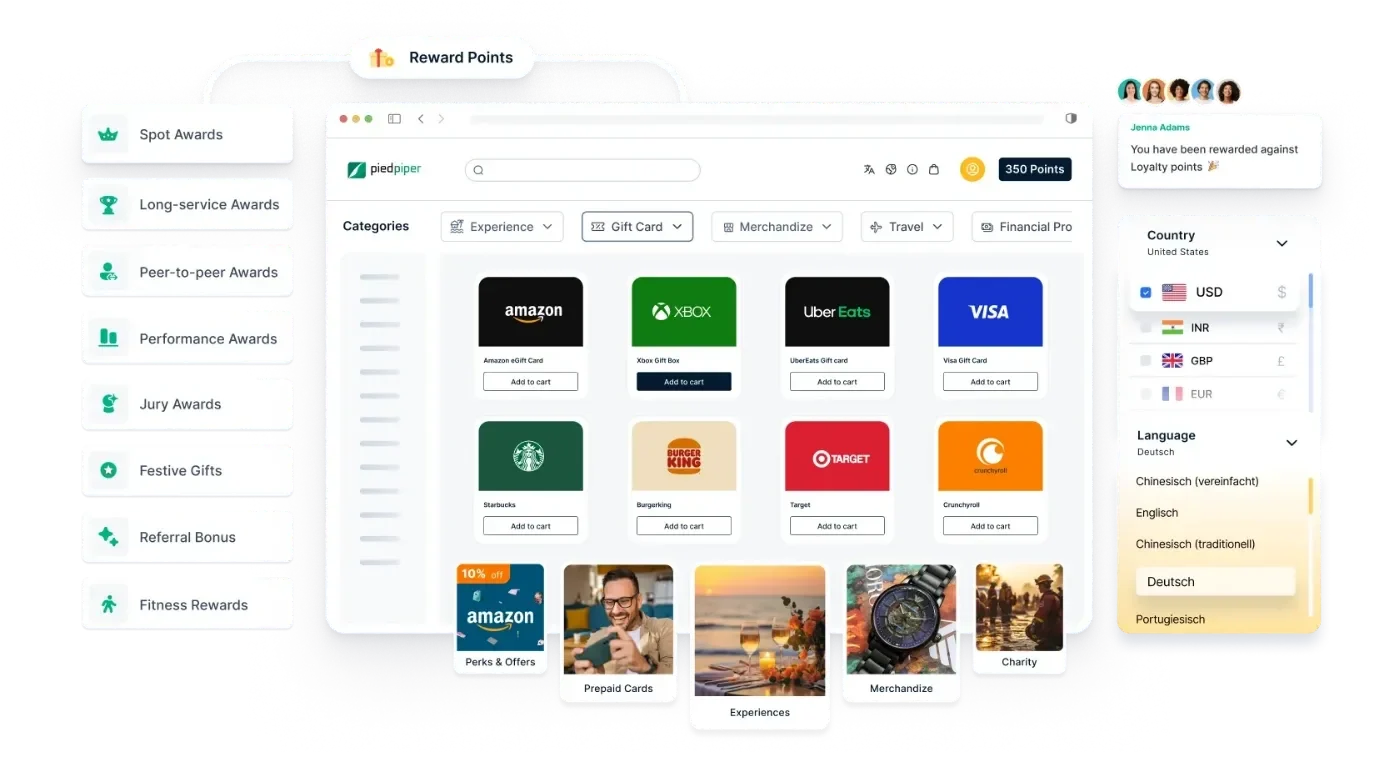
- Wide rewards marketplace: A global catalog of gift cards, merchandise, experiences and donations lets employees choose rewards that matter to them.
- Easy rewarding: Managers and peers can send rewards in a few clicks, with spot awards for instant wins and nominations for bigger honors.
- Automated milestones: Milestone rewards handle work anniversaries, birthdays, referrals and project completions by rule.
- Budget control: Allocate budgets by team, set approval rules for high-value awards and pay on redemption.
- Everyday tools: Integrations with Slack, Microsoft Teams and HR systems make rewards part of the daily workflow.
- Data-driven insights: Reports track engagement, redemption and program effectiveness so you can improve continuously.
See the full feature set on Empuls recognition, or read how KPIT Technologies replaced physical gifting with a digital rewards program.
Rewards that reflect trust
An employee rewards program is not an add-on to your HR strategy. It is the foundation for a workplace where motivation, loyalty and performance thrive. When employees feel genuinely recognized and rewarded, they bring more to their work and stay longer.
Designing a meaningful program takes planning: breaking myths, setting the right goals, personalizing rewards and keeping the system simple, timely and transparent. The most successful companies do not treat rewards as a transaction. They treat them as a reflection of the trust, respect and investment they place in their people.
Book your Empuls demo
Frequently asked questions
An employee rewards program is a formal company initiative that recognizes employee achievements and contributions with something of value. Rewards can be monetary, such as bonuses, points and gift cards, or non-monetary, such as time off, development opportunities and public recognition. Good programs reward specific behaviors and results that support company goals and values.
Set goals, turn them into measurable objectives, define who is eligible, fix the program period and reward cycles, set a budget and reward tiers, survey employees on the rewards they want, communicate the program widely, then measure and review it. Most companies start with everyday and spot rewards before adding quarterly and annual awards.
The main types are points and choice catalogs, gift cards, experiences, time off, development opportunities, wellness rewards and symbolic awards such as trophies or a Wall of Fame. They can be monetary or non-monetary and given for everyday behavior, specific wins, milestones or sustained performance. Mixing types lets every person find something they value.
There is no universal figure, so build the budget bottom-up. Decide the reward tiers you want, estimate how often each will be given and multiply by headcount. Add platform fees and taxes on awards that count as wages. Expect participation and spending to rise as the program matures, and review the budget every year.
Recognition acknowledges effort and achievement through praise, thanks and public visibility. Rewards add something tangible, such as points, gift cards or experiences. Most effective programs combine both: recognition explains what someone did well and why it mattered, and the reward makes that appreciation memorable. Recognition alone can work daily, while rewards mark bigger moments.
In the US, cash and cash equivalents such as gift cards are always taxable wages, whatever the amount, according to the IRS. Small, occasional non-cash items may qualify as de minimis fringe benefits, and some length-of-service and safety awards have special rules. Tax rules differ by country, so agree on reporting with payroll before launch.
Successful programs reward the behaviors that matter, give rewards promptly and often, make them specific and visible, and let employees choose what they receive. They have clear goals, a sustainable budget, managers who use the program and regular reviews. Participation, reach across teams and employee feedback show whether the program is working.
Criteria should be the same for everyone, but rewards themselves should allow choice. People value different things depending on role, location, life stage and personality, so a points catalog or menu of options works better than one gift for all. Keep reward values consistent across locations by adjusting for local costs where needed.





































































































































































































































































































































































































































































































































































