
Key Takeaways
The 12 traits of engaged employees span mindset, behavior and connection, from innovation and initiative to collaboration and advocacy.
Only 29% of U.S. employees were engaged as of August 2026, according to Gallup, so most teams have plenty of room to grow engagement.
Top-quartile engagement teams show 23% higher profitability and 78% lower absenteeism than bottom-quartile teams in Gallup's 2024 meta-analysis.
A drop in a usually engaged employee's traits, such as fewer ideas or skipped development, is an early warning worth raising in a one-on-one.
Combine observation with a behaviors scorecard and pulse survey data to identify engaged employees and support those who are slipping.
The 12 traits of engaged employees are innovation, leadership, open communication, enthusiasm for work, collaboration, a drive to develop, adaptability, going the extra mile, initiative, living company values, a solution-oriented mindset and advocacy for the company. Team members who show most of these consistently are likely highly engaged; those whose traits are fading may need support.
Engaged employees are a significant asset: they are more productive, more profitable to the business and more pleasant to work with. A company-wide engagement survey shows overall trends in your department or company, but it won't tell you how engaged an individual is. That is where knowing the characteristics of engaged employees helps, so you can recognize who is thriving and who might need more support.
What is an engaged employee
An engaged employee is someone who is highly involved in and enthusiastic about their work and workplace. They are more than satisfied: they find meaning and motivation in their work, believe in the organization's mission and see how what they do every day fits into the larger picture.
Gallup's employee engagement indicator sorts employees into three groups, which is a useful way to see where the traits in this guide sit:
| Group | How they feel | What you see day to day |
|---|---|---|
| Engaged | Involved in and enthusiastic about their work and workplace; psychological owners | Initiative, ideas, help for teammates, effort beyond the job description |
| Not engaged | Psychologically detached; they put in time but not energy or passion | Work done to the minimum standard, few ideas, quiet in meetings |
| Actively disengaged | Resentful that their needs are not being met | Complaints, resistance to change, negativity that spreads to others |
For what pushes people from the first group toward the third, see employee disengagement and quiet quitting.
Why engaged employees matter
Engaged employees make your workplace happier, more cohesive and more profitable. They work effectively while keeping the big picture in mind, work well with colleagues and managers and help the organization reach the goals it sets and more.
That is why the current numbers are a surprise. As of August 2026, Gallup's indicator shows only 29% of U.S. employees are engaged and 18% are actively disengaged, and its State of the Global Workplace 2026 puts global engagement at just 20%. Gallup's 11th Q12 meta-analysis shows what highly engaged teams deliver compared with the least engaged:
23%
higher profitability
Gallup Q12, 2024
18%
higher sales productivity
Gallup Q12, 2024
78%
lower absenteeism
Gallup Q12, 2024
51%
lower turnover in low-turnover organizations
Gallup Q12, 2024
Top-quartile vs bottom-quartile engagement teams
See which engagement traits are fading
Pulse surveys, eNPS and team analytics show you where to act before engagement slips.
Talk to our ExpertTrusted by 5,000+ companies
12 core traits of engaged employees
Engaged employees have many traits, but these 12 are the most reliable signs. They fall into three groups, and the mindset traits usually show up first, so they are listed first:
01 · Mindset
How they think
Innovative, excited to come to work, adaptable to change and solution-oriented.
02 · Behavior
How they act
Take initiative, go the extra mile, pursue development and step up as leaders.
03 · Connection
How they relate
Communicate openly, collaborate effectively, live company values and advocate for the company.
1. They are innovative
One of the key traits of engaged employees is a drive to innovate. They have the energy and emotional bandwidth to take on new and challenging tasks, and they are always thinking ahead, coming up with creative ways to improve their roles and the company culture. Because they feel connected to their team and the organization, they confidently share those ideas.
Disengaged employees, in contrast, often focus only on immediate responsibilities, leaving little room for creativity. Innovation is one of the standout characteristics of engaged employees, and it makes them crucial to how your organization evolves.
2. They are leaders
Employees who are merely satisfied, or worse, actively disengaged, are usually reluctant to take on leadership tasks; they don't have the energy or excitement for it. Highly engaged employees take on leadership tasks large and small, whether that means leading a new project, managing a team or acting as the link to senior leaders. They don't need a title to lead.
3. They are open communicators
Engaged employees engage proactively with peers and managers, keeping daily tasks and broader goals aligned. They are active listeners as well as talkers, and they feel empowered to share feedback, raise concerns and suggest improvements. They are also quick to recognize and appreciate others, creating a ripple effect of positivity.
4. They are excited to come to work
This might seem basic, but many employees at every level dread starting the workday. Engaged employees show up more and produce more when they do, because they don't see the job as clocking in and waiting to leave. Their role connects clearly to the organization's goals, they understand that connection, and they have the autonomy and knowledge to do the job well.
5. They collaborate effectively
If team members work together proactively, that is a strong indicator of engagement. Rather than focusing only on their own tasks, engaged employees care about the success of the whole team. That collaboration reflects trust, mutual respect and a shared vision, and it makes the workplace more cooperative and less competitive.
6. They pursue development opportunities
Engaged employees are not content with standing still. Whether it is training, a conference, a stretch assignment or a mentor, they actively look for ways to improve. They see learning as both a personal benefit and a way to contribute more to the organization's goals.
7. They adapt well to change
Change is a given, whether it is a new coworker, manager, process, technology or structure. Engaged employees are anchored by their commitment to the organization, not to a fixed set of tasks, which makes them more adaptable, especially when leaders explain why the change is happening. They are not afraid to learn new things, even when it is uncomfortable.
8. They go the extra mile
An employee who arrives exactly on time, leaves exactly on time and never goes beyond the job description may get the work done, but they won't help the organization achieve more than the minimum. Highly engaged employees go above and beyond when they see a valuable opportunity, because they care about their impact, not just their checklist.
They often exceed expectations, and on the rare occasions they fall short, they reflect, work out what went wrong and make sure it doesn't happen again. That discretionary effort is what engagement surveys try to capture.
9. They take initiative
Engaged employees don't wait to be told what to do. They spot opportunities and act, whether that means streamlining a process, solving a nagging issue or launching an internal initiative. They take ownership and move things forward without needing constant direction, while disengaged colleagues tend to stay in their lane.
10. They support company values
You know employees are engaged when your core values are behaviors you see every day, not words on a wall. Engaged employees live values such as integrity, innovation, teamwork or customer focus in meetings, messages and decisions, and they reinforce the culture by recognizing peers who do the same. Disengaged employees may follow the rules but miss the spirit.
11. They are solution-oriented
It is easy to complain when something doesn't work. Engaged employees go further: they bring a constructive mindset to problems and offer ideas to fix them, from a broken process to team friction to a better way to serve customers. That positive energy is contagious and keeps others focused on what is possible.
12. They advocate for the company
Engaged employees are your best brand ambassadors. They speak positively about the company to friends, family and professional networks because they believe in the mission, not because they are told to. You will see them sharing job openings, celebrating company wins and recommending your products. That organic advocacy strengthens your employer brand and helps recruitment; see employee advocacy for how to encourage it.
Engaged employee behaviors scorecard
Use this scorecard to turn the 12 traits into something you can observe and discuss. Rate each trait from 1 (rarely seen) to 3 (consistently seen) over the last quarter, then use the one-on-one prompt to explore any trait that scores low or has dropped.
| Trait | What you see when it is present | One-on-one prompt |
|---|---|---|
| Innovative | Suggests improvements without being asked | What is one thing you would change about how we work? |
| Leader | Volunteers to lead projects or help new joiners | Is there something you would like to own next quarter? |
| Open communicator | Raises concerns early and gives feedback | Is there anything you have not felt able to raise? |
| Excited to come to work | Steady energy, good attendance, positive tone | What part of your work energizes you most right now? |
| Collaborative | Helps teammates and shares credit | Who has helped you most recently? |
| Development-focused | Asks for training, feedback or stretch work | What skill would you like to build this year? |
| Adaptable | Adjusts quickly when plans change | How did the last change land for you? |
| Goes the extra mile | Quality and effort beyond the brief | Do you feel your extra effort is noticed? |
| Takes initiative | Fixes problems before they escalate | What is getting in the way of your work? |
| Lives company values | Decisions match values; recognizes peers | Which of our values feels most real to you? |
| Solution-oriented | Brings options, not just problems | What would you try first to fix it? |
| Advocate | Refers candidates, shares company news | Would you recommend working here to a friend? |
A total of 30 to 36 suggests a highly engaged employee, 20 to 29 a mixed picture worth a conversation, and below 20 a risk of disengagement. Use the scores to guide coaching, never as a performance rating, and compare them with how the employee rates themselves.
How to identify engaged employees
Spotting engagement goes beyond performance metrics or punctuality. Truly engaged employees consistently show behaviors that align with the organization's mission and values. Five signs are the most dependable:
- They show the traits above: They are proactive, collaborative, curious and eager to own their work.
- They communicate openly: Two-way communication, constructive concerns and ideas for improving team performance.
- They go beyond the job description: They volunteer for cross-functional projects and support teammates.
- They show emotional commitment: They care about the team and culture, which is why engaged people stay longer and perform better.
- The data agrees: eNPS, pulse surveys and continuous feedback quantify engagement and show trends by team.
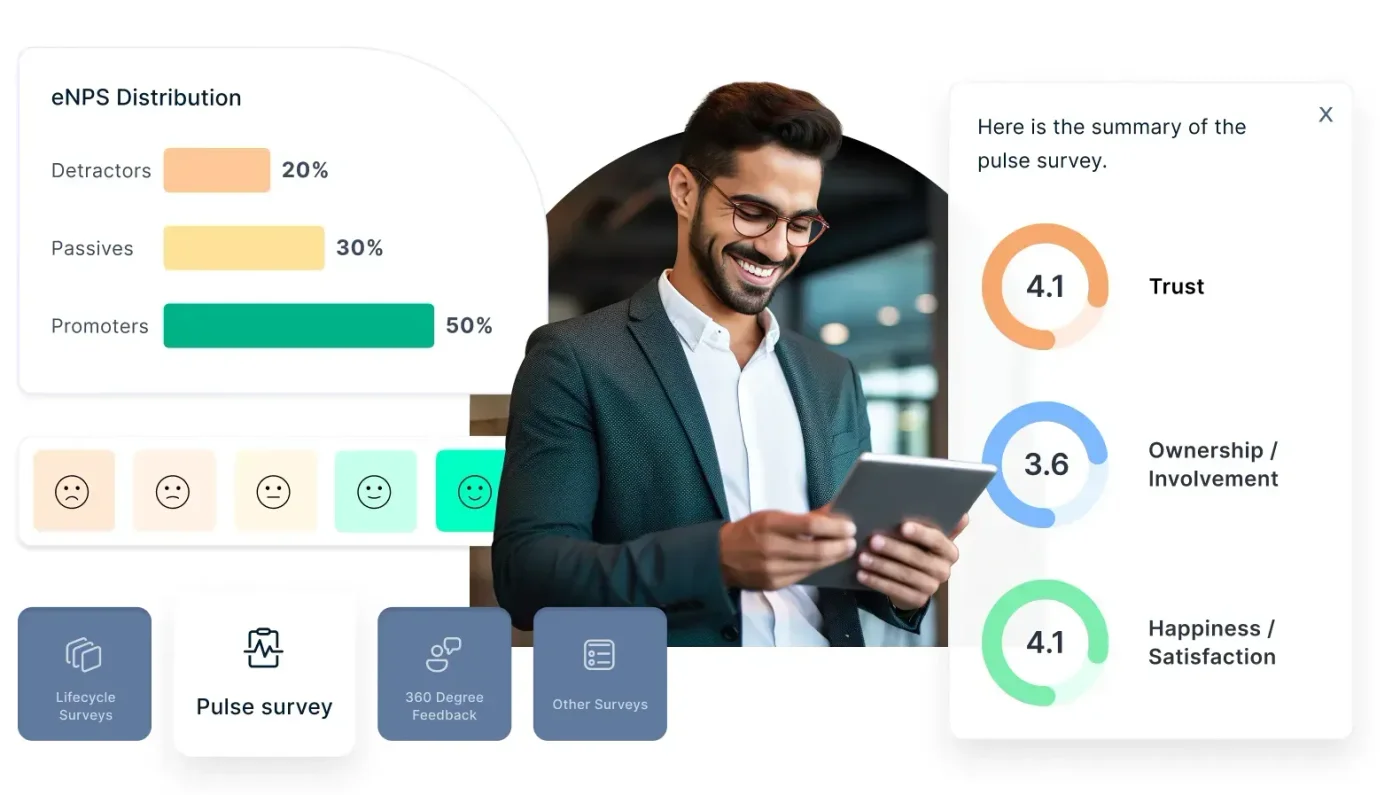
Observation and data work best together: the scorecard tells you about individuals, while surveys show team-level patterns. For the survey side, see how to measure employee engagement and the employee net promoter score.
How to nurture the traits of engaged employees
Recognizing these traits is only half the job; the real work is building conditions in which they grow. These five practices have the strongest evidence behind them, starting with the one managers can change fastest:
- Recognize the behaviors you want: Gallup and Workhuman's 2024 recognition study found well-recognized employees were 45% less likely to have changed organizations two years later. Recognize initiative, collaboration and values in action specifically and promptly.
- Make expectations clear: People can only go the extra mile when they know where the first mile ends, so agree goals and priorities in regular one-on-ones.
- Invest in growth: Offer training, stretch projects and mentoring to the people who ask for them, and ask the people who don't.
- Give autonomy and a voice: Let employees decide how to do their work and act visibly on their suggestions.
- Listen continuously: Short pulse surveys and open feedback channels catch fading engagement early, while it is still easy to fix.
For a full set of strategies, read how to improve employee engagement.
How Empuls helps you nurture engaged employees
Empuls brings listening, recognition and communication together so you can see which traits are thriving and act where they are fading:
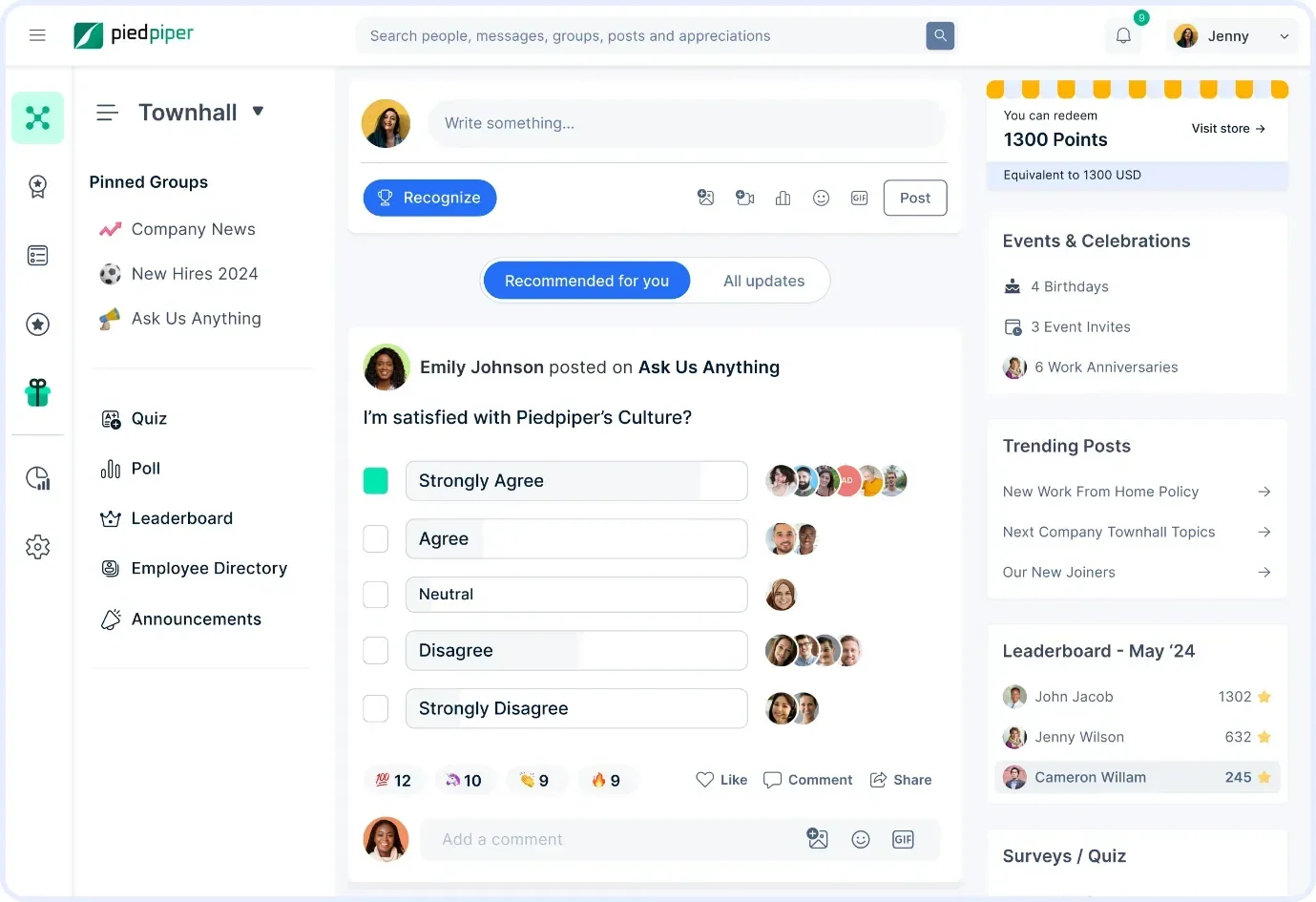
- Pulse surveys and eNPS: Pulse surveys and lifecycle surveys capture feedback from onboarding to exit.
- People analytics: Reports and analytics dashboards show engagement trends and gaps by team.
- Social intranet: A social intranet with community groups, polls and town halls supports open communication.
- Recognition and rewards: Peer and manager recognition with rewards celebrates initiative, collaboration and milestones.
Engagement looks different for every employee
Understanding the traits of engaged employees is the first step toward a thriving, high-performing workforce. From innovation to collaboration, these behaviors show which team members are emotionally invested in your success, and where support is needed.
Remember that engagement isn't one size fits all. A quiet employee may show engagement through careful work and thoughtful written ideas rather than speaking up in meetings, so read the traits in context. For practical ideas, see how to engage introverts. When everyone is engaged, everyone wins.
Book your Empuls demo
Frequently asked questions
An engaged employee is enthusiastic about their work, believes in the organization's mission and puts in discretionary effort. Typical characteristics include innovation, initiative, open communication, collaboration, adaptability, a drive to learn, living company values, a solution-oriented mindset and speaking positively about the company. Most engaged employees show many of these traits consistently, not just occasionally.
Look for consistent behaviors such as volunteering ideas, taking ownership, helping teammates, seeking feedback and growth, and speaking positively about the company. Then confirm with data: eNPS, pulse survey scores, recognition activity and attendance. A behaviors scorecard reviewed each quarter in one-on-ones helps you spot changes in an individual's engagement over time.
A satisfied employee is content with their job, pay and conditions, but may do only what is required. An engaged employee is emotionally committed to the work and the organization's goals and goes beyond the job description. Satisfaction keeps people from leaving; engagement drives productivity, innovation and advocacy.
According to Gallup, 29% of U.S. employees were engaged and 18% were actively disengaged as of August 2026. Globally, Gallup's State of the Global Workplace 2026 report found just 20% of employees were engaged in 2025. That leaves most employees in the not engaged group, putting in time but not energy or passion.
Disengaged employees tend to do the minimum, avoid extra responsibility, contribute few ideas, resist change and withdraw from team activities. Actively disengaged employees go further, voicing resentment and spreading negativity. A sudden drop in a previously engaged employee's initiative, communication or attendance is often the earliest warning sign.
You can hire for some foundations, such as curiosity, ownership and alignment with your values, using structured behavioral interviews. But engagement depends largely on the work environment: management, recognition, growth and clarity. A highly engaged hire can disengage under poor conditions, so hiring well must be paired with a culture that sustains engagement.
Managers increase engagement by holding regular one-on-ones, setting clear expectations, recognizing good work specifically and promptly, supporting development and giving people autonomy and a voice. Acting visibly on feedback matters as much as asking for it. Because managers shape most of the daily experience, their behavior is the biggest single lever on team engagement.





































































































































































































































































































































































































































































































































































