
Key Takeaways
Gratitude in the workplace is the daily habit of noticing what others contribute and thanking them sincerely and specifically.
Well-recognized employees are 45% less likely to leave, yet only 22% of US employees say they get the right amount of recognition.
In Snappy's 2026 Workforce Study, feeling appreciated was the top reason employees planned to stay, ahead of pay raises.
Gratitude works best when it is fair to every role, given without strings and practiced as a weekly habit rather than an annual event.
The most effective thank-you names what the person did and the difference it made.
Gratitude in the workplace pays off because people who feel thanked stay longer, trust their employer more and give more of themselves to their work. This guide covers where gratitude comes from, the business case and benefits of gratitude at work, nine practical ways to show it and ready-to-use thank you at work examples.
Gratitude in the workplace is the habit of noticing and acknowledging what colleagues, managers and teams contribute, and saying so sincerely. It differs from formal recognition programs: gratitude is a daily behavior, while recognition is a system that helps the behavior happen consistently.
Money, and the barter system that came before it, rests on give and take. Gratitude follows the same logic in human relationships: acknowledgment completes the loop. Put simply, gratitude is positively profitable, and the pun is intended.
Where gratitude comes from
The word gratitude comes from the Latin gratus, meaning pleasing or thankful. Researchers Robert Emmons and Cheryl Crumpler describe it as an emotional response to a gift: the appreciation a person feels after benefiting from someone else's kind act.
Most religions treat gratitude as an essential response to blessings such as health, relationships and good fortune, and philosophers from Seneca and Cicero to Adam Smith wrote about the importance of saying thank you. One school of thought treats gratitude as a trait, a quality some people have more of, while another sees it as a state, a pleasant feeling anyone can experience.
At its core, gratitude is a sequence of two actions: realizing that a thank-you is owed, and working out who should receive it. At work, the second step is often harder than it sounds, because the people who make a result possible are not always the ones in the spotlight.
The business case for gratitude in the workplace
Gratitude is not only a nice-to-have. Recent research on recognition and appreciation shows a direct link to retention, trust and performance, and it shows how often employees still go without it.
45%
less likely to leave
when employees are well recognized (Gallup and Workhuman)
22%
of US employees
get the right amount of recognition (Gallup and Workhuman)
8x
more likely to trust
their organization with intentional appreciation (O.C. Tanner, 2026)
32%
say their company
consistently gets appreciation right (Snappy, 2026)
The business case for gratitude at work
- Retention: Gallup and Workhuman found that well-recognized employees were 45% less likely to have left after two years, yet only 22% of US employees get the right amount of recognition.
- A reason to stay: In Snappy's 2026 Workforce Study of 1,500 US employees, feeling appreciated was the top reason people planned to stay in their role, ahead of pay raises and promotions.
- Trust and performance: The O.C. Tanner Institute's State of Employee Recognition 2026, based on 4,243 employees in 10 countries, found that intentional, personalized appreciation makes employees eight times more likely to trust their organization.
- A ripple effect: Author Daniel Pink describes how thanking someone often prompts them to think of people they never thanked, who then pass it on, creating a chain of gratitude. Psychologist Shawn Achor calls praise a virtuous cycle: the more people give, the more success there is to praise.
- Better citizenship: Grateful employees are more aware of their responsibilities to others. They step beyond their role to support struggling peers or help new joiners feel welcome.
Why gratitude works so consistently
Relationships are the pipelines of work and life, and gratitude keeps them open. In hectic routines, those channels get clogged by ego, stress and toxic habits. Pausing to be grateful for what we already have lowers that stress and helps us rise above the noise.
Gratitude makes people more receptive to each other, which reopens the doors to empathy, communication and trust. What turns the wheels of a business is not only money, ideas or technology, but the less visible capital of gratitude that brings out the best in human talent.
There is also a biological side. Expressing and receiving gratitude is associated with activity in the brain's reward system and with neurotransmitters such as dopamine and serotonin, which influence mood and wellbeing. Regular gratitude practice is widely used as a way to manage stress, though it supports, rather than replaces, professional mental health care.
Make saying thank you a daily habit
Give shout-outs, spot awards and rewards inside Slack and Microsoft Teams, so gratitude reaches every team and location.
Talk to our ExpertTrusted by 5,000+ companies
Benefits of gratitude at work
The benefits of gratitude at work reach both the person who receives thanks and the person who gives it. These eight are the most consistent, and the last one, the effect on the giver, is the most often overlooked.
- Stronger relationships: Grateful people come across as more approachable, which helps them build networks and wider circles of influence, in line with Barbara Fredrickson's broaden-and-build theory of positive emotions.
- More empathy: Gratitude makes people more attentive to others' moods and expectations, leading to deeper, more empathetic interactions.
- Clearer communication: People who feel and express gratitude tend to be more open, which helps them make stronger cases for their ideas.
- Better focus and decisions: Feeling settled and appreciated makes it easier to think clearly and take on difficult decisions at work.
- Wellbeing: Gratitude practice is linked with lower stress and better mood, which matters most during uncertainty and change. As motivational speaker Zig Ziglar put it, gratitude is "the healthiest of all human emotions."
- Morale: People who feel valued spread positive energy and lift the morale of those around them.
- A contagious culture: Gratitude is contagious. Recipients pass it on, setting off a chain reaction that builds a culture of positivity.
- Benefits for the giver: Gratitude does not only help the receiver. Regularly noticing what others do also changes how the giver experiences work.
Gratitude overlaps with appreciation and recognition but is not the same thing. For the distinction and how to build an appreciation program, see this guide to employee appreciation.
9 ways of showing gratitude in the workplace
How do you lift motivation for employees, sales teams, channel partners, delivery fleets and gig workers? Gratitude is the most direct answer. These nine ways move from creating reasons to say thanks to building lasting habits, and consistency (way 5) matters most.
- Create reasons for gratitude: Before you can express gratitude, people need room to make an impact. Free-flowing communication, mentoring and gamified challenges create more moments worth thanking someone for.
- Make the little things big: Not every achievement deserves a headline. Acknowledging help from another department, sending a heartfelt note, a personalized gift or simply catching up over coffee builds good energy.
- Give it without strings: Gratitude is given wholeheartedly. You cannot say "Truly appreciate it" while holding a grudge or expecting something back. Real thanks leaves only a warm feeling.
- Do not discriminate: If you thank sales for hitting a target, apply the same standard to delivery teams, drivers, support staff and freelancers. Favoritism is easy to spot and undoes the good you have done.
- Make it the framework, not an event: Gratitude cannot live only in annual award nights. Management researcher Ryan Fehr of the University of Washington describes it as a consistent habit built into everyday work. Encourage it, but never force it, or it stops being gratitude.
- Let people customize it: Avoid rigid scripts. People should find their own way to express thanks, matched to the occasion and the recipient's personality.
- Evangelize it from the top: Leaders set the tone. Doug Conant, former CEO of Campbell Soup Company, became known for writing thousands of handwritten thank-you notes to employees. Ask your most passionate employees to model it too, and run campaigns that make gratitude visible.
- Stay patient: Like happiness, the effects of gratitude take time to blossom. Keep the practice going for months before judging its impact.
- Use simple rituals: Keep a gratitude log, open meetings with a quick thank-you round and recognize everyday acts, privately or in public.
For more ways to put gratitude into practice, see these employee recognition ideas and how peer-to-peer recognition spreads thanks beyond managers.
Thank you at work examples
Knowing how to show gratitude at work often comes down to finding the right words. Use these thank you at work examples as a starting point and replace the details with what the person actually did, because specificity is what makes thanks feel real.
| Situation | Example message |
|---|---|
| A colleague covered for you | "Thanks for taking my calls on Thursday. Because of you, I could be with my family and nothing slipped." |
| A teammate solved a problem | "You found the root cause of the billing bug in an afternoon. That saved the support team a week of tickets. Thank you." |
| A manager thanking a direct report | "Your prep for the client review made the meeting. They asked for your slides afterward. I am grateful to have you on this team." |
| Thanking another department | "Thank you to the warehouse team for turning around the rush order overnight. Our customer noticed, and so did we." |
| An employee thanking a manager | "Thank you for backing my idea in the planning meeting. It gave me the confidence to lead it." |
| A frontline or field worker | "Thank you for staying calm with a difficult customer today. You turned a complaint into a thank-you note." |
| A long-serving employee | "Ten years of steady work and kindness. Thank you for everything you have taught the people around you." |
Gifts can strengthen a thank-you for bigger moments. For ideas, see these employee appreciation gifts, and to make gratitude part of everyday culture, read about creating a culture of recognition.
How Empuls helps you show gratitude in the workplace
Empuls is an employee engagement platform that makes everyday gratitude easy to give, visible to everyone and fair across locations and roles. Here is how it helps:
- Recognition for every moment: Peer-to-peer shout-outs, spot awards and nomination-based awards cover both everyday help and major achievements through Empuls recognition.
- Automated celebrations: Birthdays, work anniversaries, onboarding and promotions are celebrated on time with personalized greetings and rewards.
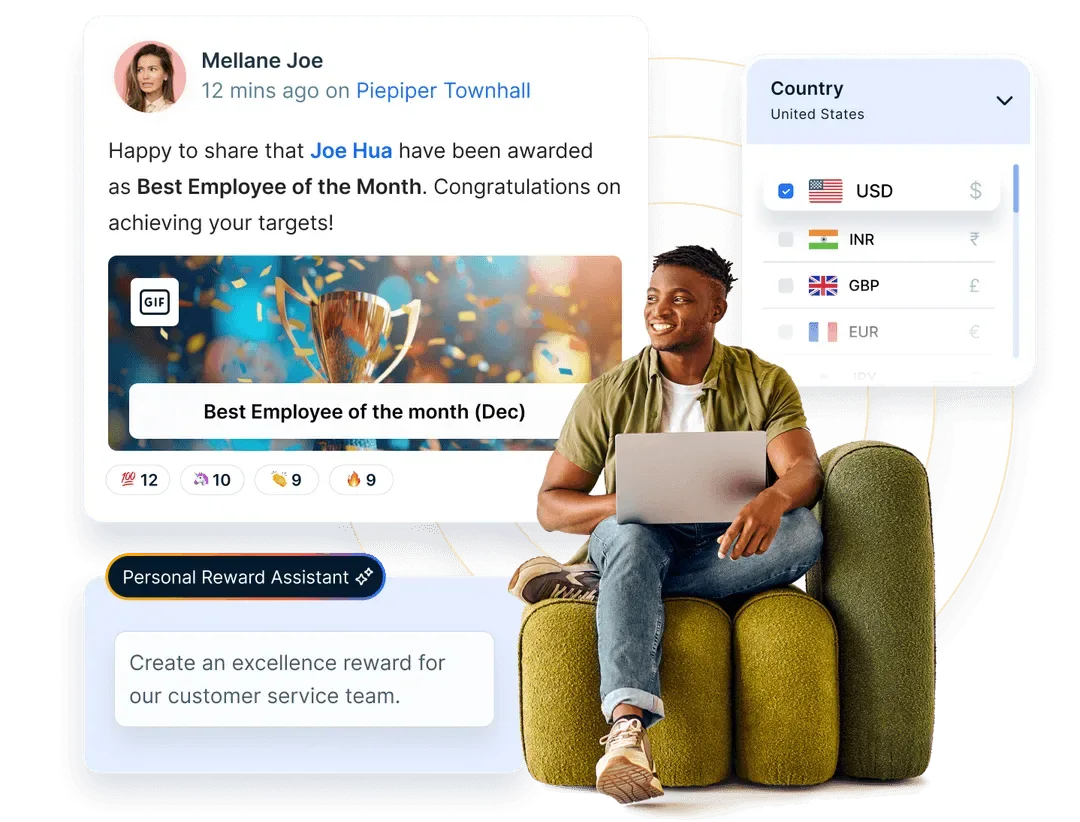
- Social gratitude: Wishboards and a public recognition feed with comments and reactions let teams thank each other together.
- Rewards people choose: A global catalog of gift cards, experiences and merchandise lets each person pick what is meaningful to them.
- Inside the flow of work: Integrations with Slack and Microsoft Teams make saying thanks part of the workday rather than another app to open.
Start with one thank-you today
Gratitude in the workplace costs little and returns a great deal: stronger relationships, higher trust and people who choose to stay. It works best when it is specific, fair to everyone and practiced every week rather than once a year.
Pick one person who made your week easier and tell them what they did. That is how a culture of gratitude starts.
Book your Empuls demo
Frequently asked questions
Gratitude in the workplace is the practice of noticing and acknowledging colleagues' efforts, contributions and support, and saying thank you sincerely. It creates a positive environment, lifts morale and strengthens relationships. Unlike a formal recognition program, gratitude is an everyday behavior that anyone can practice, from leaders to new joiners.
The 4 A's of gratitude are often described as appreciation, recognizing the value in people and situations; awareness, being mindful of what others do for you; action, expressing thanks through words or gestures; and acceptance, receiving appreciation graciously. Together they turn a feeling of thankfulness into a habit people can see.
Show gratitude professionally by thanking people specifically in person or in writing, recognizing achievements in meetings or public channels, nominating colleagues for awards, offering small tokens such as a note or reward, and supporting colleagues when they are stretched. Keep it sincere, timely and appropriate to the relationship.
Gratitude is important because it builds trust, strengthens relationships and keeps people engaged. Research from Gallup and Workhuman found well-recognized employees are 45% less likely to leave, and O.C. Tanner's 2026 study found intentional appreciation makes employees eight times more likely to trust their organization.
Managers can show gratitude by thanking employees for specific work soon after it happens, explaining the impact it had, recognizing people publicly when they are comfortable with it, writing handwritten notes for bigger moments and making sure every role and location is included. A short weekly gratitude routine keeps it consistent.
Gratitude is a feeling and a behavior: noticing what someone did and thanking them. Recognition is the structured acknowledgment of contributions, often through programs, awards and rewards. Gratitude supplies the sincerity, while recognition programs make sure thanks happens consistently and fairly across the organization.
Workplace gratitude ideas include a thank-you round at the start of team meetings, a shared gratitude wall or channel, peer-to-peer shout-outs with small rewards, handwritten notes from leaders, a monthly award for the most helpful colleague and thanking another department publicly for its support.





































































































































































































































































































































































































































































































































































