
Key Takeaways
Employee engagement in the automotive industry decides who stays and reskills as automakers and dealers rebuild their workforce around EVs, software and automation.
Automotive employers manage four distinct workforce groups, plant, engineering, dealership sales and service, and each needs its own engagement play.
Reaching frontline workers without email or desks is the first engagement challenge, so mobile, multilingual access matters more than any single program.
Tying reskilling to recognition, such as rewarding EV and high-voltage certifications, turns the EV transition from a threat into a retention lever.
Gallup's 2024 meta-analysis links top-quartile engagement to 63% fewer safety incidents and 32% fewer quality defects, outcomes that matter on every assembly line.
Employee engagement in the automotive industry is the commitment and energy that plant operators, engineers, dealership staff and service technicians bring to building, selling and servicing vehicles. It matters more now than at any point in the last few decades, because automakers and dealers are rebuilding their workforce around electric vehicles, software and automation, and engaged employees are the ones who stay, reskill and keep quality high through that change.
The automotive industry is undergoing a seismic shift. From electric vehicle innovation to the rise of smart factories, the sector is not only fast-paced but also fiercely competitive. Whether it is an assembly line operator, a design engineer or a showroom sales consultant, every employee shapes product quality, customer experience and operational efficiency.
Yet engaging a diverse and often dispersed workforce remains a significant challenge. That is where automotive employee engagement strategies come in, not as HR initiatives on the side, but as core business drivers. This guide covers why engagement matters in automotive, how plant, engineering, dealership and service teams differ, what the EV transition changes, and a practical plan to improve automotive employee retention. If you run plants and want shop-floor tactics in more depth, read our guide to employee engagement in manufacturing, which this post builds on rather than repeats.
Why employee engagement in the automotive industry matters now
The automotive industry is not just about machines. It is about the people who build, design, sell and service them, and the skills those people need are changing fast. Three data points show the scale of the shift.
61%
of UK automotive roles
expected to need new skills by 2035 (SMMT, 2026)
1M+
US workers
make vehicles and parts (WRI, 2025)
20%
of employees worldwide are engaged
down from 23% in 2022 (Gallup, 2026)
Skills, scale and engagement signals for automotive employers
The Society of Motor Manufacturers and Traders' 2026 skills survey found that 61% of current automotive roles are expected to need new skills by 2035, especially in high-voltage systems, battery technology, coding, data analytics and AI. In the US, the World Resources Institute's October 2025 study counts more than 1 million workers directly involved in manufacturing automobiles and parts. Meanwhile, Gallup's State of the Global Workplace 2026 reports that global engagement fell to 20% in 2025, with manager engagement dropping from 27% to 22% in a single year.
In such a precision-driven environment, disengaged employees don't just cost productivity. They affect safety, quality and customer trust. Here is why automotive workforce engagement is mission-critical:
- Productivity and operational efficiency: Engaged employees are more attentive, proactive and committed to excellence. In high-output plants, even minor lapses in focus can lead to defects or safety hazards, and engaged workers are more likely to follow processes, spot inefficiencies and push for continuous improvement.
- Lower turnover and absenteeism: The industry faces high attrition, particularly among production workers and customer-facing dealership roles. A strong engagement program built on appreciation, growth and fair rewards reduces churn, saving recruitment costs and institutional knowledge.
- Innovation and quality: From R&D to production lines, automotive companies rely on innovation to stay competitive. Engaged employees contribute ideas, join problem-solving and take ownership of quality.
- Better customer experience: Engaged showroom staff, service advisors and support teams communicate better and build brand loyalty, turning first-time buyers into repeat customers.
- A stronger employer brand: In a sector short of high-skill talent such as EV engineers, battery specialists and software developers, a strong engagement culture helps you hire and keep the people you need.
The four automotive workforce groups and what engages each
Automotive employers usually manage four very different workforce groups under one brand, and treating them as one audience is the most common reason engagement programs stall. The table below compares them, starting with plant teams because they are usually the largest group and the hardest to reach digitally.
| Workforce group | Typical roles | What drives engagement | Main engagement risk |
|---|---|---|---|
| Plant and production | Assembly operators, maintenance, quality inspectors, logistics | Safety, fair shifts, on-the-spot recognition, visible career steps | No email or desk access, so they miss news and recognition |
| Engineering and R&D | Design, EV powertrain, battery, software and test engineers | Meaningful projects, learning time, credit for ideas | Poaching by tech and EV startups, long projects with few visible wins |
| Dealership sales | Sales consultants, F&I, BDC and customer relations staff | Transparent incentives, fast payouts, peer competition, weekend balance | Commission volatility, long hours and weekend work push sales staff to leave |
| Service and aftersales | Technicians, service advisors, parts staff | Certification paths, EV and high-voltage training, tool and skill recognition | Technician shortages and pressure from customers in the service lane |
A plant operator and a dealership sales consultant may share a logo, but they share almost nothing else in their working day. The rest of this guide uses these four groups to show where one approach works for everyone and where you need a tailored play. For dealership sales teams specifically, the incentive mechanics are covered in our guide on how digital rewards increase automobile sales.
Unique challenges in driving automotive workforce engagement
There are six recurring challenges, and the first, reaching a frontline workforce without desks or email, carries the most weight because it decides whether any program reaches most of your people at all. They are ordered from access problems to culture and change problems, since you have to reach people before you can change how they feel.
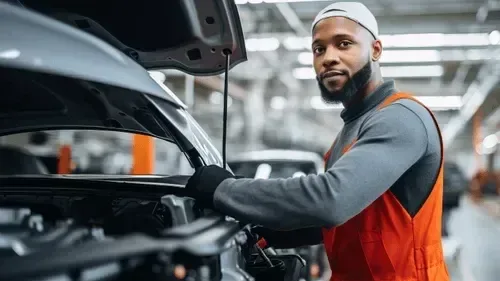
Unlike tech or service sectors, automotive workplaces are highly heterogeneous, combining corporate offices, production lines, service centers and dealership floors. This diversity creates barriers that traditional engagement models often fail to address.
1. Frontline workers with limited digital access
A large segment of the automotive workforce operates on the shop floor or in the service bay with limited digital access. These employees often don't have email or intranet access, so traditional engagement tools never reach them. Their work is physical, repetitive and time-bound, which makes recognition and motivation even more critical.
2. Communication silos across plants, offices and dealers
With factories, offices and dealerships spread across geographies, and dealerships often owned by independent groups, communication fragments easily. Important messages get lost in translation, and recognition fails to reach the right people at the right time, leaving employees feeling undervalued or isolated.
3. Hierarchical work culture
Automotive manufacturing has historically been hierarchical, which can stifle open feedback and employee voice. Frontline workers may hesitate to share opinions or suggestions, which reduces both engagement and the improvement ideas that lean production depends on.
4. Pressure for efficiency and compliance
Tight production schedules, regulatory compliance and performance metrics dominate daily workflows. In such environments, engagement is often treated as a nice-to-have unless it visibly contributes to efficiency, safety or output, so programs need to tie back to those numbers.
5. Role diversity and varying expectations
From mechanical engineers to showroom sales reps, expectations vary widely. What motivates a factory technician may not resonate with a customer service executive or a product designer, so a one-size-fits-all strategy falls short.
6. Uncertainty from the EV transition
Employees in engine and transmission work, and technicians trained only on combustion vehicles, can see the EV shift as a threat to their jobs. The WRI study found that about 7% of workers in gasoline engine and engine parts manufacturing face the most volatility because their components are specific to combustion vehicles. Silence on what happens to those roles erodes trust faster than almost anything else.
Reach every plant, office and dealership
Recognize operators, engineers and technicians on mobile, WhatsApp or SMS, with rewards they actually want.
Talk to our ExpertTrusted by 5,000+ companies
How the EV transition reshapes automotive employee engagement
The EV transition is both the biggest engagement risk and the biggest engagement opportunity in the industry today. A 2024 survey cited in the same WRI study found that 59% of auto manufacturers viewed the battery electric vehicle transition as an opportunity, and about one in ten as a threat, so how you communicate and reskill decides which way your own workforce leans.
In-demand skills include high-voltage safety, battery manufacturing processes, managing increasingly automated lines, and digital and software skills. In Europe, the ACEA and Adecco Group report The race to reskill (January 2026) warns that demand is shifting toward high-skilled engineering, IT and management roles by 2035, while some medium and low-skilled roles face structural decline. The UK shows what a response looks like: SMMT reported that automotive apprenticeships rose 33% and new starters rose 28% in the last academic year.
Reskilling is an engagement lever, not only a training budget line. Employees who can see a path from their current role to an EV-era role are far more likely to stay. Practical moves include:
- Publish role pathways: Show how an engine assembler can move into battery module assembly, or how a combustion technician can earn high-voltage certification.
- Recognize learning, not just output: Reward completed certifications, safety modules and cross-training the same way you reward production targets.
- Pair veterans with new hires: Experienced operators know the plant, new hires often know the software. Mentoring in both directions builds respect across generations.
- Talk early and often about change: Share plant plans, model launches and timelines in town halls and on the shop floor, and invite questions before rumors fill the gap.
Key pillars of automotive employee engagement
Building a culture of engagement in automotive needs five pillars working together, and continuous recognition carries the most weight because it is the pillar employees feel every week. The other four, communication, growth, well-being and feedback, make recognition credible by showing the company invests in people beyond a thank-you.
1. Transparent and inclusive communication
Open communication fosters trust and alignment, which is crucial in an industry where operational silos are common. A mobile-first social intranet gives you real-time updates, leadership messages and peer interaction across plants, offices and dealerships. Sharing shop-floor and service-bay success stories on a central feed helps bridge the gap between corporate and field teams.
2. Continuous recognition and rewards
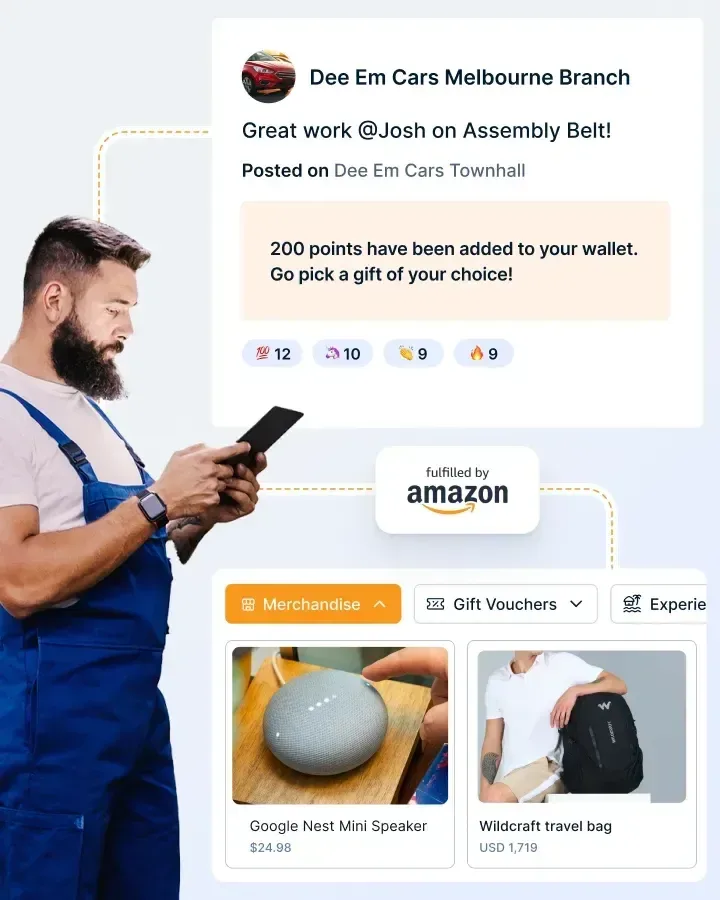
Timely appreciation is one of the strongest motivators for automotive employees, whether they are hitting daily production targets, passing a quality audit or exceeding customer satisfaction scores. Combine peer-to-peer recognition, service anniversaries and milestone rewards, and let employees choose rewards that matter to them, from merchandise to fuel cards to travel vouchers. For platform options built for deskless teams, see our roundup of recognition software for frontline and field workers.
3. Career growth and skill development
As the industry pivots to electric vehicles, automation and AI, upskilling is no longer optional. It is survival. Create learning paths for frontline staff, engineers and service professionals, map skills to future roles, and make progress visible so employees can see where their effort leads.
4. Health, wellness and benefits
Well-being matters in physically demanding, high-pressure roles. Flexible and tax-efficient benefits such as fuel, telecom, fitness and meal allowances let employees choose what helps them most, while helping the organization manage benefit spend. Our guide to types of fringe benefits covers the options in detail.
5. Real-time feedback and insights
Understanding the pulse of the workforce helps leaders act early. Pulse surveys, eNPS and lifecycle surveys, read with sentiment analysis, show inclusion gaps, sentiment trends and engagement blockers by plant, dealership or role, so leaders can intervene before issues turn into resignations.
How to implement an automotive employee engagement strategy
You understand the why, so here is the how. These seven steps run in order, because each one depends on the data or trust built by the step before it:
- Start with an engagement audit: Measure current engagement with pulse surveys, eNPS and participation data. Identify high-risk roles or regions with low morale or high attrition, such as a single plant shift or a group of dealerships.
- Segment by workforce group: Use the four groups above. Set one shared goal, then a specific play for plant, engineering, dealership and service teams.
- Build inclusive recognition programs: Recognize all roles, from line workers and engineers to sales and support staff. Automate service awards and birthdays, encourage peer-to-peer recognition and use recognition data to close gaps so no team is overlooked.
- Tie reskilling to recognition: Reward EV, high-voltage and software certifications, and publish internal moves so employees can see that new skills lead to new roles.
- Personalize benefits for each role: Go beyond generic perks with flexible, tax-saving benefits tailored to each group, such as fuel allowances for field staff or wellness subscriptions for office employees.
- Use technology for consistency and scale: Choose a platform that integrates with your HRMS and communication tools, and reaches frontline staff on mobile, so HR and people leaders get real-time insights and fewer manual tasks.
- Close the feedback loop: Act on feedback, don't just collect it. Share what you heard and what you changed, so employees see that their voice shapes the culture.
Benefits of strong employee engagement programs in automotive
Investing in engaging automotive employees is not just about morale. It directly affects your bottom line. Gallup's Q12 meta-analysis (11th edition, 2024) found that business units in the top quartile of engagement see 63% fewer safety incidents, 32% fewer quality defects and 78% lower absenteeism than bottom-quartile units, all outcomes that matter on an assembly line.
- Lower attrition and hiring costs: Engaged employees are more likely to stay, reducing the time and cost of hiring and training replacements in both plants and dealerships. Automated recognition and service awards create consistent touchpoints that reinforce loyalty.
- Improved safety and compliance: Engaged employees are more aware, careful and committed to safety protocols, whether in a production facility or a service bay. Recognizing safety milestones keeps safety top of mind without feeling like a checklist.
- Higher productivity and quality: Teams that feel seen and valued are more invested in their work, which translates into better products and fewer defects.
- More innovation and idea sharing: When employees trust the system and feel recognized, they speak up, solve problems and suggest improvements.
- Higher customer satisfaction: A technician who checks every detail or a salesperson who goes the extra mile creates a ripple effect that reaches the customer.
To prove these benefits, track a small set of metrics for each workforce group and review them every quarter:
| Metric | Plant and production | Dealership and service |
|---|---|---|
| Retention | 90-day and 12-month attrition by shift | Sales consultant and technician turnover |
| Engagement | Pulse score and eNPS by line or plant | Pulse score and eNPS by dealership |
| Recognition reach | Share of operators recognized each month | Share of advisors and technicians recognized each month |
| Safety and quality | Incident rate, defects, near-miss reports | Comebacks and rework in service |
| Skills | Certifications earned, internal moves | EV and high-voltage certifications |
| Customer outcome | On-time delivery to the next station | CSI scores and repeat customers |
How Empuls supports employee engagement in automotive
In an industry known for mechanical precision, people processes have often lagged. Empuls, Xoxoday's employee engagement platform, brings recognition, surveys, communication and benefits into one place, so the same program can reach a plant, an engineering center and a dealership network.
- Reach every frontline worker: Empuls works on iOS, Android, WhatsApp and SMS, with OTP login by mobile number or employee ID, so operators and technicians without corporate email can take part. Supervisors can hand out QR-coded reward cards for on-the-spot recognition. See frontline workforce engagement.
- Recognition and rewards in one flow: Peer and manager recognition, automated milestone rewards for service anniversaries, and a global rewards catalog employees can redeem in their own currency.
- AI that keeps recognition fair: Empuls AI includes a Recognition Coach that nudges managers to close recognition gaps, plus survey sentiment analysis that turns comments into action plans.
- Listening at scale: Run pulse, lifecycle and eNPS surveys in employees' own languages and slice results by plant, dealership or role.
- Benefits and well-being: Offer flexible benefits and wellness programs that fit each group, from fuel allowances to fitness.
- Dealer and sales incentives: Run transparent sales incentive programs for dealership teams, with automated calculations and fast payouts.
Automotive teams already use this approach. According to Empuls case studies, FCA India replaced email-based recognition with automated workflows and saw a 65% reduction in HR admin effort and 47% higher peer recognition participation, and Mercedes-Benz India automated sales incentives across 33 franchise locations with 99.9% calculation accuracy.
Building an engaged automotive workforce for the EV era
Employee engagement in the automotive industry is not a feel-good initiative. It is a business imperative. From factory floors to dealership desks, engaged employees are more productive, safer, more loyal and more willing to learn the skills the next generation of vehicles demands.
As the industry steers toward electrification, software and global competition, your workforce is your greatest asset. Start with an audit, segment your plays by workforce group, connect reskilling to recognition and keep the feedback loop closed. Done consistently, that turns recognition into retention, benefits into belonging and feedback into forward motion.
Book your Empuls demo
Frequently asked questions
Employee engagement in the automotive industry is the commitment and effort that plant workers, engineers, dealership staff and service technicians bring to their work. Engaged automotive employees follow safety and quality processes, suggest improvements, stay longer and learn new skills, which matters as the industry shifts to electric vehicles, software and automated production.
Engagement in automotive plants is often low because many production workers have no email or desk access, so communication and recognition never reach them. Hierarchical cultures, tight production schedules, repetitive physical work and uncertainty about how the EV transition will affect their jobs add to the problem and make employees less likely to speak up.
Automotive companies improve employee retention by recognizing work consistently, offering visible career and reskilling paths, paying fairly with transparent incentives, and tailoring benefits to each role. Measuring engagement by plant, dealership and role, then acting on the results quickly, helps leaders find and fix the teams most at risk of attrition.
The EV transition changes which skills automotive employers need, with growing demand for high-voltage safety, battery manufacturing and software skills. Workers in combustion-specific roles may feel insecure, which can hurt engagement. Clear communication, published role pathways and rewards for new certifications help employees see the transition as an opportunity rather than a threat.
Dealership employees respond best to transparent, fast-paying incentives, peer competition and recognition for customer satisfaction, not only sales volume. Service technicians and advisors also value certification paths and recognition for quality work. A mobile platform helps reach dealership staff who rarely sit at a desk and lets you compare engagement across locations.





































































































































































































































































































































































































































































































































































