
Key Takeaways
An employee exit survey is a short, confidential questionnaire that tells you why people leave and what would have kept them.
Most turnover is preventable: Work Institute found 75% of departures were preventable, and Gallup found 42% of voluntary leavers said their employer could have kept them.
Use an exit survey for every leaver to get comparable data, and add an exit interview for regretted or complex exits.
Ask one required primary reason for leaving with consistent answer options, so you can track trends by team, manager and tenure.
Exit data only reduces turnover when it is shared with leaders, turned into actions and paired with stay interviews and pulse surveys.
An employee exit survey is a short, structured questionnaire that departing employees complete so you learn why they are leaving and what would have kept them. Run well, it turns every resignation into data you can act on, and that matters because most departures are preventable: Work Institute's 2025 Retention Report, based on more than 120,000 exit interviews, found that 75% of employee departures were preventable.
People leave for many reasons, such as company culture, pay, the work environment, working hours and workload. Your job is to find the reasons you can fix and make the necessary changes. This guide covers what an exit survey is, how it compares with an exit interview, how to create and run one, a ready-to-use bank of exit survey questions grouped by type of departure, and how to turn the answers into lower turnover.
What is an employee exit survey
An employee exit survey is a structured questionnaire given to departing employees to understand their reasons for leaving, gather feedback on their work experience and identify areas for improvement within the organization. It usually combines rating questions, a primary reason for leaving and a few open questions.
Unlike exit interviews, which can sometimes lead to guarded responses, exit surveys give employees a confidential way to share honest views on management, workplace culture, compensation, career growth and job satisfaction. Leaders can build a more positive company culture when departing employees explain why they are leaving.
The responses show clearly where the company falls short. That is why they should be recorded and analyzed alongside your other listening data, so you can improve employee engagement and retention for the people who stay. The exit survey is one of several types covered in our guide to the employee survey.
Exit interview vs exit survey
The two methods answer the same question in different ways, and most organizations get the best results by using both. The table below compares them on the points that matter when you decide which to run, and for whom.
| Factor | Exit survey | Exit interview |
|---|---|---|
| Format | Online questionnaire, 10 to 20 questions | Conversation of 20 to 45 minutes |
| Candor | Higher, especially when anonymous or run by a third party | Lower if run by the direct manager |
| Scale | Every leaver, easy to compare over time | Usually senior, high performers or sensitive cases |
| Data | Quantified reasons and trends | Rich context and follow-up questions |
| Cost | Low once set up | HR or manager time for each exit |
| Best use | Spotting patterns across teams and quarters | Understanding one important or complex exit |
A practical rule: send the exit survey to everyone, then offer a short conversation with someone outside the employee's reporting line for regretted exits. The survey gives you comparable numbers, and the interview explains them.
Why you should use employee exit surveys
Exit surveys do four jobs for a company, and the last one, avoiding further churn, is the reason most HR teams start. Gallup's 2024 research shows how much is at stake: 42% of employees who voluntarily left said their manager or organization could have done something to prevent it, and 45% said no manager or leader discussed their job satisfaction, performance or future with them in the three months before they left.
Gain useful feedback
The feedback and ideas you collect bring new perspectives to HR and help you make current employees more satisfied. This feedback is usually about situations employees were uncomfortable raising while they were still in the role, such as a difficult manager or an unfair workload.
Build stronger relationships
A resignation does not mean someone will never work with you again. People sometimes find the new role is not what they expected and want to come back. A respectful exit survey shows you value their view, which keeps the door open for boomerang hires and referrals.
Discover weak and strong points
Criticism is one of the best ways to detect weak points. Companies and their management teams need to be open to both positive and negative feedback, because only then can they see their real strengths and weaknesses. Fixing the weak points makes the experience better for every new hire who follows.
Avoid further churn
Hiring is a long and costly process, and every regretted departure wastes the time and effort spent on recruiting and training. Gallup estimates that replacing an employee costs about 40% of annual salary for frontline staff, 80% for technical professionals and 200% for leaders and managers. Learning why people leave, and acting on it, is one of the cheapest ways to protect that investment. For the wider picture, see our guide to employee attrition.
How to create an exit survey
Creating an exit survey takes ten steps, from setting objectives to acting on what you learn. The first and last steps matter most, because a survey without a clear goal or a follow-up plan only produces a file nobody reads.
- Define your objectives: Decide what you want to learn, such as the main reasons for turnover, areas of dissatisfaction or suggestions for improvement. Write two or three questions you want the data to answer.
- Select the survey method: Choose the format and delivery channel. Online surveys sent by email, Slack or Microsoft Teams are now the default because they are fast, mobile friendly and easy to analyze.
- Choose the survey questions: Mix closed questions (rating scales and multiple choice) with open ones. Include basic context such as department and tenure band, Likert scale ratings of the job and organization, a multiple choice question on the primary reason for leaving, and open questions for detail and suggestions.
- Ensure confidentiality and anonymity: Tell respondents who will see their answers and how results are reported. Report only at group level and set a minimum group size, for example five responses, so no one can be identified.
- Keep the survey concise: Respect people's time with 10 to 20 questions that take under ten minutes. Avoid repetitive or unnecessary questions.
- Pilot test the survey: Before you roll it out, test it with a small group of recent leavers or HR colleagues to catch confusing wording and broken logic.
- Distribute the survey: Send it at a consistent point, ideally in the final week of employment, through the channel employees already use.
- Set a deadline and send reminders: Give a clear deadline and send one or two reminders. Response rates fall quickly once the person has left.
- Analyze the data: Look for patterns, trends and recurring issues by team, manager, tenure and role, not just individual comments.
- Take action: Use the insights to make decisions, share what you will change and track whether the same reasons fall over the next quarters.
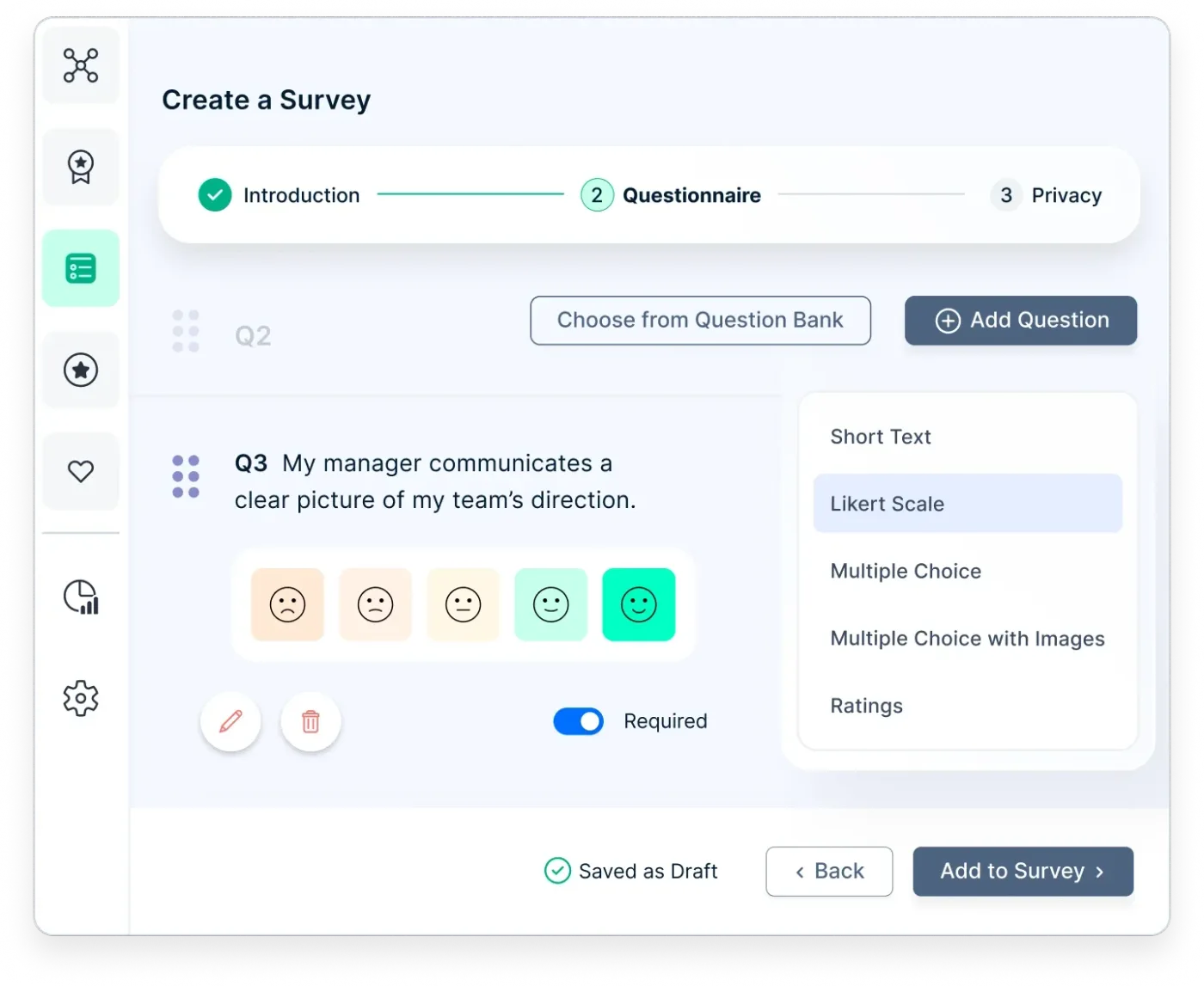
Automate exit surveys for every leaver
Trigger exit surveys from your HRIS and see the top reasons people leave, by team and manager.
Talk to our ExpertTrusted by 5,000+ companies
How to conduct an employee exit survey
There are five common ways to run an employee exit survey, and they differ mainly in cost, candor and how easy the answers are to analyze. Online survey tools win for most organizations today, with a face-to-face conversation added for the exits you most want to understand.
Face-to-face
A face-to-face session lets you clarify answers and ask follow-up questions, and you can be sure the employee answers every question. The downside is that answers must be recorded and analyzed one by one, and people are often less candid in person, especially with their own manager.
Printed surveys
Printed questionnaires are simple to prepare, but they are more costly and laborious than digital options. Employees must be in the office to complete them, which rules out remote and hybrid staff, and someone has to type up every response before it can be analyzed.
Phone calls
A phone survey reads a prepared script and records the answers. It is tiring for both parties, misunderstandings and poor connections hurt the results, and response rates for phone surveys have kept falling as people screen calls from unknown numbers.
Custom-coded online forms
Some teams build their own online exit survey in code to get exactly the look they want. It works, but it is expensive and slow to change, and it rarely includes the analytics and anonymity controls that dedicated tools provide, so few companies still choose it.
Survey and employee listening tools
Online employee survey tools are the most popular option because they need no coding, include exit survey templates and can send surveys automatically when a departure is recorded in your HR system. They also group answers by reason and team, which makes the analysis step far quicker.
Employee exit survey best practices
Seven practices separate exit surveys that change things from ones that fill a folder. Trust comes first, because without it every other step produces polite, unusable answers.
- Protect anonymity and say so: Explain who sees responses, report only aggregated results and never let the direct manager see an individual's answers.
- Time it well: Send the survey in the last week of employment, not on the final afternoon when people are handing over work. For regretted exits, consider a short follow-up 30 to 90 days after departure, when people often speak more freely.
- Ask for the primary reason first: One required multiple choice question on the main reason for leaving gives you a clean, comparable data point before the open questions.
- Use consistent reason codes: Keep the same answer options every quarter so you can track trends. Change them once a year at most.
- Segment the results: Compare reasons by team, manager, location, tenure and performance level. A company-wide average hides the problem teams.
- Pair it with stay interviews: Exit data tells you why people left. Stay interviews and pulse surveys tell you who is at risk now, while you can still act.
- Close the loop: Share themes and actions with leaders and, where appropriate, with employees, so people see that feedback leads to change.
Exit survey questions to ask employees
The question bank below is grouped into six sets: core rated items, general open questions and four sets by type of departure. Start with the core rated items for every leaver, because they give you comparable numbers, then add the set that matches the situation and adapt the wording to your company.
Core rated items for every leaver
Ask respondents to rate each statement on a five-point scale from 1 (strongly disagree) to 5 (strongly agree). Tracking these scores over time shows which drivers of turnover are getting better or worse.
| Statement | Driver it measures |
|---|---|
| I was paid fairly for the work I did. | Pay |
| My benefits met my needs. | Benefits |
| My manager supported my success and development. | Manager relationship |
| I could see a realistic path to grow my career here. | Career growth |
| My workload was manageable most of the time. | Workload |
| I had the tools, equipment and training to do my job well. | Resources |
| My work was recognized and appreciated. | Recognition |
| I trusted the senior leadership of the company. | Leadership trust |
| I felt I belonged and was treated with respect. | Inclusion |
| I would recommend this company as a place to work. | Advocacy |
Primary reason for leaving
Make this a required single-choice question so every response has one comparable reason. Offer these options: pay, benefits, career growth, manager relationship, workload or burnout, flexibility or location, company culture, job content, relocation or personal reasons, retirement, and other (please specify).
General exit survey questions
These open questions work for any departure, whatever the reason. Pick four to six of them so the survey stays short.
| Question | Answer format |
|---|---|
| Why did you decide to leave [company]? | Open text |
| What prompted you to begin looking for work elsewhere? | Open text |
| Was there a specific event that made you decide to leave? If so, what was it? | Yes or no, then open text |
| What does your new job offer that your current one does not? | Open text |
| Could anything have been done to keep you working here? If so, what? | Yes or no, then open text |
| Did you talk to anyone at the company before deciding to resign? | Yes or no |
| Would you consider coming back to the company in the future? Why or why not? | Yes, maybe or no, then open text |
| Would you recommend the company to a friend looking for a job? Why or why not? | 0 to 10 scale, then open text |
| Have you experienced any bullying or harassment? If so, did you report it to HR? | Yes or no, then open text |
| Did you experience engaging and encouraging leadership during your time here? | 1 to 5 scale |
| Did you have the right equipment, materials and training for your role? What was missing? | Yes or no, then open text |
| What one change would make the company a more attractive place to work? | Open text |
| Is there anything else you would like to share? | Open text |
| May someone from HR contact you to ask a follow-up question? | Yes or no |
Exit survey questions for retiring employees
Retirement is a bittersweet moment, and these questions help you learn about a long career while capturing knowledge before it leaves. Keep the tone warm and celebratory.
| Question | Answer format |
|---|---|
| How do you feel about your professional development and achievements here? | Open text |
| What do you plan to do after you retire? | Open text |
| Did the company give you enough training and support throughout your career? | 1 to 5 scale |
| What could have made your experience here better or more successful? | Open text |
| What advice would you give current and future employees? | Open text |
| How could we improve our benefits or retirement plan? | Open text |
| Would you like to stay involved, for example through consulting, mentoring or volunteering? | Yes, maybe or no |
Exit survey questions for terminated employees
Termination is never simple, yet the answers can reveal gaps in onboarding, training or management that contributed to the outcome. Keep these questions neutral and factual, and run them through HR rather than the former manager.
| Question | Answer format |
|---|---|
| How would you describe the circumstances that led to your termination? | Open text |
| Did you receive clear feedback or warnings before the decision? | Yes or no, then open text |
| Did you receive the support and training you needed for your role? | 1 to 5 scale |
| Did you feel management valued your work? | 1 to 5 scale |
Exit survey questions for voluntary resignations
Voluntary resignations are the exits you can most often prevent, so these questions focus on what the company could have changed. They pair well with the core rated items above.
| Question | Answer format |
|---|---|
| Is there something the company could have done to prevent your resignation? | Yes or no, then open text |
| Did you feel you received the right training and support for your role? | 1 to 5 scale |
| Did communication with your manager or coworkers influence your decision to leave? | Yes or no, then open text |
| How could we improve the company culture or workplace? | Open text |
| Would you describe the company as a great place to work? | Yes, somewhat or no |
Exit survey questions for interns
Intern exit surveys show how well your program works and whether interns would return as full-time hires. Use the answers to improve the program for the next cohort.
| Question | Answer format |
|---|---|
| How would you describe your time as an intern here? | Open text |
| Did you receive the right guidance and support for your role? | 1 to 5 scale |
| How could we make the internship program better? | Open text |
| Would you recommend this internship to other students? | 0 to 10 scale |
| Was the internship useful for your career and personal development? | 1 to 5 scale |
| Would you consider applying for a full-time role with us? If not, why not? | Yes, maybe or no, then open text |
How to analyze exit survey results
Exit survey responses only help if someone turns them into decisions, and too many companies file them away. These five steps move you from raw answers to new policies, with the comparison against other surveys being the step most teams skip.
- Collect responses consistently: Send the same survey at the same point to every leaver so the data is comparable. Short, engaging questions get more honest answers.
- Look for shared patterns: Group answers by primary reason, then by team, manager, tenure and role. Note your weak points so the same problems do not repeat, and record what people valued so you protect it.
- Compare with your other surveys: Check whether leavers raise the same issues current employees mention in engagement and pulse surveys. When an issue appears in both, prioritize it.
- Categorize weak points: Sort concerns into themes such as pay, manager, workload, culture or harassment. If a specific manager is linked to repeated exits, address it with them directly and with support.
- Share findings and agree on actions: Present a short summary to leaders each quarter with the top three reasons, the teams most affected and the actions you propose, then track whether those reasons decline.
A simple formula keeps leaders focused on the exits that matter. Preventable regretted turnover rate = regretted leavers who cite a fixable reason ÷ average headcount × 100. For example, if 12 of 30 regretted leavers in a year cite manager or career growth issues in a company with an average headcount of 600, the preventable regretted turnover rate is 12 ÷ 600 × 100 = 2%. Cutting that number is a clearer goal than cutting turnover overall.
How exit surveys improve employee retention
Exit surveys only improve retention when the lessons are acted on for the people who stay. Engagement is the bigger lever: Gallup's State of the Global Workplace 2026 report found that only 20% of employees worldwide were engaged in 2025, and manager engagement fell from 27% to 22%.
Three elements strongly shape whether people stay, so build questions about each into your exit survey:
- The manager relationship: Whether the employee felt supported, coached and recognized by their direct supervisor.
- Confidence in leadership: Whether the employee trusted senior leaders and the direction of the company.
- A sense of teamwork: Whether the employee felt part of a team that cooperates and treats each other with respect.
Use the answers to fix relationships, trust and pride in your company. If exit data points to managers, invest in manager training and regular check-ins. If it points to career growth, publish clear paths and internal mobility rules. Our guide to employee retention strategies covers the actions in detail, and employee retention programs shows how to structure them.
How to get the most from employee exit surveys
Employee surveys are useful at every stage, not just at the end, but the exit survey is one of the last chances you have to hear candid views. Departing employees have less to lose, so they often say what current staff will not.
Remember that the main goal is to use what you learn to improve the workplace for your current and future teams. Treat every departure as a lesson, track the same questions over time and pair exit data with an employee Net Promoter Score and a healthy culture of feedback, so issues surface long before the resignation letter arrives.
How Empuls helps you run exit surveys
Losing employees is inevitable, but knowing why they leave helps you build a better workplace. Empuls lifecycle surveys schedule onboarding to exit surveys around each milestone and stay in sync with your HRIS, so every leaver gets the right survey at the right time.
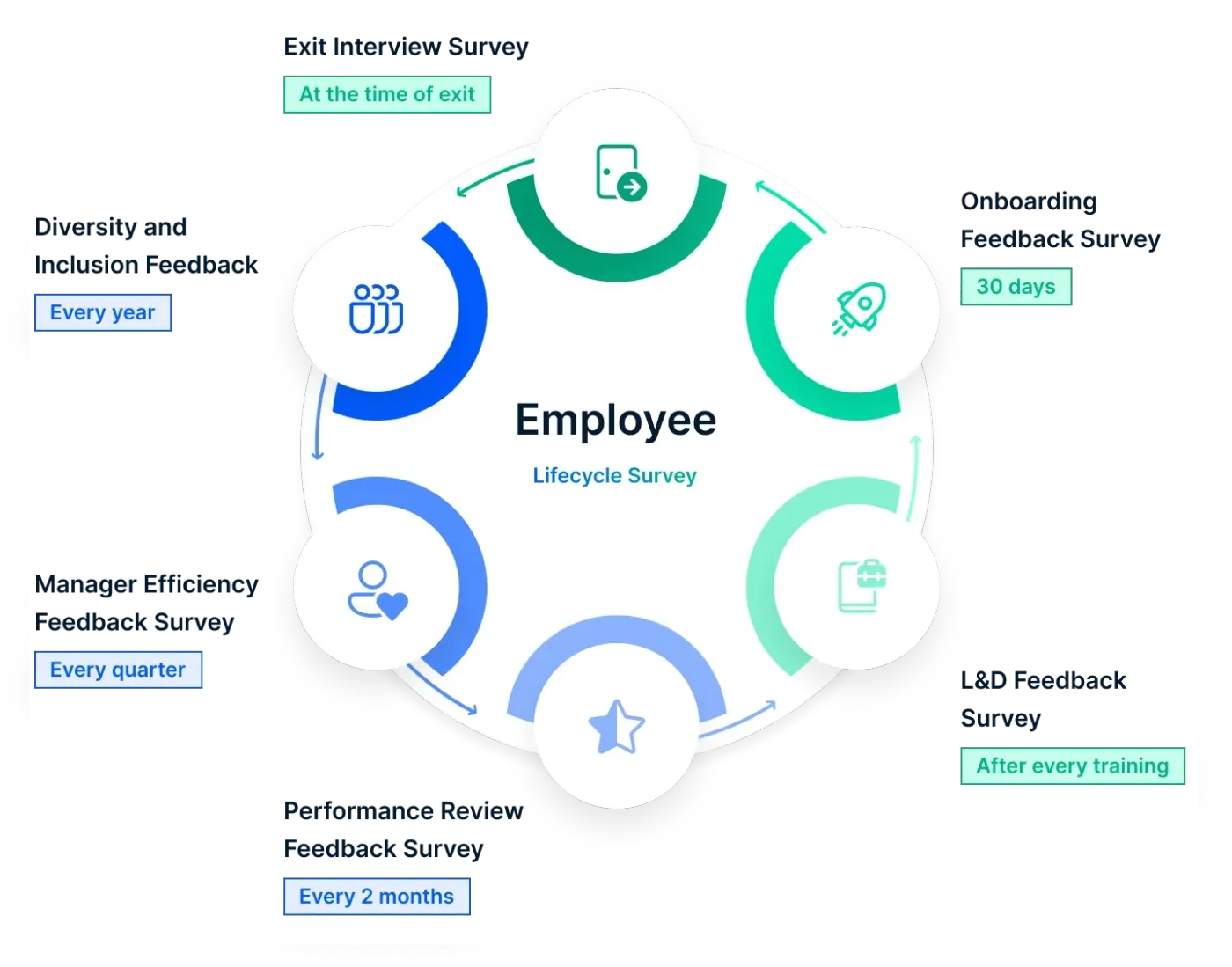
- Templates and a question bank: Start from ready-made exit survey questions or write your own in the Empuls survey builder.
- Confidential feedback: Anonymity settings and group-level reporting help departing employees feel safe sharing honest views.
- AI-driven analysis: AI sentiment analysis groups open comments into themes so you can spot recurring issues quickly.
- Delivery where people work: Send surveys through Slack, Microsoft Teams or email, with automatic reminders.
- From insight to action: Turn the top exit reasons into action plans with owners and timelines.
Do not let valuable feedback walk out the door. With an exit survey that runs automatically and feeds into action plans, every departure becomes a chance to improve.
Book your Empuls demo
Frequently asked questions
An exit survey is a written questionnaire, usually online and often anonymous, that every leaver can complete in under ten minutes. An exit interview is a conversation with HR or a neutral manager that allows follow-up questions. Surveys give comparable data across many exits, while interviews give deeper context for a single exit, so many companies use both.
Send the exit survey during the employee's final week, once the resignation is confirmed but before the last day, when people are busy with handovers. Set a short deadline and send one or two reminders. For regretted exits, a brief follow-up 30 to 90 days after departure often produces more candid answers about the real reasons for leaving.
Exit surveys should be confidential at minimum and anonymous where possible, because people are more honest when they know their manager cannot see their answers. Report results only at group level with a minimum group size, such as five responses. If you need to follow up, ask for permission to contact the person in a separate optional question.
Most exit surveys work best with 10 to 20 questions that take under ten minutes. Include about ten rated statements, one required primary reason for leaving and three to five open questions. Longer surveys reduce completion rates and lead to rushed answers, especially when departing employees are already busy with handovers.
There is no universal benchmark, but aim for a majority of leavers to respond so the data is representative. Response rates rise when the survey is short, mobile friendly, sent before the last day, clearly confidential and supported by a reminder. Track the response rate by team, because low rates in one area can hide the problems you most need to see.
HR, a people analytics team or a neutral third party should run exit interviews and surveys, not the departing employee's direct manager. Employees are more candid when the person collecting feedback has no influence over their reference or relationships. Managers should receive aggregated themes for their team, never individual responses.
Group responses by primary reason, then compare them by team, manager, tenure and role to find patterns. Check whether the same issues appear in engagement and pulse surveys, share the top three themes with leaders each quarter, agree on actions with owners and track whether those reasons for leaving decline over the following quarters.
Yes, when the results lead to action. Exit surveys show which preventable reasons drive departures, such as pay, manager relationships or career growth. Gallup found that 42% of voluntary leavers said their employer could have kept them, so fixing the top reasons and pairing exit data with stay interviews and pulse surveys can reduce future turnover.





































































































































































































































































































































































































































































































































































