
Key Takeaways
Employee gamification applies points, badges, challenges and leaderboards to work so people get faster feedback, visible progress and more recognition.
Gallup found only 20% of employees worldwide were engaged in 2025, which is why low-cost ways to make progress and recognition visible matter.
Research from 2025 and 2026 shows gamification works when it builds people's sense of competence and connection, not when it simply hands out points.
The strongest programs start with one business outcome, design player goals around real motivations and pilot before rolling out.
Rewarding only top performers, scoring easy-to-inflate activity and forcing participation are the fastest ways to make gamification backfire.
Employee gamification uses game elements such as points, badges, challenges and leaderboards to make everyday work more engaging and to reward the behaviors that matter. Done well, it gives people faster feedback, visible progress and recognition, which lifts engagement and performance. Done badly, it feels like surveillance with a scoreboard, so design matters more than mechanics.
This guide explains what employee gamification is, why gamification in the workplace works, the game mechanics to use, 12 employee gamification ideas by goal and a seven-step design template with a worked example you can copy.
What employee gamification is
Employee gamification is the practice of applying game-design elements, such as points, badges, levels, challenges and leaderboards, to work tasks and processes so they become more motivating and rewarding. It is used in onboarding, training, recognition, sales, customer service, safety, wellbeing and internal communication.
The technique is used widely in marketing, health, learning, crowdsourcing and community building. In the workplace it focuses on engagement: giving people clear goals, instant feedback and a reason to come back to the behaviors that drive results.
Two practitioners shaped how most organizations think about it. Gamification author Yu-kai Chou argues that good designs address one or more of eight human core drives: a higher purpose, accomplishment, empowerment, ownership, social influence, scarcity, unpredictability and avoidance. Speaker Gabe Zichermann describes a challenge, achievement and pleasure loop: each time you take on a task and succeed, it feels good, so you want to do it again. The more you succeed, the more you want to succeed.
Why gamification in the workplace works
The need is real. Gallup's State of the Global Workplace report found that only 20% of employees worldwide were engaged in 2025, the second straight annual decline, and estimates that low engagement costs the global economy about $10 trillion in lost productivity, or 9% of global GDP.
Recent research explains why game elements can help. A two-study paper in the International Journal of Manpower surveyed 308 hospitality employees in China and 364 in Singapore and found that the visibility, comparability and immediacy of gamified feedback shaped employees' sense of autonomy, competence and relatedness. Competence and relatedness in turn predicted meaningful work, which drove performance. In other words, gamification works when it helps people feel capable and connected, not just when it hands out points.
Field evidence points the same way. A 2025 field experiment published in the Journal of Personal Selling and Sales Management with 147 telecom sales agents found that adding a competitive quiz after virtual training raised enjoyment, which increased training motivation and the sales knowledge agents retained.
Benefits of workplace gamification
The benefits of workplace gamification come from five mechanisms, listed here from most to least immediate. Faster feedback is first because it is what people notice in the first week.
- Faster feedback: People know almost immediately whether they are on track, instead of waiting for a monthly report or an annual review.
- Visible progress: Levels, streaks and progress bars break big goals into steps, which builds confidence and keeps momentum.
- More frequent recognition: Badges, points and shout-outs make appreciation routine. Our guide to the employee recognition program shows how to structure that recognition.
- Higher participation: Gamified surveys, training, wellness challenges and polls typically draw more participation than optional programs with no feedback loop.
- Better data: Every game generates data on what people do and where they get stuck, which helps managers coach and HR improve programs.
Turn recognition and challenges into a game people want to play
Run contests, badges, leaderboards and wellness challenges with rewards employees actually redeem.
Talk to our ExpertTrusted by 5,000+ companies
Ten game mechanics that power employee engagement
Rajat Paharia, in his book Loyalty 3.0, describes ten game mechanics that most gamified solutions combine. Immediate feedback, goals and points are the foundation; the rest add competition, collaboration and long-term progression.
- Immediate feedback: The user knows whether they are winning or losing almost immediately after acting.
- Leaderboards: The user sees where they are positioned among peers.
- Goals: The user knows where they are headed and what they need to achieve.
- Badges: The user receives badges that act as shorthand for past achievements.
- Leveling up: The user moves through ascending levels of difficulty.
- Onboarding: The user learns the rules during play, not in a manual.
- Competition: The user competes with other players or groups.
- Collaboration: The user helps and gets help from others.
- Community: The user belongs to a group with shared interests.
- Points: The user accumulates points throughout play, often redeemable for rewards.
Ticking off these elements does not guarantee a working solution. Brian Burke, author of Gamify, warns against treating gamification as a magic elixir for getting people to do what the company wants. Users quickly sense poorly designed solutions and start avoiding them.
Employee gamification ideas by goal
The table lists 12 employee gamification ideas, each matched to a business goal, the mechanics it uses and the metric that shows whether it worked. Start with one idea tied to your most pressing goal rather than gamifying everything at once.
| Goal | Gamification idea | Mechanics | Metric to track |
|---|---|---|---|
| Faster onboarding | Onboarding quest with tasks for week one, month one and month three | Levels, badges, progress bar | Time to productivity, 90-day retention |
| Training completion | Learning path with points per module and a badge on certification | Points, badges, levels | Completion rate, assessment scores |
| Recognition | Peer-to-peer points with a monthly appreciation leaderboard | Points, leaderboard, community | Share of employees recognized monthly |
| Company values | Value-based badges awarded by peers and managers | Badges, social feed | Recognitions tagged to each value |
| Wellbeing | Team step challenge synced to wearables | Team competition, goals, streaks | Participation, active days per week |
| Sales performance | Short contest on one product or metric | Leaderboard, points, prizes | Target attainment, mid-performer lift |
| Customer service quality | Weekly quality and resolution challenge | Goals, badges, team leaderboard | CSAT, first-contact resolution |
| Survey participation | Points for completing pulse surveys | Points, immediate feedback | Response rate |
| Innovation | Idea challenge with peer voting | Collaboration, voting, badges | Ideas submitted and implemented |
| Safety | Streaks for incident-free days by site | Streaks, team goals | Incident rate, near-miss reports |
| Tool adoption | Milestones for using a new system or intranet | Milestones, badges, nudges | Weekly active users |
| Manager habits | Challenge for regular one-on-ones and timely recognition | Goals, peer comparison within the same band | One-on-one frequency, team engagement |
For sales teams specifically, see our comparison of sales gamification software. For learning programs, our guide to gamified learning goes deeper on game-based training.
How gamification for employee engagement supports each driver
Employee engagement is shaped by individual traits, job design and the wider organization, and gamification can support all three. The four drivers below are where well-designed game mechanics make the biggest difference.
01 · Individual
Self-efficacy and resilience
Pats on the back such as spot awards and badges build people's belief that their skills matter. Gamified onboarding and collaborative challenges help new employees adapt to the culture faster.
02 · Job design
Feedback and autonomy
Immediate-feedback mechanics, gamified pulse surveys and points for new ideas, issue discoveries and suggestions encourage people to speak up and act independently.
03 · Growth
Development and leadership
Levels, badges and leaderboards make development visible even after a leaderboard resets. Managers can also be players, with goals for timely reviews and team check-ins.
04 · Organization
Culture and wellbeing
Value-based badges reinforce core values, while live leaderboards for walks, runs and workouts make wellbeing programs social and habit-forming.
Gamified wellbeing is one of the most common entry points. For the bigger picture, see our roundup of employee wellness trends.
Employee gamification design template
Brian Burke and Yu-kai Chou both stress that design must start from people's real motivations, not from a menu of mechanics. The seven steps below follow Burke's framework; fill in the right-hand column for your own program, using the customer service example as a guide.
| Step | Question to answer | Worked example: customer service team |
|---|---|---|
| 1. Define the business outcome | Which business goal will this move, and how will you measure it? | Raise first-contact resolution from 68% to 75% in one quarter without lowering CSAT |
| 2. Define the audience | Who will play, and what drives them? | 40 agents across two shifts, mostly early-career, motivated by mastery and team belonging |
| 3. Define player goals | What goal for the player supports the business goal and a core drive? | Earn a weekly Resolver badge for 10 or more first-contact resolutions with CSAT of 4 or higher |
| 4. Choose the engagement model | Competitive or collaborative? How long? What rewards? | Shift-versus-shift team challenge over eight weeks, plus individual badges; points redeemable monthly |
| 5. Define the play space and journey | Where will people see the game, and how do they progress? | Inside the helpdesk and team chat; levels from Rookie to Expert as resolution streaks grow |
| 6. Define the game economy | What do people earn, how do they redeem it and how is it recorded? | Points per qualifying resolution, capped weekly, redeemable for gift cards; every award logged |
| 7. Play, test and iterate | How will you get feedback and adjust? | Two-week pilot with one shift, a five-question pulse survey, then adjust thresholds before rollout |
Burke shares a memorable example of step three in practice: a children's cancer treatment center turned pain reporting into a game by making young patients members of a "Pain Squad" who were promoted from rookie to sergeant to chief as they reported their pain regularly. The player goal served the clinical goal and the children's need for a sense of mission.
Common employee gamification mistakes to avoid
Six mistakes cause most gamification programs to stall, listed from most to least damaging. The first one alone can turn an engagement program into a source of resentment.
- Rewarding only the top few: Company-wide leaderboards motivate the leaders and discourage everyone else. Scope competitions to comparable peers and add personal-best goals.
- Scoring easy-to-inflate activity: Points for logins or clicks invite gaming. Score outcomes and quality, not volume alone.
- Making play mandatory: Forced participation turns a game into surveillance. Keep games opt-in where you can and never tie them to discipline.
- Relying only on extrinsic rewards: Prizes help, but purpose, mastery and belonging sustain effort. Our guide to intrinsic vs extrinsic motivation explains the balance.
- Ignoring privacy: Publishing individual health or performance data without consent damages trust. Show team results where personal data is sensitive.
- Never refreshing the game: The same challenge for a year becomes background noise. Rotate themes, metrics and formats every few weeks.
How Empuls helps you gamify employee engagement
Empuls brings recognition, rewards, challenges and wellbeing into one platform, so game mechanics connect to real recognition and rewards people value. Employees earn points, badges and certificates, see live leaderboards and redeem points from a global rewards catalog, while HR and managers track participation and results.
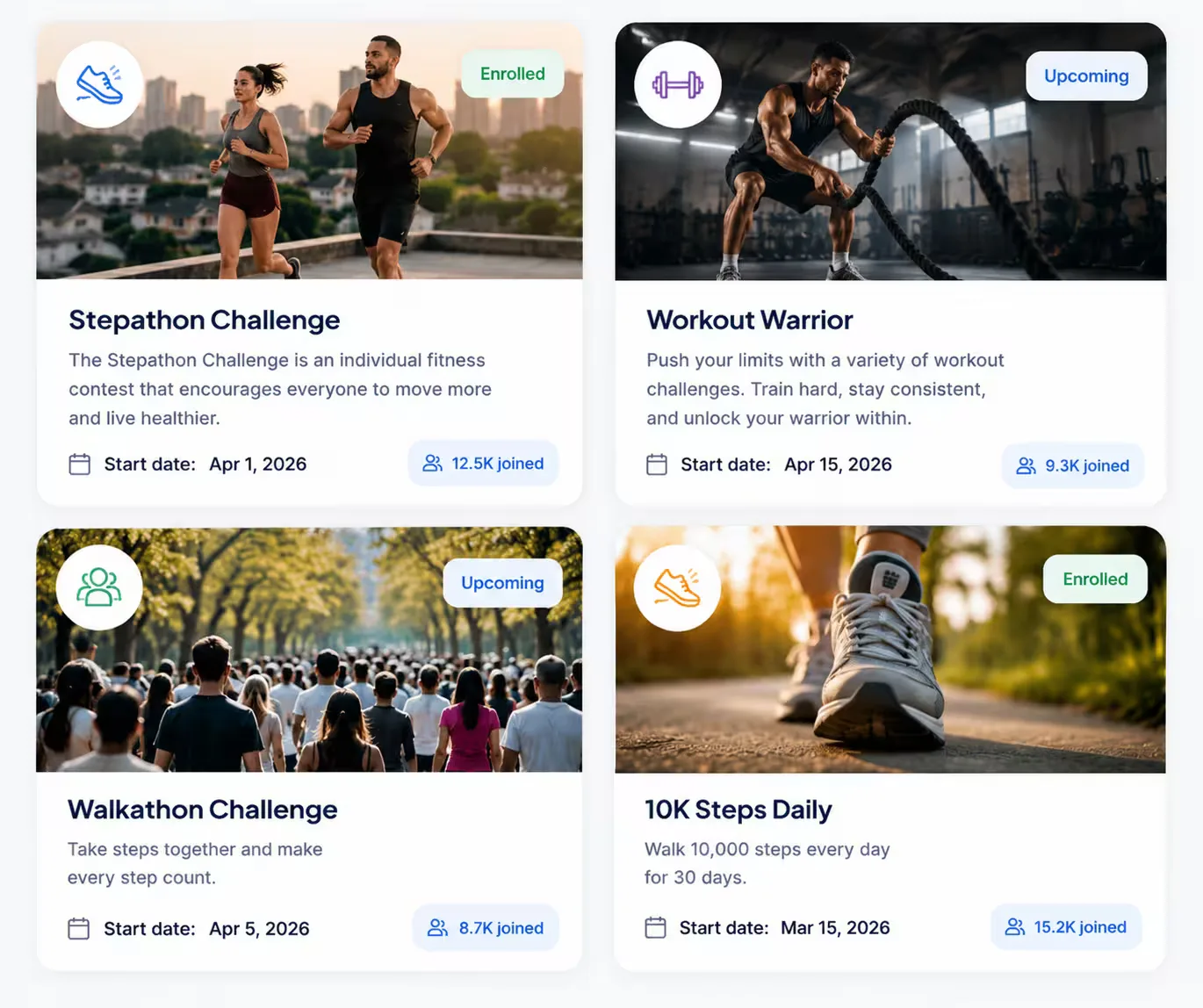
- Run contests and challenges with live leaderboards and instant rewards through Empuls challenges and contests.
- Make recognition routine with points, badges and social appreciation in Empuls recognition.
- Build healthy habits with wearable-synced step and team challenges in Empuls fitness challenges.
- Reward learning milestones automatically with training completion rewards. One enterprise that linked recognition to learning milestones raised course completion from 38% to 81%, as described in this learning participation case study.
Making employee gamification work for the long term
With increasingly digital workplaces, there is scope to gamify almost every part of work, but the programs that last are the ones that help people feel capable, connected and recognized. Start with one goal, design with the seven-step template, pilot with a small group and measure the outcome, not just participation. For more ways to lift engagement beyond games, see our employee engagement strategies.
Book your Empuls demo
Frequently asked questions
A common example is a gamified onboarding program where new hires earn points and badges for completing tasks in their first 90 days, with a progress bar showing what is left. Others include peer recognition points with a monthly leaderboard, team step challenges synced to wearables and short sales contests on a single product or metric.
It can, when it is well designed. Research published in 2026 found that gamified feedback strengthened employees' sense of competence and relatedness, which predicted meaningful work and better performance. Gamification is less effective when it rewards only top performers, feels mandatory or sits on top of unclear goals and unfair pay.
The main risks are unhealthy competition, gaming of easy metrics, privacy concerns and novelty wearing off. Leaderboards can demotivate people who never reach the top, and heavy reliance on prizes can crowd out intrinsic motivation. Scoped competitions, quality-based scoring, opt-in participation and regular refreshes reduce these risks.
Use challenges that work across locations and time zones, such as team step challenges, learning paths, peer recognition points and virtual quizzes. Deliver them where remote employees already work, such as Slack or Microsoft Teams, favor team goals over individual rankings and celebrate wins on a shared social feed so people feel connected.
Gamification adds game elements such as points, badges and leaderboards to existing work or training. Game-based learning uses an actual game, such as a simulation or quiz game, as the learning activity itself. Many organizations combine both, for example by awarding badges for completing a simulation within a gamified learning path.
Measure the business outcome the program targets, such as training completion, first-contact resolution or survey response rate, against a baseline. Add participation rates, the share of employees who reach at least one milestone, engagement survey scores for participants and the cost of rewards. Participation alone shows interest, not impact.
Rewards that people choose for themselves, such as points redeemable for gift cards, experiences or charity donations, tend to work best, combined with public recognition and badges. Keep rewards proportionate to the effort, deliver them quickly and pair them with meaningful recognition so the program does not depend only on prizes.
Workplace gamification is ethical when it is transparent, voluntary where possible and designed to help people succeed rather than to monitor them. Publish the rules, protect personal data such as health metrics, avoid penalizing low scores and let employees give feedback on the design. Problems arise when games become hidden performance surveillance.





































































































































































































































































































































































































































































































































































