
Key Takeaways
Core values in the workplace are a short set of enduring principles that guide how people behave and decide when no rule applies.
The most common examples of core values are integrity, innovation, accountability, respect, customer focus, inclusion and sustainability.
A value is only ready to launch when it has a one-line definition and at least two observable behaviors.
Gallup reports only 20% of U.S. employees feel strongly connected to their culture, so most values never leave the wall.
Recognition tied to values is one of the fastest ways to make them real: Workhuman found recently recognized employees 2.5 times more likely to feel aligned to company values.
Core values in the workplace are the small set of enduring principles that tell everyone in a company how to behave, decide and work together, especially when no rule covers the situation. Common examples include integrity, innovation, accountability, respect, customer focus, inclusion and sustainability. They only matter when they show up in hiring, recognition, decisions and leadership behavior, not just on a poster.
Core values shape company culture, guide behavior and align teams with shared goals. When values are clearly defined and authentically practiced, they foster trust, accountability and a sense of purpose. Companies that prioritize core values strengthen engagement and retention, and they attract talent that resonates with their mission.
Take Southwest Airlines as an example. Its purpose is to connect people to what matters in their lives through friendly, reliable, low-cost air travel, and its employee values, long known as "The Southwest Way," center on a warrior spirit, a servant's heart and a fun-loving attitude. By living these values, Southwest has built a loyal workforce and a dedicated customer base, showing that aligning culture with core values can lead to real business results.
This guide covers what core values are, seven company core values examples with the stories behind them, how to define core values for your own company and how to live them every day. If you want the broader picture of value types (core, aspirational, permission-to-play and accidental), read our companion guide to organizational values.
What are core values in the workplace?
Core values in the workplace are a small set of essential, enduring principles that capture an organization's culture. They represent the foundational commitments that help a company navigate complex situations while keeping its identity. As Gino Wickman, creator of the Entrepreneurial Operating System, puts it, core values dictate how everyone in the organization is expected to operate to succeed.
Strong core values for companies lead to four practical outcomes:
- Decision-making: Core values give employees a framework for making decisions that fit the organization's mission and goals. That consistency keeps the whole company moving in one direction.
- A cultural foundation: Values establish the organization's culture and influence employee satisfaction and engagement. A strong fit between personal and organizational values lifts morale and retention.
- Attracting talent: Clearly defined core values attract candidates who share those principles, which makes recruiting easier and hiring more accurate.
- Connection: In diverse and distributed teams, shared core values create a sense of belonging and make collaboration easier.
Values are one layer of a larger system. For how they sit alongside norms, assumptions and rituals, see what organizational culture is.
Why core values in the workplace matter now
Most companies have values written down, yet few employees feel them. Gallup's organizational culture indicator reports that as of May 2026, only 20% of U.S. employees strongly agree they feel connected to their organization's culture. The same research found that strongly connected employees are 4.3 times as likely to be engaged, 47% less likely to be looking for a new job and 62% less likely to feel burned out very often or always (based on February 2025 data).
20%
of U.S. employees feel strongly connected to their culture
Gallup, May 2026
4.3x
more likely to be engaged when strongly connected
Gallup, 2025 data
2.5x
more likely to feel aligned to values after recent recognition
Workhuman, 2026
Why lived values pay off
Recognition is one of the clearest ways to close that gap. A Workhuman study released in January 2026, based on more than 2,500 full-time employees in five countries, found that recently recognized employees were 67% more likely to say they understand their company's values and 2.5 times more likely to say they feel aligned to them. The lesson is simple: values need to be clearly defined, actionable, distinctive and linked to measurable outcomes before they change culture or performance.
7 examples of core values in the workplace from leading companies
The seven examples of core values below are the ones that appear most often in company value statements, each paired with an organization that puts it into practice. Integrity comes first because every other value depends on it, and the list then moves from how people work (innovation, accountability, respect) to who they serve (customers, colleagues and the planet).
1. Integrity
Integrity is crucial for building a credible and trustworthy workplace. It covers ethical behavior, honesty and transparency in all actions. Employees who embody integrity earn the respect of peers and clients, which creates a positive atmosphere for collaboration and innovation. Organizations that prioritize integrity often see better morale and a stronger reputation because their practices match their words.
Patagonia's commitment to integrity is embedded in how it runs its supply chain. The company does not own the factories that make its products, which makes ethical labor practices harder to guarantee. To address this, Patagonia uses a "4-fold" approach when working with factories: its social and environmental responsibility, sourcing and quality teams each assess a new factory, and any one of them can veto it.
Patagonia is also a founding member of the Fair Labor Association, which independently audits a sample of its supply chain and reaccredits its monitoring program every three years. Through its Footprint pages, the company publicly shares the social and environmental impacts of its products, reinforcing integrity in every part of the operation.
2. Innovation
Innovation is a core value that encourages creativity and continuous improvement. Companies stay competitive and responsive to changing markets by welcoming new ideas and encouraging experimentation. This value drives product development and lifts engagement, because team members feel motivated to contribute their own perspectives and solutions.
Apple's commitment to innovation is built into its organizational structure. After Steve Jobs returned in 1997, he replaced separate business units with a functional organization run under a single profit and loss statement, so experts in hardware, software and design work across every product instead of competing for resources.
This structure fosters collaboration across functions and lets teams work together seamlessly on product development. It is a useful reminder that a value like innovation needs supporting systems, not just encouragement, to become a habit.
3. Accountability
Workplace accountability means employees take ownership of their actions and decisions. It builds a culture where people answer for their performance, which raises trust and morale. When accountability is prioritized, employees feel safe to admit mistakes and learn from them, which improves productivity and teamwork.
Netflix builds accountability through its culture of "people over process". Instead of committees, each significant decision has an "informed captain" who gathers input, makes the call and owns the outcome. Managers give context rather than control, and employees are expected to seek out dissent, give candid feedback and share what they learn from decisions that did not work.
Accountability at Netflix is not only about individual performance. It also means supporting colleagues toward shared goals with minimal rules and bureaucracy, which frees people to do their best work.
4. Respect
Respect is essential for a positive workplace culture. It means treating everyone with dignity and fairness, regardless of position or background. A respectful environment encourages open dialogue, raises satisfaction and promotes teamwork. Companies that emphasize respect tend to see lower turnover and higher engagement, because employees feel valued and understood.
Google's research on team effectiveness, known as Project Aristotle, showed how respect works in practice. Its team effectiveness guide identifies psychological safety, the sense that you can take an interpersonal risk without being embarrassed or punished, as a key dynamic of effective teams. Respect shows up as equal airtime in discussions, empathy between colleagues and real openness to different perspectives.
5. Customer focus
Customer focus means understanding and meeting the needs of clients. This core value drives employees to put customer satisfaction at the center of every interaction and to make sure products and services match what customers expect.
Organizations with a customer-centric approach usually see better loyalty and retention because they actively seek feedback and improve their offerings. By valuing customer input, they build long-lasting relationships and a strong brand reputation.
Amazon calls this value "Customer Obsession," the first of its 16 Leadership Principles. The principle says leaders start with the customer and work backwards, and that although they pay attention to competitors, they obsess over customers. Amazon invests heavily in customer data and feedback to shape products and services, and it favors long-term customer trust over short-term gains.
6. Inclusion and equality
Inclusion, often expressed as diversity, equity and inclusion (DEI), equality or belonging, is a value that makes sure everyone feels respected, valued and supported. Embracing it means actively creating an environment that welcomes diverse perspectives and backgrounds, which leads to better creativity and decisions. Many companies have reworded this value since 2024, but the behavior it asks for, fair access to opportunity and a voice for everyone, has not changed.
Salesforce lists Equality as one of its five core values in its Code of Conduct, alongside Trust, Customer Success, Innovation and Sustainability. In practice, that value is tied to commitments such as equal pay for equal work and equal opportunity in hiring and promotion. For practical ways to build this value, see our guide to inclusion and diversity in the workplace.
7. Sustainability
Sustainability as a core value reflects a commitment to environmental stewardship and responsible use of resources. Companies that prioritize it aim to shrink their ecological footprint while supporting practices that benefit society, such as reducing waste, conserving energy and sourcing ethically. Embedding sustainability in operations also appeals to environmentally conscious customers and employees.
Unilever made sustainability central to its strategy with the Unilever Sustainable Living Plan, which ran from 2010 to 2020 and aimed to grow the business while reducing its environmental footprint. Because most of that footprint sat outside its own walls, Unilever built long-term supplier partnerships to bring sustainable sourcing into its supply chain, and it has since carried those goals into its current business strategy.
Recognize your core values in action
Tag every award and shout-out to a company value and see which values your teams live most.
Talk to our ExpertTrusted by 5,000+ companies
Core values examples translated into everyday behavior
A value is only useful when people can see it in action. The table below turns each of the seven examples of core values into behaviors you can observe, recognize and coach, plus the red flag that shows the value is not being lived.
| Core value | What it looks like day to day | Red flag |
|---|---|---|
| Integrity | Raising a problem early, keeping commitments, being honest about trade-offs | Targets hit by overpromising to customers |
| Innovation | Running small experiments, sharing what failed, improving one process each quarter | Ideas die in approval queues |
| Accountability | One named owner per decision, closing the loop on action items | Blame shifts to "the team" or "the process" |
| Respect | Equal airtime in meetings, listening before replying, respectful disagreement | The same voices dominate every discussion |
| Customer focus | Using customer feedback in planning, fixing root causes of complaints | Decisions made without customer data |
| Inclusion | Fair access to stretch work, inclusive scheduling across time zones | The same people get every opportunity |
| Sustainability | Weighing environmental cost in purchasing and travel decisions | Green claims with no measured progress |
How to define core values for your company
Knowing how to define core values matters more than picking the right words, because employees remember the process as much as the list. These eight steps move from evidence to wording to testing, and the testing step carries the most weight, since it is what separates real values from wishful ones.
- Start from purpose and strategy: Write down your mission, the strategy for the next three to five years and the behaviors that strategy will demand. Values should serve where the company is going, not just describe where it has been.
- Collect real stories: Ask employees at every level to describe a moment when the company was at its best and a moment when it fell short. Stories reveal the values people already live.
- Brainstorm individually, then as a group: Have people write candidate values on their own first so the loudest voices do not set the list, then cluster similar ideas together.
- Narrow to three to seven values: Fewer values are easier to remember and apply. Merge overlaps and drop anything that is a legal or ethical minimum, such as honesty, unless you have a distinctive take on it.
- Test each candidate: Ask whether you would hire or fire for it, whether you would keep it if it cost you money and whether it is true today or only an aspiration. Our guide to types of organizational values explains how to sort candidates into core, aspirational and permission-to-play values.
- Write each value as behaviors: Pair every value with a one-line definition and two to four observable behaviors. "Accountability: we name one owner for every decision and close the loop within a week" is far more useful than "Accountability" alone.
- Pressure-test with employees: Share the draft with a cross-section of teams and ask whether they recognize the company in it. Adjust wording until people say "that is us."
- Launch with a plan, not a poster: Decide in advance how each value will show up in hiring, onboarding, recognition and reviews before you announce it.
Step-by-step guide to implementing core values in the workplace
Embedding core values into the fabric of a company takes more than writing them down. The seven steps below follow the employee lifecycle from definition to review, and the second step, leadership behavior, matters most because employees copy what leaders do, not what they say.
1. Define authentic and actionable core values
Begin by identifying values that genuinely reflect your mission and vision, and involve both leadership and employees so the values resonate at every level. Effective values in the workplace are:
- Authentic: True to your company's identity.
- Actionable: Clear enough to guide decisions and behaviors.
- Memorable: Simple and compelling so they are easy to recall.
Avoid vague concepts like "integrity" without context. Explain what each value means and how it looks in action.
2. Align leadership behavior with core values
Leaders must model the core values daily. When leadership consistently demonstrates the values through actions, not just words, it sets the tone for the rest of the company. For example, if "transparency" is a core value, leaders should openly share challenges and invite employee feedback. This builds trust and reinforces the behaviors you want.
3. Communicate values consistently and clearly
Communication shows employees how to promote core values in the workplace. Use a mix of channels to reinforce the message:
- Internal newsletters and leadership updates
- Team meetings and town halls
- Onboarding materials
- The company intranet or a values page
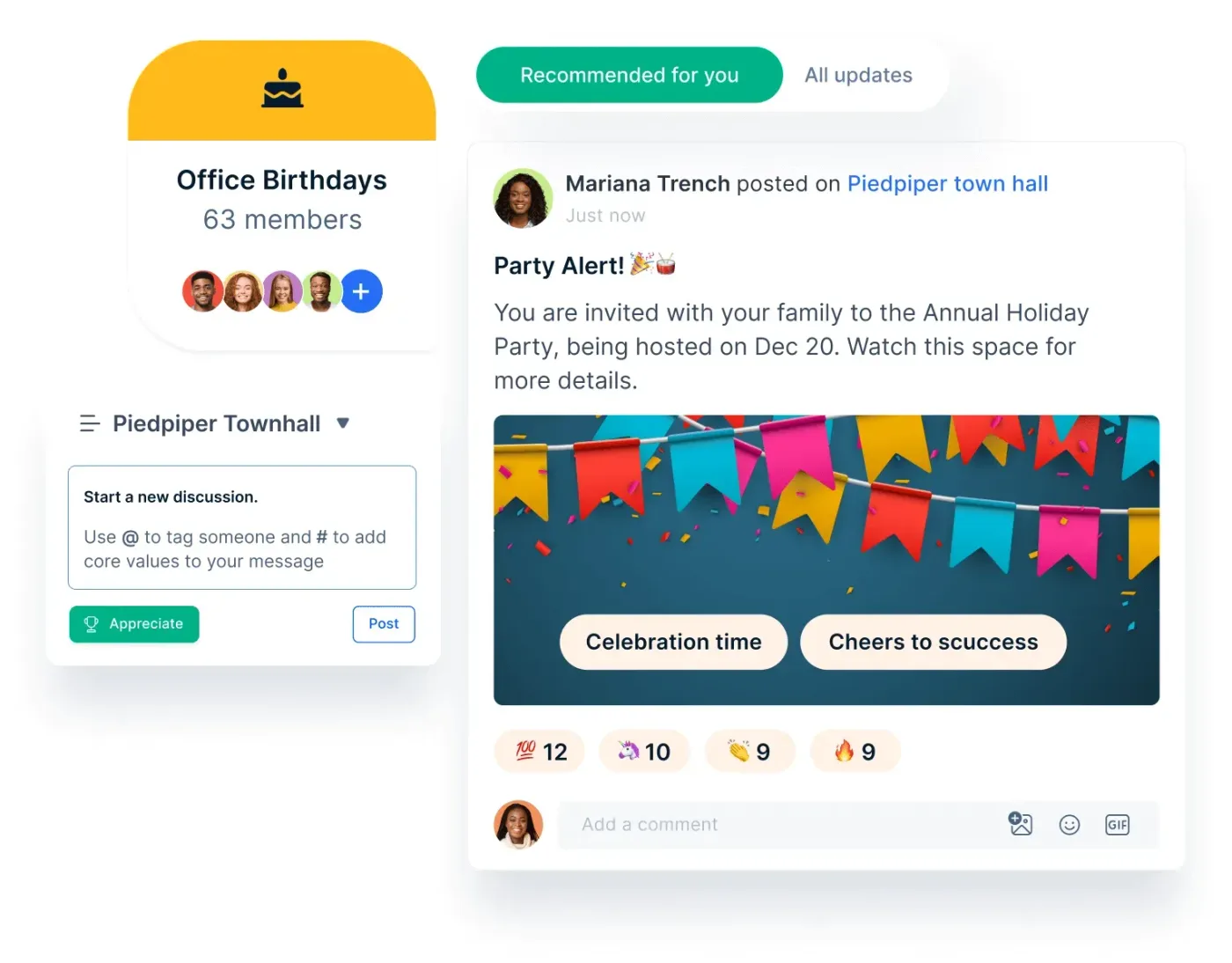
Visual reminders such as screensavers or office displays keep values top of mind, but repetition through real stories is what makes them stick. A social intranet lets employees tag the value behind a shout-out, so every post becomes an example.
4. Integrate values into hiring and onboarding
Hiring for values fit is one of the most effective ways to sustain your culture over time. Include your core values in job descriptions and add behavioral interview questions for each one, such as "Tell me about a time you raised a problem nobody wanted to hear." During onboarding, explain what the values mean and how they show up in everyday work. This sets expectations early and helps new hires understand what the company stands for.
5. Embed values in performance management
Link values to performance goals and reviews so that how people work counts alongside what they deliver. Recognize employees who embody the core values through formal rewards, shout-outs or internal awards. This celebrates the right behavior and motivates others to follow. For example, if "collaboration" is a key value, acknowledge cross-functional efforts that drive results.
6. Encourage peer-to-peer recognition
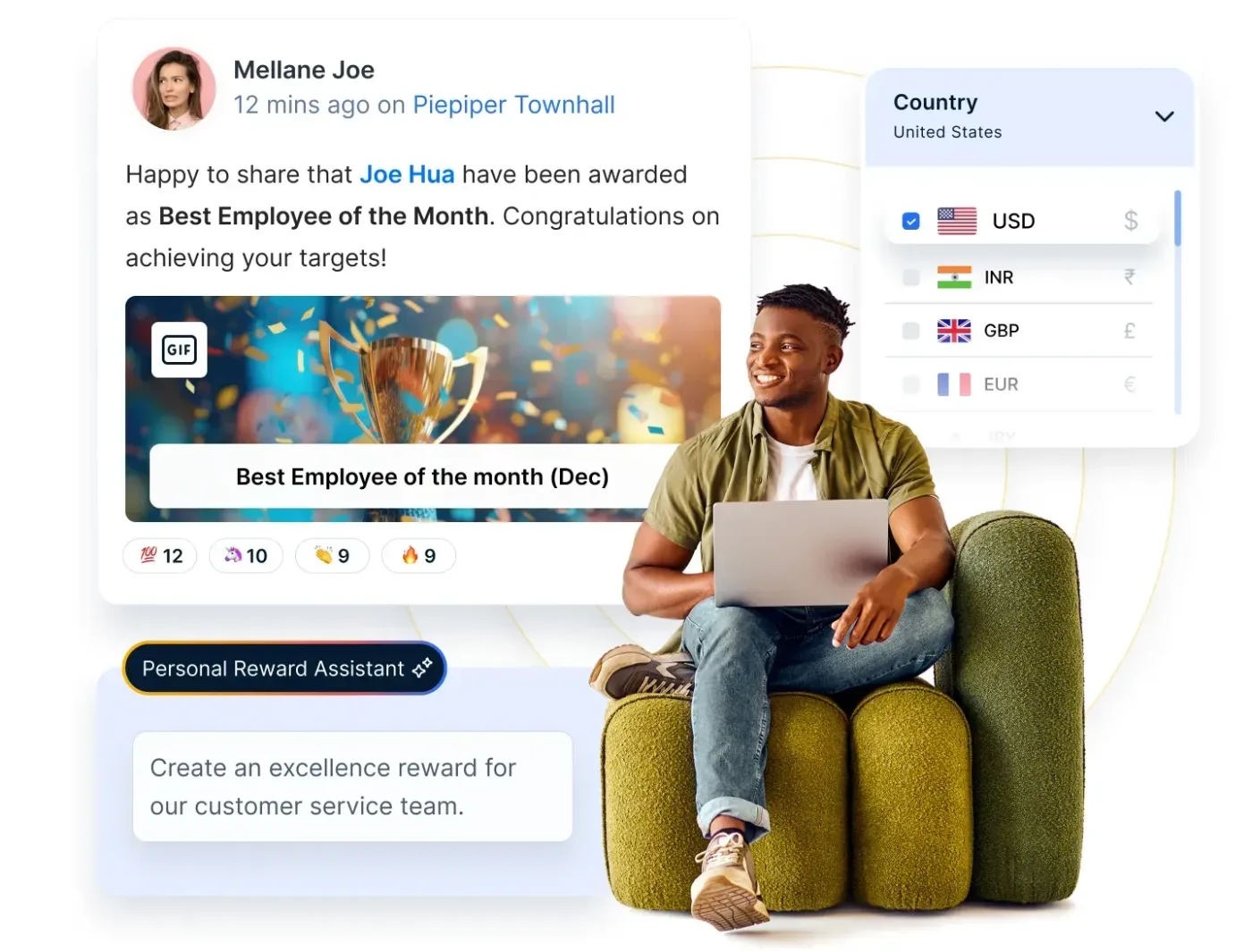
Empower employees to recognize each other for living the values. Peer recognition platforms, team shout-outs and value-based kudos make a big impact, because values are then embraced at every level rather than imposed from the top. Our guide to building a values-based recognition program covers program design, equity and measurement in detail.
7. Revisit and refine values over time
As your company grows, your core values may need to evolve. Schedule periodic reviews with leadership and employees to check whether the current values still reflect your culture and strategy. Adjust when priorities shift, after a merger or when a value has quietly stopped guiding decisions.
How to integrate core values into daily operations
Values stay abstract until they become the lens through which everyday work is judged. Here are practical ways to make sure your core values influence every part of the business:
- Hiring: Infuse values into job descriptions, interview questions and onboarding, so candidates understand what your organization stands for from day one.
- Recognition: Acknowledge and reward employees who consistently demonstrate your values, and link performance reviews to the behaviors that reflect them.
- Leadership and management: Train leaders to model and reinforce the values in their language, feedback and decisions.
- Decision-making: Use core values as a compass in ethical dilemmas and strategic choices, and say which value guided the call when you announce it.
- Training and development: Build core values into learning programs, leadership development and mentoring to reinforce cultural alignment over time.
- Community contributions: Encourage employees to take part in community activities that reflect company values. Deloitte's annual Impact Day, when its people volunteer across the country, puts its commitment to community impact into action.
- Continuous assessment: Regularly measure how well values are lived through pulse surveys, eNPS and focus groups, and act on the gaps you find.
Challenges in living core values and how to overcome them
Many organizations invest in defining strong core values, yet sustaining them is hard, especially when leadership buy-in is limited or stated values clash with actual behavior.
Consider this: your company declares integrity as a core value and promises to put ethics over personal gain. Yet a sales team routinely overpromises to close deals, and leadership overlooks it because revenue is high. Employees quickly lose trust, and that contradiction erodes morale, credibility and long-term performance.
The most common causes of a values gap, and the fix for each, are:
- Values are too generic: Words like "excellence" mean nothing without behaviors. Rewrite each value with observable actions.
- Rewards contradict values: If bonuses reward results at any cost, people will follow the money. Add a values component to reviews and incentives.
- Leaders are exempt: When senior people break the values without consequence, everyone notices. Hold leaders to the same standard first.
- No feedback loop: Without measurement, gaps stay invisible. Ask employees in regular surveys how well each value is lived and share what you will change.
By re-examining your core values and making sure they are emotionally compelling, consistently communicated and visibly practiced, you can close the gap between what is said and what is done. Our guide on how to improve organizational culture covers broader fixes when the gap runs deeper than values.
Leadership's role in exemplifying core values
Leadership sets the tone for how core values are perceived and lived. Even the best-defined values in the workplace fall flat if leaders do not demonstrate them consistently in words and actions. Effective values-led leadership looks like this:
- Visible modeling: Leaders explain which value guided a hard decision, including when it cost something.
- Consistent consequences: Leaders recognize value-aligned behavior and address violations, regardless of the person's results or seniority.
- Storytelling: Leaders open meetings and town halls with real examples of employees living a value.
- Listening: Leaders ask teams where the values are not being lived and act on the answers.
Strong leadership turns core values from symbols into the standard for behavior, decision-making and recognition across the organization.
How Empuls helps you live core values every day
Empuls, Xoxoday's employee engagement platform, gives HR and managers the tools to turn core values into daily habits instead of annual slogans. Its culture and values tools connect recognition, communication and feedback to the values you define.
- Values-tagged recognition: With Empuls recognition, every spot award and peer shout-out is tagged to a company value, building a searchable record of values in action and a Wall of Fame everyone can see.
- A social intranet for value stories: The Empuls social intranet lets you share stories of employees living the values through town halls, posts, polls and videos.
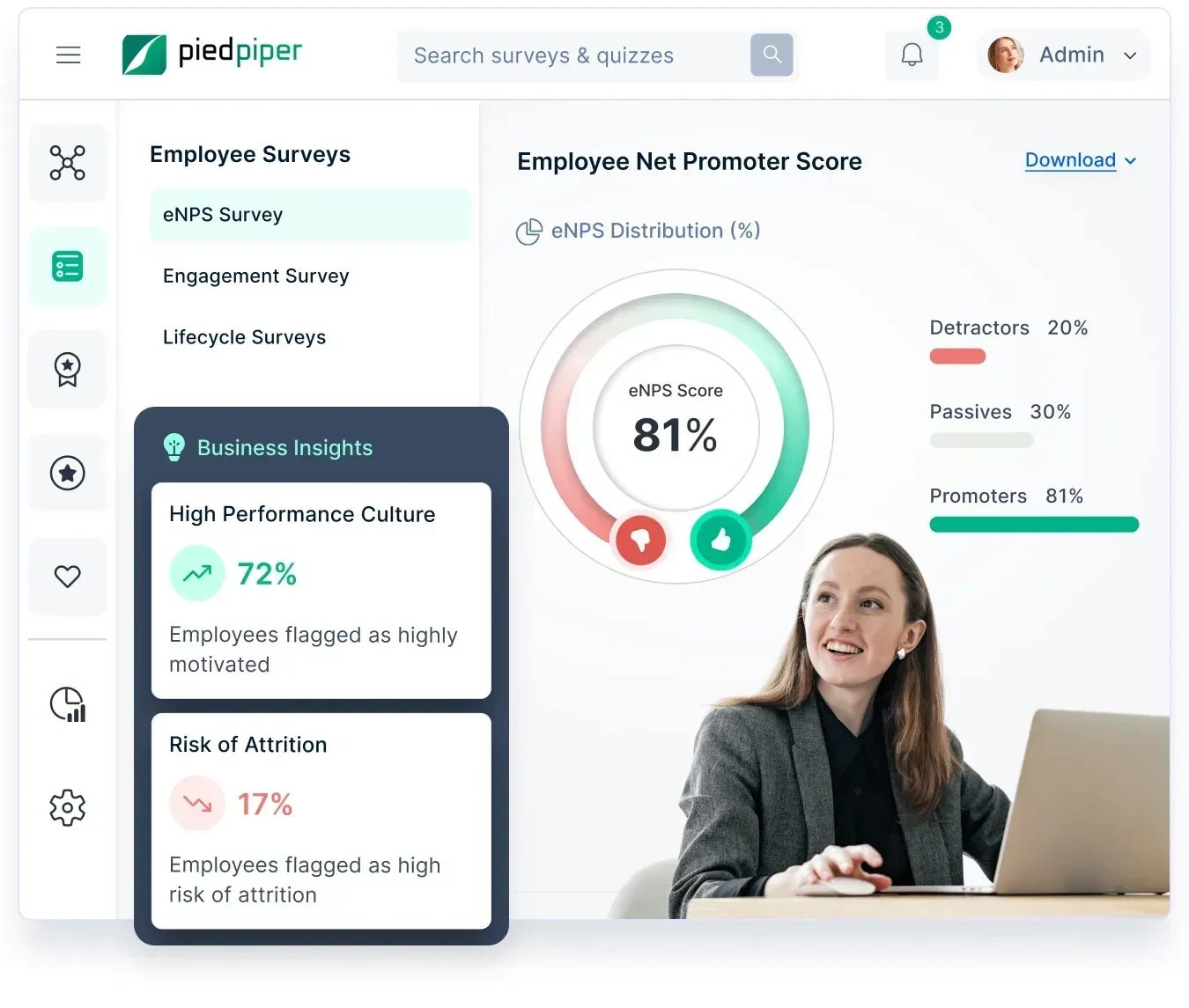
- Values in surveys: Empuls surveys let you add values questions to eNPS, pulse and lifecycle surveys, with AI summaries and action plans to close the gaps.
- Milestones that tell a values story: Milestone rewards automate service anniversaries and achievements, so you can highlight how long-tenured employees have lived your values.
Embracing core values for a thriving workplace
Core values in the workplace create a culture where employees feel valued, engaged and connected. Define a short list with real behaviors, let leaders model them, hire and review against them, recognize them every week and measure how well they are lived. Done consistently, your values become the way work gets done, not a list on a wall.
Book your Empuls demo
Frequently asked questions
The five most common core values companies choose are integrity, respect, accountability, innovation and customer focus. They appear in most value statements because they cover how people treat each other, how they own their work and how they serve customers. What makes them useful is not the word itself but the specific behaviors a company attaches to each one.
Integrity, accountability and respect are widely seen as the top three core values in the workplace. Integrity builds trust, accountability makes sure work gets done and owned, and respect creates the psychological safety teams need to speak up. Together they form a foundation that other values, such as innovation or customer focus, can build on.
Most companies do best with three to seven core values. Fewer than three rarely covers how people should work, while more than seven becomes hard to remember and apply in daily decisions. If your list is long, merge overlapping values and drop ethical minimums such as honesty, which every employer expects, unless you define them in a distinctive way.
Write a core value statement in three parts: a short name, a one-sentence definition and two to four observable behaviors. For example, "Ownership: we act like owners. We name one person for every decision, we close the loop within a week and we flag problems early." Behaviors make the value easy to hire for, recognize and coach.
A mission statement explains what a company does and why it exists, while core values describe how its people behave while doing that work. The mission points to the destination, and the values set the rules of the road. Strong companies connect the two, choosing values that make their mission and strategy more likely to succeed.
Employees show core values at work through everyday behavior: keeping commitments, raising problems early, giving credit to others, listening in meetings and putting customer needs first. Managers can make these behaviors visible by recognizing them publicly and naming the value each one reflects, which helps the whole team understand what living the values looks like.
Company core values usually fail because they are too generic, leaders do not model them, or rewards contradict them. When people see results rewarded at any cost, they ignore the values on the wall. Fixing this means defining behaviors for each value, holding leaders to the same standard and adding values to hiring, recognition and performance reviews.





































































































































































































































































































































































































































































































































































