
Key Takeaways
An employee engagement survey vendor provides the software, research-backed questions, analytics and support needed to measure engagement and act on the results.
Perceptyx data shows only 51% of employees see real improvements after giving feedback, so action planning should be the most heavily weighted selection criterion.
Score vendors on a weighted scorecard covering action planning, anonymity, survey science, analytics, reach, integrations and total cost.
Ask every vendor to show what a line manager sees and does the day after results publish, and pilot with real teams before signing.
Confirm minimum reporting thresholds, security certifications, a data processing agreement and full data export rights in writing.
To choose an employee engagement survey vendor, define what you need the survey to change, score each vendor against weighted criteria (survey science, anonymity, analytics, action planning, reach, integrations, security and total cost), then run a short pilot with real managers before you sign. The right vendor is the one whose results your managers will actually act on, not the one with the longest feature list.
An employee engagement survey vendor is a company that provides the software, research-backed question sets, analytics and often the expert support you need to measure engagement and turn the results into action. Choosing one is not about ticking a box. It is about finding a partner that gives you reliable data, meaningful insight and the tools to improve the workplace.
This guide sets out how to choose an employee survey vendor step by step: the engagement survey vendor selection criteria that matter, a weighted scorecard you can copy, the questions to ask in demos and RFPs, the red flags to watch for and how Empuls fits.
Why the vendor you choose shapes what changes
Most organizations already run some kind of engagement survey. The problem is what happens after it. Perceptyx benchmark data in its 2025 employee listening analysis shows that 71% of employees say results were shared and 59% say action plans were created, but only 51% see actual improvements from their feedback. A vendor that stops at reporting leaves you stuck in that gap.
Managers are where the gap closes or widens. Gallup's employee engagement indicator reports that managers account for at least 70% of the variance in team engagement. That makes one question central to vendor selection: what does a line manager see and do the day after results publish?
Types of employee engagement survey vendors
Vendors fall into five broad models, and knowing which one you need narrows the field quickly. Decide first whether you need deep research and consulting, a broad people platform or an engagement platform that connects surveys to recognition and everyday action.
| Vendor model | Typical examples | Best fit | Watch for |
|---|---|---|---|
| Enterprise experience management suites | Qualtrics, Microsoft Viva Glint | Large enterprises with research teams and complex listening programs | Implementation effort, cost and how much is left to your team to act on |
| Listening and people-analytics specialists | Perceptyx, Culture Amp, Peakon | Organizations that want strong survey science and benchmarks | Whether action planning and frontline reach are included or extra |
| Performance management platforms with surveys | Lattice, 15Five | Teams that want surveys tied to reviews and goals | Survey depth compared with specialists |
| Engagement platforms that combine surveys with recognition | Empuls | Organizations that want listening, recognition and rewards in one place | Fit with your existing HR tools and research needs |
| General survey tools | SurveyMonkey, Google Forms | Small teams running occasional surveys | Anonymity controls, analytics, benchmarking and action tracking are limited or absent |
For a side-by-side look at specific platforms, see the list of the best employee engagement survey tools. This guide focuses on how to choose among them.
10 features to look for in an employee engagement survey vendor
These ten features separate vendors that deliver reliable data and action from those that only collect responses. Anonymity and action planning carry the most weight, because without the first you get no honest answers and without the second nothing changes.
1. Research-backed, customizable survey templates
Many vendors offer templates, but a strong vendor provides validated questions built on recognized engagement models, such as an engagement index or eNPS, and explains the research behind them. You should be able to customize the templates to your workplace without breaking trend comparisons.
2. Guaranteed anonymity and confidentiality
Employees need confidence that they cannot be identified. Look for encrypted data collection, role-based access so only designated people see data, aggregated reporting and a minimum group size (often 5) that also applies to demographic cross-cuts.
3. AI-powered sentiment analysis and real-time insight
Basic tools give you raw data. Better vendors read open-ended comments, group them into themes, score sentiment, flag engagement risks and update dashboards in real time instead of sending static reports weeks later. Ask how accurate the theme detection is and whether it works in every language you need.
4. Automated pulse and lifecycle surveys
One survey a year gives you a snapshot. A strong vendor supports recurring pulse surveys, lifecycle surveys at onboarding, after training and at exit, and trigger-based surveys after major events such as reorganizations or leadership changes.
5. Integration with workplace tools and your HRIS
Employees respond less when they must log into yet another tool. Look for delivery through Slack, Microsoft Teams, email and mobile, and syncing with HRIS platforms such as Workday, BambooHR or SAP SuccessFactors so demographics stay accurate and lifecycle surveys trigger automatically.
6. Benchmarking and comparative analytics
Scores mean little without context. The best vendors offer external benchmarks against industry norms, internal benchmarks across departments, locations and levels, and historical trends that show improvement or decline over time.
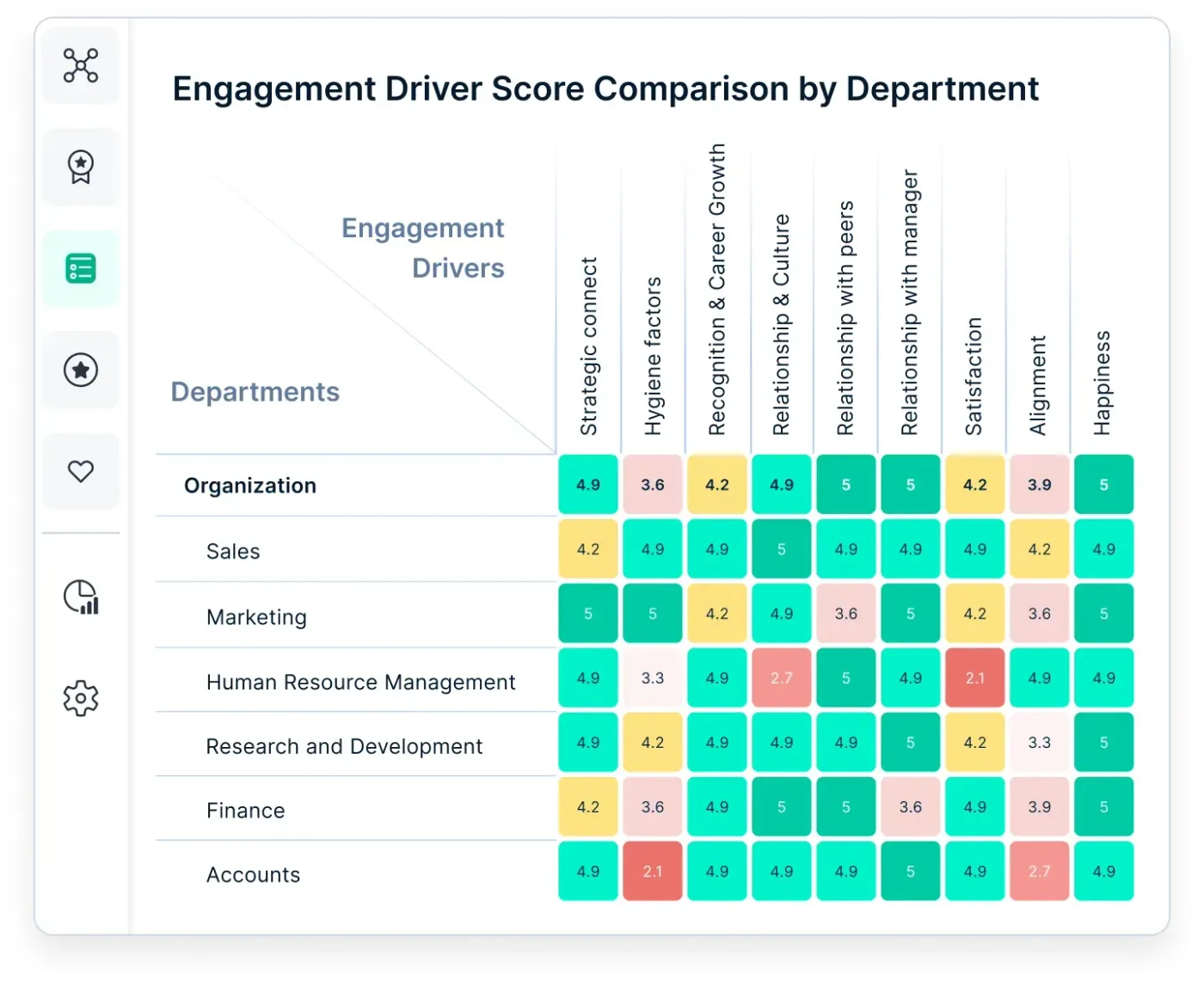
A driver heatmap like this shows at a glance which teams are low on which drivers, which is the view a manager needs to decide where to act.
7. Actionable reports and guided action plans
A quality platform tells you what to do next. Look for driver analysis that shows what moves engagement most, recommendations based on your results, and action plans that managers can own, with deadlines and progress tracking.
8. Multi-language and inclusive survey design
A global workforce needs surveys in multiple languages with good translations, open-text analysis that works across languages, and accessibility features so every employee can take part.
9. A mobile-friendly, simple experience
Engagement drops when surveys are clunky. Look for one-tap participation by email, chat or mobile, the ability to save and finish later, and a clean interface. This matters most for frontline and deskless employees without a corporate email.
10. Transparent pricing and strong support
Hidden costs and weak support can derail a good program. Make sure the vendor lists what is included in each tier, how users are counted and what upgrades cost, and offers a named contact for setup, training and help interpreting results.
Shortlisting survey vendors? See the manager view first
Walk through Empuls surveys, AI comment themes and action plans with your own scenario.
Talk to our ExpertTrusted by 5,000+ companies
Engagement survey vendor selection criteria: a weighted scorecard
A weighted scorecard keeps the decision objective and stops the best demo from winning by default. Score each vendor from 1 to 5 on every criterion, multiply by the weight and add up the totals, adjusting the weights to your priorities.
| Criterion | Weight | What a 5 looks like |
|---|---|---|
| Action planning and manager enablement | 20% | Managers get their own team view, suggested actions, owners, deadlines and follow-up pulses |
| Anonymity and data protection | 15% | Configurable minimum group size on every cut, role-based access, recognized security certifications |
| Survey science and templates | 15% | Validated questions, documented methodology, benchmarks and the ability to customize safely |
| Analytics and AI insight | 15% | Driver analysis, comment themes and sentiment in all your languages, real-time dashboards |
| Reach and ease of use | 15% | Slack, Teams, email, mobile and options for employees without a corporate email |
| Integrations | 10% | Native HRIS sync, SSO and lifecycle triggers |
| Total cost and support | 10% | Clear pricing, no surprise add-ons, named support and onboarding help |
How to choose an employee survey vendor in 6 steps
Choosing an employee survey vendor follows six steps, from defining the problem to signing the contract. The pilot in step 5 is the step most teams skip and the one that most often changes the decision.
- Define the outcome: Write down the business problem the survey should help solve, such as turnover in one function or low trust after a reorganization, and the decisions the results will inform.
- Map your requirements: List headcount, locations, languages, the share of frontline employees, your HRIS, the channels employees use and your security and data-residency requirements.
- Build a shortlist: Use the vendor models above to pick three or four vendors that fit your size and needs, then send the same requirements to each.
- Run structured demos: Ask every vendor to show the same scenario, including the screen a manager sees after results publish, and use the question list below.
- Pilot with real teams: Run a short pulse with two or three teams through each finalist, or your top choice, and check response rates, the manager experience and the quality of comment analysis.
- Check references and the contract: Speak with customers of a similar size and industry, and confirm pricing, data ownership, data export at the end of the contract and service levels in writing.
Questions to ask an employee survey vendor
Use these questions in demos and RFPs, grouped by the three areas that matter most: expertise, technology and ease of use. Expertise comes first because a vendor that cannot help you interpret results and plan action is only selling software.
| Area | Questions to ask |
|---|---|
| Expertise | What research is your survey design based on, and can we see the methodology? / How do you help us interpret results? / What post-survey action planning and manager coaching do you provide? / How many customers of our size and industry do you support? |
| Anonymity and security | What is the default minimum reporting group, and does it apply to demographic filters? / Who at our company can see what? / Which security certifications do you hold, and where is data stored? / Will you sign a data processing agreement? |
| Technology | Which HRIS and SSO systems do you integrate with natively? / Can surveys be delivered in Slack, Teams, email and mobile? / How do you reach employees without a corporate email? / How does your AI comment analysis work across languages? |
| Ease of use | How quickly do results appear after a survey closes? / What does a line manager see, and what can they do from that screen? / Are results segmented by team, location, tenure and level? |
| Commercials | How are users counted, and what is included in each tier? / Are action planning, benchmarks and integrations included or extra? / Can we export all historical data in standard formats if we leave? |
If a vendor collects personal data about EU employees on your behalf, the GDPR requires a written contract with your processor (Article 28 of the GDPR), so ask for the data processing agreement early. If you plan to use AI features with EU employees, also ask how the vendor addresses the EU AI Act, which classifies certain AI systems used to monitor or evaluate workers as high-risk.
Red flags when comparing employee survey platforms
An employee survey platform comparison is not complete until you check for warning signs. Any one of these should prompt a harder look before you sign:
- No minimum reporting threshold: Or one that disappears when you filter by demographics. Employees will stop answering honestly once someone is identified.
- A dashboard tour instead of the manager view: If the vendor cannot show what a manager does the day after results publish, action planning is an afterthought.
- Essential features sold as add-ons: Action planning, benchmarks, HRIS integration or SSO priced separately can double the real cost.
- No clear data exit: If you cannot export your full history in standard formats when you leave, you lose years of trend data.
- Email-only delivery: Frontline and field employees will be underrepresented in your results.
- Vague AI claims: Ask for a live example on comments similar to yours rather than accepting a slide.
Cost matters, but a tool that saves money in the short term can cost more over time if results never lead to change. Judge the price against the participation, insight and action it produces.
How Empuls works as an employee engagement survey vendor
Empuls is an employee engagement platform that combines surveys with recognition, rewards and wellbeing, so the actions that come out of a survey can happen in the same place. Here is how Empuls Surveys maps to the criteria above, based on its current product pages.
- Survey science: Empuls survey models are grounded in the Deming PDCA cycle and the AON Hewitt Say-Stay-Strive framework, validated in consultation with SHRM. The survey methodology page explains the approach.
- Every survey type in one place: Engagement and eNPS surveys, recurring pulse surveys weekly, monthly or quarterly, and lifecycle surveys triggered at onboarding, milestones and exit.
- Reach: Delivery through Slack, Microsoft Teams and email, with reminders that stop once someone responds, plus survey delivery and open-text analysis in 20+ languages.
- Anonymity: Individual responses are anonymized, and team breakdowns appear only above a configurable minimum group size, typically 5.
- AI insight: AI sentiment analysis classifies open comments, clusters them into themes and gives managers ready-to-read summaries, with internal and external benchmarking.
- Action: Insights turn into action plans with owners and deadlines, and HR can launch employee recognition or wellbeing initiatives from the same platform.
- Security and data ownership: Empuls is SOC 2 Type II certified and ISO 27001:2022 compliant, supports GDPR compliance with data processing agreements, and offers a full data export in standard formats at the end of a contract.
- Integrations: HRIS connections such as Workday, BambooHR and SAP SuccessFactors keep demographics accurate and trigger lifecycle surveys automatically.
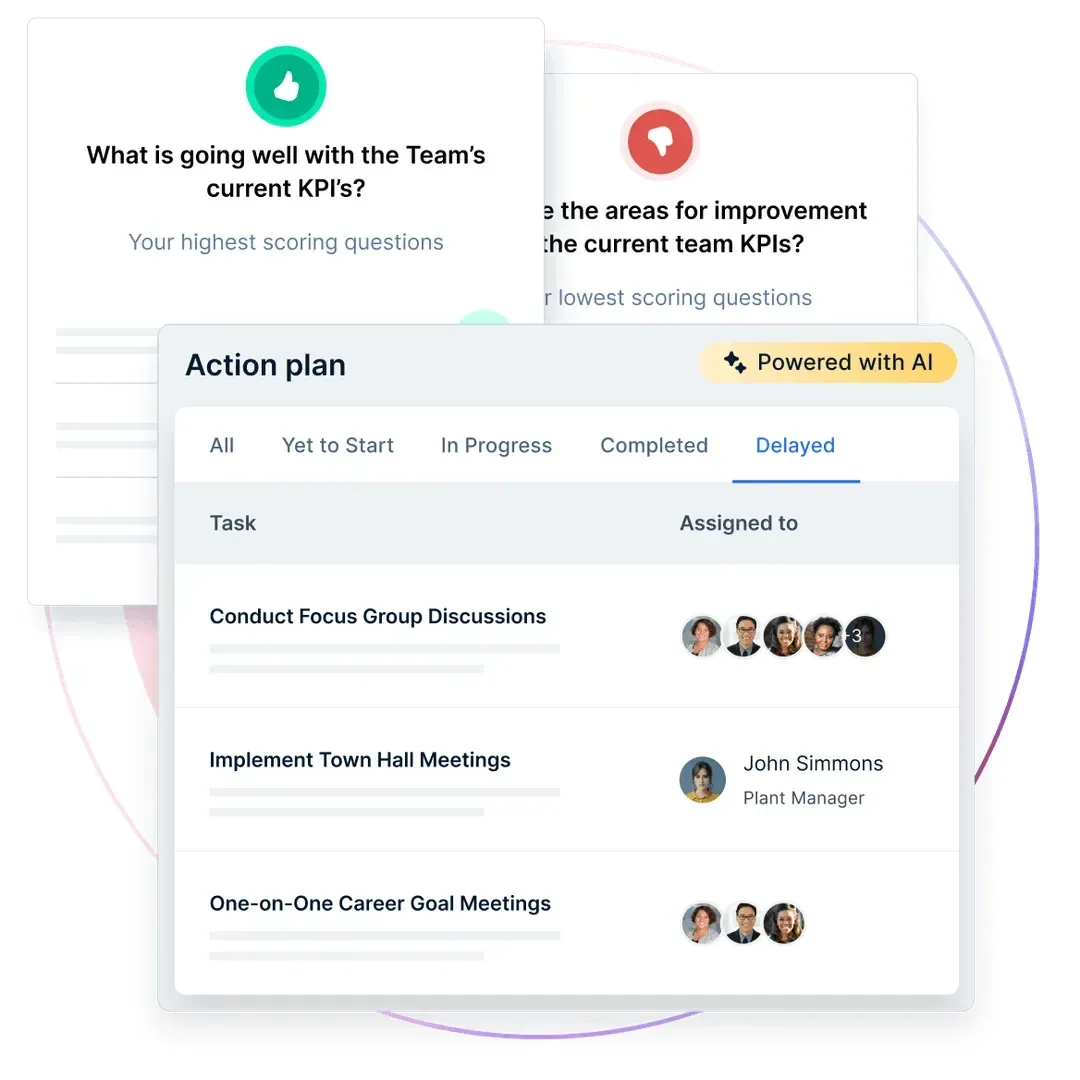
The results show up in participation and follow-through. In one Empuls continuous listening case study, a global enterprise of more than 10,000 employees raised survey participation from 39% to 88% and increased the share of teams implementing manager action plans from 24% to 72%. To see how Empuls compares with specific vendors, browse the Empuls comparisons, such as Empuls vs Qualtrics and Empuls vs Viva Glint.
Choose a partner, not just a platform
The best employee engagement survey vendors have one thing in common: they act as partners, helping you design the right survey, interpret the results and turn them into change. Use the scorecard, ask the hard questions and pilot with real managers before you commit.
Once you have chosen a vendor, plan your first cycle with this guide to running an employee engagement survey, and use the overview of employee survey types to decide what else your listening program needs.
Book your Empuls demo
Frequently asked questions
An employee engagement survey vendor provides the platform and expertise to measure engagement. That usually includes validated survey questions, distribution across email, chat and mobile, anonymity controls, analytics and benchmarks, comment analysis and tools for action planning. Many vendors also help you interpret results and coach managers on what to do next.
The best employee engagement survey tool depends on your size, budget and how much support you need with action. Enterprise suites suit large research-led programs, listening specialists offer strong survey science, and engagement platforms such as Empuls combine surveys with recognition and rewards. Compare them on action planning, anonymity, reach and total cost.
Employee engagement survey platforms are usually priced per employee per month or per year, and the total depends on headcount, survey types, languages and whether action planning, benchmarks and integrations are included. Ask each vendor for a full quote at your headcount, including add-ons and implementation, so you compare total cost rather than headline price.
A general survey tool can work for a small team running occasional surveys. Once you need reliable anonymity, trend data, benchmarks, segmentation by team and a way for managers to act, a dedicated vendor usually costs less than the HR time spent building and analyzing surveys manually, and it produces more trustworthy results.
Implementation time depends on your size and integrations. A simple pulse program can launch within days, while an enterprise rollout with HRIS sync, SSO, custom questions and manager training typically takes several weeks. Ask each vendor for a realistic timeline for an organization like yours and what they need from your team.
Look for independent certifications such as SOC 2 Type II and ISO 27001, encryption in transit and at rest, role-based access controls and clear data residency options. If you have employees in the EU, the vendor should sign a GDPR data processing agreement. Ask for the latest audit reports rather than relying on a logo.
Compare employee survey vendors fairly by sending each the same requirements, asking them to demo the same scenario and scoring them on a weighted scorecard. Include a manager's view of results, minimum reporting thresholds and total cost in every comparison, and pilot your top choice with real teams before you sign.





































































































































































































































































































































































































































































































































































