
Key Takeaways
A new employee onboarding checklist lists the tasks, owners and milestones that take a new hire from signed offer to fully productive team member.
Insight Global's 2025 survey found 22% of workers have left a job within 90 days, and 4 in 5 would stay longer with better onboarding.
Effective onboarding runs in phases: preboarding, the first day, the first week, the first 90 days and the rest of the first year.
Naming an owner for every task fixes the handoff between recruiting, HR, IT and hiring managers that often breaks onboarding.
Track 90-day retention, time to productivity and 30, 60 and 90-day survey scores to see whether onboarding works.
A new employee onboarding checklist is a step-by-step list of the tasks, owners and milestones that take a new hire from signed offer to fully productive team member. The best checklists run in phases, from preboarding and the first day through the first 90 days and the first year, so nothing important depends on memory. This guide gives you a ready-to-use checklist for every phase, the onboarding process steps to build your own and the metrics that show whether it works.
The first few weeks shape how new hires see your company and their role. A well-crafted employee onboarding checklist welcomes people and equips them with the tools, knowledge and cultural insight they need to thrive. Whether you run a startup or an enterprise, a clear onboarding plan creates an inclusive environment, reduces early attrition and strengthens your employer brand.
Why a structured onboarding process matters
Early turnover is expensive and, by many accounts, rising. In Insight Global's 2025 Employee Sentiment Report, a survey of 905 US workers, 22% said they had left a job within the first 90 days, often because of poor training, and 4 in 5 said they would stay longer in a role with better onboarding. Workers also said it takes 6 to 7 months to feel settled in a new role, far longer than most onboarding programs last.
22%
of workers have left a job
within the first 90 days (Insight Global, 2025)
4 in 5
workers
would stay longer with better onboarding (Insight Global, 2025)
61%
of HR leaders
say early attrition rose in the past year (Enboarder, 2025)
Why the first 90 days decide whether new hires stay
HR leaders see the same pattern. In Enboarder's 2025 HR Leader Survey of 1,000 HR leaders in the US, UK and Australia, 60.8% said early attrition had increased over the past 12 months, and only 36% described the handoff between recruiting, HR and hiring managers as seamless. A shared checklist with named owners is the simplest fix for that handoff.
What an employee onboarding checklist includes
An employee onboarding checklist is a systematic tool that lists the tasks, activities and milestones to complete during onboarding, with an owner and a deadline for each. It serves as a roadmap for HR, hiring managers and team leaders, so every new hire gets the same essentials no matter who is running their first week.
A complete checklist covers ten elements:
- Preboarding activities between offer acceptance and day one.
- Orientation and an introduction to the company, its mission and values.
- Job-specific training on tools, processes and products.
- Introductions to the team, key colleagues and a buddy.
- The employee handbook, policies and required compliance paperwork.
- IT setup, equipment and system access.
- Performance expectations and early goals.
- Ongoing support and mentorship.
- Regular check-ins and feedback, including onboarding surveys.
- Follow-up and evaluation of the onboarding program itself.
Onboarding is different from orientation. Orientation is a one-time event, usually on the first day, while onboarding is the full process that lasts months and ends only when the new hire is productive and feels they belong.
The complete new employee onboarding checklist by phase
This is the core checklist, organized into six phases with the owner for each task. Copy it into your HR system or a shared document, then adapt the tasks to your roles, locations and culture.
| Phase | Task | Owner |
|---|---|---|
| Preboarding | Send the signed offer, start date, schedule and dress code | HR |
| Preboarding | Collect tax, payroll and right-to-work documents digitally | HR |
| Preboarding | Order the laptop and equipment and create accounts | IT |
| Preboarding | Send a welcome message and first-week agenda | Hiring manager |
| Preboarding | Assign an onboarding buddy and tell the team who is joining | Hiring manager |
| Preboarding | Ship a welcome kit or schedule a welcome gift | HR |
| First day | Greet the new hire and give a workspace or virtual tour | Hiring manager |
| First day | Confirm equipment, logins and security setup work | IT |
| First day | Introduce the team and the buddy | Hiring manager |
| First day | Share mission, values and how the team works | Hiring manager |
| First day | Complete remaining paperwork and benefits enrollment steps | HR |
| First day | Post a team welcome and schedule a team lunch or coffee | Buddy |
| First week | Walk through role responsibilities and the first 30-day goals | Hiring manager |
| First week | Complete core tool, product and compliance training | HR and team lead |
| First week | Book introductions with key cross-functional partners | Hiring manager |
| First week | Assign a small, meaningful first task | Hiring manager |
| First week | Hold an end-of-week check-in | Hiring manager |
| First 90 days | Agree 30, 60 and 90-day goals and review them on schedule | Hiring manager |
| First 90 days | Hold weekly one-on-ones and buddy check-ins | Hiring manager and buddy |
| First 90 days | Run 30, 60 and 90-day onboarding surveys | HR |
| First 90 days | Recognize first wins publicly | Hiring manager and team |
| Months 3 to 6 | Assign stretch projects and agree a development plan | Hiring manager |
| Months 3 to 6 | Enroll in relevant training or mentoring | HR |
| Months 7 to 12 | Hold a formal performance review and set annual goals | Hiring manager |
| Months 7 to 12 | Celebrate the first work anniversary | HR and team |
The sections below explain what good looks like in each phase, so the people running onboarding understand why each task matters.
Preboarding checklist before day one
Preboarding covers the days or weeks between offer acceptance and the start date, and it is where many companies lose new hires through silence. These five tasks keep the new hire excited and make the first day about people rather than paperwork.
- Handle paperwork early: Collect contracts, tax forms and bank details digitally before day one. In the US, employers must complete Section 2 of Form I-9 within three business days of the first day of work for pay, so schedule document checks in advance.
- Prepare equipment and access: Order the laptop, create email and system accounts and test them, so the new hire can work from the first hour.
- Send a welcome and an agenda: A short message from the manager plus a first-week schedule removes uncertainty.
- Assign a buddy: Choose a peer who can answer everyday questions and introduce the unwritten rules.
- Plan a welcome gesture: A welcome kit or gift tells people they were expected. Our guide to onboarding gifts for new hires has ideas for every budget.
Make every new hire feel expected on day one
Automate personalized welcomes, gifts and team shoutouts for every joiner, synced from your HRIS.
Talk to our ExpertTrusted by 5,000+ companies
First day onboarding checklist
A warm, organized first day is the most visible part of onboarding. Seven actions shape it, and the first three, introductions, culture and role clarity, matter most for how the new hire feels when they log off.
1. Introduce the team and company culture
Start by introducing the new employee to their team. Arrange a short team meeting where everyone shares a brief introduction and their role, which helps the new hire feel included from the start. Then introduce the company culture: share the mission, vision and values and explain how they guide everyday work. This helps the new employee understand expectations and align their goals. Our guide to core values in the workplace shows how to make values concrete.
2. Provide an overview of job responsibilities
Give the new employee a clear overview of their responsibilities, the key tasks they will own and how their role fits within the team and the company. This sets expectations and shows why their work matters. Make sure they also have the tools, equipment and access permissions they need, which shows your commitment to their success and lets them start contributing quickly.
3. Provide orientation and training sessions
Design an orientation that covers the company's history, structure and products or services, then add training on the tools, software and processes the new hire will use. Spread sessions across the first weeks rather than packing them into one day, because information overload is one of the most common onboarding mistakes. Encourage questions, and let the buddy support learning between sessions.
4. Set clear performance expectations
Communicate the goals the new employee should work toward and give them measurable targets and milestones. Agree what success looks like at 30, 60 and 90 days, then check in regularly to discuss progress, give feedback and address challenges. Clear expectations keep people motivated and on track.
5. Plan ongoing support and feedback
Onboarding does not stop after the first few days. Two habits keep support going:
- A mentor or buddy: Pairing the new employee with an experienced colleague builds camaraderie and gives them someone to ask. Regular buddy check-ins help address challenges and smooth the move into the company culture.
- Regular check-ins: Schedule one-on-ones to gauge progress, address concerns and discuss goals and development. Listening actively and acting on feedback helps new hires feel valued.
6. Encourage social interaction
Encourage social connection to build belonging. Organize team lunches, outings or virtual events where people connect on a personal level, and create chances for cross-team collaboration and knowledge sharing. Social ties are often what keep people through a difficult first month.
7. Involve the new hire in team activities
Involve the new employee in team projects early. A meaningful first task lets them contribute their skills and ideas, which builds ownership and confidence, and involving them in decisions shows trust. Invite them to company-wide initiatives too, such as volunteering or innovation challenges, so they connect with the organization's purpose.
First 90 days: 30, 60 and 90-day milestones
The first 90 days turn a new hire into a contributor. Break the period into three milestones, each with its own focus, and review them in one-on-ones so the new hire always knows where they stand.
| Milestone | Focus | Signs it is on track |
|---|---|---|
| Day 30 | Learning: tools, processes, people and how work gets done | Completes core training, knows key contacts, delivers a first small task |
| Day 60 | Contributing: owning tasks and working more independently | Handles regular work with less help and shares ideas in meetings |
| Day 90 | Performing: meeting role expectations and setting longer-term goals | Hits agreed 90-day goals and has a development plan for the year |
Ask for feedback at each milestone with a short onboarding survey covering role clarity, training, tools, manager support and belonging. Our employee survey guide explains how lifecycle surveys fit with your other listening.
Months three to six: strengthening engagement and growth
As the new employee settles in, the focus shifts from learning the job to growing in it. These three strategies keep engagement high once the novelty of a new role wears off.
- Assign challenging projects: Give the employee projects that stretch their skills and match their interests. Meaningful work boosts motivation and lets them show what they can do.
- Encourage skill development: Support training programs, workshops or conferences that help them excel in their role and prepare for future growth.
- Continue mentorship: Keep the mentor or buddy relationship going, or move to a more senior mentor, so the employee always has guidance and a point of contact.
Months seven to twelve: integration and long-term growth
The second half of the first year confirms that the new hire is fully integrated and sets up their long-term growth. Three practices matter most here, with performance reviews first because they shape everything else.
- Performance reviews and goal setting: Hold a formal review, give clear feedback and set goals together that match the employee's aspirations and the organization's objectives. Revisit them regularly.
- Collaboration and team building: Organize team-building activities, workshops or retreats and encourage cross-department work, which strengthens relationships and morale.
- Recognition and rewards: Acknowledge contributions publicly and regularly, and celebrate the first work anniversary. Recognition reinforces that the employee's work is valued and motivates them to keep excelling.
How to create an employee onboarding checklist
If you are building a checklist from scratch or improving an old one, follow these eight onboarding process steps in order. The first three decide the content, and the last three keep it useful over time.
- Identify key onboarding activities: List every task, activity and milestone, including paperwork, training, introductions and provisioning of resources.
- Set the timeline and sequence: Decide the order of activities and a deadline for each, and allow realistic time for each one.
- Involve stakeholders: Work with HR, managers, IT, team leaders and recent hires to make sure nothing is missing.
- Customize for your organization: Tailor the checklist to your culture, industry, roles and locations, with variants for remote, hybrid and frontline hires.
- Add owners and descriptions: For each task, state what needs to be done, who is responsible, the deadline and any resources.
- Review and refine: Check that the sequence and timeline make sense and adjust based on stakeholder feedback.
- Test it: Run the checklist with a new hire or a small group and gather feedback on what worked and what was missing.
- Update it regularly: Review the checklist at least once a year and whenever tools, policies or the organization change.
New hire onboarding best practices for remote and hybrid teams
Remote and hybrid new hires miss the casual conversations that teach office newcomers how things work, so the checklist has to do more of that job. Five new hire onboarding best practices close the gap.
- Ship equipment early: Make sure the laptop and accessories arrive and work before day one.
- Over-communicate the schedule: Share a clear agenda with video links for every session in the first week.
- Make introductions deliberate: Book short video calls with teammates and key partners instead of relying on chance meetings.
- Use the buddy more: Schedule daily buddy check-ins in week one and at least weekly after that.
- Welcome people publicly online: A welcome post on the company feed or in Slack or Teams lets colleagues across locations say hello.
For frontline and deskless hires, keep paperwork and training mobile-friendly and build onboarding into shift schedules rather than adding it on top. Our guide to recognition for remote and frontline teams covers how to keep those employees connected after onboarding.
Onboarding metrics to track
Measure onboarding so you can improve it. These five metrics are simple to collect, and the first two are the clearest signs of whether your process works.
- 90-day and first-year retention: The share of new hires still with you at 90 days and one year.
- Time to productivity: How long it takes a new hire to reach agreed performance goals.
- Onboarding survey scores: New hire ratings of role clarity, training, tools, manager support and belonging at 30, 60 and 90 days.
- Checklist completion: The share of checklist tasks completed on time, by owner.
- Hiring manager satisfaction: Whether managers feel the new hire was ready to contribute when expected.
How Empuls makes onboarding an experience
A checklist covers what must happen; Empuls helps new hires feel welcome while it does. Because Empuls syncs with your HRIS, every new joiner is picked up automatically, so welcomes, gifts and check-ins happen on time for one hire or a thousand.
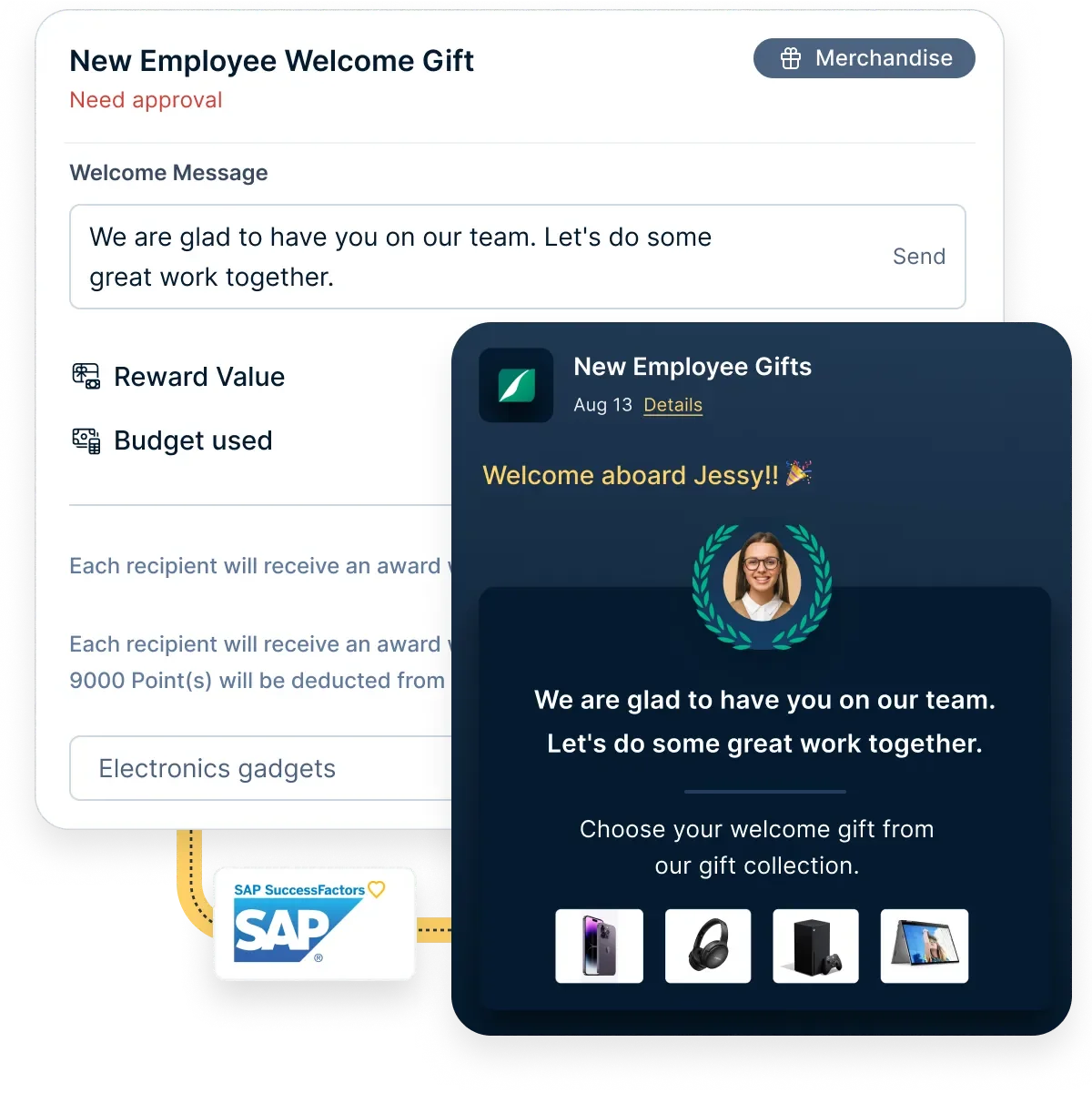
- Personalized day-one welcomes: Messages personalized with the new hire's name, team and role, with reward points credited on the joining date and delivery to email, Slack and Teams.
- Scheduled welcome gifts and kits: Queue a gift before day one, or let new hires pick from branded swag, curated collections and digital gift cards.
- A public welcome: Welcome posts publish to a New Joiners thread on the social feed so colleagues across teams can react and add notes.
- Feedback through the first year: Lifecycle surveys at key points show what new hires need, and recognition celebrates their first wins and milestones.
See Empuls onboarding, explore lifecycle surveys for 30, 60 and 90-day feedback and learn how Empuls recognition helps new hires feel valued from their first win.
Building an onboarding process that lasts
Effective onboarding builds a strong, committed workforce. A phased new employee onboarding checklist with clear owners makes sure every new hire gets a warm welcome, the right training, ongoing support and real integration into the team. Start with the checklist above, measure retention and survey scores at 90 days, and refine the process with every new hire. The investment pays back in engagement, faster productivity and people who stay.
Book your Empuls demo
Frequently asked questions
Employee onboarding integrates new employees into the organization. It familiarizes them with the culture, gives them the training and tools they need, sets clear performance expectations and connects them with colleagues. The goal is a positive early experience that leads to faster productivity, stronger engagement and higher retention.
Onboarding should last at least 90 days, and many organizations extend it through the first year. Orientation may take a day or a week, but new hires need longer to become productive and feel settled. Insight Global's 2025 survey found workers say it takes 6 to 7 months to feel settled in a new role.
A new hire onboarding plan should include a timeline, key activities, an owner for each task and the resources needed. It should cover preboarding paperwork and equipment, first-day introductions and orientation, role training, 30, 60 and 90-day goals, a buddy or mentor, regular check-ins, onboarding surveys and recognition of early wins.
The 5 C's of onboarding are compliance, clarification, culture, connection and check back. Compliance covers paperwork and policies, clarification explains the role and expectations, culture shares values and norms, connection builds relationships with colleagues, and check back means regular follow-up to see how the new hire is doing.
On the first day, a new employee should meet their manager, team and buddy, confirm their equipment and system access work, complete any remaining paperwork, learn the company's mission and values and get an overview of their role and first-week schedule. Ending the day with a short check-in helps answer open questions.
Good onboarding creates a positive first impression, builds belonging and sets clear expectations, all of which make new hires more likely to stay. Insight Global's 2025 survey found 22% of workers had left a job within 90 days, often because of poor training, and 4 in 5 said better onboarding would make them stay longer.
Common onboarding challenges include information overload, unclear job responsibilities, equipment and access delays, weak social integration, poor handoffs between recruiting, HR and managers, and too little training or follow-up. A phased checklist with named owners and regular check-ins addresses most of them.
Onboarding is shared. HR usually owns the process, paperwork and policies, IT owns equipment and access, the hiring manager owns role clarity, goals and check-ins, and a buddy helps with everyday questions and social connection. Naming an owner for each checklist task prevents things from falling through the gaps between them.





































































































































































































































































































































































































































































































































































