
Key Takeaways
An employee wellbeing program is a planned set of policies, benefits and activities that supports employees' physical, mental, financial and social health.
Only 34% of employees worldwide are thriving, according to Gallup's 2026 State of the Global Workplace, so most workforces have room to improve.
Job control, social support and manageable workloads shape wellbeing more than any perk, so fix how work is designed before adding apps or classes.
Simple health and wellness incentives that reward participation, with rewards employees choose, lift engagement without feeling like surveillance.
Measure participation, utilization, wellbeing scores, absence and regretted attrition from day one, and adjust the program every quarter.
An employee wellbeing program is a planned set of policies, benefits and activities that helps employees stay physically, mentally, financially and socially healthy. The programs that work start by fixing how work is designed, then add flexible support people choose for themselves, and they measure participation and outcomes instead of counting perks.
Every business wants its employees to be happy and healthy, and since people spend so much of their lives at work, employers carry a real share of that responsibility. This guide shows how to build an employee wellbeing program step by step, with a ready-to-use planning template, 20 corporate wellness ideas, health and wellness incentives that lift participation and the metrics that prove impact.
What an employee wellbeing program is
An employee wellbeing program is an organized effort by an employer to improve the whole health of its people, covering body, mind, money and relationships at work. Early wellness programs focused mainly on physical health, such as smoking cessation, gym discounts, healthy office snacks and step competitions. Most now include mental health support, such as an employee assistance program (EAP), counseling and stress reduction, along with financial and social support.
Healthy workplace initiatives are all about making a healthy life easier and cheaper to live, and about removing the parts of work that make people unwell. The table shows the five dimensions most programs now cover and typical initiatives in each.
| Dimension | What it covers | Typical initiatives |
|---|---|---|
| Physical | Fitness, nutrition, sleep, preventive care | Fitness challenges, gym memberships, health screenings, healthy food at work |
| Mental | Stress, anxiety, emotional resilience | EAP, therapy sessions, manager training, mental health days |
| Financial | Money stress, savings, emergencies | Earned wage access, financial coaching, emergency loans, discounts |
| Social | Belonging, friendships, community | Team activities, volunteering, peer recognition, employee groups |
| Work design | Workload, control, flexibility, fairness | Flexible schedules, realistic workloads, clear roles, fair reviews |
A wellbeing program is broader than a wellness program. Wellness usually means physical health activities, while wellbeing also covers how people feel about their work, their finances and their relationships. For the shifts shaping this space right now, read about the employee wellness trends for 2026.
Benefits of employee wellbeing programs
Employers invest in these programs because happy, healthy employees are more productive and engaged than employees who are tired, stressed, worried or sick. The scale of the problem is large, and the data shows most workforces are not yet thriving.
34%
of employees worldwide
are thriving in their overall lives (Gallup, 2026)
12B
working days lost a year
to depression and anxiety (WHO)
44%
of US employees
feel holistically healthy (MetLife, 2026)
$2.30
expected return
per $1 invested in employee health (MetLife, 2026)
Why employee wellbeing is a business issue
Gallup's State of the Global Workplace 2026 found that only 34% of employees worldwide are thriving, while global engagement fell to 20% and low engagement cost the world economy about $10 trillion in lost productivity. The World Health Organization estimates that 12 billion working days are lost every year to depression and anxiety, at a cost of US$1 trillion in lost productivity.
The upside is just as clear. In MetLife's 2026 Employee Benefit Trends Study, holistically healthy employees reported being 25% more productive and loyal and taking 10% fewer sick days, and employers expected an average return of $2.30 for every $1 invested in employee health. Here is what a well-designed program delivers:
- Fewer absences: Healthy employees miss work less often, which matters more as healthcare costs keep rising.
- Higher productivity: Lower stress and better sleep improve focus, problem-solving and the quality of everyday decisions.
- Stronger engagement: People who feel cared for put more effort into their work and stay committed through busy periods.
- Better retention: Employees are less likely to leave an employer that supports them, which cuts hiring and training costs.
- Easier hiring: A visible, credible wellbeing offer helps you stand out to candidates who compare the whole package, not just salary.
Three workplace factors that shape employee wellbeing
Three factors inside the employer's control do more for employee health than any perk: job control, social support and the motivation that comes from both. Job control comes first because it shapes the other two, and the WHO lists low job control among the main workplace risks to mental health.
1. Job control
One of the biggest factors in employee wellbeing, and in employee engagement, is how much discretion people have over what they do and how they do it. Limited job control is linked with poorer physical health, including heart disease, and with higher levels of anxiety and depression. This explains why senior people with demanding jobs often suffer fewer health effects than frontline staff: they have more say over their work.
You can raise job control without changing anyone's title. One health benefits company let the advocates who answer member calls solve complex problems on the spot instead of following a strict script. Retention, satisfaction and motivation improved, and members got faster answers, so everybody benefited.
2. Motivation
Job control also has a strong effect on how motivated people feel. When employees cannot shape their work, are forced to follow outdated procedures and are then blamed for poor results, or are set goals they cannot reach in their role, work feels chaotic and unpredictable. That is a powerful demotivator, because effort seems unlikely to be recognized or rewarded.
Ownership restores a sense of competence and accomplishment. For a deeper look at what drives effort, see this guide on what employee motivation is.
3. Social support
Friends and a strong social network protect health and reduce stress, including stress at work. Yet many workplaces erode social support. Forced ranking and fixed promotion quotas pit colleagues against each other, and a purely transactional culture, where work is exchanged only for money, leaves people isolated. Peer recognition, team rituals and shared causes rebuild those connections.
Why many workplace wellbeing initiatives fail
When most employers think about wellbeing, they focus on getting individuals to change their own behavior: quit smoking, drink less, exercise more or eat better. Often the real goal is to lower healthcare costs, and employees can tell the difference.
The evidence backs a different approach. A 2024 study by Oxford researcher William Fleming of more than 46,000 UK workers found that participants in individual-level programs, such as resilience training, wellbeing apps and relaxation classes, were no better off than non-participants, with volunteering the one exception. Fleming concluded that organizational changes to scheduling, management practices, resources and job design look more promising. The WHO makes the same recommendation: target working conditions first, then train managers.
The most common mistakes look like this:
- Treating symptoms, not causes: Unmanageable workloads, unfair practices, unclear roles and poor communication cause most stress. A gym discount will not fix them.
- Designing without asking: There is often a large gap between what leaders think employees need and what employees want. Expensive programs nobody asked for go unused.
- Punishing unhealthy behavior: Programs built to cut premiums by penalizing people feel like surveillance, and participation drops.
- Focusing only on physical health: Mental, financial and social needs are just as real, and often more urgent.
- Launching once and going quiet: If employees do not know a program exists or see no value in it, they will not join. Awareness and motivation need constant attention.
Burnout deserves its own plan, because it comes from chronic workplace stress rather than personal weakness. Read this guide on how to prevent burnout in the workplace for manager-level strategies.
Launch wellness challenges that people actually join
Run fitness challenges, wellbeing pulses and rewards from one platform, with participation data built in.
Talk to our ExpertTrusted by 5,000+ companies
How to build an employee wellbeing program in 8 steps
Building an employee wellbeing program takes eight steps, from listening to employees to measuring results and adjusting. The first two steps matter most, because a program designed around real needs and real causes of stress is the one people will use and thank you for.
1. Start by listening to employees
Instead of assuming, involve employees in the design. Use a short survey to learn what they value most, what stresses them and which kinds of support they would use. Repeat it with employee pulse surveys so you can see sentiment change over time, and ask managers what they see on their teams.
2. Identify root causes, not just symptoms
Look at workload, fairness, communication, role clarity and leadership quality before you buy any perk. Prioritize job control, autonomy and social support, which research links most closely to wellbeing. Burnout is not solved with a gym pass; it needs structural fixes such as realistic staffing and protected time off.
3. Set goals, budget and ownership
Write down two or three measurable goals, such as lifting participation to 50% or cutting unplanned absence by a set amount. Agree a per-employee budget, secure visible leadership support and name an owner, ideally backed by a small committee of wellbeing champions from different teams and locations.
4. Design a holistic, flexible program
Cover every dimension with a few strong initiatives rather than many weak ones:
- Physical wellness: Fitness benefits, step challenges and health screenings.
- Mental wellness: Therapy sessions, meditation apps and stress management workshops.
- Financial wellness: Salary advances, tax-saving benefits and early wage access.
- Lifestyle needs: Remote work support, childcare and learning allowances.
5. Make it inclusive and personal
Avoid one-size-fits-all choices. A 25-year-old renter, a parent of young children and a frontline worker on shifts need different things. Offer choice through flexible budgets, adapt options by role, location and life stage, and make sure remote and frontline employees get equal value.
6. Add incentives that reward healthy actions
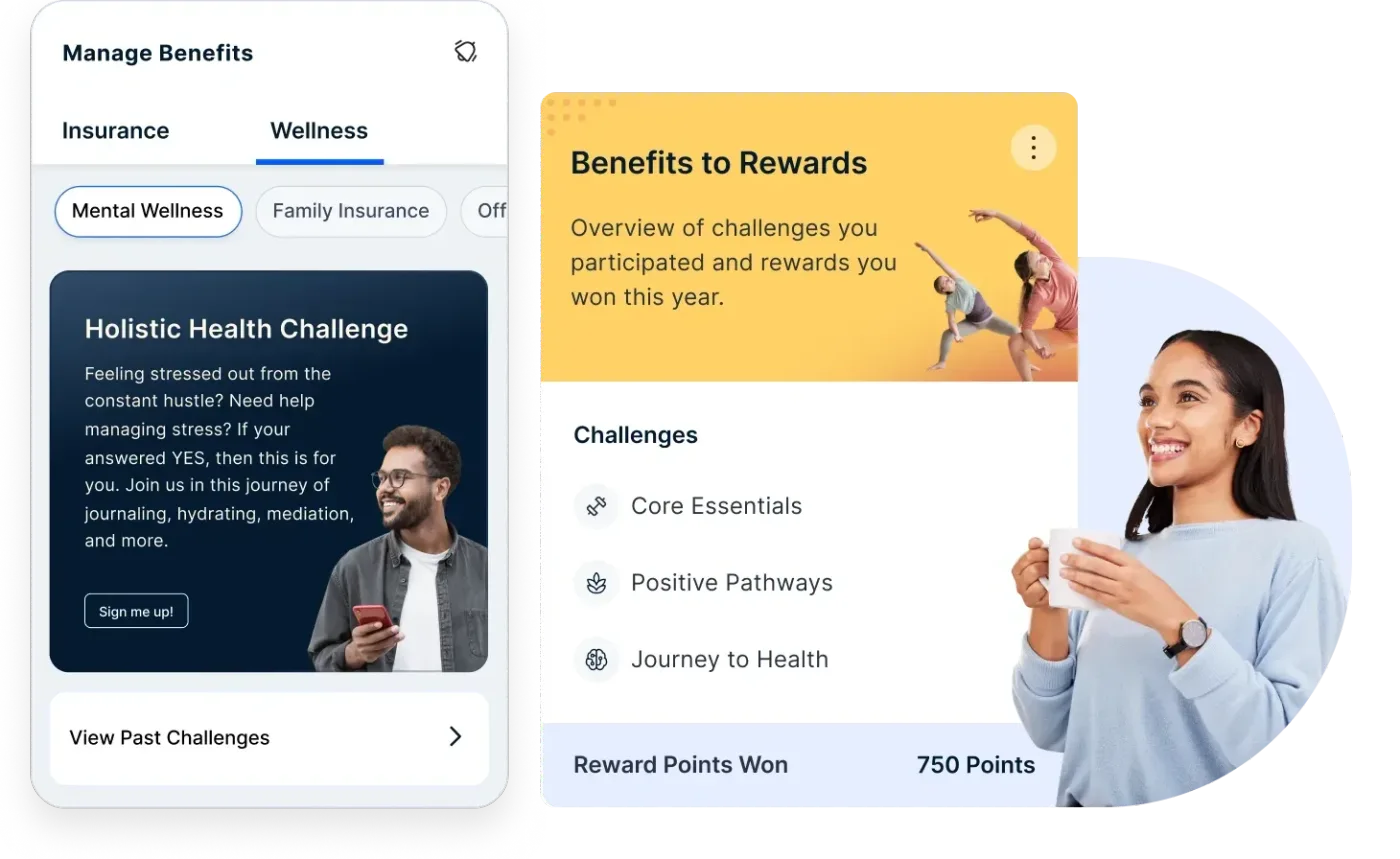
Incentives are the nudge that turns intention into action. Reward participation and progress, keep the rules simple and let people choose their own rewards. The incentives section below gives ideas by budget and a worked points example.
7. Communicate clearly and often
Even the best program fails without awareness. Announce it on the channels people actually use, such as chat tools, email, the intranet, posters and team huddles, and remind people at moments that matter, such as onboarding, busy seasons and open enrollment. Automate the routine touches, such as birthday wishes, service anniversaries and wellness nudges, so no moment is missed.
8. Measure impact and iterate
Track participation, sentiment and outcomes from the start, review them every quarter and change what is not working. Retire initiatives nobody uses and put the budget into what employees value.
Employee wellbeing program planning template
Use this template to turn the steps above into a one-page plan. Fill in one row per dimension, starting with the signal from your own data, and keep only the initiatives you can fund, promote and measure.
| Dimension | Signal to check first | Starter initiative | Incentive idea | Metric to track |
|---|---|---|---|---|
| Physical | Absence rate, screening uptake, survey energy scores | Quarterly team step or movement challenge | Points for weekly streaks, team prize for the top cohort | Participation rate, active weeks per person |
| Mental | Stress and burnout items in pulse surveys, EAP use | Manager mental health training plus therapy sessions | Points for completing a workshop or a no-meeting focus week | EAP and therapy utilization, stress score trend |
| Financial | Payroll advance requests, money stress in surveys | Earned wage access and financial coaching | Points for completing a budgeting course | Uptake, share reporting money stress |
| Social | Belonging scores, new-hire connection | Volunteering day and peer recognition | Team rewards for volunteering hours | Volunteering participation, belonging score |
| Work design | Overtime hours, after-hours messages, workload items | Flexible schedules and meeting-free blocks | Recognition for teams that cut after-hours work | Overtime trend, workload score, regretted attrition |
Then run your launch on a 90-day timeline:
- Days 1 to 15: Run the baseline survey, pull absence and attrition data and agree goals and budget with leadership.
- Days 16 to 30: Choose one initiative per dimension, recruit champions and set up the incentive rules.
- Days 31 to 45: Launch with a clear message from a senior leader and a first challenge everyone can join.
- Days 46 to 75: Send short reminders, celebrate early wins publicly and fix any access problems quickly.
- Days 76 to 90: Re-survey, compare against the baseline and decide what to keep, change or drop for the next quarter.
20 corporate wellness ideas for the workplace
The 20 workplace wellness ideas below are grouped by dimension, so you can pick one or two from each group. Start with the mental health and work design ideas, which tackle the causes of stress, then add the physical, financial and social employee wellness activities that make the program visible and fun.
Mental health and stress ideas
- Mental health counseling: Getting help can be hard in many places. Confidential access to licensed counselors or therapy sessions is popular and compassionate.
- Employee assistance program: An EAP gives confidential help with personal or work problems, including stress, anxiety, depression, substance use and major life events.
- Stress management workshops: Teach practical techniques and make self-care part of the working week, not something people squeeze in after hours.
- Yoga and meditation classes: On-site or virtual sessions help people relax, and regular practice supports heart health and lower back comfort.
- Manager training: Train managers to spot distress, listen well and adjust workloads. The WHO recommends this as one of the most useful workplace actions.
Work design and flexibility ideas
- Flexible work schedules: Control over when and where people work is one of the most valued wellbeing benefits, because it helps them balance work and life.
- Meeting-free focus time: Protect blocks of time each week for deep work and recovery.
- Parental and caregiver support: Paid parental leave, childcare allowances and backup care help working parents and carers stay, and they tend to be very loyal in return.
- Wellness and nap spaces: A quiet room for rest, prayer or a short reset is one of the simplest wellness ideas for the office, giving people a place to recharge during long days.
Physical health ideas
- On-site or virtual fitness classes: Desk jobs mean long hours of sitting. Classes during the workday help people move and break up the routine.
- Gym membership discounts: Partner with local gyms or fitness networks so employees can choose a location near home or work.
- Health screenings: Regular on-site screenings find health risks early and point people to the right support.
- Wellness challenges: Step, hydration, sleep or gratitude-journal challenges create healthy habits and a little friendly competition.
- Healthy food and nutrition education: Swap candy for healthy snacks, which avoid the afternoon sugar crash, and run healthy eating and meal-planning workshops.
- Smoking cessation support: A tobacco-free policy plus access to quit tools and coaching helps people break a hard habit.
Financial wellness ideas
- Early access to earned wages: Letting employees withdraw part of their earned salary before payday helps them handle emergencies without high-interest loans.
- Tax-saving flexible benefits: Meal, fuel, telecom or books allowances can reduce taxable income in markets such as India and increase take-home pay.
- Employee discount program: Savings on groceries, fitness, travel and healthcare stretch every paycheck. This guide explains how to run an employee discount program.
Social and community ideas
- Volunteer opportunities: Paid volunteering days and team service projects build bonds and a sense of purpose. They were also the one intervention with a measurable wellbeing benefit in the Oxford study. See these ideas for workplace giving.
- Outdoor activities and wellness fairs: Hikes, bike rides, team picnics and health fairs combine movement, learning and social time. Let employees vote on the activity to lift turnout.
Employee wellbeing program examples from well-known employers
These employee wellbeing program examples show different models you can borrow, from a large campus fitness center to a personal reimbursement budget. Each works because it fits the company's people and culture, not because of its size.
| Employer or model | What they offer | What to borrow |
|---|---|---|
| Nike | A large on-campus fitness center at its Oregon headquarters, plus engagement and wellbeing surveys for workers in its supply chain | Ask people about their working conditions, not only their fitness |
| Expedia Group | A wellness and fitness reimbursement employees spend on gym memberships, classes, equipment and, in some locations, wellbeing resources | Give a personal budget and let people choose |
| Campus amenities such as fitness centers, healthy food and spaces to rest | Make the healthy choice the easy choice during the workday | |
| Patagonia | On-site childcare at its headquarters and a culture that encourages time outdoors | Support caregivers and protect time to recharge |
| Remote-first software companies | Home office budgets and open conversations about mental health, including time off before people hit a crisis | Normalize talking about mental health and taking preventive time off |
| Healthcare employers | Wellness gift cards and discounts tied to screenings and education webinars | Pair education with a small reward for action |
Health and wellness incentives that drive participation
Health and wellness incentives are rewards, such as points, gift cards, wellness gear, premium discounts or paid time off, that an employer offers to encourage healthy actions. They answer the third big participation problem: employees know about the program and see its value but still need a reason to start.
Employee wellness incentives work best when they reward effort and progress rather than health outcomes people cannot fully control. In the US, rewards tied to health outcomes in a group health plan must follow the HIPAA nondiscrimination rules for wellness programs, as amended by the Affordable Care Act,, which generally cap such rewards at 30% of the cost of coverage, or 50% for tobacco programs. Participation-based rewards, such as points for joining a challenge, are simpler to run and feel fairer. Well-chosen wellness rewards for employees deliver several benefits at once:
- Higher participation: A clear reward gives hesitant employees a reason to join.
- Camaraderie: Shared challenges let colleagues spend time together on something other than work.
- Healthy competition: Leaderboards and team goals motivate people who would otherwise stay on the sidelines.
- A healthier culture: Rewards make healthy habits visible and normal instead of forced.
Wellness incentive program ideas by budget
Workplace health incentives do not need to be expensive. Small, frequent rewards keep momentum, and bigger rewards suit milestones or team wins.
| Budget per reward | Wellness incentive ideas | Best used for |
|---|---|---|
| Under $100 | Water bottles, yoga mats, resistance bands, grocery or health food gift cards, cooking lessons, a self-care kit, tickets to a charity run, a wellness app subscription | Weekly streaks, joining a challenge, completing a workshop |
| $100 to $300 | Running shoes, a wearable fitness tracker, gym membership months, spa vouchers, hiking gear, healthy cookware | Monthly goals, finishing a multi-week program |
| Over $300 | Home exercise equipment, a wellness retreat, a travel voucher for an active weekend, an extra paid day off | Annual achievements, top team prizes |
How to design a wellness incentive program
The best incentive programs are simple to understand and easy to earn. Follow these five steps:
- Choose the behaviors to reward: With your wellbeing committee, list the healthy actions that matter most, such as screenings, activity, workshops or volunteering. Start small so everyone has a fair chance to earn.
- Assign point values by importance: Rank the actions and give the most points to the most important ones. Resist complex formulas; people should be able to explain the rules in one sentence.
- Let employees pick their rewards: Preferences differ, so offer a catalog of options rather than one fixed prize.
- Mix small and big rewards: Frequent small rewards build habits, while benefits-based rewards, such as extra time off or premium discounts, mark bigger milestones.
- Track engagement and redemption: Monitor who joins, how consistently they take part and what they redeem, and use that data to adjust the program.
Here is a worked example for a 1,000-person company with a quarterly budget of $15 per employee, or $15,000:
| Healthy action | Points | Why this weight |
|---|---|---|
| Complete an annual health screening | 1,000 | Highest priority: finds risks early |
| Attend a stress management or financial wellness workshop | 500 | Builds skills that last |
| Hit a weekly activity goal (for example, 35,000 steps) | 100 per week | Builds a habit; up to 1,300 a quarter |
| Volunteer for a half day with your team | 400 | Supports purpose and connection |
At 100 points per dollar, an employee who completes everything earns about $32 in a quarter. If 45% of employees take part and average two-thirds of the available points, your spend is roughly $9,600, leaving room for team prizes. Adjust point values each quarter based on what people actually do.
How to measure the impact of your wellbeing program
You cannot improve what you do not measure, and leadership will ask what the investment returns. Track a mix of activity, experience and business metrics:
| Metric | How to calculate it | What it tells you |
|---|---|---|
| Participation rate | Employees who took part ÷ eligible employees × 100 | Whether people know about and want the program |
| Benefit utilization | Employees using a benefit (EAP, therapy, gym) ÷ eligible × 100 | Which offerings deliver value and which are invisible |
| Wellbeing or stress score | Average score on wellbeing items in pulse surveys | Whether people feel better over time |
| Unplanned absence | Unplanned absence days ÷ scheduled days × 100 | The health effect on attendance |
| Regretted attrition | Regretted leavers ÷ average headcount × 100 | Whether wellbeing helps you keep good people |
| Cost per participant | Total program cost ÷ participants | Whether spend is efficient |
Compare participants with non-participants where you can, and report trends by team and location, not just company averages. A rising stress score in one department is an early warning that a workload or manager issue needs attention.
How Empuls helps you run an employee wellbeing program
Running wellness, benefits, challenges and rewards across several vendors makes participation hard to track and harder to grow. Empuls brings them into one platform, so HR can launch programs quickly and employees find everything in one place.
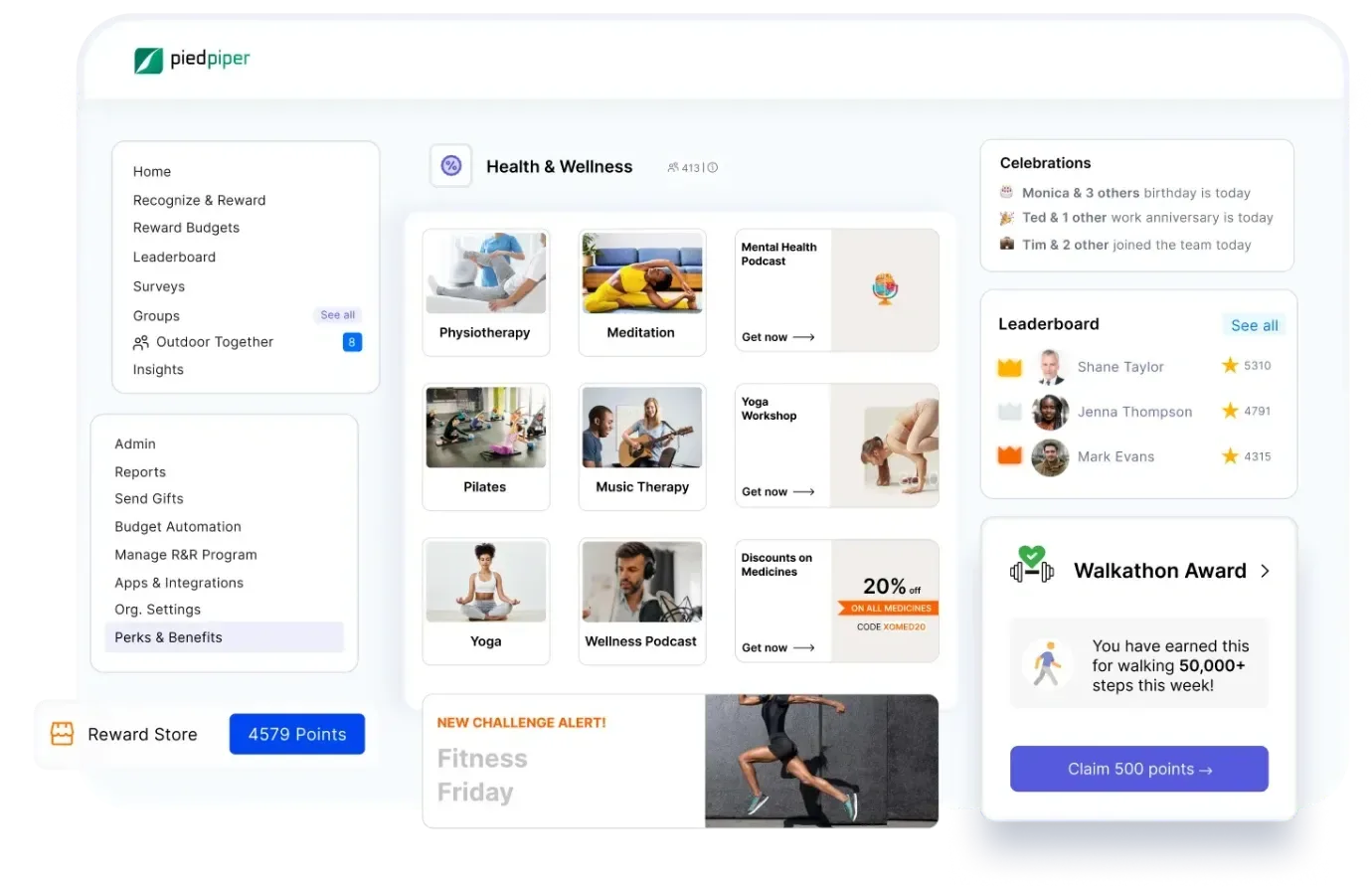
- Wellness programs and partners: Empuls Wellness connects employees to a curated network of fitness, mental health, diagnostics and care partners, with wallets you configure by cohort through the corporate wellness program.
- Fitness challenges with automatic rewards: Fitness challenges sync with common wearables and phone apps, run leaderboards and streaks and pay out rewards when goals are hit.
- Wellbeing pulse and analytics: The Mood-o-Meter daily check-in and wellbeing reports show trends by team and location, so you spot stress early. Explore the employee wellbeing solution.
- Flexible budgets and rewards: Lifestyle accounts and a global rewards catalog let employees spend on the wellness options they value.
Building a wellbeing program employees value
An effective employee wellbeing program is not a checkbox exercise. It is an investment in people that starts with fixing the work itself, adds flexible support across physical, mental, financial and social health and uses incentives and clear communication to drive participation.
Start small with the planning template, measure from day one and adjust every quarter. When employees feel healthy, supported and connected, they bring their best selves to work. For the financial side of wellbeing, read this guide to employee financial wellbeing.
Book your Empuls demo
Frequently asked questions
An employee wellbeing program should include support for physical, mental, financial and social health, plus changes to how work is designed, such as manageable workloads and flexibility. Common elements are an EAP or therapy access, fitness challenges, health screenings, financial wellness tools, volunteering and manager training, backed by clear communication, simple incentives and regular measurement.
Employee wellness usually refers to physical health activities, such as fitness, nutrition and screenings. Employee wellbeing is broader: it also covers mental health, financial security, social connection and how people feel about their work. A wellbeing program therefore includes wellness activities but also looks at workload, job control, fairness and support from managers.
There is no single benchmark, so start from your goals and headcount. Many employers set a per-employee annual budget that covers a core resource such as an EAP, one or two company-wide challenges and a flexible allowance. Starting small, measuring participation and outcomes and then shifting money to what employees use is more effective than a large upfront spend.
Increase participation by asking employees what they want, offering choice, communicating on the channels they already use and adding simple rewards for taking part. Make activities easy to join during the workday, include remote and frontline staff, let teams compete together and celebrate progress publicly. Senior leaders taking part visibly also signals that it is safe to join.
Good health and wellness incentives are rewards employees value and can earn fairly, such as points redeemable for a catalog of gifts, fitness gear, wellness app subscriptions, gym months, spa vouchers or an extra day off. Reward participation and progress rather than health outcomes alone, keep the rules simple and let employees choose their own rewards.
They can be, but design matters. A 2024 Oxford study of over 46,000 UK workers found that individual-level programs such as apps and resilience classes showed little benefit on their own, while volunteering did. Programs that also improve working conditions, manager support and flexibility, and that are measured and adjusted, are far more likely to work.
HR or a people team usually owns the employee wellbeing program, with a named lead and budget. It works best with visible support from senior leaders, a committee of wellbeing champions from different teams and locations and active involvement from managers, who control workloads and day-to-day stress. Finance and benefits teams help with budgets and vendors.
Measure ROI by comparing program cost with changes in unplanned absence, regretted attrition, healthcare claims and productivity indicators, alongside participation and wellbeing scores. Compare participants with non-participants where possible and track trends over at least a year. MetLife's 2026 study found employers expect about $2.30 back for every $1 invested in employee health.





































































































































































































































































































































































































































































































































































