
Key Takeaways
Employee behaviors to recognize are the observable actions and habits you want repeated, such as adaptability, integrity, teamwork, ownership and resilience.
Recognizing behaviors, not only results, tells employees how good work gets done and shapes culture faster.
Gallup and Workhuman found that well-recognized employees were 45% less likely to leave after two years, yet only 22% say they get the right amount of recognition.
Effective recognition is specific, timely, tied to a company value and matched in size to the effort behind it.
Clear recognition criteria and peer-to-peer recognition help catch invisible work and keep recognition fair across the team.
The employee behaviors to recognize are the everyday actions that drive results and reflect your values: adaptability, integrity, teamwork, ownership, initiative and resilience, among others. Recognize them specifically and soon after they happen, and you get more of them. This guide lists 15 behaviors to reward at work, what each looks like in practice and a ready-to-use recognition matrix with sample messages.
Recognition is a fundamental craving of every human being. We all want to be acknowledged and appreciated for our contributions to any given cause, and employees are no exception. In today's workplace, recognizing the right actions and attitudes has a direct impact on morale, motivation and performance.
Employee behaviors to recognize are the observable actions, habits and attitudes that an organization wants to see repeated, as opposed to outcomes alone such as hitting a target. Recognizing behavior tells people how good work gets done, not just that it got done, which is why behavior-based recognition shapes culture faster than results-based rewards.
Why recognizing behaviors matters as much as recognizing results
The benefits of employee rewards and recognition are numerous. They range from increased productivity and better employee engagement to a calmer, lower-tension work environment. When the recognition names a specific behavior, those benefits compound, because people learn exactly what to repeat.
The data shows how much is at stake. In Gallup and Workhuman research published in 2024, only 22% of employees said they get the right amount of recognition, and well-recognized employees were 45% less likely to have left after two years. Employees whose recognition met at least four of Gallup's five pillars of strategic recognition were nine times as likely to be engaged as those whose recognition met none.
Frequency matters too. A Gallup study of more than 20,000 workers found that 61% of employees who get feedback and recognition from their manager at least weekly are engaged, compared with 38% of those who get weekly feedback but less frequent recognition. With global engagement at just 20% in Gallup's 2026 State of the Global Workplace report, recognizing the right behaviors is one of the cheapest levers you have.
Turn your values into everyday recognition
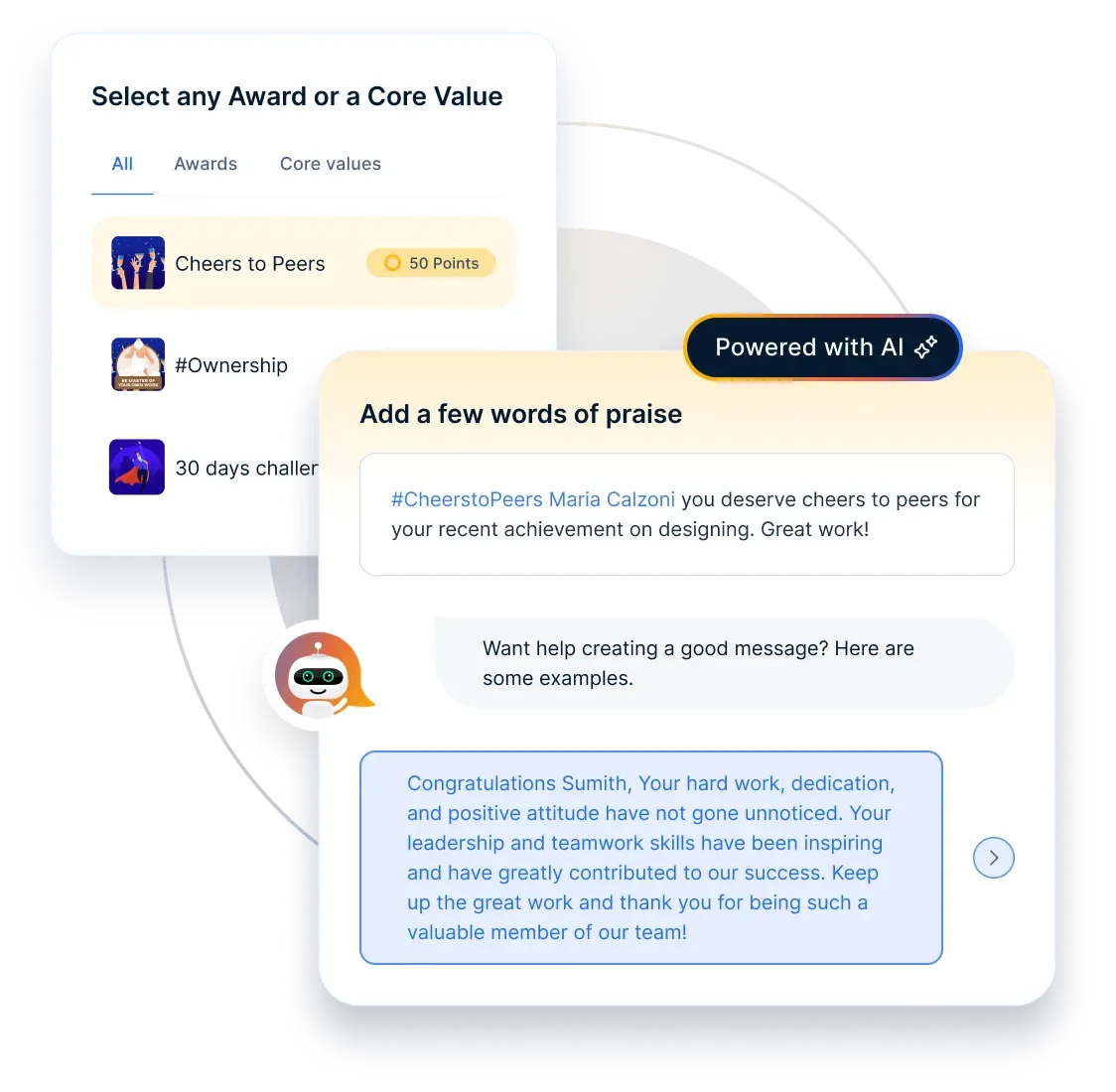
Let employees recognize peers for specific behaviors and core values, with AI help writing every message.
Talk to our ExpertTrusted by 5,000+ companies
15 employee behaviors to recognize at work
Here is the list of 15 employee behaviors you should recognize and reward, each with a short note on what to look for. The first five (adaptability, integrity, teamwork, learning and work ethic) apply to every role, so start there if you are building recognition criteria for the first time.
1. Adaptability
Organizations should recognize and appreciate employees who adapt to changing styles and roles and still perform efficiently. Adaptability is a valuable skill, especially for startups or small businesses where people cover several areas instead of one specialty. An adaptable employee is not afraid of change or a sudden shift in lanes in the middle of a project.
Recognize it when: someone picks up a new tool, process or role quickly after a reorganization, a system change or a shift in priorities, and keeps quality high while doing it. Adaptability is a gem, and companies should reward it in every employee who displays it.
2. Honesty and integrity
It is always a good thing to trust an employee, and it is even better to let them know they are trusted. An employee with integrity will do the right thing for the business even in the manager's absence, and even when it does not benefit them personally. Let these employees know you appreciate the trait and want to nurture it.
Recognize it when: someone flags their own error early, raises a compliance or safety concern, or gives a customer an honest answer that costs a short-term sale.
3. Teamwork
Many workplaces feel competitive, with colleagues measuring themselves against each other. That makes employees who collaborate well especially valuable. Teamwork is when an employee does not see themselves as the only expert, but works with others to complete tasks quickly and well.
Recognize it when: someone shares credit, helps a teammate hit a deadline or connects two teams that should have been talking. Praise it publicly or with a reward, because public recognition encourages other employees to do the same.
4. Willingness to learn and improve
Employees who seek out feedback, build new skills and apply them keep your organization ready for what comes next. A willingness to learn matters more than ever as roles change with AI and automation, and it is often the trait that separates a good hire from a future leader.
Recognize it when: someone completes a certification, teaches the team what they learned, asks for feedback and acts on it, or volunteers for a stretch assignment. Recognizing learning signals that growth is valued, not just output.
5. Good work ethic
An employee with a strong work ethic accomplishes tasks on time and efficiently, and this deserves recognition. A good work ethic helps the business keep up with a competitive market, because these employees find faster ways to complete tasks and use resources well.
Recognize it when: someone consistently delivers to a high standard without reminders, improves how a recurring task gets done or keeps their commitments during a demanding period. Recognize the consistency, not just long hours, so you do not reward burnout.
6. Humility
Humility is a desirable trait in an employee. It is the bedrock of a team player who is always ready to learn, and it makes a company run more smoothly. Humble employees share credit, accept that they can be wrong and listen before they argue.
Recognize it when: someone admits a mistake openly, credits the people who helped them or changes their position after hearing a better idea. Recognizing humility nurtures a culture of continuous learning and openness.
7. Confidence
A confident employee spreads positivity when the team faces a difficult task, and that often leads to the task being completed successfully. People show confidence in their attitude to tricky work and in their composure when the stakes are high.
Recognize it when: someone presents to leadership or a key client with composure, makes a well-reasoned call under pressure or speaks up with a different view. Appreciate this behavior so that the spark does not die out, while keeping the focus on sound judgment rather than bravado.
8. Dependability
It is important to recognize and appreciate a dependable employee. A trustworthy employee can be called on when it matters and delivers without fail.
A responsible employee does not need close supervision and can be trusted with sensitive and essential assignments. Such employees keep the company running even when the leader or supervisor is absent. Recognize it when: someone covers a critical shift, owns a recurring process that never breaks or is the person colleagues go to in a crisis.
9. Proactiveness
A proactive employee is a problem solver who acts instead of reacting. They read what is happening in the market or with customers and act to keep the company ahead, even before being asked.
Some service teams, for example, contact customers about a known issue before the customer complains, which turns a likely complaint into loyalty. Employers should learn to spot proactive employees and appreciate them. Recognize it when: someone anticipates a problem and fixes it before it reaches a customer or a deadline.
10. Communication
Few things are as satisfying as working with someone who communicates ideas, thoughts and feelings clearly. Effective communication keeps the business running smoothly, so it is wise to reward and recognize employees who communicate well with colleagues, managers and customers.
Recognize it when: someone writes the update that saves everyone a meeting, explains a complex topic simply or handles a difficult conversation with care. For more on the skill itself, see this guide to active listening.
11. Initiative
Employees who take initiative do not wait to be told what to do. They identify opportunities, take ownership and act independently to add value to the business.
Whether it is suggesting a process improvement, volunteering for a project or anticipating problems before they arise, initiative deserves recognition. Recognize it when: someone starts something useful that was not in their job description. Appreciating this behavior inspires others to step forward with confidence and creativity.
12. Emotional intelligence
In today's workplace, emotional intelligence is as important as technical skill. Employees who show empathy, self-awareness and the ability to manage their emotions contribute greatly to team harmony and show leadership potential.
Recognize it when: someone calms a tense meeting, notices a struggling colleague and offers support, or gives hard feedback kindly. Recognizing emotional intelligence promotes a culture of understanding, respect and resilience, especially in high-stress environments.
13. Ownership and accountability
Employees who own their work take full responsibility for their tasks and outcomes, good or bad. They follow through on commitments, admit mistakes and look for solutions instead of blame.
Recognize it when: someone closes the loop on a problem end to end, or reports a miss along with a plan to fix it. Recognizing this trait reinforces a culture where accountability is valued over blame, and where growth is rooted in responsibility and trust.
14. Creativity and innovation
Creativity is not just for designers or marketing teams. It is an essential behavior in every function. Employees who think differently, solve problems in new ways or improve existing processes bring fresh energy to the workplace.
Recognize it when: someone tests a new approach, builds a template others reuse or finds a cheaper, faster way to get a result. Organizations that reward creative thinking, including smart experiments that did not work, unlock hidden potential and encourage innovation.
15. Resilience
In the face of setbacks, change or adversity, resilient employees bounce back stronger. They stay focused, motivated and optimistic under pressure.
Recognize it when: someone recovers well from a lost deal, a failed launch or a tough quarter and helps the team regroup. Recognizing resilience boosts individual morale and strengthens the team's collective spirit, especially during periods of uncertainty or transformation.
Positive workplace behaviors that are easy to overlook
Some of the most valuable positive workplace behaviors happen out of sight, so they rarely make it into a shout-out. Watch for these four in particular, because recognizing them spreads credit beyond the most visible people and helps keep recognition fair.
- Invisible work: Fixing a broken process, documenting a workaround or cleaning up data that everyone else relies on.
- Helping new hires: Answering questions, pairing on first tasks and making a newcomer feel welcome.
- Recognizing others: Employees who regularly appreciate colleagues are culture carriers, and thanking them keeps the habit alive.
- Raising risks early: Speaking up about a problem that is uncomfortable to raise protects the business and deserves credit.
If the same few names keep getting recognized, review who is missing. This guide to preventing bias in recognition programs shows how to spot and fix the gaps.
Employee recognition criteria: a behavior recognition matrix
Clear employee recognition criteria answer the question of what to recognize employees for, so managers and peers recognize consistently. Use the matrix below as a starting template: keep the behaviors that match your values, adjust the criteria and copy the sample messages into your recognition tool.
| Behavior | Recognition criteria (what qualifies) | Sample recognition message | Best format |
|---|---|---|---|
| Adaptability | Took on a new role, tool or process and kept quality high | Thanks for picking up the new billing system in a week and keeping every invoice on time. | Manager shout-out |
| Honesty and integrity | Raised an error, risk or conflict of interest openly | Flagging that pricing error before it went out saved us a lot of trust. Thank you. | Private note plus manager award |
| Teamwork | Helped another person or team succeed | You jumped in to help support clear the backlog. That is what one team looks like. | Peer recognition |
| Willingness to learn | Built a new skill and applied or shared it | Congratulations on the certification, and thanks for running the team session on it. | Peer recognition plus points |
| Work ethic | Delivered consistently to a high standard | Your weekly reports have been accurate and on time all quarter. It does not go unnoticed. | Manager award |
| Humility | Shared credit or openly admitted a mistake | Thank you for crediting the whole team in the client review. | Peer recognition |
| Confidence | Handled a high-stakes moment with composure | You handled the board's tough questions with calm and clarity. | Manager shout-out |
| Dependability | Covered a critical need or owned a process reliably | Thanks for covering the weekend release. We could relax because you were on it. | Spot award |
| Proactiveness | Prevented a problem before it happened | Reaching out to those accounts before renewal kept three customers with us. | Spot award |
| Communication | Made information clear and saved others time | Your launch brief answered every question before anyone asked. | Peer recognition |
| Initiative | Started something useful outside the job description | The onboarding checklist you built on your own is now used by every team. | Nomination for a quarterly award |
| Emotional intelligence | Supported a colleague or eased a tense situation | Thank you for how you handled that difficult call with care and patience. | Private note from manager |
| Ownership | Closed a problem end to end or owned a miss with a fix | You owned the outage, found the cause and shared the fix. That is real ownership. | Manager award tied to values |
| Creativity | Found a new, better or cheaper way to do the work | Your new template cut our report time in half. | Spot award plus points |
| Resilience | Recovered well from a setback and helped others regroup | After the lost deal, you rallied the team and won the next two. Thank you. | Manager shout-out |
Notice that every sample names the specific action and its effect. That is what turns a generic thank-you into recognition people remember and repeat. For more phrasing ideas, see these employee appreciation ideas, and if you want named awards for these behaviors, browse these employee award titles.
How to recognize behaviors so they are repeated
Knowing which behaviors to reward at work is half the job. These six practices decide whether recognition actually changes behavior, and the first two, being specific and being timely, matter most.
- Be specific: Name the action and its impact. "Great job" is pleasant, but "your checklist cut onboarding time by a day" tells everyone what to repeat.
- Be timely: Recognize the behavior soon after it happens, ideally the same week, so the link between action and appreciation is clear.
- Tie it to a value: Tag recognition with the company value it reflects. A values-based recognition program turns abstract core values in the workplace into visible examples.
- Match the reward to the effort: A quick peer shout-out suits everyday teamwork, while a project that changed a quarter deserves a manager award or points.
- Open it to peers: Managers cannot see everything. Peer-to-peer recognition catches the invisible work and spreads credit more widely.
- Review the data: Check which behaviors and values are recognized most and least, and who is being missed, every quarter.
For a full program design, from budgets to launch, see this guide to building an employee recognition program, and for the habits that make it last, read about creating a culture of recognition.
How Empuls helps you recognize the right employee behaviors
Recognizing employee behaviors becomes far more effective when it is consistent, timely and tied to your company's values. Empuls recognition is an employee rewards and recognition platform that turns everyday appreciation into a culture-building habit, whether that is a quick thank-you, a major win or rewarding someone for living a company value.
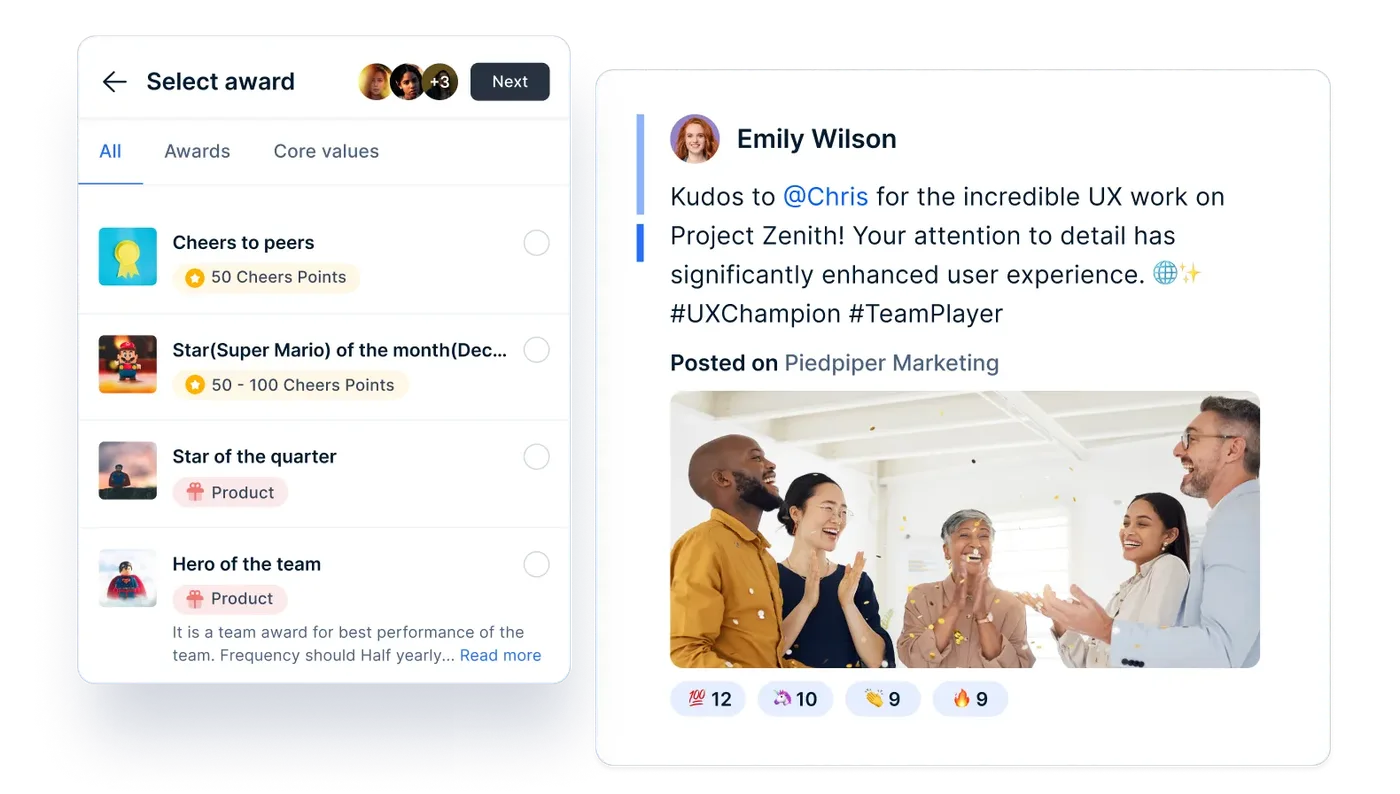
- Recognition in every direction: Peers, managers and cross-functional teammates can appreciate each other in the moment, with awards and points you configure.
- Tie recognition to core values: Employees pick an award or a core value when they recognize someone, so every moment reinforces a specific behavior.
- AI recognition coach and AI-assisted messages: AI suggests who to appreciate next based on past recognition and helps turn a few words into a specific, polished message.
- Social recognition feed: Recognition is celebrated publicly on the social intranet and Wall of Fame, where colleagues react and comment.
- Rewards catalog: Points convert into gift cards, experiences, merchandise and donations, and spot awards handle instant in-the-moment wins.
- Track recognition trends: Reports and analytics show who is recognized, for which values and how often, so leaders can reinforce the right behaviors.
Recognize the behaviors you want to see more of
Employee recognition goes far beyond celebrating milestones or meeting KPIs. It is about acknowledging the everyday behaviors that build a thriving workplace. From adaptability and integrity to initiative, communication and resilience, these traits are the heartbeat of a high-performing, values-driven team.
When organizations make it a habit to recognize and reward positive behaviors, they build a culture of appreciation, trust and continuous improvement. Whether it is a simple thank-you, a shout-out in a team meeting or a structured rewards program, every act of recognition reinforces the behaviors that matter most. For the bigger picture, start with this guide to employee appreciation. After all, people do not just work for a paycheck. They work where they feel appreciated.
Book your Empuls demo
Frequently asked questions
Recognize behaviors that drive results and reflect your values: adaptability, honesty and integrity, teamwork, willingness to learn, work ethic, humility, confidence, dependability, proactiveness, communication, initiative, emotional intelligence, ownership, creativity and resilience. Also watch for easily missed behaviors such as invisible process work, helping new hires and recognizing others, so credit does not go only to the most visible people.
Recognize both, but do not skip behaviors. Results show that the work got done, while behaviors show how it got done, which is what you want other employees to copy. Recognizing behaviors also lets you reward people whose effort was strong even when the outcome depended on factors outside their control, which feels fairer and keeps motivation up.
Write recognition criteria as observable actions, not personality traits. For each behavior, describe what qualifies, such as "raised a risk before it reached a customer", and link it to a company value. Add a sample message and the right recognition format, from a peer shout-out to a manager award. Review the criteria each year as your values and priorities change.
Aim for recognition at least weekly across a team, not once a year. Gallup found that 61% of employees who get feedback and recognition from their manager at least weekly are engaged, compared with 38% of those who get weekly feedback but less frequent recognition. Peer recognition helps reach that frequency without relying only on managers.
A good example names the action and its effect: "Thanks for reaching out to those three accounts before renewal. Your proactive calls kept them with us." It is specific, timely and tied to a value such as customer focus. Compare that with "Great job this month", which is pleasant but does not tell anyone what to repeat.
You can reward behavior without money through public shout-outs, a handwritten note from a leader, a named award, a stretch assignment, extra flexibility, a learning opportunity or time with senior leaders. Non-monetary recognition works best when it is specific and personal. Many teams combine it with small points that employees can redeem for rewards they choose.
Recognizing positive workplace behaviors reinforces what you want more of, builds trust and improves retention. In Gallup and Workhuman research, well-recognized employees were 45% less likely to leave after two years. Recognition also signals to the whole team what the organization values, which makes culture visible in everyday actions rather than only on a values poster.





































































































































































































































































































































































































































































































































































