
Key Takeaways
Employee satisfaction surveys measure how content people are with their roles, managers, pay, growth and culture, and show what to fix before people leave.
A strong survey has a clear objective, 15 to 25 focused questions, guaranteed anonymity and a pilot run before launch.
Score each question as percent favorable and compare it by team, tenure and location and over time, rather than relying on averages.
Perceptyx found only 51% of employees see real improvements after surveys, so sharing results and acting on two or three priorities matters more than the questions.
Combine an annual satisfaction survey with quarterly pulse, lifecycle and exit surveys to catch problems between cycles.
Employee satisfaction surveys tell you how content people are with their jobs, managers, pay, growth and workplace, so you can fix problems before they turn into resignations. To conduct one well, set a clear goal, ask 15 to 25 focused questions, protect anonymity, share the results and act on two or three priorities. This guide walks you through each step and gives you a ready-to-use template.
Do your employees genuinely enjoy their work, or are you assuming they are satisfied? Without structured feedback, businesses risk low engagement, high turnover and declining productivity, and the signals are easy to miss. The Conference Board's Job Satisfaction 2026 survey found that 68.9% of US workers are satisfied with their jobs overall, yet satisfaction with the individual elements of a job averaged only 59%. A good survey shows you which elements sit below that line in your company.
What an employee satisfaction survey is
An employee satisfaction survey is a confidential questionnaire that measures how happy or unhappy employees are with their roles, managers, pay, growth, culture and working conditions. Asking employees directly and regularly is the best way to get this information: if you do not ask, they will not tell you.
You send the survey to all employees on a regular cycle, every quarter or every year, and ask what is going well and what could be improved. Some organizations run frequent, short employee pulse surveys to gauge opinions throughout the year, many run one comprehensive survey each year, and some combine both. Satisfaction surveys are one of several survey types; our guide to types of employee surveys shows where each fits.
Why employee satisfaction surveys matter
It is easy for leaders to assume employees are satisfied. You offer a good job with decent pay and benefits, so it sounds like it should be enough. But it is hard for senior people to know what most employees like and dislike, and factors you consider minor may be the ones that drive frustration or happiness. Guessing will not get you those answers; a well-designed survey will.
53%
of US employees watching for or seeking a new job
Gallup, August 2026
46%
fewer employees lost by the happiest companies than the unhappiest
BambooHR, H1 2026
51%
of employees see real improvements after surveys
Perceptyx, 2025
Why asking, and acting, matters
The cost of not listening is high. Gallup's employee retention indicator shows that 53% of US employees were watching for or actively seeking a new job as of August 2026. The BambooHR 2026 Employee Happiness Index, based on more than 2.5 million eNPS scores, found that the happiest companies lose 46% fewer employees than the unhappiest. Regular satisfaction surveys deliver five benefits:
- They lift engagement: Asking for opinions, and visibly acting on them, shows employees that you value their views. That alone helps people feel appreciated and more positive about the company.
- They track how people feel over time: How do employees feel about recent changes? Do they agree with them? Regular surveys record attitudes and sentiment so management can see whether needs are being addressed.
- They guide organizational growth: Surveys show whether employees have the tools they need, how effective leadership structures are and where culture can improve. Comparing departments shows which teams work well, so you can spread those practices.
- They give employees a safe voice: It takes a strong-willed employee to tell a manager something uncomfortable. An anonymous survey gives everyone a safe space to express views without fear of repercussions.
- They predict and reduce turnover: The right questions show how happy people are in their jobs and what they need for their careers, so you can act before good people decide to leave.
What employee satisfaction surveys should measure
Before you write a single question, decide which drivers of satisfaction you will measure. These seven factors consistently shape how satisfied people are, so cover each of them in your survey.
01 · 01
Pay and financial security
Fair pay and confidence in the company's stability take stress off people's shoulders. A confidential survey is a safe place to raise these uncomfortable topics.
02 · 02
Appreciation
Employees who feel their hard work goes unnoticed disengage quietly. Ask how often people feel recognized and by whom.
03 · 03
Relationships
Poor relationships with coworkers or managers make every workday harder. Good ones lift morale, productivity and the wish to stay.
04 · 04
Work-life balance
Excessive workloads and long hours lead to burnout. People want time for family, friends and the things they love outside work.
05 · 05
Career development
Employees want to know the company invests in their skills and has a path for them. Without one, even content employees look elsewhere.
06 · 06
Autonomy and tools
Micromanagement frustrates top performers, and missing tools frustrate everyone. Ask whether people have the ownership and resources to do their best work.
07 · 07
Culture and purpose
People enjoy working somewhere with clear values and work that matters. Ask whether they believe in the mission and feel their work is meaningful.
Prioritize the factors that link to your business goals or to the areas you are already trying to improve. If you have just changed your hybrid policy, for example, weight the survey toward work-life balance and tools.
How to conduct an employee satisfaction survey in 9 steps
A well-run survey goes beyond collecting responses: it should reveal real sentiment and drive measurable improvements. Follow these nine steps in order, and give the most attention to steps 4 and 8, because anonymity decides whether answers are honest and action decides whether people respond next time.
- Define a clear objective: Decide what you want to learn before drafting questions. Are you assessing overall job satisfaction, finding the reasons behind turnover in one region or evaluating leadership effectiveness? A survey without a focus produces scattered insights that are hard to act on.
- Choose a mix of question types: Balance rating questions (a five-point agree scale or a 0 to 10 scale) with two or three open questions. Ratings show trends; open answers explain them. For example, pair "I see a path to grow my career here" with "What is one thing the company could do to improve your work experience?"
- Keep it concise but comprehensive: A survey that takes more than about 10 minutes risks low participation. Aim for 15 to 25 targeted questions covering role clarity, management, work-life balance, growth, pay and recognition.
- Guarantee anonymity and say so: If employees fear backlash, they give diplomatic answers instead of real ones. Use an anonymous survey tool, report results only for groups above a minimum size and explain this clearly in the invitation.
- Pilot the survey: Send it to a small, mixed group first. Fix confusing wording, leading questions and anything that takes too long before the full launch.
- Pick the right timing: Avoid peak workload periods, holidays and the weeks right after layoffs or pay reviews, which skew answers. Keep the survey open for one to two weeks.
- Drive participation with clear communication: Explain why the survey matters and how feedback will be used, ask leaders and managers to encourage participation, and send one or two reminders without becoming pushy. Make it easy to answer on mobile, in Slack or Microsoft Teams, and in the languages your teams speak.
- Share results and act on them: Share high-level findings with employees within a few weeks, pick two or three priorities instead of trying to fix everything, assign owners and deadlines, and tell people what is changing because of their feedback.
- Measure the impact over time: Repeat the core questions in the next cycle and compare scores. If they do not move, revisit the actions, refine the questions or run a short follow-up pulse on the problem area.
Launch your next satisfaction survey in minutes
Start from validated templates, keep answers anonymous and see results by team as they come in.
Talk to our ExpertTrusted by 5,000+ companies
How often to run employee satisfaction surveys
There is no single right frequency, and most companies combine a deep annual survey with lighter, more frequent check-ins. Use this table to choose a mix that fits your size and how fast things change in your business.
| Survey | When to run it | Length | Best for |
|---|---|---|---|
| Annual satisfaction survey | Once a year, same month each year | 20 to 40 questions, 10 to 15 minutes | A full baseline across every driver, compared year over year |
| Quarterly pulse survey | Every three months | 5 to 15 questions, under 5 minutes | Tracking priority areas and checking that actions work |
| Lifecycle surveys | Onboarding, 30, 60 and 90 days, milestones | 5 to 10 questions | Spotting issues at moments that shape satisfaction |
| Exit survey | Final week before the last day | 10 to 20 questions | Understanding why people leave and what would have kept them |
Lifecycle and exit surveys catch problems an annual survey misses, such as a rough first month or a manager who drives people out. Our employee exit survey guide covers the final stage in detail, and our post on why annual employee surveys fail explains why a single yearly survey is rarely enough on its own.
Employee satisfaction survey template with 30 questions
This employee satisfaction survey template groups 30 questions into five areas, each rated on a five-point scale from strongly disagree (1) to strongly agree (5) unless noted. Start with the eight core questions, which work as a short survey on their own, then add the areas you most need to understand.
Eight core employee satisfaction survey questions
These eight questions cover the drivers that matter most. Each one tells you something different, so keep all of them in every cycle and compare the scores over time.
| # | Question | Why ask it |
|---|---|---|
| 1 | I am inspired by the mission and purpose of our company. | People enjoy working somewhere with strong values and a clear mission. |
| 2 | I see a path to advance and grow my career here. | Even happy employees leave if they see no long-term growth path. |
| 3 | I like our company culture. | Shows whether the culture you think you have is the one people experience. |
| 4 | I find my work meaningful. | Work that matters drives engagement as well as happiness. |
| 5 | How would you rate your work-life balance? (1 very poor to 5 excellent) | A generous leave policy means little if culture discourages taking time off. |
| 6 | I have the tools and technology to do my job well. | Capable people become frustrated when tools hold them back. |
| 7 | Overall, how happy are you at work? (1 very unhappy to 5 very happy) | Simple, direct and easy to track over time. |
| 8 | I feel valued for my contributions. | Shows whether recognition is part of daily work or an afterthought. |
Role, workload and growth questions
| Area | Question |
|---|---|
| Role clarity | I have a clear understanding of my job expectations and goals. |
| Role clarity | My work contributes meaningfully to the company's success. |
| Role clarity | I am excited about my daily tasks and projects. |
| Workload | My workload is reasonable and manageable. |
| Workload | I rarely experience stress or burnout because of work. |
| Workload | My team collaborates effectively to achieve shared goals. |
| Growth | I have opportunities for learning and career advancement. |
| Growth | The company invests in my professional growth. |
| Growth | I receive constructive feedback that helps me improve. |
Manager, leadership and communication questions
| Area | Question |
|---|---|
| Manager | My manager gives me useful feedback and guidance. |
| Manager | I feel comfortable approaching my manager with concerns. |
| Manager | My manager recognizes and appreciates my work. |
| Leadership | Leadership is transparent about company goals and decisions. |
| Communication | I feel informed about company updates and strategic changes. |
| Autonomy | I am satisfied with the level of autonomy in my role. |
Pay, benefits, culture and open questions
| Area | Question | Format |
|---|---|---|
| Pay | My salary fairly reflects my contributions and responsibilities. | Five-point agree scale |
| Benefits | I am satisfied with the benefits offered (healthcare, paid leave, bonuses). | Five-point agree scale |
| Culture | I feel included and respected as part of my team. | Five-point agree scale |
| Culture | I feel comfortable sharing ideas and concerns at work. | Five-point agree scale |
| Loyalty | How likely are you to recommend this company as a place to work? | 0 to 10 (eNPS) |
| Open | What is one thing we should keep doing? | Free text |
| Open | What is one thing that would most improve your work experience? | Free text |
For more question banks, see our 40 employee engagement survey questions by driver, 30 questions about management and the employee benefits survey guide. The loyalty question above is the basis of the employee Net Promoter Score.
How to analyze employee satisfaction survey results
Raw averages hide the story, so report each question as a favorability score and then slice it by group. The worked example below shows how one question is scored.
| Answer | Responses | Share |
|---|---|---|
| Strongly agree (5) | 18 | 15% |
| Agree (4) | 42 | 35% |
| Neutral (3) | 30 | 25% |
| Disagree (2) | 20 | 17% |
| Strongly disagree (1) | 10 | 8% |
| Favorable (4 + 5) | 60 of 120 | 50% |
A 50% favorable score on career growth, with a quarter of people neutral, tells you growth is a priority. Then dig deeper:
- Compare groups: Break each score down by team, location, tenure and level, and look for gaps of 10 points or more between groups.
- Compare over time: Track the same questions each cycle; the trend matters more than any single score.
- Read the comments: Group open answers into themes such as pay, workload or manager support, and count how often each appears.
- Add other signals: Check satisfaction scores against eNPS, retention, absenteeism and productivity. High turnover and frequent absences often confirm what low scores suggest.
- Talk to people: One-on-one check-ins and stay interviews explain the why behind a score and show what keeps people from leaving.
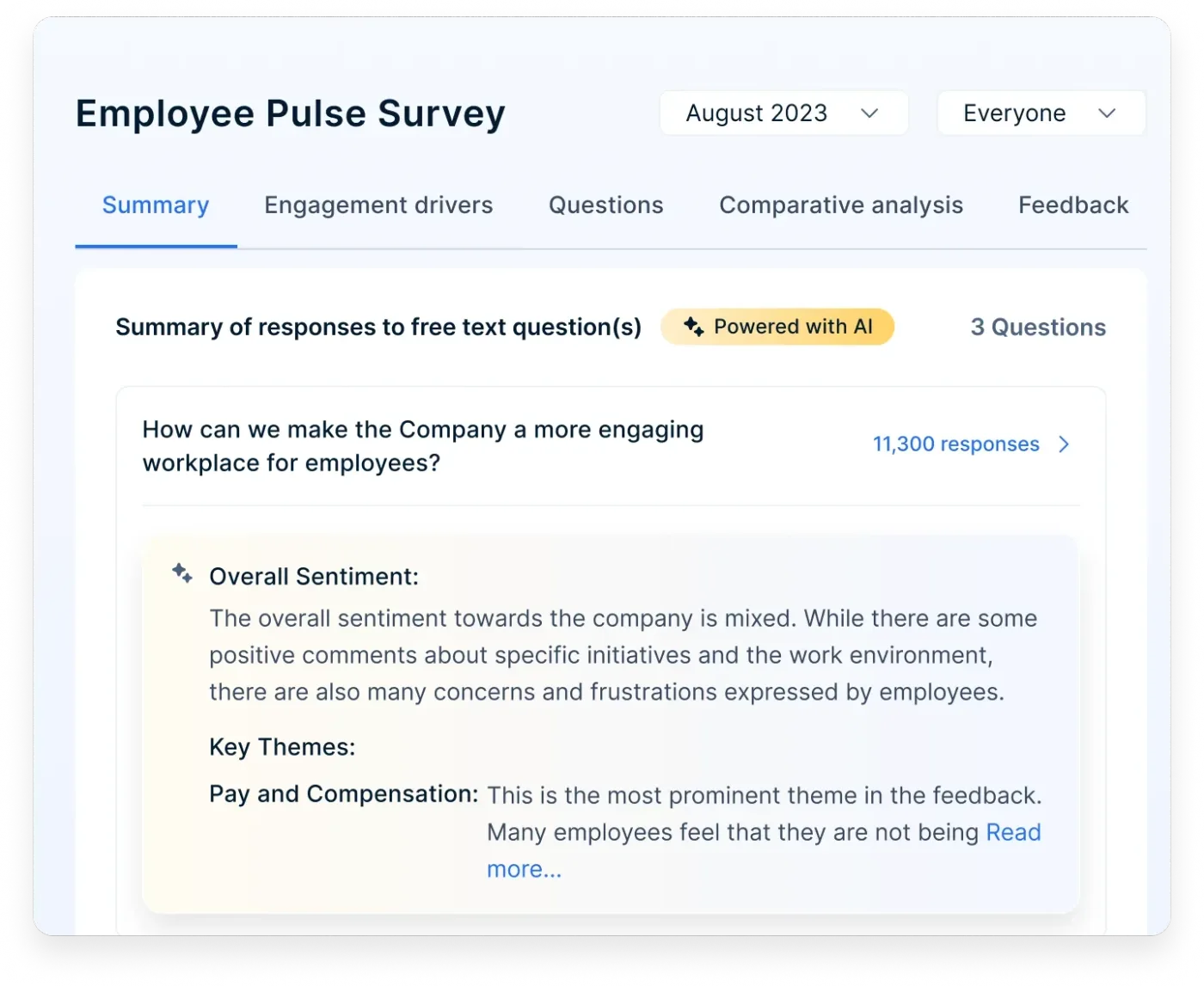
Reading hundreds of comments by hand is slow. AI theme clustering, such as Empuls AI sentiment analysis, summarizes open answers into named themes so you can see the most common concerns in minutes.
Turn survey results into action
The biggest mistake companies make is collecting data and doing nothing with it. Perceptyx's 2025 employee listening analysis found that 71% of employees report survey results being shared and 59% say action plans were created, but only 51% see actual improvements resulting from their feedback. Close that gap with five habits:
- Share results quickly: Present company-wide findings within two to four weeks, including the uncomfortable ones. Transparency builds trust.
- Prioritize two or three areas: Choose the lowest-scoring drivers that matter most to the business rather than trying to fix everything at once.
- Assign ownership: Give each action an owner in HR, leadership or the team, with a deadline and a measure of success. An employee engagement action plan template keeps this organized.
- Involve managers: Give each manager a simple team report and ask them to discuss it with their team and agree on one local action.
- Close the loop: Tell employees what changed because of their feedback, using "you said, we did" updates, then check progress with a short pulse survey.
Employee satisfaction survey best practices and mistakes to avoid
Most failed surveys fail for the same handful of reasons. Avoid these mistakes and follow the matching best practice:
| Mistake | Best practice |
|---|---|
| Long surveys that take 20 minutes or more | Keep it to 15 to 25 questions and test the completion time in a pilot |
| Vague or leading questions | Ask about one idea per question in neutral wording |
| Weak or unclear anonymity | Set a minimum group size for reports and explain it up front |
| Changing questions every cycle | Keep a stable core set so you can compare trends |
| Results that never reach employees | Share findings and planned actions within a few weeks |
| No follow-through | Assign owners and deadlines, then measure again |
Satisfaction rises when the basics are right: a positive culture, coworkers people trust, good managers and the freedom to do the job well. Use the survey to find which of these needs work, then build on the strengths you already have. If certain teams score well, find out what they do differently and spread those practices. For broader tactics, read our guide on how to measure employee engagement and our tips for a healthy culture of feedback.
How Empuls helps you run employee satisfaction surveys
Empuls brings survey design, delivery, analysis and action planning into one platform, so HR spends less time on spreadsheets and more time on fixes. With Empuls employee surveys, you can:
- Start from validated templates: Choose from 50+ templates and 800+ validated questions, or build your own with conditional logic, recurring schedules and configurable anonymity.
- Survey at every moment: Run annual surveys, pulse surveys and eNPS, plus lifecycle surveys triggered automatically from HRIS events such as a start date or exit date.
- Reach people where they work: Deliver surveys through Slack, Microsoft Teams, WhatsApp or email, with support for 20+ languages.
- See what is driving scores: View engagement driver scores, heatmaps by department, tenure and location, and AI summaries of open comments, with anonymity enforced through minimum group sizes.
- Close the loop: Turn findings into action plans with owners, deadlines and driver tags, then confirm progress with a follow-up pulse.
A well-structured employee satisfaction survey is more than a feedback tool: it is a strategic way to improve culture, lift engagement and keep your best people. Collecting feedback is only the first step; acting on it is what builds trust and long-term commitment.
Book your Empuls demo
Frequently asked questions
An employee satisfaction survey shows how content employees are with their roles, managers, pay, growth and work environment. Its purpose is to find pain points and strengths so you can act on them. Run regularly, it helps you improve culture, lift morale, reduce turnover and check whether the changes you make are working.
Most companies run a full employee satisfaction survey once a year and shorter pulse surveys every quarter to track priority areas between cycles. Add lifecycle surveys at onboarding and key milestones, and an exit survey for every leaver. Survey more often only if you can share results and act on them each time.
Aim for 15 to 25 questions that take about 10 minutes to complete. Include rated statements across the main drivers, one eNPS question and two or three open questions. Annual surveys can stretch to about 40 questions if needed, but completion rates and answer quality drop as surveys get longer.
Yes, anonymous or at least confidential surveys get more honest answers because employees know their manager cannot trace a response back to them. Report results only for groups above a minimum size, often five people, and explain this in the invitation. If you need to follow up, use a separate optional question asking permission.
Many organizations aim for 70% or more, though there is no universal benchmark. Response rates rise when the survey is short, mobile friendly, clearly anonymous and supported by managers, and when employees saw action after the last survey. Track response rates by team, because low participation in one group can hide the problems you most need to see.
A satisfaction survey measures how content employees are with pay, conditions, management and the job itself. An engagement survey measures motivation, commitment and emotional connection to the organization. Satisfied employees are not always engaged, so many companies measure both, often in one combined survey with separate sections.
The most common method is percent favorable: divide the number of agree and strongly agree answers by the total responses and multiply by 100. For example, 60 favorable answers out of 120 gives 50%. Average the favorable scores of related questions to get a score for each driver, and track them over time.
Share the main findings with employees within a few weeks, choose two or three priority areas, assign owners and deadlines, and ask managers to discuss team results. Tell employees what changed because of their feedback, then run a short pulse survey to check whether scores in the priority areas are improving.





































































































































































































































































































































































































































































































































































