
Key Takeaways
Sales gamification software applies points, leaderboards, contests and rewards to sales data so reps stay motivated between payouts.
Ebsta and Pavilion's 2025 benchmarks found 78% of sellers missed quota, which is why gamification should be designed for the middle of the team, not just the top.
Data accuracy and a link to real incentives matter more than visual polish when choosing a sales gamification platform.
A weighted scorecard covering data, fairness, incentives, integrations, rep experience, analytics and admin effort makes vendor comparisons objective.
Short contests on one verifiable outcome, with published rules and prompt payouts, keep a sales game from being gamed.
Sales gamification software turns everyday selling into a visible game, with live leaderboards, contests, badges and rewards tied to your CRM data. The best sales gamification tools keep the whole team, not only the top ten, chasing a realistic next goal. This guide compares 12 platforms, gives you a weighted scorecard to pick one and shows how to launch without the game being gamed.
Sales teams constantly look for ways to lift performance, motivation and results between paydays. Gamification for sales teams does that by adding game mechanics to the sales process, so reps see where they stand every day, compete in a healthy way and get recognized while it still changes the month.
What sales gamification software is and why it matters now
Sales gamification software is a platform that applies game mechanics, such as points, rankings, challenges and rewards, to sales activities and results so that reps stay motivated and focused on the behaviors that close revenue. It reads data from your CRM and other systems, scores it against rules you set and shows the results on leaderboards, dashboards, mobile apps and office TV screens.
The case for it is a performance gap that commission alone does not close. The Ebsta and Pavilion 2025 GTM Benchmarks report found that 78% of sellers missed quota, up from 69% the year before, and that just 14% of sellers generated 80% of new revenue. A commission plan pays for results at the end of the cycle. A good sales gamification platform works on the weeks in between and gives the middle of the team something realistic to chase.
78%
of sellers missed quota
up from 69% a year earlier (Ebsta and Pavilion, 2025)
14%
of sellers
generated 80% of new revenue (Ebsta and Pavilion, 2025)
The performance gap sales gamification is meant to narrow
Gamification is not a replacement for a sound pay plan. If the plan itself is confusing or unfair, a leaderboard only makes that more visible, so fix the plan first with our guide to the signs of a bad sales incentive plan.
Core features of sales gamification tools
Nine building blocks show up in almost every sales gamification tool, though vendors weight them differently. The first three, leaderboards, points and challenges, do most of the motivational work, while the rest decide whether the program is trusted and sustainable.
- Leaderboards: Real-time rankings of reps based on metrics such as revenue, deals closed, meetings booked or target attainment. Good sales leaderboard software lets you scope rankings by team, region or plan, so people compete with peers in a comparable role.
- Points, badges and levels: Virtual rewards for completing tasks or reaching milestones. They recognize individual and team achievements and give a sense of progress between big wins.
- Challenges and goals: Managers create time-boxed contests and goals based on sales targets, product launches, activity levels or skill-building exercises, which gives the team a clear focus for the week or month.
- Performance analytics: Reports on individual and team progress, conversion rates, revenue generated and activity levels, so managers can see what the game is actually changing and where to coach.
- Real-time updates and notifications: Alerts on rank changes, new challenges and goals within reach, in the app or in Slack, Microsoft Teams or email, which keep the game top of mind.
- Collaboration and communication: Team challenges, social feeds and chat that let reps share tips and celebrate wins together, so the game builds the team rather than splitting it.
- Rewards and incentives: A way to turn points or contest wins into something real, such as gift cards, experiences, extra time off or a cash bonus, ideally through an approval and payout process finance trusts.
- Training and learning modules: Quizzes, practice sessions and microlearning that reward product knowledge and skill building, not only closed deals.
- Customization and flexibility: Your own metrics, rules, badges, themes and branding, so the game matches your sales motion and culture rather than a vendor template.
If your main goal is learning rather than selling, game-based training works differently from sales contests. Our guide to gamified learning covers that side in depth.
How to choose a sales gamification platform
Use these eight criteria to compare vendors, in this order of importance. Data accuracy and fairness come first, because a leaderboard only motivates if reps believe it.
- Data source and accuracy: Check where scores come from. Rankings should come from validated CRM, ERP or point-of-sale data, not self-reported activity, and every score should be traceable back to the record behind it.
- Fair comparisons: Look for leaderboards scoped by team, region, tenure or plan, plus milestone and personal-best mechanics that give mid-performers a realistic win.
- Link to real incentives: Decide whether you need gamification on its own or tied to commissions and SPIFs. If prizes and payouts sit in another tool, someone will reconcile them by hand.
- Integrations: Confirm native connectors for your CRM, calling and conversation tools, HRMS and collaboration apps, and how often data syncs.
- Where reps see it: Web, mobile, Slack or Teams and sales-floor TVs. Field and frontline sellers need mobile first; inside sales teams often get the most from a shared screen.
- Coaching and analytics: Managers should see who is drifting off pace and why, and act on it in coaching, not just watch the rankings move.
- Admin effort: Ask how long it takes a sales ops manager to launch a new contest without vendor help, and how rules are changed mid-cycle.
- Security and pricing model: Check certifications such as SOC 2 and ISO 27001, role-based access and audit trails, and whether pricing is per user, per account or tied to modules you will not use.
Sales gamification software compared at a glance
The table summarizes where each of the 12 platforms in this guide fits best. Use it to build a shortlist of two or three, then score that shortlist with the evaluation scorecard further down.
| Platform | Best for | Gamification focus | Stands out for |
|---|---|---|---|
| Xoxoday Empuls | Enterprise sales teams that also pay incentives | Leaderboards, SPIFs, contests, badges, streaks, milestones | Games run on the same data that calculates and pays commissions |
| Ambition | Revenue teams that want coaching at scale | Competitions, incentives, workflow alerts | Coaching programs and cadences across roles |
| SalesScreen | Teams that want always-on, AI-assisted games | Competitions, missions, streaks, recognition | AI that proposes games and flags reps drifting off pace |
| Spinify | Teams that want fast setup and many integrations | Leaderboards, competitions, rewards | AI coach plus TV, web and mobile displays |
| Hoopla | Inside sales floors and contact centers | Races, tournaments, head-to-head challenges | Plug-and-play TV broadcasting and a Salesforce widget |
| LevelEleven | Salesforce-centric teams | Competitions, badges, milestones | Daily scorecards and structured coaching |
| Plecto | Teams that run on KPI dashboards | Contests, achievements, streaks | Real-time dashboards with 150+ integrations |
| Centrical | Frontline and contact center teams | Narrative games, points, coins, levels | Gamification combined with training and feedback |
| SmartWinnr | Regulated industries such as pharma and banking | KPI contests, leaderboards | AI roleplays and field coaching |
| SparkPlug | Retail, brand and restaurant teams | POS-based rankings and incentive campaigns | Brand-funded incentives and automated reward fulfillment |
| Pointagram | Small teams and budget pilots | Competitions, badges, quests, reward store | A free plan and per-player pricing |
| Zoho CRM (Motivator) | Teams already on Zoho CRM | Gamified goals and progress | Built into the CRM, no extra vendor |
Run sales contests on your real incentive data
See leaderboards, SPIFs and milestone journeys built on the same plan data that pays your team.
Talk to our ExpertTrusted by 5,000+ companies
The 12 best sales gamification software platforms
The 12 platforms below are grouped by what they do best, starting with incentive-linked and enterprise platforms and ending with lightweight and CRM-native options. Several tools from older lists have since been acquired, discontinued or repositioned away from sales gamification, so they are not included here.
1. Xoxoday Empuls
Empuls is an enterprise sales incentive and commission platform with sales gamification built in. It lets you define KPIs, rules, variables and conditions in a no-code plan builder, automate commission calculations and run leaderboards, SPIFs and contests on top of the same plan data, so the game and the payout always agree.
- Gamification: Live leaderboards scoped by team, region or plan, SPIFs and contests on top of the base plan, custom and animated badges, streaks, points and themed milestone journeys with a buffer so near misses still count.
- Incentives and payouts: Automated calculation of tiers, splits and clawbacks, with approved payouts sent to payroll or delivered as cash or rewards.
- Visibility: Web and mobile scorecards with rank, earnings and what the next deal adds, plus goal-aware nudges in the app and on WhatsApp, Slack or Teams.
- Integrations: Connectors for CRM, ERP and HRMS systems such as Salesforce, HubSpot, SAP SuccessFactors and Oracle.
Consider: Empuls is built for enterprise sales organizations that want gamification and incentive pay on one platform. A small team that only wants a TV leaderboard may find a lighter tool quicker to start.
2. Ambition
Ambition positions itself as an execution and coaching platform for revenue teams, with gamification as one of its core components. Managers can build and display competitions, incentives and workflow alerts, and run coaching programs and automated 1:1 cadences across teams, roles and departments.
Consider: Ambition suits organizations where coaching discipline is the main goal and gamification supports it. Pricing is quoted on request.
3. SalesScreen
SalesScreen is a dedicated sales gamification platform focused on visual performance tracking, recognition and goal attainment. It now describes its approach as always-on, agentic gamification: its AI proposes competitions, missions, streaks and rewards from performance signals, and flags which reps and behaviors are drifting off pace.
- Real-time activity tracking and personalized recognition.
- Coaching tools with context from performance data.
- Connects to CRM, conversation intelligence and sales engagement tools, with a mobile app.
4. Spinify
Spinify transforms sales data into engaging leaderboards and competitions with a visually appealing interface and quick setup. It adds an AI coach that runs personalized sessions and AI-powered growth plans, and displays results on TV, web and mobile.
Integrations: Salesforce, HubSpot, Slack, Microsoft Teams, Excel, Google Sheets, Zapier, Gong and Power BI, among others. Consider: rewards are customizable, but incentive calculation and payouts sit outside the tool.
5. Hoopla
Hoopla is one of the longest-running sales motivation platforms. Its dynamic leaderboards, TV broadcasts and celebrations create a lively atmosphere on the sales floor, and its competition formats include races, tournaments, head-to-head matchups and live call battles.
- A plug-and-play device that turns an existing TV into a live scoreboard.
- Direct connections to Salesforce and HubSpot, plus a leaderboard widget inside Salesforce.
- Automated announcements and shoutouts, and a rewards store where reps redeem points.
6. LevelEleven
LevelEleven, now part of Ascent Cloud, is a sales performance management platform that uses gamification and data transparency to drive productivity. It turns goals into daily scorecards reps can follow, adds competitions, badges and milestones, and gives managers coaching notes and templates.
Consider: it is listed on the Salesforce AppExchange and fits best when Salesforce is your system of record.
7. Plecto
Plecto is dashboard software that uses gamification to motivate employees by visualizing performance indicators openly. You can build real-time dashboards with an AI builder or templates, turn goals into competitions, run weekly contests and recognize progress with achievements and streaks.
Integrations: Plecto states support for more than 150 integrations, which keep dashboards updated automatically from your data sources.
8. Centrical
Centrical combines performance management, gamification, training and feedback for frontline teams, with strong use in contact centers and BPOs. Its game narratives, such as car races where people progress by hitting targets, sit alongside points, redeemable coins, badges, levels and a virtual store for tangible rewards.
Consider: Centrical fits service and frontline sales teams better than field or enterprise account teams.
9. SmartWinnr
SmartWinnr combines competition, training and coaching in one platform, with a focus on regulated industries such as pharmaceuticals, medical devices, banking and insurance. It turns sales KPIs into contests with dynamic leaderboards and adds AI roleplays that score practice conversations for compliance, tone and objection handling.
Consider: a strong fit when product knowledge and compliant conversations matter as much as volume.
10. SparkPlug
SparkPlug is a sales incentive platform for specialty retailers, consumer brands and restaurants. It connects to point-of-sale systems for daily rankings, runs incentive campaigns for frontline staff, supports brand- or retailer-sponsored incentives and automates reward fulfillment.
For a broader view of retail options, see our comparison of sales incentive platforms for retail brands.
11. Pointagram
Pointagram is a general-purpose gamification tool that many small sales teams use to start. According to Pointagram's pricing page, the free plan allows unlimited players with limits of two active competitions and two active badges, and paid per-player pricing starts at 4 euros per player per month.
Consider: a low-risk way to pilot gamification before buying an enterprise platform.
12. Zoho CRM (Motivator)
If your team already runs on Zoho CRM, its built-in Motivator gamifies goals and shows the team's progress inside the CRM. It is the simplest option for small and mid-sized teams that want leaderboards without adding another vendor.
Consider: it does not cover incentive calculation, payouts or deep coaching, so larger teams often outgrow it.
Sales gamification platform evaluation scorecard
Score each shortlisted platform from 1 to 5 on the seven criteria below, multiply by the weight and add the results for a total out of 500. The weights favor data accuracy and the link to real pay, because those decide whether the program survives its first quarter.
| Criterion | Weight | What a 5 looks like |
|---|---|---|
| Data accuracy and traceability | 20 | Scores come from validated CRM or POS data and every point traces to a record |
| Fairness of competition | 15 | Leaderboards scoped by team, region or plan, with milestones for mid-performers |
| Link to incentives and payouts | 20 | Contest prizes and SPIFs flow through the same approval and payout process |
| Integrations | 15 | Native connectors for your CRM, calling tools, HRMS and chat apps |
| Rep experience | 10 | Mobile, Slack or Teams and TV views reps check without being told |
| Manager analytics and coaching | 10 | Shows who is off pace and why, with coaching actions |
| Admin effort, security and cost | 10 | Ops launches a contest alone; SOC 2 or ISO 27001; clear pricing |
Worked example: A 150-person sales team compares Platform A, a standalone leaderboard tool, with Platform B, an incentive platform with gamification built in. Platform A scores 4 on data accuracy (80), 4 on fairness (60), 2 on the incentive link (40), 5 on integrations (75), 5 on rep experience (50), 3 on analytics (30) and 4 on admin and cost (40), for 375. Platform B scores 5 (100), 4 (60), 5 (100), 4 (60), 4 (40), 4 (40) and 3 (30), for 430. Platform B wins because the team pays monthly SPIFs and wants one source of truth, even though Platform A is easier to start.
How to launch sales gamification without the game being gamed
Most programs that fail do so in the first month, because the rules feel unfair or the game rewards the wrong behavior. Follow these six steps in order, and pay the most attention to the second one.
- Pick one business outcome: Choose a single goal for the first contest, such as pipeline created, a product launch or a slow-moving SKU, and set a baseline for it.
- Score behaviors you can verify: Use metrics your systems record and validate, and avoid easy-to-inflate activities such as logged calls without a minimum duration.
- Design for the middle: Scope leaderboards to comparable peers and add milestones or personal-best goals, so more than the top few have a realistic win.
- Publish the rules: Show every rep how points, ranks and prizes are calculated before the contest starts, and do not change rules mid-contest.
- Keep contests short and varied: Run two to four week contests, mix individual and team formats and rotate the metric to avoid fatigue.
- Review and pay promptly: Compare results with the baseline, pay winners quickly through an approved process and keep what moved the outcome.
Gamification also helps retention when it makes progress and recognition visible. Our guide to sales team retention strategies shows how it fits with pay, coaching and career paths, and our wider guide to employee gamification covers uses beyond sales.
How Empuls helps sales teams compete on real incentive data
Empuls runs sales gamification on the same platform that calculates and pays incentives, so every leaderboard, SPIF and contest uses validated plan data and every prize goes through approvals and the audit trail. Sales professionals see their rank, earnings and next milestone on web and mobile, while managers see team attainment and who needs support.
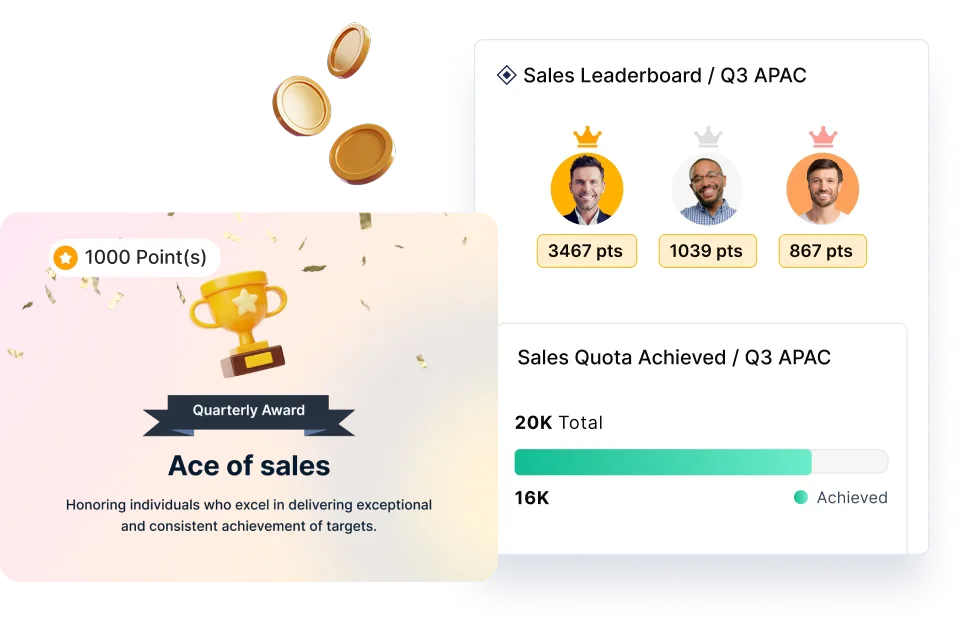
- Explore Empuls sales gamification for leaderboards, SPIFs, contests, badges and milestone journeys.
- See how gamification fits with plans, calculations and payouts in Empuls sales incentives.
- Read how Mercedes-Benz India automated sales incentives across 33 franchises with gamified milestone tracking.
Choosing the right sales gamification software
Finding the best sales gamification software can transform your sales team's performance and motivation, but only if the game is fair, tied to real data and linked to rewards people value. Shortlist two or three platforms with the comparison table, score them with the weighted scorecard and run a four-week pilot on one clear outcome before you roll out. If you also manage commissions, compare platforms that do both in our guide to incentive management software.
Book your Empuls demo
Frequently asked questions
Sales gamification works when it targets a clear outcome, uses verifiable data and gives most of the team a realistic chance to win. It lifts focus and activity in the weeks between payouts. It fails when rules feel unfair, when only the top few can win or when it rewards easy-to-inflate activity instead of behaviors that lead to revenue.
Pricing varies widely. Lightweight tools offer free plans or charge a few dollars or euros per user per month, while enterprise platforms usually quote custom prices based on users, modules and integrations. Pointagram, for example, publishes a free plan and per-player pricing from 4 euros per month. Budget separately for the rewards and prizes the game will pay out.
Sales incentive software calculates, approves and pays commissions and bonuses under a compensation plan. Sales gamification software adds leaderboards, contests, badges and points to motivate behavior during the cycle. Some platforms, such as Empuls, combine both, so contests and SPIFs use the same data and payout process as the base commission plan.
A sales leaderboard is a live ranking of reps or teams on a metric such as revenue, deals closed, meetings booked or quota attainment. It is usually shown in an app, in Slack or Teams and on office screens. The most motivating leaderboards compare people with similar roles and targets rather than ranking the whole company together.
Scope competitions to comparable peers, add milestones and personal-best goals so mid-performers can win, and mix team and individual contests. Publish the rules before you start and never change them mid-contest. Reward behaviors that lead to good revenue, and pair the game with coaching so low ranks become a prompt for support, not public shame.
Gamification in CRM means adding game elements such as leaderboards, goals, points and challenges to a customer relationship management system, so reps are rewarded for updating records, completing activities and closing deals. Some CRMs, such as Zoho CRM, include basic gamification, while dedicated tools connect to Salesforce, HubSpot and others for richer contests and rewards.
Yes. Small teams can start with a free or low-cost tool, or with the gamification built into their CRM, and run one simple monthly contest. Keep the metric clear and the prize meaningful. As the team grows and adds commissions, SPIFs and multiple regions, a platform that links gamification to incentive pay becomes more valuable.
Track the outcome the game targets, such as pipeline created, win rate or product mix, against a baseline. Add participation rates, the share of reps who hit at least one milestone, changes among mid-performers and the cost of prizes against incremental revenue. These show whether the program lifts the whole team or only rewards people who would have won anyway.





































































































































































































































































































































































































































































































































































