
Key Takeaways
Intrinsic motivation is doing work because it is satisfying in itself; extrinsic motivation is doing it for an outside reward or to avoid a penalty.
Extrinsic rewards are best for triggering effort on clear, measurable or unappealing tasks, while intrinsic drivers sustain effort, quality and innovation.
Tangible rewards that feel controlling can reduce interest in work people already enjoy, while informational recognition tends to strengthen it.
Gallup's 2025 data shows 50% of employees with strong work purpose are engaged, versus 9% of those with low purpose.
The best motivation systems combine fair pay and recognition with autonomy, competence, belonging and meaningful work.
Intrinsic vs extrinsic motivation comes down to where the reward sits. Intrinsic motivation is doing something because the activity itself is satisfying, while extrinsic motivation is doing it to earn an outside reward or avoid a penalty. At work, the best results come from combining both: fair pay and recognition to trigger effort, and purpose, growth and autonomy to sustain it.
Consider Peter in sales, who closes more deals every month than his peers. At first glance, his supervisor might credit this success to the company's incentive program, a classic case of extrinsic motivation at work. The real story is deeper: Peter overcame a childhood stammer, and every successful pitch is a personal triumph he turned into a career advantage.
Peter's story shows why the difference between intrinsic and extrinsic motivation matters: what drives an employee's performance is often more complex than it appears. This guide explains both types with examples, how they differ, what current research shows and how to design a workplace that uses both. For the broader picture, start with our guide to what employee motivation is.
What intrinsic and extrinsic motivation mean
Why do we do what we do? Psychologists have long described two principal drivers, intrinsic motivation (born inside us) and extrinsic motivation (added from the world outside us), and research has documented plenty about how each one works. We cover extrinsic motivation first because it is what most workplaces design for, then intrinsic motivation, which tends to sustain effort for longer.
Extrinsic motivation
Extrinsic motivation is the drive to act in order to gain a reward or avoid a punishment that comes from outside the activity. The stimulus, or reason to act, is mostly tangible: things visible to us and part of the external world we live in.
In the iceberg model, where the top part holds visible, measurable behavior and the hidden part holds the deeper drivers behind it, extrinsic motivation roughly maps to the visible tip. In Maslow's hierarchy of needs, it roughly corresponds to the lower half of the pyramid, where security, status and material needs live.
In the workplace, extrinsic motivation makes us reach targets before the deadline so we don't miss our incentive, take a course to get promoted faster and follow company policies so we aren't penalized for non-compliance. Extrinsic motivation examples at work usually take one of four forms:
- Financial incentives: Salary raises, performance bonuses, commissions and sales incentives. They work especially well for specific, measurable goals because the benefit is immediate and tangible.
- Recognition and rewards: A thank-you from a manager, public praise in a meeting, peer shout-outs or formal awards such as employee of the month. When people feel valued, they are motivated to maintain or exceed their performance.
- Promotions and career advancement: The promise of a promotion, more responsibility or a new title can drive long-term effort, as people work to show they're ready for the next level.
- Job security and benefits: Stable employment, health insurance, paid time off and retirement plans provide a safety net that makes people feel secure, which in turn drives commitment.
Intrinsic motivation
Intrinsic motivation is the drive to do something because it is interesting, enjoyable or meaningful in itself. The activity is its own justification and its own reward. If you reach targets because you love the buzz of a successful pitch, learn a skill because you're eager to master new technology or follow company values because you cherish the culture, you are intrinsically motivated.
Intrinsic motivation maps to the hidden part of the iceberg. In Maslow's terms, it corresponds to the upper half of the pyramid, where higher needs such as self-esteem, achievement, belonging and self-development live. Intrinsic motivation examples at work usually fall into three forms:
- Meaningful work and purpose: People find intrinsic motivation when their work connects to a larger mission and they can see its impact. Patagonia is a well-known example: its stated purpose, "We're in business to save our home planet," gives employees working on sustainability projects a strong sense of meaning.
- Personal growth and development: Opportunities to learn and build skills are a powerful intrinsic reward. Structured leadership programs, mentoring, stretch assignments and job rotations help employees grow personally and professionally, which keeps them engaged.
- Autonomy and ownership: When people are free to make decisions, be creative and own their work, they are more motivated. 3M's long-running "15% Culture" encourages employees to spend part of their work time on ideas that excite them; the Post-it Note came out of exactly this kind of self-directed time.
The difference between intrinsic and extrinsic motivation
The main difference between intrinsic and extrinsic motivation is the source of the reward. Extrinsic motivation is about outcomes such as money, status, recognition and security; intrinsic motivation is about our sense of identity, purpose and the things that bring us joy and fulfillment. Loosely put, if extrinsic motivation makes us "look good," intrinsic motivation makes us "feel good."
Intrinsic motivation usually shows up in voluntary, spontaneous activities, such as learning to sing or helping out a sick coworker. The table below compares the two in workplace terms:
| Aspect | Intrinsic motivation | Extrinsic motivation |
|---|---|---|
| Definition | Driven by internal satisfaction, passion or purpose | Driven by external rewards such as money, recognition or benefits |
| Key focus | Personal growth, fulfillment, meaning, creativity | Tangible rewards, deadlines, performance metrics |
| Examples | Loving the work itself, personal mastery, purpose alignment | Bonuses, promotions, awards, public recognition |
| Strengths | Encourages resilience, innovation and deep commitment | Boosts immediate productivity, ensures compliance, triggers action |
| Drawbacks | Selective effort; motivation can fade if passion does | Can create dependency and reduce interest if overused |
| Best use cases | Long-term projects, innovation-driven roles, leadership building | Short-term goals, sales targets, routine or regulatory tasks |
| Impact on culture | Builds emotional connection and ownership | Reinforces measurable achievement and accountability |
| Risk if overemphasized | Burnout or disengagement if personal goals go unmet | "Doing the bare minimum" or losing passion for the work |
This kind of bucketing can be too simplistic, because the two are sometimes hard to tell apart. It is better to think of them as points on a continuum: only at the extreme ends are they truly separate. Someone may spend hours perfecting a presentation not to impress others but because they are a perfectionist, and something that feels good, such as providing for family or excelling at work, can be extrinsically motivated at another level.
Reward effort and build meaning at the same time
Run recognition, rewards, milestones and pulse surveys from one Empuls platform.
Talk to our ExpertTrusted by 5,000+ companies
The motivation continuum from external to intrinsic
Self-determination theory, developed by psychologists Edward Deci and Richard Ryan, turns that continuum into six practical stages. The middle stages matter most for managers, because most workplace motivation sits there: people do work for outside reasons but can come to own those reasons as their own.
| Type of motivation | What drives the person | Workplace example |
|---|---|---|
| Amotivation | No real reason to act | Going through the motions on a task that feels pointless |
| External regulation | Rewards and penalties | Hitting a target only to earn the bonus |
| Introjected regulation | Guilt, pride or pressure to look good | Staying late so colleagues don't think you're slacking |
| Identified regulation | Personally valuing the outcome | Completing compliance training because you believe safety matters |
| Integrated regulation | The goal fits your identity and values | A nurse doing extra patient checks because care is who she is |
| Intrinsic motivation | Interest and enjoyment of the task itself | A developer refactoring code because solving it is satisfying |
The practical lesson is that extrinsic motivation is not all the same. Moving people from external and introjected motivation toward identified and integrated motivation, by explaining why work matters, giving choice and building competence, produces much of the persistence usually credited to pure intrinsic drive. Our pillar guide covers self-determination theory and other employee motivation theories in more detail.
Intrinsic vs extrinsic motivation at work: what current data shows
Recent research shows that both levers matter, and that most organizations underuse the intrinsic one. Three findings stand out:
18%
of US workers say their job has a purpose they believe in
Gallup, 2025
45%
less likely to leave when well recognized
Gallup and Workhuman, 2024
50% vs 9%
engaged with strong vs low work purpose
Gallup, 2025
83% vs 82%
rate work-life balance vs pay as important
Randstad, 2025
Motivation at work in numbers
- Purpose is powerful but rare: In Gallup's 2025 study on purposeful work, only 18% of US workers said their current job has a purpose they personally believe in, while 45% said they work mainly for a paycheck and benefits. Yet 50% of employees with strong work purpose were engaged, compared with 9% of those with low purpose, and they were far less likely to feel burned out (13% vs 38%).
- Recognition bridges both types: Gallup and Workhuman research found that well-recognized employees were 45% less likely to have left their organization two years later. Recognition is extrinsic in form, but it feeds intrinsic needs for competence and belonging.
- Pay still matters, but not alone: In Randstad's Workmonitor 2025, 83% of workers rated work-life balance as important against 82% for pay, the first time balance edged ahead in the survey's history.
Extrinsic vs intrinsic motivation: which is better
It is easy to be idealistic and put intrinsic motivation on a higher pedestal. A workplace where everyone is perfectly self-motivated is an ideal, not reality, and in practice both forms of motivation are needed for a team to function well. The useful question is not which type is better but what each does well and where each falls short.
Where extrinsic motivation helps: Whether through the pull of an incentive or the push of a consequence, extrinsic motivation provides the trigger we need to meet deadlines, keeps order and consistency through clear benchmarks and keeps customers happy. It is especially useful for keeping productivity up when a task is unappealing, which is often the case in real life. An initial extrinsic push, such as an incentive, is also one of the most effective ways to help people overcome inertia, step outside their comfort zone and try new skills.
Where extrinsic motivation falls short: A team driven only by external rewards may lack ownership, do only as much as it has to, give up when agreed conditions change and feel little urge to innovate.
Where intrinsic motivation helps: Intrinsic motivation can build a competitive edge that is hard to copy, because the standards come from within. When people are fired up by purpose beyond their KPIs, they keep refining their work after it meets the official benchmark, redo work without being asked when a goal is missed and stay resilient and creative in the face of obstacles.
Where intrinsic motivation falls short: Intrinsically motivated people can be picky about tasks, uninterested in work that doesn't excite them and quick to lose their spark if conditions change.
There is also a well-documented risk in mixing the two badly. Research in the self-determination tradition, often called the overjustification effect, shows that adding tangible, performance-contingent rewards to a task people already enjoy can reduce their interest once the reward stops, especially when the reward feels controlling. Rewards that feel informational, such as recognition that tells people their work mattered, are far less likely to have this effect. Our guide to how incentives influence behavior looks at incentive design in detail.
So the question for founders, talent leaders and HR managers is not which kind of motivation is better, but which mix your organization needs. The answer is both, in a ratio that depends on the nature of the work, the goals and rewards model you've designed and, above all, the personalities of your people.
How to design for both motivation levers
An organization is all about its people, which makes motivation design the most important and trickiest part of your business. Get it right and you build a people system that delivers with consistency and quality; get it wrong and you enter a cycle of sub-par performance, rework and blame. Everyone's motivational triggers are different, so find out what moves each person and align your levers accordingly.
Because it is the employee who ultimately interprets a reward as intrinsic or extrinsic, you don't need separate systems for each type. The idea is to empathize, enable and empower: create conditions where the right kind of motivation is sparked in every situation. These seven elements belong in every motivation matrix, in remote and frontline teams as much as in offices:
- Autonomy: Whether people are driven from outside or inside, nobody likes working under pressure, and even subtle hints of control can break morale. Beyond core policies, step back and give people the space to do things their way.
- Recognition: Recognition is not only an external stimulus. An intrinsically motivated person can be just as energized by a reward that fits their values and passions, and recognition doesn't always need to be a thing: a genuine thank-you or a public shout-out on the company intranet works too. Be quick, specific and genuine. See how to build an employee recognition program.
- Feedback: Feedback is both an enabler and an incentive. It fine-tunes performance with direction, and a good word adds satisfaction and involvement while boosting productivity. Tools such as 360-degree feedback make it a habit.
- Sense of competence: Make success meaningful and tied to personal growth. Design goals so every target and milestone instills a sense of achievement; extrinsically driven people enjoy that lift too, and it often pushes them to raise their game.
- Relatedness: A sense of belonging starts with an inspiring, supportive culture people identify with and are willing to put in extra effort for. A strong culture influences even extrinsically motivated people, balancing outside and inside drivers.
- Role and talent fit: People in the wrong jobs will be demotivated. If a hire starts on the wrong foot, keep internal moves open so a misfit can find a role that matches their strengths and motivational triggers.
- Moderation: Don't overdo rewards on work people already love. A programmer passionate about coding may shine brighter when some rewards are linked to performance, but past a point the rewards start defining the behavior, and the spark gives way to doing just enough to tick boxes.
For more ideas you can put into practice, see our employee motivation strategies and our examples of non-monetary compensation that lean on intrinsic drivers.
How Empuls supports both kinds of motivation
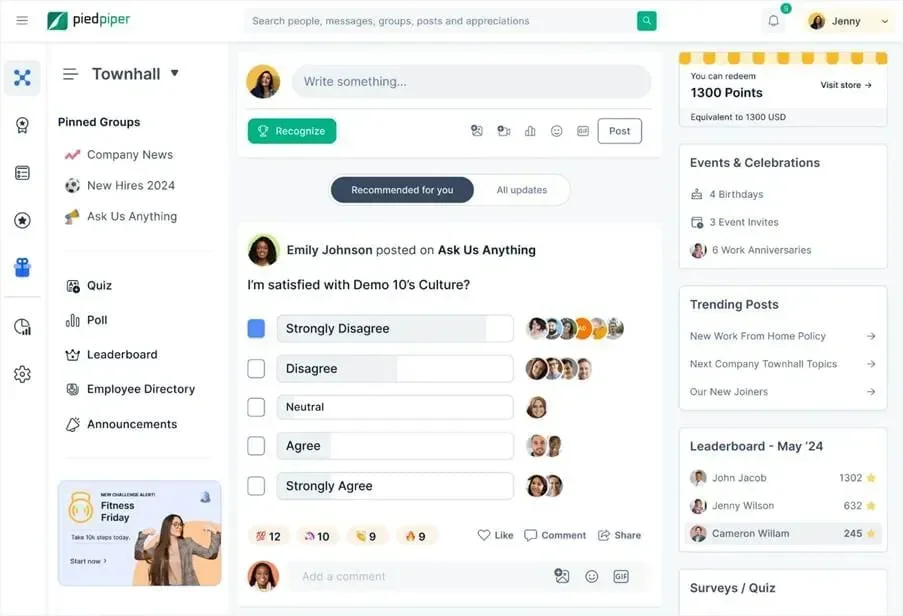
Empuls, Xoxoday's employee engagement platform, turns recognition and rewards into a simple, consistent experience, and adds the connection and listening tools that feed intrinsic motivation:
- A culture of appreciation: Celebrate every win, big or small, with recognition that is timely and inclusive, including AI-assisted messages that help managers be specific.
- Multiple award types: Recognize in the moment with value badges, spot awards and peer recognition, or run formal nominations reviewed by a jury and performance-based awards tied to goals.
- Automated rewards and budgets: Workflows distribute reward budgets fairly and on time, employees redeem points instantly in a rewards store, and admins see full budget utilization.
- Milestones and service awards: Turn work anniversaries and life events into memorable moments with milestone rewards and celebrations.
- Wellbeing and benefits: Support needs beyond work with benefits and wellness programs.
- Connection and voice: A social intranet and pulse surveys build belonging and show people their voice changes things.
Conclusion
Intrinsic and extrinsic motivation can coexist, and sometimes one is camouflaged as the other, because each person sees the same event through their own values. For one employee, being named employee of the month matters because it comes with a dinner voucher (extrinsic). For someone like Peter, it may mean a personal milestone or proof to himself of how far he has come (intrinsic). How well you work in those gray areas decides how effective your motivation system is: use extrinsic rewards to trigger and recognize effort, and purpose, growth, autonomy and belonging to sustain it.
Book your Empuls demo
Frequently asked questions
Intrinsic motivation examples at work include solving a hard problem because it is interesting, learning a new skill out of curiosity, taking pride in high-quality work, helping a colleague because you care, and working on a mission you believe in. Employees who choose stretch projects or keep improving work after it meets the standard are often intrinsically motivated.
Extrinsic motivation examples at work include working toward a bonus or commission, aiming for a promotion or new title, earning points in a recognition program, competing for an employee of the month award, meeting deadlines to avoid penalties and following policies to stay compliant. Benefits and job security also act as extrinsic motivators because they come from outside the work itself.
Recognition is technically an extrinsic motivator because it comes from someone else, but it strongly feeds intrinsic needs. Specific, timely recognition tells people their work mattered, which builds a sense of competence and belonging. That is why recognition is one of the few levers that supports both types of motivation, provided it feels genuine rather than controlling.
Yes, in some conditions. When people already enjoy a task and receive tangible rewards that feel controlling or tied tightly to performance, their interest can drop once the rewards stop. This is called the overjustification effect. Rewards that feel informational, such as specific recognition, and rewards for dull tasks rarely have this effect, so design matters more than the reward itself.
Money is an extrinsic motivator because it is a reward from outside the work itself. Fair pay is essential: if people feel underpaid, they become dissatisfied and demotivated. But beyond the point where pay feels fair, more money tends to buy compliance and short-term effort rather than lasting engagement, which depends more on purpose, growth and recognition.
Managers can increase intrinsic motivation by explaining why the work matters, giving people choice over how they do it, matching tasks to strengths, offering growth and stretch opportunities, giving regular specific feedback and building a team where people feel they belong. Avoiding micromanagement and celebrating progress, not only final results, also helps people take ownership of their work.
Yes. According to self-determination theory, people can internalize extrinsic motivation over time. Someone who starts a task for a reward may come to value the outcome, then see it as part of who they are. Managers speed this up by explaining the purpose behind tasks, offering choice and helping people build competence, so outside reasons become personal ones.
Neither type is more effective on its own. Extrinsic motivation works well for short-term goals, routine or unappealing tasks and clear, measurable targets. Intrinsic motivation drives long-term commitment, creativity and quality. Most high-performing teams combine fair pay, benefits and recognition with meaningful work, autonomy and growth, adjusting the mix to the role and the person.





































































































































































































































































































































































































































































































































































