
Key Takeaways
HR software digitizes and automates people processes such as records, payroll, hiring, performance, engagement and compliance.
Decide the type you need first: an HRIS, an HCM suite, a payroll-first platform, a unified workforce platform or an engagement platform.
Small businesses usually get the most value from an easy HRIS or payroll-first tool, while enterprises run an HCM suite with specialist tools on top.
A weighted scorecard covering fit, adoption, integrations, scalability, security, analytics and cost makes vendor comparisons objective.
Engagement platforms such as Empuls sit on top of your HRIS and use its data to automate recognition, celebrations and surveys.
The best HR software depends on what you need to fix first: payroll and compliance, a single employee record, hiring, or engagement and retention. Small businesses usually do best with an all-in-one HRIS that includes payroll, while large enterprises run a full HCM suite and add specialist tools on top. This guide compares 12 top HR software solutions by best fit, explains the main types and gives you a weighted scorecard to choose one.
Efficient HR processes are the gears and levers that keep an organization moving toward its goals. HR software digitizes those processes, from onboarding and payroll to reviews and recognition, so HR teams spend less time on admin and more time on the people work that drives growth, productivity and a healthy work environment.
What HR software is and why you need it
HR software is any application that digitizes and automates human resources work, such as employee records, payroll, time tracking, benefits, recruiting, onboarding, performance management, engagement and compliance. Some products cover one job well, while HR management software suites combine many of them on a shared employee database.
HR departments face a long list of demanding tasks: recruitment and onboarding, payroll, time tracking, performance management and compliance with changing labor laws. Without the right tools, that administrative load crowds out strategic work.
HR software eases the pressure in three ways. It frees up time by automating routine processes, reduces errors and applies HR policies consistently across the organization. The wider gains of digital HR include better data management, faster processing, improved employee engagement and lower costs, which is why HR software has become an essential tool for businesses of every size.
Types of HR management software
Most buying mistakes start with comparing tools from different categories as if they did the same job. The table below separates the five main types of HR management software, so you can see which one you actually need before you compare vendors.
| Type | What it covers | Typical buyer | Examples in this guide |
|---|---|---|---|
| HRIS | Employee records, time off, documents, onboarding, basic reporting, often payroll | Small and midsize businesses | BambooHR, PeopleForce, Zelt |
| HCM suite | Core HR, payroll, talent, learning, workforce management and analytics at scale | Large and global enterprises | Workday, SAP SuccessFactors, Oracle, UKG Pro, Dayforce |
| Payroll-first platform | Payroll, tax filing, benefits and essential HR | Small businesses and growing teams | Gusto, ADP Workforce Now |
| Unified workforce platform | HR and payroll plus IT, devices and spend on one data layer | Fast-growing and distributed companies | Rippling, Zelt |
| Engagement and recognition platform | Recognition, rewards, surveys, benefits, communication and wellbeing | Any organization that already has an HRIS | Empuls |
An HRIS or HCM suite is your system of record. Engagement platforms sit on top of it, pulling employee data from the HRIS so recognition, surveys and celebrations run automatically.
Key features to look for in HR software
Eight features show up on almost every shortlist, though their importance depends on your size and the problem you are solving. The first three form the foundation; the rest decide how much value you get once the basics work.
- Centralized employee database: One accurate record for every employee, which every other feature depends on.
- Payroll management: Accurate, on-time pay with tax handling, which reduces costly errors.
- Time and attendance tracking: Replaces manual timesheets and improves accuracy for hourly and shift teams.
- Recruitment and onboarding: Job postings, applicant tracking and structured onboarding workflows.
- Employee self-service: A portal or mobile app where people update details, request leave and find payslips.
- Performance and talent management: Goals, reviews and feedback that help you identify and grow talent.
- Engagement and recognition: Surveys, recognition and rewards that show how people feel and keep them motivated.
- Reporting and analytics: Dashboards on headcount, turnover, engagement and cost that inform strategic decisions.
AI features are now common across these areas, from assistants that answer employee questions to tools that summarize survey comments. Our guide to AI in HR explains where AI helps and where it needs careful oversight.
Best HR software at a glance
The table summarizes where each of the 12 platforms in this guide fits best. Use it to build a shortlist of two or three, then score that shortlist with the evaluation scorecard further down.
| Software | Type | Best for | Stands out for |
|---|---|---|---|
| Xoxoday Empuls | Engagement and recognition | Adding engagement on top of any HRIS | Recognition, rewards, surveys, benefits and communication in one platform |
| BambooHR | HRIS | Small and midsize businesses | Ease of use and an all-in-one HR record with payroll add-on |
| Gusto | Payroll-first | US small businesses | Payroll, benefits and compliance for owners without an HR team |
| Rippling | Unified workforce platform | Growing and global teams | HR, payroll, IT and finance on one data foundation |
| Workday HCM | HCM suite | Large enterprises | Unified HR, payroll and talent with AI agents |
| SAP SuccessFactors | HCM suite | Global enterprises, especially SAP users | Broad suite with Joule AI assistants |
| Oracle Fusion Cloud HCM | HCM suite | Enterprises on Oracle, including PeopleSoft users | Embedded AI agents and a PeopleSoft migration path |
| UKG Pro | HCM suite | Large organizations with complex workforces | HR, payroll and workforce management with UKG Bryte AI |
| ADP Workforce Now | Payroll-first HR suite | Midsize businesses in the US and Canada | Payroll, benefits and talent with ADP Assist |
| Dayforce | HCM suite | Enterprises that need continuous payroll | Single application for HR, payroll and workforce management |
| PeopleForce | HRIS | Startups to mid-market teams | Core HR, recruiting, performance and pulse surveys together |
| Zelt | Unified workforce platform | UK small and mid-sized companies | HR, payroll, devices and apps in one place |
Already have an HRIS? Add the engagement layer
See how Empuls syncs with your HR system to run recognition, rewards, surveys and benefits automatically.
Talk to our ExpertTrusted by 5,000+ companies
The 12 best HR software solutions
The 12 platforms below are grouped by type, starting with engagement and small business tools and ending with enterprise suites and specialist all-in-one options. Several tools from older lists have since been discontinued as standalone products or folded into larger companies, so they are not included here.
1. Xoxoday Empuls
Empuls is an employee engagement platform that brings recognition, rewards, surveys, benefits, celebrations, communication and wellbeing into one place. It does not replace your HRIS or payroll. Instead, it connects to them through more than 60 HRMS connectors, including Workday, SAP SuccessFactors, UKG, ADP, BambooHR and Rippling, so new hires, anniversaries and org changes flow in automatically.
- Recognition and rewards: Peer-to-peer recognition, spot awards, nominations with jury workflows and award campaigns, with points redeemable in a global rewards catalog.
- Surveys and listening: Engagement, pulse, eNPS and lifecycle surveys, with AI sentiment analysis of open comments and action plans for managers.
- Benefits and perks: Flexible benefits, lifestyle accounts, discounts and tax-saving benefits on one platform.
- Celebrations and communication: Automated birthday, anniversary and onboarding moments, plus a social intranet with groups, polls and a wall of fame.
- Where people work: Web, mobile and two-way integrations with Slack and Microsoft Teams, which helps reach deskless and frontline teams.
- AI and security: The Em copilot answers questions from your own data within each user's permissions, and the platform is SOC 2, ISO 27001 and GDPR compliant.
Consider: Empuls is the engagement layer of your HR stack. You still need an HRIS or HCM suite for records and payroll.
2. BambooHR
BambooHR is an all-in-one HR software solution built for small and midsize businesses, including one-person HR departments. Its intuitive interface covers HR data and reporting, hiring and onboarding, benefits administration, employee experience, performance management and compensation. Payroll and time tracking are offered as an add-on that shares data with the rest of the platform, and Bamboo AI surfaces insights and completes routine work.
Consider: a strong first HRIS for growing teams; very large or multi-country organizations usually outgrow it.
3. Gusto
Gusto is a cloud platform that simplifies payroll, benefits and HR for small businesses in the US. It automates payroll runs and tax filing, supports benefits such as health insurance and 401(k) plans and offers onboarding, handbook and document tools. Its AI assistant, Gus, answers payroll, benefits and HR questions and asks the owner to confirm before it makes changes.
Consider: ideal when payroll is the main pain and there is no dedicated HR team; less suited to complex talent management.
4. Rippling
Rippling runs HR, payroll, IT and finance on one unified system with a shared data foundation. Beyond core HR, benefits, recruiting, performance and learning, it manages identity, devices and app access, plus corporate cards and expenses. It also supports global payroll and employer of record services, and Rippling AI generates workforce reports from prompts.
Consider: powerful for companies that want one system for people and IT operations; plan the rollout carefully because of its breadth.
5. Workday HCM
Workday HCM is a unified suite that combines human resource management, talent acquisition, talent management, payroll and workforce management for large organizations. Its AI-powered Skills Cloud maps employee capabilities to role needs, and Workday's AI layer, Sana, coordinates agents for talent acquisition, payroll, workforce management and organizational design.
Consider: extensive functionality and strong analytics, with implementation effort and cost to match.
6. SAP SuccessFactors
SAP SuccessFactors is a cloud HCM suite for enterprise organizations, covering core HR, payroll, time, compensation, recruiting, onboarding, learning, performance and career development. SAP is building Joule AI assistants across these modules to handle end-to-end HR tasks from a single workspace, with some agents still in restricted availability.
Consider: a natural fit when your finance and operations already run on SAP.
7. Oracle Fusion Cloud HCM
Oracle Fusion Cloud HCM is Oracle's modern HR suite, with embedded AI agents across benefits, compensation, recruiting, learning and talent. Many large organizations still run PeopleSoft HCM, Oracle's older on-premises product. Oracle states on its PeopleSoft page that it extends PeopleSoft support through at least 2037 and offers a path to move to Fusion Cloud HCM.
Consider: best for enterprises already invested in Oracle or planning a PeopleSoft migration.
8. UKG Pro
UKG Pro, formerly UltiPro, combines HR, payroll, talent management and workforce management in one suite for large organizations with complex workforce needs. Its workforce management module covers timekeeping, scheduling and intraday staffing, and UKG Bryte AI adds predictive, conversational and agentic features across the suite.
Consider: strong for hourly and frontline-heavy enterprises; UKG Ready is the company's option for smaller organizations.
9. ADP Workforce Now
ADP Workforce Now is an all-in-one platform for midsize businesses that integrates payroll, HR, time, benefits and talent across the US and Canada. It comes in packages that add benefits administration and time and attendance, and ADP Assist adds AI features such as payroll anomaly detection and AI-generated job descriptions.
Consider: a dependable choice when payroll accuracy and compliance support come first.
10. Dayforce
Dayforce, formerly Ceridian, is a global human capital management platform that combines HR, payroll, benefits, workforce management and talent in a single application, with continuous payroll calculation as a signature feature. The company was taken private by Thoma Bravo in early 2026 and continues to operate under the Dayforce name.
Consider: best for enterprises that want real-time pay and workforce data in one system.
11. PeopleForce
PeopleForce is an all-in-one HR platform for companies from startups to enterprises. It covers core HR, onboarding and offboarding, leave tracking, documents and e-signature, recruiting, OKRs and 360-degree reviews, pulse surveys, employee case management and time tracking, with a payroll hub recently added.
Consider: good value for teams that want HRIS, recruiting and performance from one vendor.
12. Zelt
Zelt is a UK people operations platform for small and mid-sized companies that connects HR, payroll, devices and apps. It also covers time off, benefits, surveys, reviews, goals and scheduling, with data hosted on UK servers, so HR, finance and operations leaders see the whole workforce in one place.
Consider: a fit for UK businesses that want HR and IT admin together; less suited to large multi-country teams.
HR software for small business
HR software for small business should solve the most painful manual task first and grow with you. Four priorities matter most when you have no large HR team, and payroll accuracy comes first because errors cost money and trust.
- Payroll and compliance: Accurate pay, tax filing and compliance alerts, built in or tightly integrated.
- Fast setup: A system you can configure in days, not months, without a consultant.
- Self-service: Employees handle their own details, leave and documents, which saves owners hours each month.
- Room to grow: Add-ons for performance, engagement and benefits so you do not have to switch platforms at 100 employees.
Even small teams benefit from regular recognition and feedback. Our guide to employee recognition programs shows how to start without a big budget.
How to choose the best HR software
Choosing the right HR software starts with your organization's unique needs, because size, industry and operating model all change what matters. Scalability, ease of use, integrations, security and data privacy, vendor support and the pricing model should all factor into the decision, and the weights below show how to balance them.
HR software evaluation scorecard
Score each shortlisted platform from 1 to 5 on the seven criteria, multiply by the weight and add the results for a total out of 500. Adjust the weights to your situation, for example by raising integrations if you run several systems.
| Criterion | Weight | What a 5 looks like |
|---|---|---|
| Fit to your main problem | 20 | Solves your top pain, such as payroll errors or low engagement, out of the box |
| Ease of use and adoption | 15 | Employees and managers use it without training; strong mobile app |
| Integrations | 15 | Native connectors to your payroll, HRIS, finance, Slack or Teams, with two-way sync |
| Scalability and global support | 15 | Handles your next three years of headcount, countries, languages and currencies |
| Security and compliance | 15 | SOC 2 or ISO 27001, GDPR support, role-based access and audit logs |
| Reporting and analytics | 10 | Self-serve dashboards on headcount, turnover, engagement and cost |
| Support and total cost | 10 | Clear pricing model, implementation help and responsive support |
Before demos, write down your requirements so every vendor answers the same questions:
- List the three processes that cost your team the most time today.
- Map the systems the new tool must connect to and who owns each one.
- Decide which data must stay in your system of record and which can live in specialist tools.
- Ask each vendor for a live demo of your top three scenarios, not a standard tour.
- Check security documents, data residency options and contract exit terms.
- Run a pilot with real users and measure time saved or adoption before you sign a long contract.
The impact of efficient HR software on workforce management
Efficient HR software changes how HR operates and how it contributes to business outcomes. The five effects below build on each other, starting with automation and ending with compliance.
- Improved operational efficiency: Repetitive tasks such as payroll processing, benefits administration and time tracking run automatically, freeing HR for strategic initiatives.
- Greater accuracy: Automation reduces human error, which keeps data clean and pay correct.
- Better employee engagement and satisfaction: Self-service portals, recognition and easy access to information improve the employee experience and lift productivity.
- Strategic decisions from real-time analytics: Reporting helps HR leaders track key metrics, spot trends and measure HR programs, which guides talent management, succession planning and workforce development.
- Simpler compliance: Alerts, stored documentation and consistent workflows help you keep up with changing employment laws and data rules and avoid penalties.
Engagement is where many HR stacks are weakest. If yours is, our employee engagement survey vendor guide explains what to look for in a listening tool.
How Empuls adds engagement to your HR stack
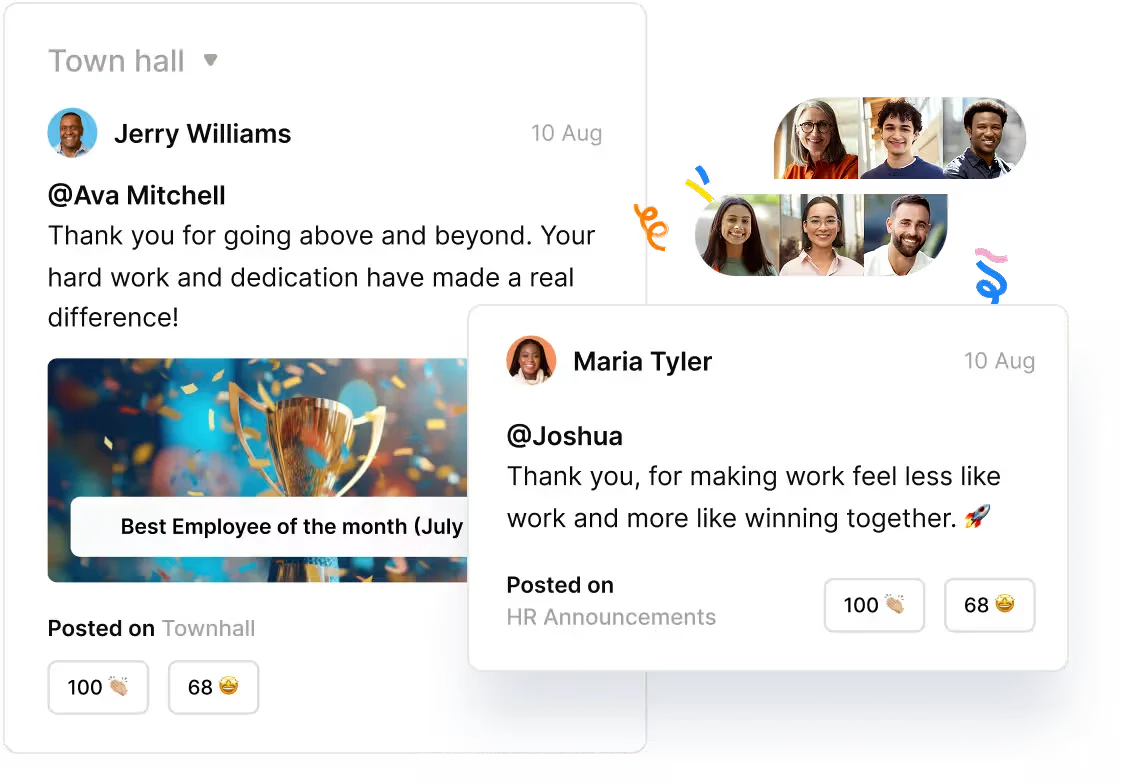
Your HRIS keeps records and runs payroll; Empuls keeps people motivated and heard. Because it syncs with the HR system you already use, recognition, celebrations and surveys run on accurate employee data without manual upkeep.
- Make appreciation a habit with Empuls recognition, from peer kudos to nominations and award campaigns.
- Listen continuously with Empuls surveys, including pulse, eNPS and AI sentiment analysis.
- Offer flexible perks people actually use with Empuls benefits.
- See the HRIS and collaboration tools Empuls connects to on the Empuls integrations page, such as Workday and BambooHR.
Choosing HR software that fits your workforce
Investing in the best HR software is a strategic necessity, not an option. Start by deciding which type you need, shortlist two or three platforms with the comparison table and score them with the weighted scorecard. Whether you run a small business or a global enterprise, the right combination, usually a solid HRIS or HCM suite plus an engagement layer, streamlines operations, keeps you compliant and helps HR move from administrative task management to strategic business partnership.
Book your Empuls demo
Frequently asked questions
The best HR software for a small business is one that fixes its biggest manual task, usually payroll, and is easy to set up without a consultant. Payroll-first tools such as Gusto and all-in-one HRIS platforms such as BambooHR or PeopleForce are common choices. Check that it can add performance and engagement features as you grow.
An HRIS (human resources information system) manages core employee data, time off, documents and often payroll. An HCM (human capital management) suite adds broader talent functions such as recruiting, learning, performance, workforce planning and analytics, usually for larger organizations. In practice the terms overlap, so compare features rather than labels.
Most HR software is priced per employee per month, with small business tools often charging a base fee plus a per-person rate and enterprise suites quoting custom prices based on modules, headcount and countries. Budget for implementation, integrations and training as well as the subscription, and ask vendors for a full total cost of ownership.
Core features include a centralized employee database, payroll, time and attendance, recruitment and onboarding, employee self-service, performance management, engagement and recognition, and reporting and analytics. Security, role-based access and integrations with your other systems matter just as much as the feature list.
Empuls is employee engagement software rather than an HRIS or payroll system. It covers recognition, rewards, surveys, benefits, celebrations, communication and wellbeing, and connects to more than 60 HRMS platforms, such as Workday, SAP SuccessFactors, UKG, ADP and BambooHR, so it works alongside the HR software you already use.
Small business HRIS and payroll tools can often go live in a few days to a few weeks. Mid-market platforms usually take one to three months, while enterprise HCM suites can take six months or more depending on modules, countries, data migration and integrations. A phased rollout reduces risk.
Start with fit to your main problem, then compare ease of use, payroll and compliance coverage, integrations, scalability across countries, security certifications, reporting and total cost. Ask each vendor to demo your own scenarios and score them on a weighted scorecard so the comparison stays objective.
Often, yes. Most HRIS and HCM suites focus on records, payroll and compliance, and their engagement tools tend to be basic. A dedicated engagement platform adds richer recognition, rewards, surveys and benefits, and uses HRIS data to automate them. Check whether your HRIS covers what employees will actually use daily.





































































































































































































































































































































































































































































































































































