
Key Takeaways
A strong organizational culture is a shared set of values and everyday behaviors that most employees understand, believe in and act on.
Only 26.7% of employees believe in their organization's culture, according to Gartner's 2025 research, so most companies have real room to improve.
Culture changes through five levers: leader behavior, symbols and rituals, people practices, business processes, and environment and infrastructure.
Limit a culture change program to three to five behavior shifts over 12 to 18 months, and give each a measurable shape.
Culture surveys and focus groups at the start and end of a 12-month roadmap show whether the new behaviors are really taking hold.
Here is how to build a strong organizational culture: audit the culture you have, define the few behaviors the business needs next, make leaders the visible custodians of that change, tell the story simply, and redesign systems, rewards and the employee experience so the new behaviors become the easy default. Then measure progress with regular surveys and adjust.
A strong organizational culture is a shared set of values, beliefs and everyday behaviors that most employees understand, believe in and act on, consistently enough that it guides decisions even when no one is watching. This playbook covers when culture change is needed, the dimensions and levers to work on, the leader's role, an 8-step plan and a 12-month roadmap.
Why culture is a strategic necessity
In an era where businesses constantly evolve to stay ahead, building a strong organizational culture has become more than an HR initiative. It is a strategic necessity. A thriving culture keeps employees engaged, motivated and aligned with the company's vision, and without it, even the best strategies can falter. For the fundamentals, see what organizational culture is.
With business transformation a priority for growth leaders, the need to make the most of human capital has never been more urgent. The companies that succeed recognize employees as their biggest asset and invest in a culture that fosters collaboration, innovation and long-term commitment. Leaders also acknowledge that this is easier said than done if they did not prioritize a people-first culture in the past.
The current numbers show how much room most companies have. Gartner's October 2025 culture research found that only 26.7% of employees believe in their organization's culture and 26.4% act on its behalf, both down from 2022. Gallup's organizational culture indicator shows what is at stake: employees who feel strongly connected to their culture are 4.3 times as likely to be engaged and 47% less likely to be looking for a new job.
26.7%
of employees believe in their organization's culture
Gartner, 2025
4.3x
as likely to be engaged when connected to culture
Gallup
20%
of employees worldwide were engaged in 2025
Gallup, 2026
22%
of managers were engaged, down from 27%
Gallup, 2026
The culture gap most organizations need to close
The role and importance of organizational culture are well documented; read why organizational culture is important for the full business case. The real challenge is how to build a strong organizational culture: one that adapts to change, aligns with business goals and resonates with employees at every level.
Culture can be shaped, not just inherited
Execution eats planning for breakfast. Executing a winning business strategy requires the entire workforce to move in lockstep, guided by common beliefs and unified toward a common purpose. In short, it requires a culture that knits teams together and generates the outcomes you want.
Culture doesn't build itself. Planting, watering and inspiring it every day is everybody's business. Culture is a living, breathing entity that depends on the choices people make at work every day. Unlike a strategy deck, a funding plan or a policy file, which can sit dormant, culture lives in the people of a company.
People are never passive. They can be recharged and reinforced through timely nudges, incentives and interventions, which makes culture something you can consciously influence. Culture also constantly interacts with and adapts to the internal and external environment, which makes it vulnerable to strong forces. Keeping it on course is an essential goal for leaders.
That is easier said than done. Most leaders are well versed in strategy and planning, but culture is harder to see on a spreadsheet. Rooted in unspoken conduct, patterns and norms, it can feel elusive until you deliberately name it, measure it and manage it. The iceberg model of culture is a useful way to see what lies beneath the visible behaviors.
Signs it is time for a cultural transformation
Like people, culture can run into ill health. Meltdowns rarely happen overnight; they result from the gradual erosion of the values, goals and forces that hold a team together. Long before a breakdown, culture usually sends warning signals, and custodians of culture need to spot them and respond at the right time.
A change effort that is not going to plan, a merger that leaves employees confused about the bigger purpose, or a harsh review on an employer review site are all threats you can catch early if you are alert. Here are the signs it may be time to review and revamp your organizational culture framework:
- Blurred identity: Your brand identity in the market is getting blurred, and you are not part of the conversations that matter as often as you would like.
- Wrong reasons: When you do feature in public discussion, it is not for the reasons you would want.
- Poor reviews: Employee reviews, ratings and feedback are uncharitable.
- Talent loss: You are losing top talent to rivals.
- Leadership disconnect: Leaders and the rest of the organization disagree on fundamental issues.
- Low enthusiasm: Employees no longer greet new company initiatives with the energy they once did.
- Toxic signals: Morale is down, new joiners feel isolated, people stop caring about outcomes and your best performers have gone quiet.
Eight culture dimensions to make choices on
Once you know it is time to change, the question is what exactly to change. Cultural attributes drive business strategy, and one widely used culture model maps eight dimensions where leaders must make conscious choices to realign culture with business goals.
| Dimension | What it describes | Question to ask |
|---|---|---|
| Courage | How far employees show resilience when facing adversity, ethical dilemmas, failure or opposition | Do people speak up when something is wrong? |
| Commitment | The pride and ownership employees feel for the organization's success and brand | Do people act like owners? |
| Inclusion | How far the organization accepts diversity and lets people bring their authentic selves to work | Can everyone contribute fully? |
| Shared beliefs | How strongly employees show commitment to the organization's core values | Do values guide daily decisions? |
| Collective focus | The emphasis on collaboration, teaming and cooperation | Do teams share information and credit? |
| Risk and governance | The emphasis on compliance, quality and structure | Is control helping or slowing the work? |
| External orientation | The focus on customers and the external environment | Do customer needs shape priorities? |
| Change and innovation | The willingness to embrace ambiguity, change and risk to grow | Are new ideas tested quickly? |
You will not move all eight at once. Pick the two or three dimensions where the gap between today's culture and what the strategy needs is widest, and focus there.
Five levers of organizational culture transformation
For organizational culture transformation to change course mid-flight, disruption must happen in specific areas. Leaders must spell out the target and integrate it with business initiatives, people practices must adopt it in letter and spirit, processes must carry the momentum and infrastructure must support the journey at every step.
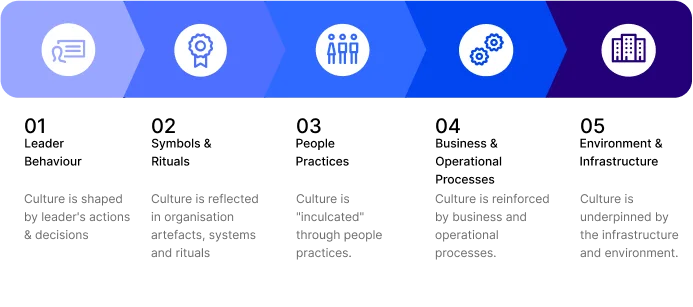
- Leader behavior: Culture is shaped by leaders' actions and decisions, far more than by their words.
- Symbols and rituals: Culture shows in artifacts, systems and rituals, such as how wins are celebrated and how meetings run.
- People practices: Hiring, onboarding, performance management, recognition and promotion decide which behaviors spread.
- Business and operational processes: How decisions are made and work flows either reinforces the target culture or undermines it.
- Environment and infrastructure: Workspaces, tools and digital platforms make the desired behaviors easy or hard.
Every thought and action should map back to the overarching purpose of the journey. If a lever is pulling in a different direction, for example a bonus plan that rewards individual heroics while the culture asks for collaboration, fix the lever before asking people to change.
See whether your culture change is landing
Run pulse surveys on target behaviors and recognize them every week.
Talk to our ExpertTrusted by 5,000+ companies
The role of a leader in shaping culture
A leader sets the tone for organizational culture. Whether through hands-on collaboration or structured management, their behavior signals how things work: a visible, approachable leader fosters openness, while a closed-door approach can stifle communication. Leaders also shape how rewards and recognition flow, and if efforts are not acknowledged fairly, employees disengage.
Managers matter as much as executives, and they are under strain. Gallup's State of the Global Workplace 2026 found manager engagement fell from 27% to 22% in a single year and that lower engagement among managers accounts for most of the recent downturn in employee engagement. Four leadership behaviors make the biggest difference.
Leading with ethics
Great leaders don't just drive performance; they uphold values. Ethics in leadership is not about universal agreement but about consistency, fairness and clarity. Even people who do not share a leader's viewpoint will respect one who stands by a clear, inclusive code of ethics.
Unethical or vague values, on the other hand, confuse teams and damage trust. A leader's integrity, transparency and example become the foundation of a respected workplace.
Leading through crisis
It is easy to lead in good times, but a crisis defines true leadership. When things go wrong, employees look to leaders for strength, guidance and decisive action. Dodging tough decisions weakens confidence, while facing challenges head-on builds lasting credibility and alignment.
Driving cultural change
Company culture must evolve with time, and when change is needed, it is the leader's responsibility to drive it from the front, not from the sidelines. Change is uncomfortable, but leaders must model the behaviors and mindsets they want others to adopt.
Employees resist what leaders don't believe in. To shift a culture, leaders must live the change themselves. For how change efforts are structured, see these components of organizational change.
Doing the hard things
Leadership often means personal discomfort: sacrificing preferences, adapting to new tools or following others' advice when it is in the company's best interest. Great leaders do not cling to ego; they do what is best for the mission, even when it is not easy.
How to build a strong organizational culture: an 8-step playbook
These eight steps run in order, from diagnosis to everyday experience. A well-defined culture is not just a set of values; it is the driving force behind engaged employees, innovation and growth, so the early steps of auditing, ownership and communication decide whether the later ones stick.
1. Audit the current culture and articulate the next
Any attempt to build or rebuild the culture code must begin with a careful analysis of the existing culture, while defining the critical beliefs and behaviors that must be in place to support the business's future ambitions. You need a clear understanding of how the current culture works and what outcomes it produces, because that shows exactly which parts must change to align culture with new realities.
For example, a technology company with an authority-driven culture may find that a learning culture suits growth better in a market that changes almost every day. The next culture must account for challenges, opportunities, strengths, trends and aspirations.
Be careful not to spread yourself too thin. Focus on a handful of high-priority shifts that matter more than others, and give each a measurable shape, such as defined behaviors or performance KPIs, so everyone understands what the culture stands for and what it expects from every player. Then outline roles, establish accountabilities and align culture and performance metrics with the purpose of the brand journey.
2. Appoint custodians of culture
Culture must begin at the top and flow down. Leaders have a vital role in embedding the cultural fabric: they are uniquely placed to drive change across hierarchies and levels and to create a safe climate for adoption. Of course, leaders must be enthusiastic about it themselves first.
A top-down approach is not the only way to plant the seeds of culture, though. A bottom-up approach actively considers the habits, passions and aspirations of employees at every level, including frontline teams. It is inclusive, celebrates diversity, gives employee experience its due and makes culture personal.
On the flip side, a bottom-up approach with too many voices can decentralize the process until it spins out of control. A blend of the two usually works best. Either way, there must be custodians who take ownership and steer the transition.
3. Communicate the story
Once leaders have a clear picture of the culture they want to build, they need to generate enthusiasm for it across teams and departments. Culture is everyone's business, and everyone must play an active role in spreading it, but first people must understand the new behaviors and expectations.
Structured forums for dialogue, two-way feedback channels that give employees a voice and a network of culture champions all help build awareness and momentum. Tell stories that matter, systematically and memorably: well-chosen stories demystify protocols, connect personally and align people more closely with the mission. Leaders often think they have nailed culture when employees see it differently, so listen as much as you broadcast.
4. Don't overcomplicate
If you cannot write your values and culture down in a few words, they are probably too complex to understand. Some of the most enduring culture stories thrive on simplicity, such as one-word or two-word mottos that everyone can repeat.
Too many culture messages and activities can backfire, causing anything from puzzled irritation to alienation. It is easier to remember rules when the rules are simple. Present a lean, clear version of the next culture framework, from what it stands for to what it expects from each person. From morale to productivity to compliance, a simple culture code accelerates nearly every part of the change. For examples of short, usable values, see these core values in the workplace.
5. Redesign the work system
People are only part of it. Systems, structures and processes must all be tuned to support the target culture, nudging the desired behavior at every turn. That includes the balance between central and local decisions, workflows that embody and reward culture attributes, structured coaching and workshops, and performance management where cultural behaviors are recognized and rewarded.
Subcultures matter too. Deloitte's 2024 Global Human Capital Trends research found that 71% of business and HR leaders rate focusing on individual teams as a place to build culture as very or critically important. Use design thinking at scale to redesign how work happens:
- Examine how employees work and behave, across a cross-section of functions, levels and locations.
- Read external employer review sites for insights from employees who are not speaking up internally.
- Analyze needs, challenges and habits to simplify work patterns and build efficiency.
- Create journey maps for key worker personas.
- Use technology to create a shared cultural experience across a distributed workforce.
- Identify and nurture team subcultures aligned with the bigger journey, and spot culture risks early.
- Build incentives and rewards into the flow of work, and enlist C-suite support to drive adoption.
- Keep tracking, measuring and refining the employee experience.
6. Encourage interaction
Forging connections, encouraging collaboration and promoting communication between employees and teams is a powerful catalyst for alignment, morale and performance. Healthy interaction allows a free exchange of ideas, brings teams closer and prevents breakdowns caused by poor communication.
Communication gaps often hide in plain sight: managers may care about employees' growth while employees remain unaware of the development opportunities available. Bridge the gap by being honest early, listening with empathy, documenting ideas and decisions, and encouraging kind candor so teams feel safe to back themselves and make big decisions. Building a culture of feedback makes this a habit.
7. Hire for culture add, not culture fit
The idea that we must hire people who already match our mission and manner is gradually falling out of favor. It is too idealistic to expect an outsider to match an insider exactly, it risks missing out on top talent, and hiring people who all think alike tends to produce the same ideas every time.
Hiring for culture add solves all three problems. It means staying loyal to your roots while staying open to new thinking, judging candidates on how they can enrich the culture rather than simply comply with it. Engaging diverse talent pools also builds inclusion and diversity in the workplace, which strengthens creative thinking, problem solving and decision making.
8. Go big on employee experience
Nothing works if your people don't. To ignite your culture, make employees the heroes around which you design the workplace and the workflow. Many leaders believe they are investing in their people while far fewer employees feel that investment, and that gap can genuinely hurt the business. Three approaches help close it; keep each one personal, engaging and consistent.
Help employees find and pursue their purpose: People respond to two kinds of motivation. Extrinsic motivators such as money, recognition and status are easier to understand and use, but intrinsic motivation, rooted in natural interests and a sense of meaning, is the real multiplier. When a workplace connects organizational goals with what employees care about, it unlocks energy and creativity no strategy can match. See intrinsic vs extrinsic motivation for how to balance both.
Take care of body, mind and spirit: Offer programs and workshops on stress, healthy habits, nutrition, financial planning and family support to improve work-life balance and physical and mental fitness. Small acts of care in a crisis, such as helping an employee through a medical emergency or an accident, often do more for culture than any campaign. For program ideas, see these employee wellbeing programs.
Respect contributions and reward impact: A culture that gives employees a strong sense of belonging is built on respect and fairness. Give people a stage to shine, a voice in decisions, access to experienced mentors and room to take on projects they are passionate about. Above all, design a reward and recognition approach that acknowledges involvement, applauds effort and rewards achievement, fairly, memorably and on time. Creating a culture of recognition shows how.
A 12-month culture transformation roadmap
The playbook works best as a sequence with milestones. Use this roadmap to plan culture change in the workplace over a year, adjusting the pace to the size of the organization and the depth of the shift.
| Phase | Months | Key actions | How you know it is working |
|---|---|---|---|
| Diagnose | 1 to 2 | Culture survey, focus groups, exit and review data; pick the dimensions to shift | Baseline scores and three to five target behaviors agreed |
| Define and commit | 2 to 3 | Write a simple culture code, name custodians and champions, align leaders | Leaders can describe the target behaviors the same way |
| Communicate | 3 to 4 | Launch with stories, town halls and team conversations; open feedback channels | Employees can explain what is changing and why |
| Redesign systems | 4 to 8 | Update hiring, onboarding, performance reviews, recognition and key processes | Target behaviors are recognized and rewarded every week |
| Reinforce | 8 to 11 | Coach managers, celebrate examples, fix levers that pull the wrong way | Pulse scores on target behaviors improve |
| Review | 12 | Repeat the culture survey, compare with baseline, choose next shifts | Gains in belief, engagement and retention against baseline |
Keep checking the pulse with surveys and focus groups
Culture surveys measure how far a team's behavior matches its stated values, persona and purpose. They map the organization's human side to its strategy and show the impact on business results. They act as both a compass and an alarm clock: they show where you are doing well, where gaps remain and where effort is falling short.
Designing a culture survey well is critical to getting the most out of it. Follow these rules of thumb:
- Ask about observable, measurable behavior rather than views and opinions.
- Include questions that correlate directly with the organization's performance.
- Avoid combining different topics in one question.
- Include some negatively worded questions, which make people think twice before answering.
- Avoid loaded or emotionally charged terms.
- Use one consistent rating scale throughout.
Don't stop at surveys. Follow them with focus groups, which add qualitative insight to the numbers. Set clear goals and ground rules, choose participants and a facilitator carefully, and guide the conversation so it stays on track. For survey types and question design, see this guide to the employee survey.
How Empuls helps build a strong organizational culture
Great workplaces are built with intention. A strong organizational culture is not about perks or buzzwords; it is about how employees feel, connect and engage every day. Empuls helps organizations shape culture from the inside out by making recognition, listening and communication part of daily work.
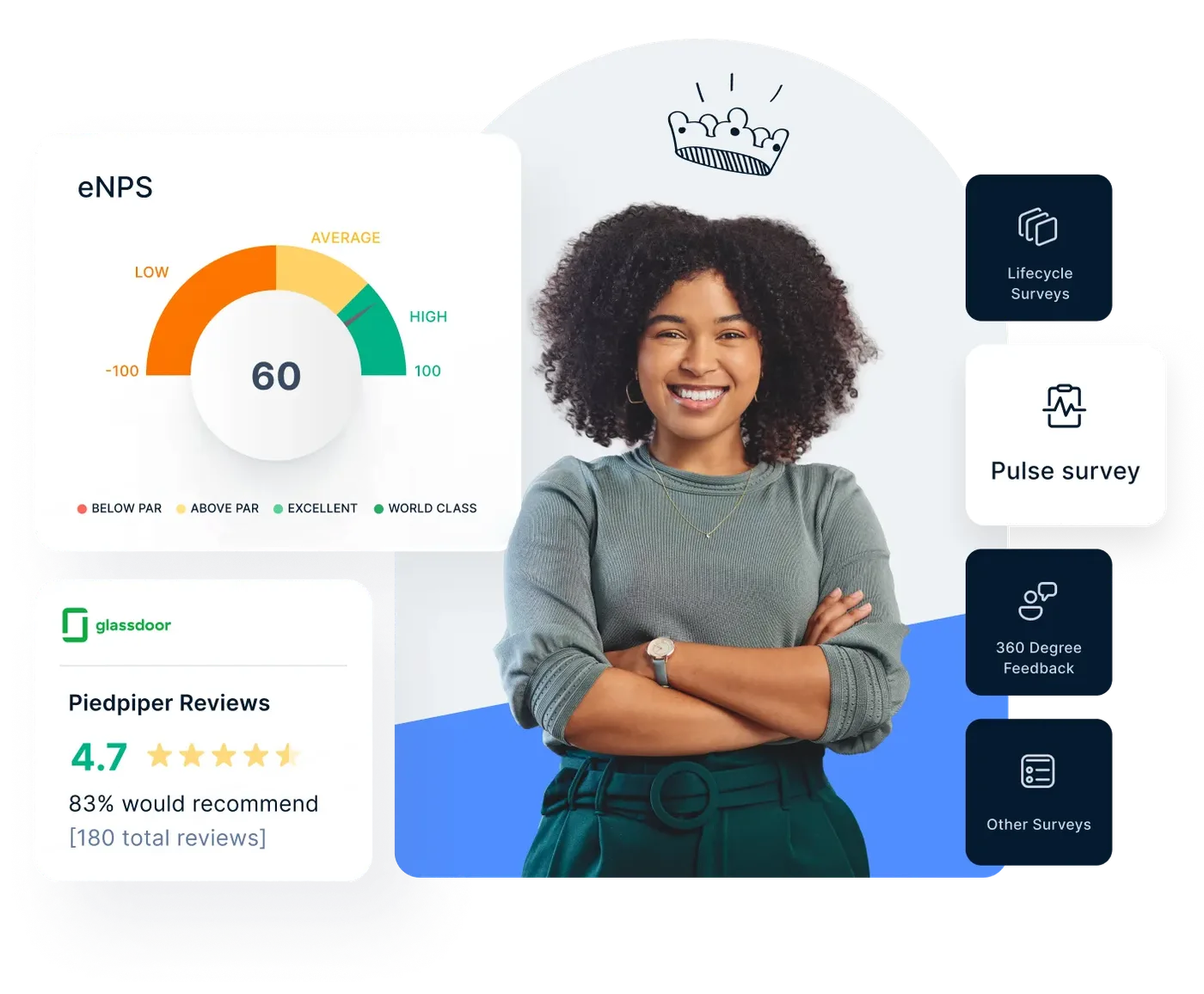
- Recognition that feels real: Everyday peer and manager recognition tied to your values, not just yearly awards.
- A voice that is heard: Pulse surveys and lifecycle surveys with action plans that turn feedback into change.
- Conversations that connect: A social intranet that keeps distributed teams informed and connected.
- Rewards that motivate: Personalized rewards that show employees their contributions count.
For companies that want to do more than talk about organizational culture, Empuls makes it actionable, because when employees feel valued, work becomes a place where people grow, contribute and belong.
Build the journey, not the destination
A great culture will eventually lift business performance, but starting with performance puts the cart before the horse. Focus on creating a growth environment, and performance follows. When you chase results without a psychologically safe environment, you create a win-at-all-costs culture where fear and insecurity drive decisions.
The evidence for safety is strong: in the American Psychological Association's 2024 Work in America survey, workers with high psychological safety were far less likely to describe their workplace as toxic. When you build a culture of growth, people relax, look past shortcomings and engage with their work and their team, creating a climate of honesty, teamwork and fulfillment.
Nurture a strong organizational culture by combining psychological safety, continuous learning, collaboration, open communication, regular feedback, personal accountability, diversity and a set of strong, shared values. For more ways to strengthen the culture you already have, see how to improve organizational culture, build a positive company culture and create cultural alignment.
Book your Empuls demo
Frequently asked questions
A strong organizational culture is one where most employees understand, believe in and act on a shared set of values and behaviors. It guides decisions consistently, even without rules or supervision. Strong is not the same as healthy, so the goal is a culture that is both widely shared and aligned with the strategy and with how people want to be treated.
Meaningful culture change usually takes 12 to 18 months for a focused set of behaviors, and longer for a full transformation in a large organization. Early signs, such as leaders modeling new behaviors and improved pulse scores, can appear within a few months. Limiting the program to three to five shifts helps progress show sooner.
Everyone shapes culture, but leaders own it. Executives set direction and model behaviors, managers translate them into daily team habits, HR designs the people practices that reinforce them, and employees spread the culture through how they work together. Naming culture custodians and champions makes ownership clear and keeps the change on track.
Start by auditing the current culture with surveys, focus groups, exit interviews and review data. Then define the few behaviors the business needs next, agree on them with the leadership team and name custodians. Only after that should you communicate the change and redesign systems, so the message and the reality match from day one.
Measure culture with a baseline culture survey on observable behaviors, followed by regular pulse surveys on the target behaviors, plus focus groups for context. Track related outcomes such as engagement, eNPS, retention of high performers and internal mobility. Compare results with the baseline at the end of each cycle to see whether the change is taking hold.
Culture change often fails because leaders announce values but do not change their own behavior, too many priorities dilute focus, or systems such as pay, promotion and performance reviews keep rewarding the old behaviors. Weak communication and no measurement add to the problem. Fixing the levers, not just the messaging, is what makes change stick.
Culture fit hires people who already match the existing culture, which can lead to similar thinking and missed talent. Culture add hires people who share the core values but bring new perspectives, skills and experiences that enrich the culture. Culture add supports diversity and better problem solving while keeping the organization true to its roots.





































































































































































































































































































































































































































































































































































