
Key Takeaways
Organizational culture is important because it shapes the everyday choices that drive engagement, retention, execution and financial results.
Employees who feel connected to their organization's culture are 4.3 times as likely to be engaged and 47% less likely to be job hunting, according to Gallup.
Over 27 years, the Fortune 100 Best Companies to Work For delivered 3.5 times the cumulative stock returns of the top 1,000 US companies, per Great Place To Work.
Culture works in both directions: a healthy culture multiplies performance, while a toxic one drives burnout, attrition and failed change.
Track culture through metrics you already have, such as engagement scores, regretted attrition, referral hires and burnout rates.
The short answer to why organizational culture is important: it shapes how every employee thinks, decides and behaves, and those everyday choices drive engagement, retention, execution and, ultimately, financial results. A strong culture aligns people with strategy, attracts and keeps talent, and helps a company change without losing itself. A weak or toxic one quietly taxes every goal you set.
Why do your business and teams need a deeply aligned and patiently nurtured culture to raise their game? This post answers that question with eight clear reasons, the latest research on the importance of organizational culture and the metrics that show whether yours is working.
There are dozens of ways to say “Hello!” in English alone. Your organizational culture is the way you prefer to say yours. If it is distinctly your own, you have struck gold: you have set yourself apart from a sea of rivals, and thanks to the tone, the warmth and the spontaneous tilt of the head when you say it, you may have made an instant and lasting connection with someone. That, right there, is your organizational culture.
The purpose of organizational culture
Culture is the signature style in which you deliver your promise to customers, employees, channel partners and other stakeholders. If you need a refresher on the basics, start with what is organizational culture.
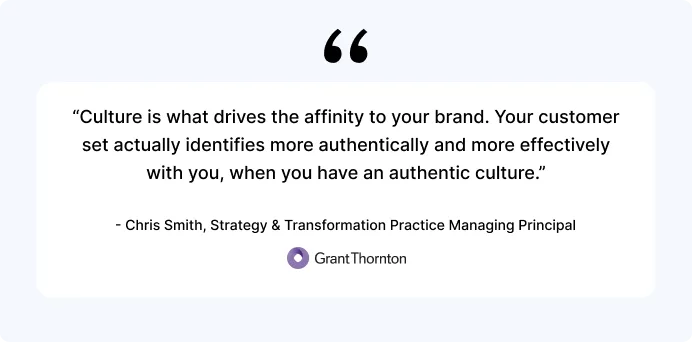
Over time, that “Hello!” becomes your halo: a code rivals can emulate but never copy, insurance against a market that is fast becoming commoditized, and a shared password for employees who belong to the tribe.
Organizational culture statistics leaders can't ignore
The research on culture has moved beyond opinion. Recent large studies tie culture directly to engagement, burnout, retention, discretionary effort and shareholder returns, and they also show how few organizations have it right:
20%
of US employees strongly agree they feel connected to their organization's culture
Gallup, 2026
3.5x
cumulative stock returns of the Fortune 100 Best Companies to Work For vs the top 1,000 US companies over 27 years
Great Place To Work, 2025
15%
of US workers describe their workplace as toxic
APA, 2024
Culture by the numbers
| Finding | Source |
|---|---|
| Employees who feel connected to their culture are 4.3 times as likely to be engaged, 47% less likely to be job hunting and 62% less likely to feel burned out often or always | Gallup organizational culture indicator |
| Discretionary effort is 42% higher at companies recognized as great workplaces with high-trust cultures | Great Place To Work, 2025 |
| Workers with high psychological safety are 10 times less likely to call their workplace toxic (3% vs 30%) | APA Work in America 2024 |
| Well-recognized employees are 45% less likely to have left their employer two years later | Gallup and Workhuman, 2024 |
| Only 20% of employees worldwide were engaged in 2025, and low engagement cost an estimated $10 trillion in lost productivity | Gallup State of the Global Workplace 2026 |
The business case for culture
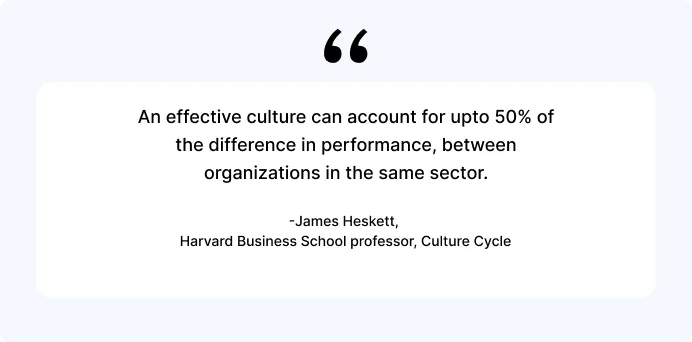
An organization can have all the technology, support and funding in the world, but culture will ultimately decide outcomes. That is because culture influences the one form of capital that controls all the others: people. In calm times, the right culture keeps workers engaged, happy and productive. In times of uncertainty and disruption, it empowers them to respond, pivot and reboot.
Because of its hold over people, culture leaves a strong imprint on practically every business function: strategy, operations, finance, HR, marketing, sales and customer service. It guides expectations, builds resilience, informs decisions and influences planning. That is how culture affects performance: not through one big lever, but through thousands of small choices made the same way.
Due to all these factors, and above all its power to attract and retain top talent, culture has become a boardroom KPI. Merriam-Webster even named “culture” its word of the year in 2014, and culture manifestos remain among the most widely shared pieces of company content online.
The role of organizational culture
Organizational culture affects every spoke that turns the wheels of business: employees, suppliers, customers, investors, the communities a company operates in and the wider social and natural environment.
Inside the company, culture touches the core people issues that McKinsey partners Scott Keller and Mary Meaney cover in their book “Leading Organizations,” such as:
- Attracting and retaining talent
- Developing current talent
- Managing performance
- Creating effective leadership teams
- Making decisions
- Reorganizing to capture value quickly
- Reducing overhead costs for the long term
- Leading transformational change
- Transitioning into new leadership roles
Get culture right and each of these gets easier. Get it wrong and each one becomes a fight.
Make your culture visible every day
Recognize values in action and track culture connection with pulse surveys on one platform.
Talk to our ExpertTrusted by 5,000+ companies
8 reasons why organizational culture is important
When you win on culture, you win everywhere. The eight strong company culture reasons below move from the everyday (alignment and motivation) to the strategic (competitive edge and risk), and the first, alignment, carries the most weight because every other benefit depends on people pulling in the same direction.
1. Culture is the aligner
Organizations gain momentum when employees are aligned and moving toward the business goal with passion. That momentum lets them deliver a seamless, differentiated customer journey while creating a compelling employee experience.
Alignment means that everyone, from customers to current and prospective employees, shareholders, industry influencers and the media, thinks and talks about the company in the same way, with the same accents and metaphors. It also gives leaders, managers and individual contributors direction, clarifying how to prioritize their time, energy and resources.
2. Culture is the multiplier
Of all the strengths an organization can build, connecting employees to their work at a personal level is perhaps the most powerful. It is also the trickiest, because many workers see a job as little more than a source of income, and many leaders default to an economic view of their firm.
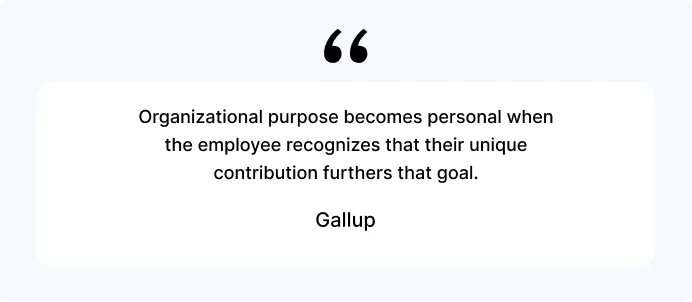
That is changing. Organizations that make their mission personal to employees reap the rewards: Gallup finds that employees who feel connected to their organization's culture are 4.3 times as likely to be engaged. The right culture brings purpose to the center of the work experience. Purpose bridges what employees do best with what the company does best, and connects what employees care about most with the impact the organization has on its industry, society and the environment.
3. Culture is the implementer
Culture bridges your vision and your execution. It gives structure and expression to strategy and goals, and it clears the confusion that too many choices bring, laying out a path people can trust.
As you advance, culture keeps adding the clarity and focus needed to make good decisions on the go. If your business is the play, your culture is the playbook.
4. Culture is the GPS
Culture is also a powerful lever for transformation, especially in times of flux. A well-defined, deeply ingrained culture helps an organization navigate change without selling out its core.
Large transformation programs most often stall on people and culture issues rather than on strategy. Leaders who find culture too complex to solve, and leave it to fester on the back burner or relegate it to HR, give up what could have been a unique competitive advantage, and sometimes the difference between survival and decline.
5. Culture is the decision-maker
Culture is a good indicator of whether a new product launch, merger or hire will fly. It shows whether a move is in sync with the soul of the business and will help fulfill its cause, or whether, like the wrong medicine, the system is likely to reject it.
That is why leaders who keep a finger on the pulse of their teams are often better placed to make big decisions than peers with fancier qualifications and titles.
6. Culture is the unassailable edge
In a commoditized, competitive world, where technology is democratized, talent is fished from common pools and business models are easily copied, workplace culture is one of the few things that truly sets you apart.
Culture originates in a deeply human place, and no two groups of humans are the same, which makes culture very hard to copy. When attention is the scarcest currency, culture offers a simple, though not easy, way to stand out. The numbers back this up: Great Place To Work reports that over 27 years, cumulative stock returns for the Fortune 100 Best Companies to Work For were 3.5 times those of the top 1,000 US companies by market cap.
7. Culture is a double-edged sword
Culture can be a tailwind or a headwind, depending on which way you face. Positive tribal energy leads to high performance and strong morale, while toxic workplaces pay a heavy price that goes well beyond weak results if they don't change in time.
History offers plenty of warnings. One US energy trading giant collapsed in the early 2000s after building a culture that celebrated individual stars, rewarded undermining colleagues and punished bad news. In another common pattern, performance suffers after a merger brings together one company built on “low cost” and another built on “quality service,” and employees receive mixed signals about what matters. The APA's 2024 Work in America survey found that 15% of US workers describe their workplace as toxic.
8. Culture is the health tonic
Mental health at work is now firmly in the spotlight, and the onus is on talent leaders and workplace designers to keep employees healthy and happy. Research points to the same drivers again and again: psychological safety, flexibility, autonomy, being listened to, inclusion, a sense of belonging and consistent recognition.
The flip side is just as clear. Toxic cultures create needless stress, damage relationships at work and at home, and lead to burnout. In the APA survey, workers with high psychological safety were far more likely to say they belong (95% vs 69%) and far less likely to call their workplace toxic (3% vs 30%).
A trust-driven, supportive culture produces healthier workers and changes how they see their leaders, which strengthens the employer brand. Gallup's chief scientist Jim Harter has long observed that people with high individual well-being are more likely to see their workplace as positive, productive and engaging, and that when they struggle, it rubs off on the team. That is why companies now appoint wellbeing leaders and train managers in listening, flexibility and empathy. As HR analyst Josh Bersin put it, the CEO increasingly has to be the chief empathy officer.
Organizational culture as a talent magnet
Today's top talent wants meaningful work, opportunities to grow and flexible working conditions. Talent doesn't just join companies; it joins missions.
The new generation of talent wants to make an impact and sees its career as a primary way to make a difference. It is also obsessed with personal development, inside and outside work, and seeks out organizations that can feed that need. LinkedIn's 2025 Workplace Learning Report found that career progress is people's No. 1 motivation to learn, and providing learning opportunities is employers' No. 1 retention strategy.
Culture is what keeps that talent. Gallup's culture data shows that employees who feel connected to their organization's culture are 47% less likely to be watching for or actively seeking another job. And because engagement is the performance dimension of culture, an engagement-first culture helps you not only attract top talent but put it to work in the best possible way, inspiring people to bring their full selves to work every day.
Engagement isn't everything, though. Culture designers must also make sure strengths are celebrated, inclusion is nurtured, growth is provided for and achievement is rewarded. As Steve Jobs liked to say, a small team of A+ players can run circles around a giant team of B and C players.
Culture and your employer brand
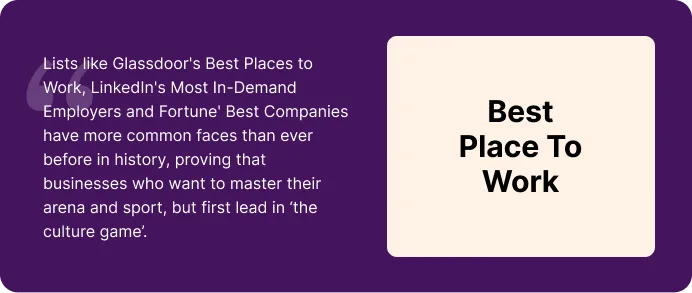
When you get the talent dimension right, your trophy is the holy grail of modern business: a magnetic employer brand. Recruitment now looks a lot like marketing, and candidates research a company's culture through reviews, social posts and their own networks long before they apply.
Talent is scarce and worth fighting for. McKinsey's Steven Hankin coined the phrase “war for talent” in 1997, and the contest to build the best workplace in the world has only intensified since. Lavish perks no longer raise eyebrows, and they don't build loyalty on their own. Organizations that use culture as their core employer value proposition see the bigger payoff. Grocery chain Wegmans, for example, has been named to the Fortune 100 Best Companies to Work For list every year since it began in 1998, built on a simple principle: take care of your people and they will take care of your customers.
To protect your employer brand, make sure the culture candidates read about is the culture they experience. Respond to reviews openly, let employees tell their own stories and fix the issues that come up repeatedly. A gap between the promised and the real culture shows up quickly in early attrition.
Organizational culture benefits you can measure
Culture can feel abstract, but its benefits show up in numbers you already track. Use this table to connect each reason above to a metric:
| Benefit | What to measure | Healthy signal |
|---|---|---|
| Alignment | Share of employees who understand company goals and how their work contributes | Rising quarter over quarter |
| Engagement | Engagement score and eNPS from pulse surveys | Above your industry benchmark and improving |
| Retention | Regretted attrition and first-year attrition | Falling, especially among top performers |
| Wellbeing | Burnout and psychological safety survey items | Fewer people reporting frequent burnout |
| Employer brand | Offer acceptance rate, referral share of hires, review ratings | More hires from referrals, fewer declined offers |
| Performance | Productivity, quality and customer satisfaction by team | High-culture teams outperform the rest |
Strengthen your culture with Empuls
Knowing why organizational culture is important is the first step; making it visible every day is the next. Empuls, Xoxoday's employee engagement platform, helps you do that:
- Recognize values in action: Use recognition and awards tied to your company values, so people see which behaviors the culture prizes.
- Listen continuously: Run pulse and lifecycle surveys to track culture connection, wellbeing and engagement, then act on the results.
- Connect every team: Give distributed and frontline employees one place to share news, celebrate wins and join groups through the social intranet.
- Support wellbeing: Offer wellness programs and fitness challenges that make healthy habits part of work life.
For practical steps to shift a culture that has drifted, see how to improve organizational culture.
When two plus two equals ten
With its potent mix of shared aspiration and deep bonding, culture makes a group more than the sum of its parts. Daniel Coyle opens his bestseller “The Culture Code” by asking why certain groups add up to more than the sum of their parts while others add up to less. His answer is culture, and he titles that chapter “When Two Plus Two Equals Ten.”
When you nurture it with intent, culture holds a tribal force that punches far above its weight, accomplishes more than any capability audit would suggest and always adds up to more than the sum of your parts. That is the clearest reason why organizational culture is important.
Book your Empuls demo
Frequently asked questions
Organizational culture is important because it guides how people behave when no rule tells them what to do. A strong culture aligns employees with strategy, raises engagement and discretionary effort, improves retention and wellbeing, speeds up decisions and helps a company change without losing its identity. A toxic culture does the opposite.
Culture affects performance through thousands of daily choices about effort, quality, collaboration and customer care. Research from Gallup links culture connection to much higher engagement, and engaged teams show higher productivity and profitability and lower absenteeism and turnover. Culture also shapes how quickly teams adapt to change, which protects performance over time.
The main benefits of a strong company culture are better alignment with goals, higher engagement, lower turnover, a stronger employer brand, better wellbeing and faster, more consistent decisions. Companies with high-trust cultures also report more discretionary effort from employees and, among the best workplaces, stronger long-term stock returns.
A bad culture raises stress, burnout and turnover, lowers trust and makes people hide mistakes instead of fixing them. Over time it damages the employer brand, slows change programs and can lead to ethical failures. In 2024, 15% of US workers described their workplace as toxic, according to the American Psychological Association.
Look at engagement and eNPS scores, regretted attrition, offer acceptance rates, referral hires and burnout indicators, and compare them across teams. Ask employees whether they feel connected to the culture and safe to speak up. If these signals improve together, your culture is working; if they diverge by team, you have subculture issues.





































































































































































































































































































































































































































































































































































