
Key Takeaways
The 10 pillars of employee engagement are communication, work environment, collaboration, rewards, personal development, role definition, leadership support, goal alignment, feedback and growth.
Leadership support is the heaviest pillar, because managers account for about 70% of the variance in team engagement according to Gallup.
Scoring one survey statement per pillar turns the pillars into an employee engagement framework that shows each team where to start.
Only 20% of employees worldwide were engaged in 2025, so most organizations have at least one weak pillar to fix.
Engagement fails when it is left to HR alone; executives, managers and employees each own part of every pillar.
The 10 pillars of employee engagement are communication, work environment, collaboration, rewards and incentives, personal development, role definition, leadership support, alignment with company goals, surveys and feedback, and growth and mentoring. Strengthen these and engagement follows; neglect one and the others have to work harder to compensate.
Employee engagement is an employee's emotional commitment and sense of responsibility toward their work and their employer. It is also scarce: Gallup's State of the Global Workplace research found that only 20% of employees worldwide were engaged in 2025, the second annual decline in a row. This guide explains each pillar, how they fit into an employee engagement framework and how to check which ones need work.
What the pillars of employee engagement are
Pillars of employee engagement are the core workplace conditions that hold engagement up, such as clear communication, recognition, growth and supportive leadership. They are also the key drivers of employee engagement that management can control, which is why it pays to understand them before choosing tactics or tools.
Empirical evidence shows that higher engagement has a profound effect on an organization's success, from productivity and revenue to performance and retention. Gallup's 2024 Q12 meta-analysis found that teams in the top quartile of engagement had 23% higher profitability and 78% lower absenteeism than bottom-quartile teams. Management must understand the causes of engagement and remove the barriers to better alignment between employees and the company. Our guide to the benefits of employee engagement covers the business case in full.
Employee engagement pillars at a glance
Different models group the pillars differently. Some use four, such as connection, communication, appreciation and voice, while others use five or six, but they share the same core themes. The table maps the 10 pillars in this guide to what each one means and the signal that tells you it is weak.
| Pillar | What it means | Warning sign it is weak |
|---|---|---|
| 1. Communication | Open, two-way and well-timed information | Employees hear news from outside the company first |
| 2. Work environment | A safe, respectful and healthy place to work | Poor online reviews and rising sick days |
| 3. Collaboration | Teams that work well together across locations | Silos and duplicated work |
| 4. Rewards and incentives | Fair pay plus timely recognition and wellbeing support | Good work goes unnoticed |
| 5. Personal development | Training and reskilling opportunities | Low internal mobility |
| 6. Role definition | Clear expectations and how the role contributes | Confusion about priorities |
| 7. Leadership support | Visible investment by executives and managers | Engagement treated as an HR project |
| 8. Alignment with goals | A link between daily work and company purpose | Employees cannot explain the strategy |
| 9. Surveys and feedback | Continuous listening followed by action | Falling survey response rates |
| 10. Growth and mentoring | Coaching and visible career paths | High performers leave for promotions elsewhere |
Strengthen every pillar in one platform
Recognize, listen, connect and celebrate with Empuls.
Talk to our ExpertTrusted by 5,000+ companies
The 10 pillars of employee engagement explained
The 10 pillars below run from the everyday foundations of communication and environment to the longer-term drivers of growth and mentoring. Leadership support carries the most weight, because Gallup's research on engagement and productivity estimates managers account for about 70% of the variance in team engagement, but every pillar depends on the others to hold.
1. Communication
Communication lies at the heart of any effort to improve engagement and create a positive company culture. It builds trust and transparency and lifts morale. Effective communication also means adjusting plans in response to employee feedback.
Assuming employees have what they need to do a good job can be a fatal flaw, and ignoring their needs or obstacles can snowball into bigger problems like poor morale. Today, communication also means using the right technology and creating safe spaces for candid conversations, especially for remote and hybrid teams. Set ground rules for how and when to communicate, so it does not become a demand at all hours of the day and night.
2. Work environment
Work environments are now reviewed publicly by employees on job sites, and negative feedback makes both hiring and retention harder. Toxic settings are easy to spot and are a clear sign of poor engagement.
Disengaged employees are unenthusiastic about their work and likely to leave at short notice. They also tend to poison the well, criticizing a company that does not meet their needs, and their influence shows up in weaker team performance and poor customer interactions. A healthy environment includes physical and psychological safety, fair treatment and attention to wellbeing, so treat workload and stress as part of the environment, not separate from it.
3. Collaboration
You cannot force employees to be friends, but you can create more opportunities for casual interactions that let bonds form. Teams where people get on with each other tend to be happier and more productive, and close working relationships are a reason people stay.
With hybrid work, employees are rarely all in one place, so effective collaboration depends on choosing the right digital tools for a dispersed workforce. Video meetings, shared workspaces and interest groups now do much of what corridors and coffee machines once did. Pick a small set of tools, agree how each is used and make sure frontline and remote workers have equal access.
4. Rewards and incentives
Rewards and incentives are an essential part of the engagement toolbox, and employee expectations have shifted. Many companies have rethought total rewards, adjusting both financial and non-financial rewards to fit how people now work. Appreciation, particularly when someone goes above and beyond, is a powerful incentive to keep doing better, because it shows managers are noticing excellent work.
Recognition is also one of the best-evidenced engagement levers. A Gallup and Workhuman study found that well-recognized employees were 45% less likely to have left after two years, yet only 22% of employees say they get the right amount of recognition. Wellbeing belongs here too, since stressed employees have higher absenteeism and turnover. See our guides to total rewards strategy and employee wellness trends.
5. Personal development
Technology now allows more training and reskilling options than ever. When employees are engaged and feel supported by leaders and managers, they produce their best work, and development is a big part of that support. Engagement is about the individual's growth, but employee development directly benefits the organization too.
A culture of continuous learning creates agile organizations that keep pace with competitors and the market. LinkedIn's Workplace Learning Report 2024 found that 90% of organizations are concerned about employee retention and that providing learning opportunities is their number one retention strategy. Not using these options is a poor excuse for employers and can become a serious threat to the business.
6. Role definition
Employees need to understand and be able to articulate what is expected of them if they are to succeed, and providing that clarity is the manager's responsibility. When roles are unclear, people don't know how their work contributes to success, which leads to confusion and frustration. Gallup reports that only about half of US employees strongly agree they know what is expected of them at work.
Newer ways of working define roles more by outcomes than by tasks, so expectations and delegation need rethinking, and autonomy over how the work gets done becomes part of the role. Work and role definitions also need to fit employees' expectations for their own lives. Understand each person's choices and help them connect their objectives with the company's goals.
7. Support from leadership
Employee engagement needs buy-in and investment from the board and management. Employees need to see that the C-suite is invested in the success of the engagement strategy; only then will they trust the effort and commit to the engagement framework.
Managers matter most of all. According to the same Gallup research, managers account for 70% of the variance in team engagement, and engaged teams work more safely, produce higher quality and deliver higher profitability. That should remove any doubt about why leaders should actively support engagement: it directly affects the bottom line.
8. Alignment with company goals
Employees increasingly want more than a paycheck. They want meaning and purpose in what they do, and younger generations are especially focused on it. Deloitte's 2025 Gen Z and Millennial Survey found that 89% of Gen Zs and 92% of millennials say a sense of purpose is important to their job satisfaction and wellbeing.
Helping employees understand how their work affects the bigger picture is a crucial part of a manager's role. Performance conversations should focus on how each person can better meet the organization's objectives, and company values should show up in what gets recognized. Our guide to organizational values shows how to make them visible in daily work.
9. Surveys and feedback
You will not fix engagement problems until you know why they are happening. Surveys give everyone a chance to contribute and reassure staff that their feedback is taken seriously. Listening is great, but you also need data: baseline each component of engagement, then use KPIs to track progress, and ask whether people have the resources, tools and technology to do their jobs well.
A one-off survey does not give you the continuous listening that produces the best data and results, so combine pulse, lifecycle and eNPS surveys. Remember that doing nothing with what employees tell you damages culture more than not asking. Feedback should prompt action, not analysis paralysis. Our article on why annual employee surveys fail explains how to keep listening useful.
10. Growth opportunities and mentoring
Employees look for ways to add value through their work and move their careers forward. Managers should encourage higher performance with effective coaching and training opportunities, and build trusted conversations where employees are not afraid of the consequences of speaking up.
Managers who hold continuous conversations and show how each person's work leads to organizational success create more enthusiastic, engaged employees. It is a familiar adage that people quit managers, not jobs, so managers should work on showing empathy. In his book Give and Take, Wharton professor Adam Grant shows how a leader's generosity can be a strong predictor of team success and helps people perform at their best.
How to use the pillars as an employee engagement framework
The pillars become an employee engagement framework when you score them, pick the weakest and act. Use one survey statement per pillar, ask employees to rate it from 1 to 5 and compare results by team:
| Pillar | Survey statement | Action if the score is low |
|---|---|---|
| Communication | I get the information I need to do my job well. | Set a regular update rhythm and a single channel for news |
| Work environment | I feel safe and respected at work. | Review workload, conduct and wellbeing support |
| Collaboration | My team works well with other teams. | Create cross-team projects and interest groups |
| Rewards and incentives | I receive recognition for good work. | Launch peer and manager recognition with clear criteria |
| Personal development | I have opportunities to learn and grow. | Offer learning time and visible training paths |
| Role definition | I know what is expected of me at work. | Run goal-setting conversations for every role |
| Leadership support | Leaders here care about employee engagement. | Have executives sponsor and report on engagement goals |
| Alignment with goals | I understand how my work supports company goals. | Link team goals to strategy in town halls and one-on-ones |
| Surveys and feedback | Action is taken on survey results. | Publish what you heard and what you will change |
| Growth and mentoring | Someone at work encourages my development. | Start a mentoring program and train managers to coach |
Once you know which pillars need work, choose strategies from our guide on how to improve employee engagement, apply the rules of employee engagement to keep the effort on track and turn priorities into owned actions with an employee engagement action plan.
The biggest mistake: leaving engagement to HR
The most frequent mistake organizations make is treating employee engagement as the sole responsibility of the HR department. If engagement does not run through the whole organization, particularly managers and leaders, low engagement persists along with its costs.
- Executives: Set engagement goals, fund them and report on progress like any other business metric.
- Managers: Own team-level action plans, hold regular one-on-ones and recognize good work.
- HR: Design the programs, provide tools and data, and coach managers.
- Employees: Give honest feedback, recognize peers and take part in shaping solutions.
For a closer look at how responsibilities split, read our guide to the role of HR in employee engagement. Gallup's latest data shows engagement falling, but some organizations engage their people at far higher rates than average, so decline is not inevitable when every level plays its part.
How Empuls strengthens the pillars of employee engagement
Building real engagement is not just about perks or paychecks; it is about strong connections across the pillars that drive fulfillment, motivation and purpose. Empuls, Xoxoday's AI-powered employee engagement platform, helps HR leaders and managers strengthen each one:
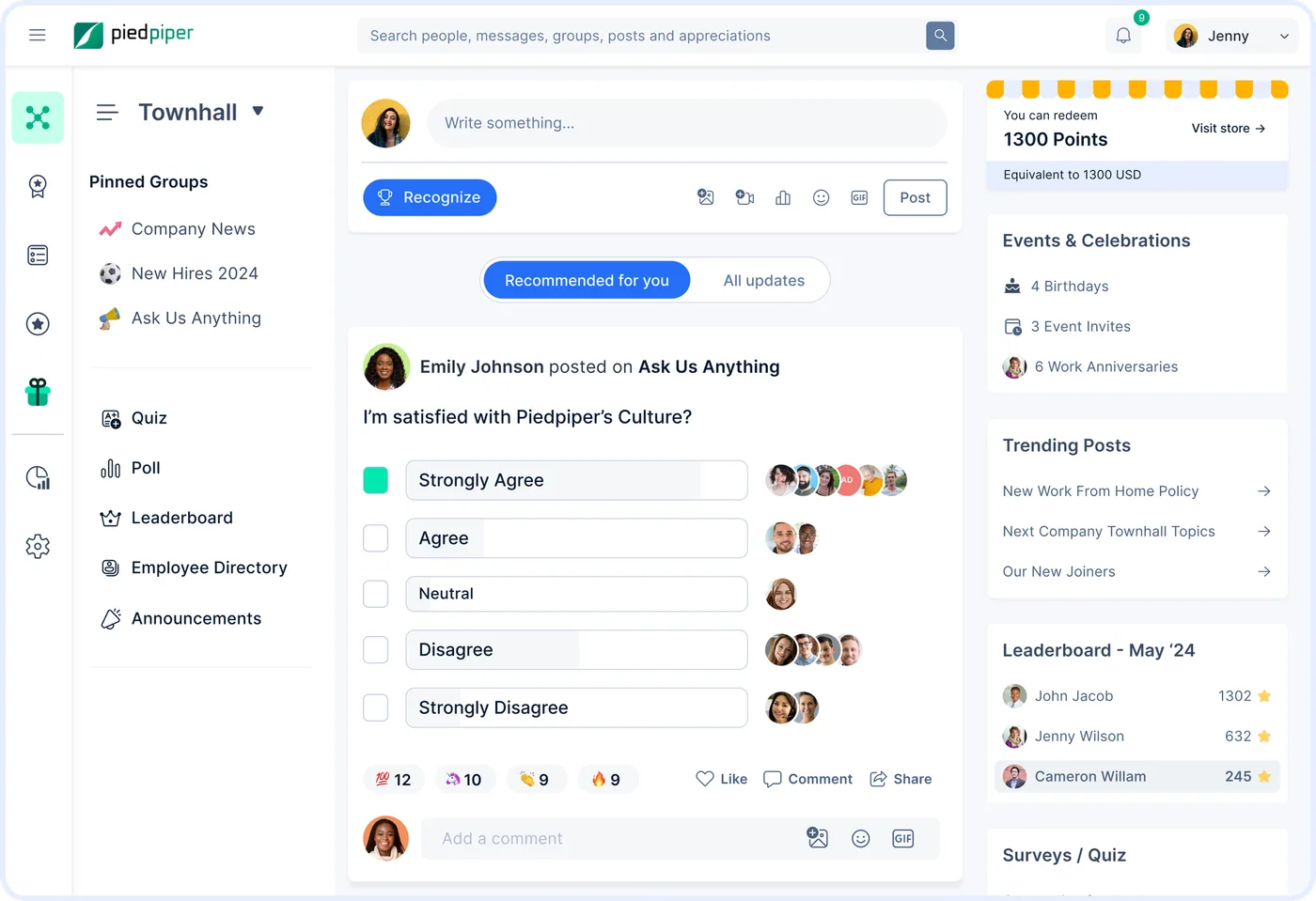
- Communication and leadership: A social intranet for town halls, company news, polls and Ask Me Anything sessions keeps leaders visible and everyone informed.
- Rewards and recognition: Peer-to-peer recognition, milestone rewards and smart nudges help people recognize great work when it happens.
- Work environment and wellbeing: Wellness programs and flexible benefits show employees you care about life outside work.
- Collaboration and connection: Community groups, celebrations and wishboards strengthen peer connections wherever people work.
- Alignment and purpose: Values-based recognition and badges tie everyday appreciation back to company values and mission.
- Surveys and feedback: Pulse surveys, eNPS and lifecycle surveys with analytics and action plans help you act faster.
The evidence is clear that an engaged workforce is critical to an organization's success. Treat the pillars as a system, measure them regularly and make engagement everyone's job, and you will build a workforce that is motivated, committed and wants to stay.
Book your Empuls demo
Frequently asked questions
The pillars of employee engagement are the core workplace conditions that sustain engagement. A practical set of 10 is communication, work environment, collaboration, rewards and incentives, personal development, role definition, leadership support, alignment with company goals, surveys and feedback, and growth and mentoring. Other models group these into four to six pillars, but the themes are the same.
One widely used model names four pillars of employee engagement: connection, communication, appreciation and voice. Connection is about relationships and belonging, communication about clear and open information, appreciation about recognition, and voice about employees being heard and seeing action. The four-pillar model is a simpler grouping of the same drivers covered by longer frameworks.
The key drivers of employee engagement are the manager relationship, clear expectations, recognition, growth opportunities, a sense of purpose, a healthy work environment and a real voice through feedback. Gallup estimates managers account for about 70% of the variance in team engagement, which makes the manager the single most important driver, followed closely by recognition and role clarity.
An employee engagement framework is a structured model of the factors that drive engagement, used to measure, prioritize and improve it. A simple framework lists the pillars, attaches a survey statement and metric to each, scores them by team and links low scores to specific actions. It keeps engagement work focused on causes rather than one-off activities.
Leadership support, especially from direct managers, is the most important pillar because it shapes almost every other one. Managers set expectations, give recognition, hold development conversations and act on feedback. Gallup's research shows managers account for about 70% of the variance in team engagement, so investing in manager selection and coaching usually has the biggest effect.
Measure the pillars of employee engagement with one or two survey statements per pillar, rated on a 1 to 5 scale, and compare scores by team and over time. Add supporting metrics such as recognition activity, training hours, internal mobility and voluntary turnover. Review results every quarter and focus each team on its lowest-scoring pillar.
To improve employee engagement using the pillars, score each pillar in a survey, choose the one or two weakest for each team and assign owners, deadlines and metrics to fixes. Communicate what you heard and what will change, then re-measure with a pulse survey. Strengthening the weakest pillar usually lifts overall engagement faster than adding new programs to strong ones.





































































































































































































































































































































































































































































































































































