
Key Takeaways
A rewards platform is software that lets organizations recognize and reward employees digitally and in real time, with rewards employees choose themselves.
Traditional reward systems relied on annual bonuses, tenure awards and generic gifts that arrived too late and reached too few people.
IRF's 2025 study found only 28% of employees are recognized daily or weekly, while 37% are recognized rarely or never.
Modern rewards systems are real-time, personalized, peer-driven, global and measurable, which is why well-recognized employees are 45% less likely to leave within two years.
Moving to a digital rewards platform works best in steps: audit, define goals, choose a platform, automate milestones, launch with managers and measure.
A rewards platform is software that lets an organization recognize and reward employees digitally, in real time, with points, gift cards, experiences and public appreciation that people choose and redeem themselves. It replaces the traditional reward system of annual bonuses, tenure plaques and generic gifts, which recognized people too rarely and too late for today's distributed workforce.
The way companies reward and recognize employees has shifted significantly. What used to be an occasional gesture tied to tenure or annual performance reviews is no longer enough for a diverse, hybrid and global workforce. This guide compares the traditional vs modern rewards system, shows the data behind the shift, and gives you a self-check and a step-by-step plan to move to a digital rewards platform.
Why the traditional reward system stopped working
A traditional reward system often relied on rigid structures, delayed feedback and limited personalization. Bonuses once a year, service awards after five or ten years and generic thank-you notes were seen as sufficient. Over time, these practices started to feel disconnected from the day-to-day experience of employees.
People want to be appreciated in real time. They value recognition that is timely, personal and tied to the actual impact they create, and they want rewards that reflect their interests and needs, not one-size-fits-all tokens. In a Harvard Business Review piece, former Yum! Brands chief executive David Novak described an oncologist at a renowned hospital who received a plastic keychain to mark 40 years of service. That kind of inflexibility, repeated across thousands of companies, pushed organizations to rethink their rewards and recognition programs.
This shift paved the way for modern employee reward systems that prioritize flexibility, frequency and relevance. With technology, organizations can now recognize contributions continuously, deliver customized rewards and make appreciation an everyday part of the employee experience. Modern systems do not just replace the old ones. They redefine how companies think about engagement and motivation.
The data behind the shift to digital rewards platforms
Recognition still reaches too few people too rarely, and the research shows what that costs. In the Incentive Research Foundation's 2025 study, Building a Culture of Recognition, only 28% of 1,078 respondents said they receive recognition daily or weekly, and 37% said they get it rarely or never. Formal, traditional forms were the least common: 23% had received a best employee award, 16% a plaque and 10% a trophy, compared with 80% who had received verbal praise.
The same study found that employees with access to recognition platforms are recognized more often, from a broader set of sources, and find it easier to recognize others. Access is uneven, though: only 17.7% of respondents earning under $25,000 had a platform, compared with 58.1% of those earning $150,000 or more. And respondents rated their current platforms just 59 out of 100 for effectiveness, a reminder that tools alone do not build a culture.
28%
recognized daily or weekly
IRF, 2025
37%
recognized rarely or never
IRF, 2025
22%
get the right amount of recognition
Gallup and Workhuman, 2024
45%
less likely to leave within two years
when well recognized (Gallup and Workhuman, 2024)
Why rewards and recognition needed a modern, digital approach
The retention case is just as clear. Gallup and Workhuman's 2024 analysis of nearly 3,500 employees found that just 22% say they get the right amount of recognition for their work, while well-recognized employees were 45% less likely to have changed organizations two years later.
Traditional rewards system
A traditional reward system is built on legacy practices that were once effective in hierarchical, in-office workplaces. These systems focused on tenure and top-down evaluations, offered rewards only after long periods and mostly in monetary form, and tended to be manual, rigid and limited in scope. Eight features define them:
- Manual HR policy: Recognition programs are managed through spreadsheets, emails or basic HR tools, which leads to inefficiency, inconsistency and a lack of visibility.
- Performance bonus based on annual appraisal: Rewards are tied to a yearly review that does not reflect real-time performance or day-to-day contributions.
- Generic service or achievement awards: A one-size-fits-all approach with standard gifts or certificates that ignore individual preferences and the uniqueness of the effort.
- End-result oriented and limited in scope: The focus stays on final outcomes and ignores smaller wins and consistent effort through the year.
- Financial incentives only: Rewards are mostly monetary, such as bonuses and ESOPs. Employees who value experiences, development or social recognition feel overlooked.
- Delayed, reactive appreciation: Recognition is sporadic and often comes too late to lift morale or motivation.
- Localized application: Programs are not built to scale across regions or serve a global workforce.
- Top-down management approach: Only managers or leaders can recognize, which leaves peers out and reduces participation.
Still running rewards on spreadsheets and plaques?
Move to real-time recognition and rewards employees choose, in one global platform.
Talk to our ExpertTrusted by 5,000+ companies
Modern rewards system
Modern employee reward systems reflect the values and expectations of today's workforce. They run on a digital rewards platform, are driven by data and are designed to be inclusive, immediate and personalized, so recognition becomes continuous and open to everyone. Eight features define them:
- Automated digital platform: Technology handles workflows, approvals and tracking, which cuts admin effort and scales across teams and geographies.
- Real-time recognition based on continuous feedback: Recognition happens in the moment, tied to real achievements, which keeps it relevant and motivating.
- Personalized experiences: Employees choose rewards that match their interests and values, which makes the gesture more meaningful.
- Scope for innovation: These systems reward creativity, collaboration and new ideas, not only targets met.
- Aimed at career development: Recognition connects to learning goals, mentorship and personal milestones that support long-term growth.
- Timely, proactive recognition: Smart nudges and automated reminders make sure milestones and achievements are not missed.
- Global platform: Multiple languages, currencies and cultural contexts make the program work for remote and international teams.
- Employee-centric leadership: Recognition is democratized and built into everyday workflows. Peer-to-peer appreciation is encouraged, and leaders use data to recognize fairly.
Traditional vs modern rewards system compared
Seen side by side, the difference is less about budget and more about timing, choice and reach. The table below maps each outdated element of traditional rewards and recognition to its modern, digital counterpart.
| Element | Traditional rewards system | Modern digital rewards platform |
|---|---|---|
| Timing | A yearly award ceremony with delayed recognition, if any, which feels impersonal and demotivating | Real-time recognition and rewards on any device, when the achievement happens |
| Personalization | Generic appreciation and gifts that ignore individual effort | Rewards chosen by the employee from a catalog, with AI suggestions based on preferences and effort |
| Variety | Repetitive thank-you emails and token gifts that lead to low engagement | Points, gift cards, experiences, merchandise and charitable donations, redeemed across channels |
| Experience | Heavy reliance on performance bonuses and service awards | A mix of continuous feedback, public celebration and tailored recognition |
| Process | A lengthy appraisal process, a rigid rating system and layers of manual approval | Automated workflows, configurable approvals and budget controls built in |
| Focus | Only the end result | Progress, behaviors, values and career development |
| Innovation | Process and end goals only | Recognition tied to long-term vision, new ideas and collaboration |
| Reach | Local, company-specific policies that cannot scale globally | One cloud platform with multi-language and multi-currency support |
| Who recognizes | Managers and leadership only | Managers, peers, cross-functional teammates and leaders |
| Measurement | Little or no data | Analytics on participation, coverage, budget use and redemption |
Physical rewards process vs digital rewards platform
Conventional rewards are limited in scope and lack the convenience and versatility of a digital rewards platform. The top-down traditional process places weight on perceived ability, while a digital platform records recognition and performance data as it happens, which leaves less room for bias and error.
| Aspect | Physical rewards process | Digital rewards platform |
|---|---|---|
| What it is | A manual, process-heavy HR policy | An automated digital platform or tool |
| How people are rewarded | Vouchers, certificates, plaques and gifts, bonuses, financial incentives, ESOPs, offsite events, vacations and comp-off | Points and reward links, a rewards marketplace, continuous feedback and instant nomination, gamified leaderboards, peer-to-peer recognition, social shout-outs, onsite and offsite events |
| When | At an annual awards ceremony or town hall, with bonuses in the yearly pay package | Automatically and on time, as soon as a target is met or a scheduled milestone arrives |
| What is recognized | Organizational performance, service anniversaries, milestone achievements | Individual effort, team performance, personal and professional milestones, innovation, exceptional achievement, company initiatives |
Local vs global rewards programs
Local recognition programs have narrower reach than a global platform. Small businesses with fewer employees can still run a local program, but enterprises with a diverse workforce across locations, and with hybrid and remote teams, rely on scalable global platforms with rewards automation. The range of SaaS employee rewards software available today means organizations of every size can take their programs digital and appeal to a multi-generational workforce.
| Local rewards program | Global rewards program |
|---|---|
| Several siloed HRMS and HRIS tools with separate databases that do not integrate | One platform that integrates with HRMS, collaboration and single sign-on tools |
| Documented on paper as an HR policy, local in language and culture | Adapts to any language and culture with multilingual and regional support |
| Vouchers and gift cheques in a regional currency that cannot be redeemed elsewhere | A global catalog with multi-currency redemption |
| Manual processes prone to bias and errors | Rewards automation tied to defined goals and KPIs |
Real programs show the range of approaches. Some companies keep physical rewards but add heartfelt handwritten thank-you notes to their recognition program. Others run flexible digital reward systems that analyze individual preferences to offer tailored benefits. Some reward community work, such as a charity gift card for employees who log a set number of volunteer hours each quarter, and global employers tailor time-off policies to each location and role. The common thread is choice and relevance, which a modern employee recognition platform makes easy to deliver at scale.
Self-check: how traditional is your rewards system
Use this quick audit to see where your current program sits. Score one point for every row where the modern answer describes your organization today; a score of 6 or less out of 8 means your rewards system still leans traditional.
| Question | Traditional answer | Modern answer |
|---|---|---|
| How long after an achievement is it recognized? | Weeks or months, at review time | Within days, often the same day |
| Who can recognize someone? | Managers only | Anyone, including peers |
| Who chooses the reward? | HR or the manager | The employee, from a catalog |
| Can every employee, including frontline and remote staff, take part? | Mostly office staff | Everyone, on mobile and in the tools they use |
| Are milestones like work anniversaries recognized automatically? | Manually, and sometimes missed | Automatically, on time |
| Does the program work in every country you operate in? | One country or currency | Multiple languages and currencies |
| Can you see participation and budget use by team? | No reliable data | Live dashboards and reports |
| Are behaviors and values recognized, not only results? | Results only | Results, behaviors and values |
How to move from a traditional to a digital rewards platform
Switching platforms is the easy part; changing habits takes a plan. These six steps keep what already works in your traditional program while adding the speed and reach of a digital one:
- Audit what you have: List every award, bonus and recognition practice, its budget and who it reaches, and use the self-check above to find the gaps.
- Define goals and values: Decide which behaviors, values and outcomes to recognize, and set measures such as participation rate, recognition coverage and retention.
- Choose the right rewards platform: Shortlist employee rewards software against clear criteria, such as real-time and peer recognition, catalog reach, mobile access, integrations and security. This guide on choosing the right employee rewards and recognition platform covers 16 criteria in detail.
- Migrate and automate: Move service awards, birthdays and anniversaries onto automated milestone rewards, connect your HRMS and collaboration tools, and set budgets and approval rules.
- Launch with managers first: Train managers to give specific, sincere recognition, then open peer-to-peer recognition to everyone with a clear launch campaign.
- Measure and refine: Review participation, coverage across teams and locations, redemption and retention each quarter, and adjust awards that are not used.
Keep the best of the old system. Service milestones, leadership awards and in-person celebrations still matter; a digital platform simply makes sure they happen on time and reach everyone. For the full program view, see this employee recognition guide.
How Empuls helps you build a modern rewards system
Empuls is an AI-powered recognition and rewards platform that helps organizations move from outdated programs to a modern employee reward system. It brings peer and manager recognition, automated milestone rewards, a global rewards catalog and analytics into one place:
01 · Recognition
Real-time, peer and manager recognition
Peers, managers and cross-functional teammates appreciate each other in the moment, with achievements celebrated publicly on the Wall of Fame, and AI helps turn a few words into a polished recognition message.
02 · Automation
Milestones that never get missed
Milestone rewards fire automatically for anniversaries, goals, training and referrals through HRMS, performance and LMS integrations or the Empuls API.
03 · Rewards
A global catalog employees choose from
Employees redeem points for gift cards, merchandise, experiences, travel and charitable donations, with multi-currency redemption across regions.
04 · Control
Budgets, approvals and analytics
Set award budgets and approval rules, get anomaly alerts, and track adoption, participation and ROI in dashboards, or ask Empuls AI in plain language.
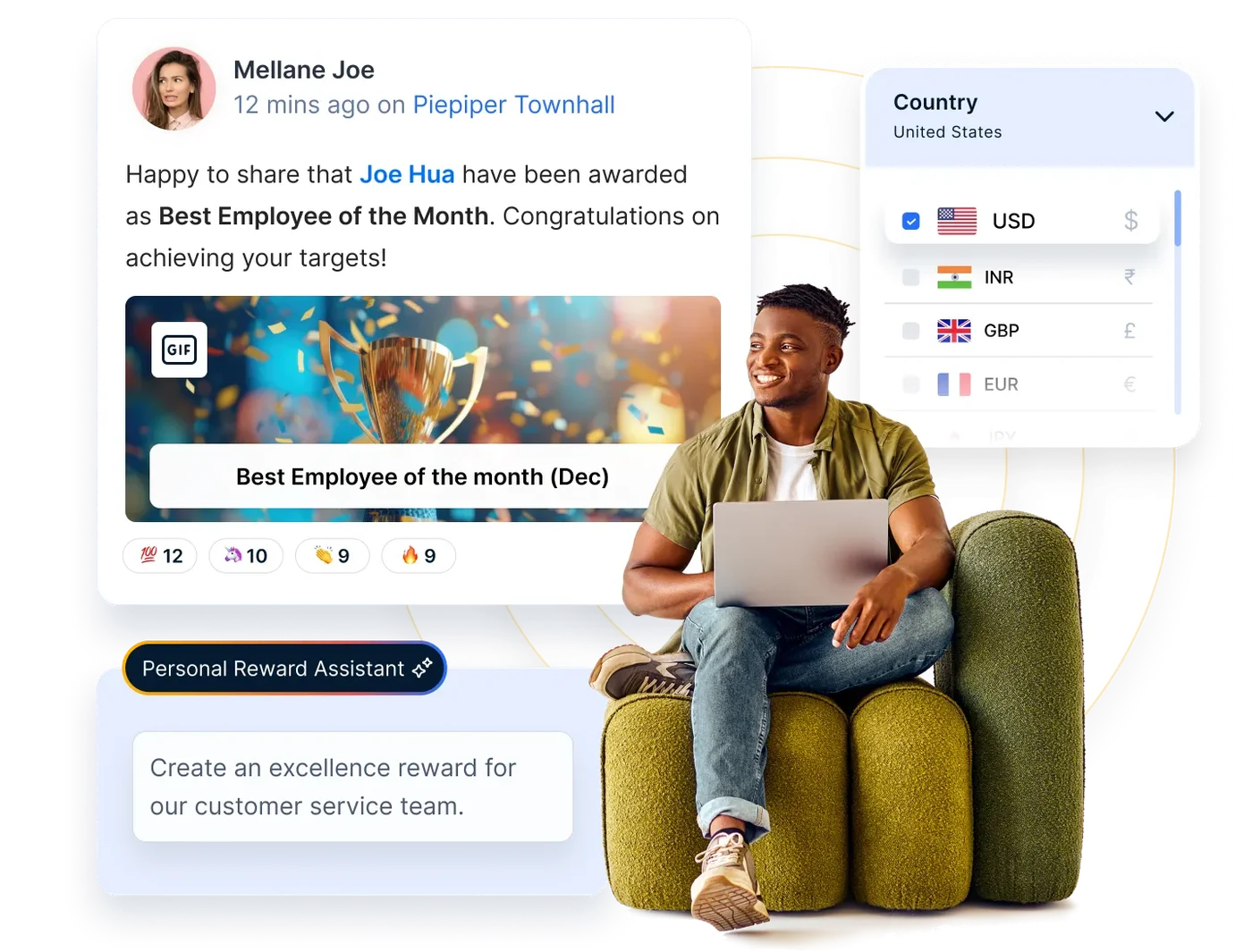
Empuls integrates with communication channels such as Slack and Microsoft Teams, HRIS and payroll, so recognition reaches everyone where they already work. Explore milestone rewards, service awards and the recognition ROI calculator to size the impact for your organization.
The bottom line on rewards platforms
A modern, digital approach to rewards and recognition wins on every count that matters to employees: timing, choice, fairness and reach. Traditional practices cannot match the simplicity, cost and time efficiency of a modern rewards platform, and they fall short of what a dynamic workforce expects.
The goal is not to throw away every tradition. It is to recognize the value people bring every day, not once a year, and to let a rewards platform carry that appreciation to every employee, in every location.
Book your Empuls demo
Frequently asked questions
An employee rewards platform is software that lets managers and peers recognize employees and attach rewards, usually points redeemable for gift cards, experiences or merchandise. It automates milestones like work anniversaries, tracks budgets and approvals, and reports on participation, so recognition happens consistently across teams and locations instead of depending on manual processes.
Traditional reward systems are periodic, top-down and mostly monetary, built on annual bonuses, tenure awards and generic gifts. Modern reward systems are continuous and digital: recognition happens in real time, peers can take part, employees choose their rewards, and data shows who is being recognized. The shift is mainly about timing, choice and reach.
Digital rewards are usually faster, easier to personalize and simpler to deliver across locations, which makes them better for most day-to-day recognition. Physical rewards still work for special moments such as long-service milestones or top performer awards. Many organizations combine both, using a digital platform to manage and deliver physical rewards as well.
Less than many leaders assume. In the Incentive Research Foundation's 2025 study, 58% of respondents said they expect only a sincere thank you for going above and beyond, about three quarters said a tangible reward increases the effect, and 47% said a reward under $50 is enough. Sincerity and timing matter more than value.
Look for real-time peer and manager recognition, automated milestone rewards, a reward catalog that covers your countries and currencies, mobile access for frontline staff, integrations with HRMS and collaboration tools, budget controls, analytics and strong security certifications. Ease of use matters most, because a platform people find clunky will not be used.
Yes. Many rewards platforms are priced per employee and scale down to small teams, and they save small HR teams time by automating birthdays, anniversaries and approvals. A small business can start with peer recognition and a modest monthly points budget, then add milestone rewards and analytics as the team grows.
Most organizations can launch a modern employee recognition platform in a few weeks, depending on integrations and how many programs they migrate. Plan time to configure awards and budgets, connect your HRMS and collaboration tools, train managers and run a launch campaign, then review participation after the first quarter.





































































































































































































































































































































































































































































































































































