
Key Takeaways
An employee of the month program works when criteria are public, peers can nominate and a small panel scores nominations independently.
Gallup and Workhuman found employees whose recognition meets at least four of five quality pillars are nine times as likely to be engaged.
A weighted scorecard covering impact, values, helping others, initiative and consistency keeps the award from becoming a popularity contest.
Making winners ineligible for 12 months and adding categories spreads recognition across more of the team.
One monthly award cannot replace everyday recognition, so pair it with weekly peer-to-peer appreciation.
An employee of the month program works when everyone knows the criteria, peers can nominate, a small panel scores nominations fairly and the winner gets a specific citation plus a reward they value. Run it alongside everyday recognition, not instead of it, because one award a month can never notice everyone who deserves it.
This guide covers the benefits of an employee of the month program, why many programs fall flat, a weighted criteria scorecard and nomination template, step-by-step instructions to run one, 20 employee of the month reward ideas and the best alternatives.
What an employee of the month program is
An employee of the month program is a recognition award that names one or more employees each month for outstanding performance, behavior or contribution, and celebrates them publicly with a reward such as a gift card, extra time off or a feature on a wall of fame. The best programs choose winners through transparent criteria and nominations rather than a manager's private choice.
Recognition is now an integral part of most organizations' culture, and few leaders question whether it is worth doing. What is under scrutiny is how employee of the month programs are structured, because the format decides whether the award inspires the whole team or only one person.
Benefits of an employee of the month program
A well-run program gives recognition a regular, visible moment and shows everyone what great work looks like. Five benefits stand out:
- Visible standards: Publishing why someone won tells the whole team which behaviors and results matter most.
- Higher morale: Public appreciation boosts the winner's pride and lifts team spirit when the choice feels fair.
- Retention: Feeling recognized makes people more likely to stay.
- Values in action: Tying the award to company values turns abstract statements into real examples.
- A habit of noticing: Monthly nominations prompt managers and peers to look for good work they might otherwise miss.
45%
less likely to leave
for well-recognized employees two years later
9x
as likely to be engaged
when recognition meets at least four of five pillars
55%
of US employees
get no recognition or recognition that meets none of the pillars
Gallup and Workhuman research on recognition, 2024
Gallup and Workhuman research found that well-recognized employees were 45% less likely to have changed organizations two years later, and that employees whose recognition meets at least four of five quality pillars, such as being equitable and personalized, are nine times as likely to be engaged. Yet 55% of US employees get no recognition or recognition that meets none of the pillars. An employee of the month program can help close that gap, but only if it is designed well.
Why employee of the month programs fall flat
A poorly designed program does more than lack impact: it can harm morale and set colleagues against each other. Six problems explain most failures, and unclear criteria come first because people cannot aim for a standard nobody has shared.
- Bad selection criteria: There is no clear reason why someone wins, or the requirements are not measurable. Winners do not know what they did right, and everyone else suspects favoritism.
- Focus on the award, not the work: When the prize is the goal, especially a cash bonus, people chase the award instead of improving their performance. Keep the focus on shared business goals.
- A team cannot be employee of the month: Most goals are reached by groups. Singling out one person overlooks others who worked equally hard and can breed resentment.
- Unhealthy competition: Some competition helps, but when one person's win feels like everyone else's loss, collaboration suffers and people who are not picked feel demotivated.
- Managers think recognition is done: Handing out a monthly award twelve times a year is not a recognition strategy. Day-to-day appreciation creates more lasting impact: Gallup found 61% of employees who get weekly feedback and recognition from their manager are engaged, compared with 38% who get weekly feedback but less frequent recognition.
- Only twelve winners a year: In a team of 50, most people will never win, however hard they work, and many will feel overlooked.
| Pitfall | Fix |
|---|---|
| Hidden or vague criteria | Publish three to five weighted criteria and score every nomination against them |
| Manager picks alone | Open nominations to peers and use a small panel that scores independently |
| One winner, many overlooked | Add categories or allow several winners, and run weekly peer recognition alongside |
| Popularity contest | Require a specific example and evidence in every nomination |
| Same people win repeatedly | Make winners ineligible for the next 12 months |
| Winner chosen weeks later | Fix the timeline: nominations close on day 25, winner announced in the first week |
| Generic plaque | Let the winner choose a reward from a menu or catalog |
Employee of the month criteria
Good employee of the month criteria reward values and specific contributions rather than the person's popularity. The ideal employee is a reliable team player who seeks growth, solves problems, helps others and spreads optimism, so the criteria should be as varied as those traits.
- Recognize values, not just results: Rewarding behavior that reflects company values helps everyone align with them instead of comparing themselves with one star performer.
- Recognize different deeds: If the most proactive problem preventer wins one month, the best guide to a new colleague could win the next.
- Use evidence: Ask for a concrete example, a result or a customer comment with every nomination.
- Include financial impact too: Measurable results such as revenue, savings or quality scores belong in the mix, but not as the only measure.
Use this scorecard to rate each nomination from 1 to 5 on every criterion, then multiply by the weight. The highest total wins, and a tie goes to the nominee with the stronger evidence.
| Criterion | Weight | What a 5 looks like | Evidence to ask for |
|---|---|---|---|
| Impact on goals | 30% | Clearly moved a team or company goal, such as revenue, quality or customer satisfaction | Numbers, before and after, customer feedback |
| Living company values | 25% | Showed a core value in a way others can learn from | A specific example tied to a named value |
| Helping others | 20% | Made colleagues more successful through coaching, cover or knowledge sharing | Peer comments, people helped |
| Initiative and problem solving | 15% | Spotted and fixed a problem without being asked | The problem, the action, the result |
| Consistency | 10% | Delivered reliably all month, not just once | Attendance, quality or delivery record |
Keep the weights the same for at least two quarters so results are comparable. If your program has several categories, use only the criteria that fit each category.
Run nominations and judging without spreadsheets
Collect evidence-backed nominations, score them with an independent panel and celebrate winners on a company-wide wall of fame.
Talk to our ExpertTrusted by 5,000+ companies
How to run an employee of the month program
Eight steps take you from launch to a program people trust, and publishing the criteria comes first because transparency is what makes the award feel fair. Follow them in order and review after the first quarter.
- Set the purpose and categories: Decide what the award should encourage, such as customer focus or teamwork, and whether you will have one award or several categories.
- Publish criteria and eligibility: Share the scorecard, who can be nominated and the rule that winners sit out for 12 months.
- Open nominations to everyone: Let peers and managers nominate through a short form, ideally in the tools people already use.
- Screen and score fairly: Check that nominations meet the rules, then have a small rotating panel score them independently before comparing results.
- Announce with a specific citation: Explain exactly what the winner did and why it mattered, at a team meeting and on the company feed.
- Let the winner choose a reward: Offer a menu or catalog so the reward fits, from a day off to an experience.
- Recognize runners-up and nominators: Send a thank-you to everyone nominated, and to the people who took the time to nominate.
- Review every quarter: Check who has been nominated and won by team, location and role, and fix any gaps. Our guide on preventing bias in recognition programs shows what to look for.
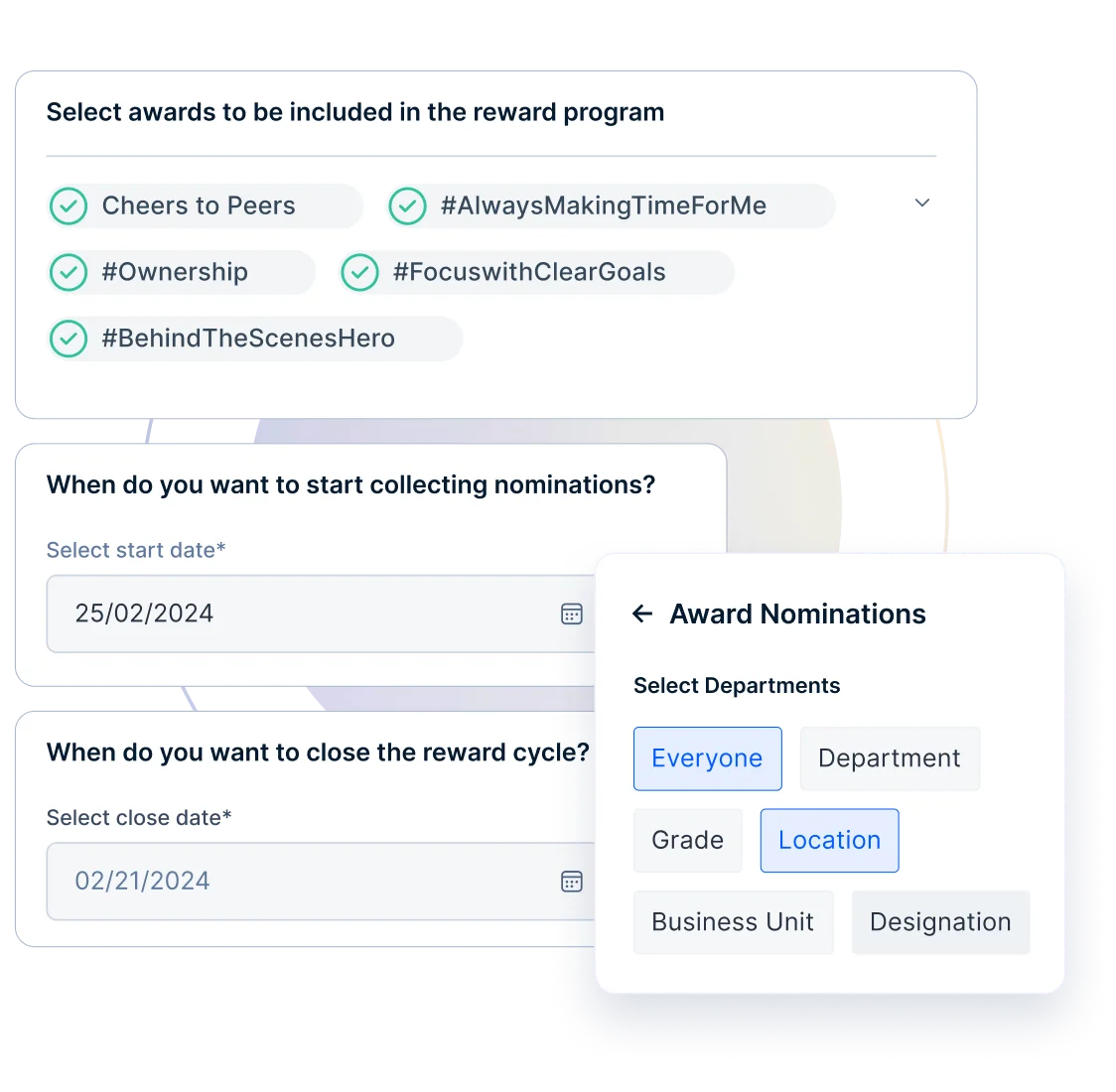
A simple nomination form keeps submissions consistent and easy to score. Use these fields:
| Field | Prompt for the nominator |
|---|---|
| Nominee and team | Who are you nominating, and which team are they in? |
| Category | Which award or value does this nomination fit? |
| What they did | Describe the specific action in two or three sentences. |
| Impact | What changed because of it, for customers, colleagues or results? |
| Evidence | Add numbers, a customer comment or a link that supports the nomination. |
| Value shown | Which company value did this demonstrate, and how? |
Make the award more inclusive with categories
Adding categories lets more people be recognized for different strengths and keeps the program light and fun. Five creative categories are below, with problem solving first because it rewards the work managers most want to see.
- Most creative problem solver of the month
- The employee who never repeated a mistake
- Calmest under pressure
- Conflict resolution champion
- Best guide to a new colleague
Categories bring three benefits. They prompt managers and employees to talk about more than targets and graphs, they encourage well-rounded development, and they relieve stress by keeping recognition enjoyable. Teams that want to recognize a group can add a collaboration of the month award, covered in the alternatives below.
Employee of the month reward ideas
Think beyond plaques and certificates: the best employee of the month rewards reflect the winner's interests and show you noticed them as an individual. These 20 employee of the month ideas include 15 creative rewards and 5 unique ones, with experiences and time off first because they are the most remembered.
15 creative employee of the month rewards
These ideas range from free to moderate cost, so you can mix them to fit your budget. Let the winner choose from three or four options each month.
- Experience-based rewards: Concert or event tickets, or a weekend getaway, give the winner something to look forward to and remember.
- Extra paid time off: An extra day off, or leaving early on a day of their choice, offers the gift of time to recharge.
- Company-wide announcement: A newsletter feature, email or meeting shout-out reinforces their importance and pride.
- Personalized gift cards: Choose a card for their favorite restaurant or store, or let them pick from a catalog, so the reward feels thoughtful.
- VIP parking spot: Prime parking for the month is practical, prestigious and visible to the team.
- Customized trophy or award: Add their name, achievement or a quirky token that reflects their personality to make a keepsake.
- Lunch with the CEO or leadership: Time with decision-makers lets the winner share ideas and builds relationships across levels.
- Professional development opportunities: A course, conference or workshop of their choice keeps giving long after the month ends.
- Recognition wall: Display winners' names and photos on a physical or digital wall that adds to the company's story.
- Team celebration: A team lunch in the winner's honor celebrates them and highlights the teamwork behind the result.
- Fitness and wellness programs: A gym membership, wellness class or fitness app subscription supports a healthy lifestyle.
- Office perks: First pick of office supplies, a premium desk location or a favorite meeting room for the month.
- High-tech gadgets: Noise-canceling headphones or smart home devices add value at work and at home.
- Custom swag: Limited-edition branded clothing, mugs or bottles that only winners receive.
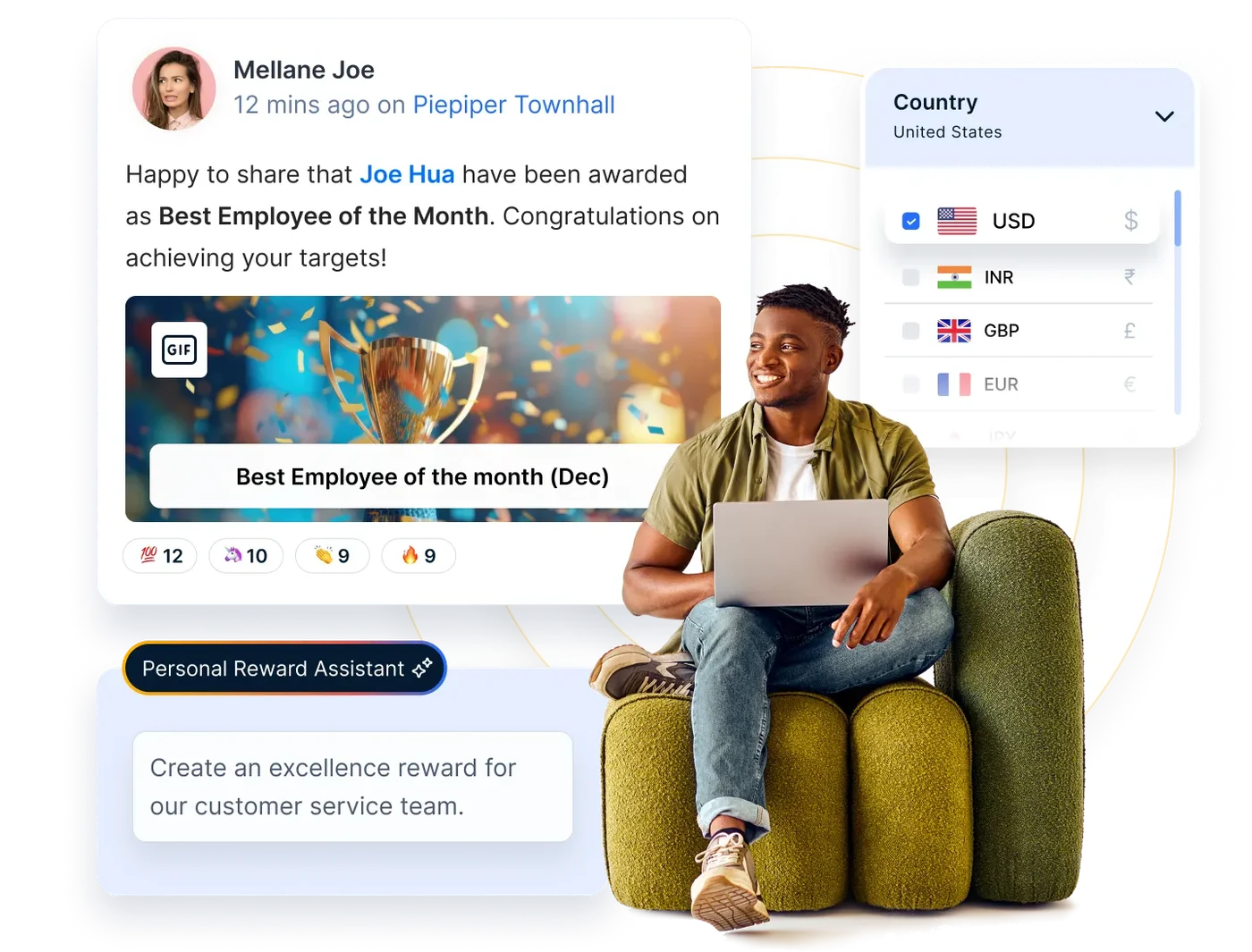
- Cash bonuses or gift cards: A financial reward lets employees choose what they want, which keeps it flexible and practical.
5 unique employee of the month award ideas
These five ideas go the extra mile and make the award memorable. They work best for teams that enjoy a bit of fun.
- Office makeover: New supplies, an ergonomic chair or plants to personalize their workspace.
- Personalized artwork: A commissioned caricature or portrait as a lighthearted keepsake.
- Boss for the day: The winner joins senior leadership meetings or makes a few team decisions for a day.
- Subscription services: A meal kit, streaming platform or wellness app they love, for a few months.
- Adventure day: Skydiving, a hot air balloon ride or zip-lining for employees who love adventure.
For more inspiration, browse our employee reward ideas and employee award titles.
The best alternatives to employee of the month
If a single monthly winner does not suit your culture, six alternatives recognize more people more often. Peer-to-peer recognition comes first because it works every day, not once a month.
- Peer-to-peer recognition: Colleagues recognize each other whenever they see good work, so recognition is frequent and feels less political. See our guide to peer-to-peer recognition.
- Multiple awards: Give several values awards each month, such as a values champion award that comes with preferred parking, a trophy and snacks, and allow more than one winner.
- Collaboration of the month: Recognize the whole team behind a project instead of singling out one person, which encourages cooperation.
- Going the extra mile program: Employees nominate colleagues who went beyond their role, such as helping patients or customers faster, and leaders tally the nominations to pick winners.
- Recognition day with rewards: Hold a celebration, such as a barbecue or party, where several awards are handed out for different actions.
- Recognizing passions: Give employees a few hours a week to work on a project they care about, which shows you respect them as individuals.
Spot awards are another option for recognizing great work in the moment, and our list of on-the-spot recognition ideas has plenty to start with.
How Empuls makes employee of the month fair and meaningful
Empuls runs the full employee of the month cycle, from nominations to judging to celebration, and pairs it with everyday recognition so nobody waits a month to feel valued. Every winner is backed by a clear, auditable trail.
- Collect structured nominations with evidence, AI-assisted writing and multi-level approvals through Empuls nominations.
- Score nominations with an independent panel whose ratings stay locked until everyone has voted, using jury awards.
- Schedule monthly or quarterly programs with reminders, budgets and fairness rules through award campaigns.
- Celebrate winners on a company-wide wall of fame and let them choose rewards from a global catalog.
Running an employee of the month program people trust
An employee of the month program motivates when the criteria are public, nominations are open, scoring is fair and the reward fits the winner. Add categories so more strengths are recognized, make winners sit out for a year and run weekly peer recognition alongside so everyone feels seen. For the bigger picture, see our employee recognition guide and our ideas for employee recognition.
Book your Empuls demo
Frequently asked questions
Publish three to five weighted criteria, let peers and managers nominate with a specific example and evidence, and have a small rotating panel score each nomination independently. The highest total wins. Make winners ineligible for 12 months and review nominations by team and location each quarter to spot bias.
Strong criteria usually include impact on team or company goals, living the company values, helping colleagues, initiative and problem solving, and consistency over the month. Weight them, for example 30% impact and 25% values, and ask nominators for evidence such as results, customer comments or peer feedback for each one.
Good rewards include an extra paid day off, an experience such as event tickets, a gift card the winner chooses, lunch with the CEO, a training course, a reserved parking spot or a feature on a wall of fame. Offering three or four options and letting the winner choose works better than one fixed prize.
It can be, if it is designed well. A single winner chosen privately by a manager often breeds resentment and leaves most people unrecognized. Programs with public criteria, open nominations, several categories and everyday recognition alongside are far more effective and feel fair to the people who do not win.
Name the winner, describe exactly what they did, explain the impact on customers, colleagues or results, and link it to a company value. Thank the nominators and mention other nominees where appropriate. Keep it short, specific and sincere, and share it at a team meeting and on the company feed.
A traditional employee of the month award goes to one person, but you can add a collaboration or team of the month award to recognize the group behind a project. Team awards encourage cooperation and avoid singling out one person for results that many people achieved together.
Most organizations make winners ineligible for the next 12 months. This spreads recognition across the team and stops the award from becoming predictable. Consistent top performers can still be recognized through peer shout-outs, spot awards or a quarterly or annual award in the meantime.
Popular alternatives include peer-to-peer recognition, multiple values awards each month, a collaboration of the month award, a going the extra mile program where employees nominate colleagues, a recognition day with several awards, and spot awards that recognize great work the moment it happens.





































































































































































































































































































































































































































































































































































