
Key Takeaways
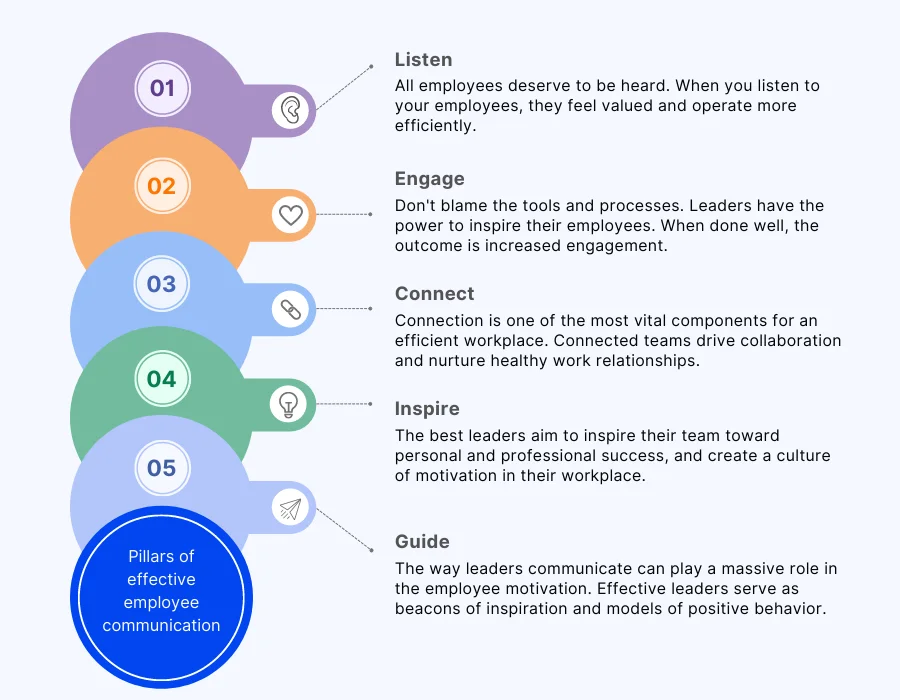
The five pillars of effective communication in the workplace are listen, engage, connect, inspire and guide.
Listening comes first: leaders who hear employees directly, without interrupting or defending, earn the trust the other pillars need.
Gallup reports 53% of U.S. employees were watching for or seeking a new job in August 2026, a sign that the employer's message often is not getting through.
Gallagher's 2026 research found 61% of organizations have no formal approach to change communication, which makes the guide pillar a quick win.
Turn each pillar into one monthly action with a clear measure, and review the results every quarter.
Effective communication in the workplace rests on five pillars: listen, engage, connect, inspire and guide. Leaders who listen first, involve employees in solving problems, make people feel part of the conversation, give them a purpose they can picture and offer clear direction build teams that trust each other and stay aligned.
Effective communication in the workplace is the clear, two-way exchange of information and ideas that leaves everyone understanding what is happening, why it matters and what to do next. As the author and speaker Paul J. Meyer put it, "Communication, the human connection, is the key to personal and career success."
If that statement is not convincing enough, the data on workplace communication is. Grammarly's 2024 State of Business Communication report found that every knowledge worker surveyed experiences miscommunication at least weekly, and about one in five business leaders said poor communication had cost them business.
Without the right communication strategy, solution and synergy, it is hard to align multiple organizational stakeholders. That raises a crucial question: what are the key drivers of effective employee communication? As a leader, listening must always take precedence over speaking. With that said, here are the five pillars of communication in the workplace that every company should stick to. For the wider picture, including the types of workplace communication and ten best practices, see our complete guide to employee communication.
5 pillars of communication in the workplace
At its core, effective communication in the workplace is about understanding and empathizing with your audience. To keep your communication strategy, solution and synergy aligned, focus on these five pillars in order, because listening comes first and shapes everything that follows.
1. Listen
The HSBC Exchange meeting, known internally as "Shut Up and Listen," stands as a testament to a successful communication program.
On the surface, it may seem like a program for employees, but it was really designed for senior management.
The program asked leaders to stay quiet so they could hear from employees. The internal communications team opened a direct line between leadership and staff.
In a program aimed at rebuilding employee trust, senior leaders were not allowed to interrupt, correct, deviate or counter what employees said. They could only listen, take notes and share an update afterward.
In groups of fewer than ten people, every employee had a chance to raise concerns and grievances directly, without fear of retaliation.
In a classic version of a skip-level meeting, employees discussed everything from compensation to everyday grievances directly with senior HSBC leaders.
Why listening matters: You can capture employee feedback through skip-level meetings like the one above, reverse town halls, open discussions, leadership chats, Q&A sessions, polls and surveys. As a leader, getting first-hand knowledge of your employees' perspective on their work and lives is critical for the company.
Further down the line, you can measure the change in sentiment through periodic pulse surveys, by counting how many employees return to the exercise and by keeping an eye on public reviews. Use this listening experience and data to improve and guide future communication. To build the skill itself, read our guide to active listening in the workplace.
2. Engage
Barclays, the banking and financial services company, set an excellent example of engaging employees through training and communication.
When the bank rolled out its digital banking services, it realized that many employees did not know how to use them well, so they could not serve customers effectively. Barclays responded by launching the Digital Eagles program.
The program engaged Barclays colleagues in using its apps, getting the most out of the internet and helping customers do the same.
Turning novices into experts, the initiative grew from a small group of volunteers into a national network of thousands of colleagues who now share digital skills with customers and communities.
It is a classic example of leaders resolving a pressing issue by engaging employees, and it shows that communicating with employees is vital.
Why engaging matters: When companies test, teach and learn alongside employees, they solve the current problem and future-proof the business. To come up with ideas like this, or roll them out well, involve employees, crowdsource ideas and create a sense of unity, which is itself a way to improve employee engagement.
Remember that not everything needs to flow from central management. Two-way dialogue across every level is the easiest way to resolve issues of all sizes.
3. Connect
Connecting with employees may sound similar to engaging them, but consider the mess created by a disconnect between leaders at PayPal and their employees.
In 2014, David Marcus, then president of PayPal, learned that many staff were not using the PayPal app and sent a memo telling them to use it or find work elsewhere:
"If you are one of the folks who refused to install the PayPal app or if you can't remember your password, do yourself a favor, go find something that will connect with your heart and mind elsewhere."
After the memo leaked to the press and became a public spectacle, the lesson was clear: people need to feel connected and be part of the conversation to be motivated at work. An ultimatum cannot do what curiosity about why employees were not using the app could have done.
Why connecting matters: The disconnect that led to an ultimatum could have been avoided with a little effort and insight: asking employees what got in their way, and giving them a social platform to connect and share feedback openly.
4. Inspire
Clarks, the footwear brand that began in a small English town, decided to compete globally. With four major divisions, it was gearing up to become a global contender with a ten-year plan.
Leaders could picture that plan easily, but many employees struggled to imagine growth on that scale. What Clarks did next was ingenious: it made a movie.
The movie solved two problems at once. It helped employees visualize the organization's future, and it started a wider conversation about the brand.
The beauty of the campaign was that employees helped make it, breaking from the corporate routine. Creative teams made props, other staff recorded voiceovers and starred as leads, and the company intranet carried it to everyone.
Why inspiring matters: By getting creative, leaders can make a compelling case and bring the workforce in line with the company's purpose and goals. If leaders tap into employees' emotions, they have truly inspired them.
5. Guide
Employees who are logically and emotionally invested in your company often ask what is next. That is especially true during big changes, such as new ways of working, restructuring or a shift between remote, hybrid and office work. It is the leader's responsibility to guide employees using the company's principles and values, and to give them clear guardrails along the way.
Why guiding matters: Many global companies have published clear guidelines to shape how they work through major transitions. You can do the same, and use the moment to realign people with the company's vision if needed. Gallagher's 2026 Employee Communications Report found that 61% of organizations have no formal approach to change communication, so a simple guide to what is changing, why and what it means for each team already puts you ahead.
Put all five pillars on one platform
Listen with pulse surveys and polls, connect teams in groups and share updates that do not get lost.
Talk to our ExpertTrusted by 5,000+ companies
Workplace communication skills behind the pillars
The five pillars only work when leaders and employees have the everyday skills to apply them. Six workplace communication skills matter most, and listening tops the list because every other pillar depends on it.
| Skill | What it looks like at work | Pillar it supports |
|---|---|---|
| Active listening | Letting people finish, summarizing what you heard and asking clarifying questions | Listen |
| Clarity | Leading with the main point and the action needed, in plain language | Guide |
| Empathy | Considering how a message will land for each audience before you send it | Connect |
| Giving and receiving feedback | Being specific, focusing on behavior and acting on what you hear | Engage |
| Storytelling | Explaining the why behind decisions with examples people can picture | Inspire |
| Adapting your style | Adjusting tone, detail and channel to the person in front of you | Connect |
People also communicate differently, some direct and fast, others reflective and detailed. Our guide to workplace communication styles explains how to recognize and adapt to each one.
Effective communication is the key to employee engagement
For every employer, the employee value proposition is a big priority, and companies invest heavily to get it right, from learning and development to total rewards that strengthen the employer and employee relationship. That investment keeps growing year on year.
Yet many employees are still looking elsewhere. Gallup's employee retention and attraction indicator reports that as of August 2026, 53% of U.S. employees were watching for or actively seeking a new job. Despite employers' attention and spending, employees often do not recognize the value on offer.
53%
of U.S. employees watching for or actively seeking a new job
Gallup, August 2026
20%
of employees worldwide engaged at work in 2025
Gallup, 2026
1 in 5
business leaders say poor communication has cost them business
Grammarly and The Harris Poll, 2024
Why the message is not getting through
So why is there such a disconnect between companies and their employees? The answer is simple: the message is not getting through. Gallup's State of the Global Workplace 2026 press release found that only 20% of employees worldwide were engaged in 2025, with the decline driven largely by falling manager engagement, and managers carry most day-to-day communication.
Employee communication is broken, and the reasons are apparent
The way we work, and the workforce itself, have changed dramatically. Up to five generations now work side by side, each with different habits and expectations for how they receive information.
Consumption of information has changed. Traditional workplace communication methods no longer work on their own in modern workplaces.
Today, people want to receive information differently. They expect communication to reach them whenever and wherever they need it, in a format that is familiar, easy to consume and not overwhelming. Gallagher's 2026 research found that 83% of HR and communications professionals believe information overload is a growing problem, so more messages are not the answer; better ones are.
Effective communication in the workplace: a five pillars checklist
Use this checklist to turn the pillars into habits. Pick one action per pillar for the next month, starting with listening, and track the measure in the last column so you can see what is working.
| Pillar | What good looks like | Try this month | How to measure |
|---|---|---|---|
| Listen | Leaders hear from employees directly and without defensiveness | Run one skip-level or listen-only session per team | Attendance, issues raised, sentiment in the next pulse survey |
| Engage | Employees help solve problems, not just receive decisions | Crowdsource ideas on one real business problem | Ideas submitted and adopted, participation rate |
| Connect | People feel part of the conversation across teams and locations | Set up interest or project groups and a weekly team update | Active members, comments and reactions |
| Inspire | Employees can picture where the company is going and their part in it | Share the strategy as a story, with employee voices | Survey item: I understand how my work contributes |
| Guide | Clear direction and guardrails during change | Publish a one-page guide for the next change: what, why, when, who to ask | Questions received, survey item: I know what is expected of me |
Review the checklist each quarter. If one measure stalls, go back to listening: it usually shows what is blocking the other four pillars.
How to improve communication at work with the right tool
A company's success depends on employees understanding the value it provides, and an effective communication strategy is vital to achieving that. Modern employee communication means meeting people where they are, whether they work in an office, remotely or across time zones. Email and meetings alone are no longer enough; employees need an interactive space where they can find information, collaborate and stay connected.
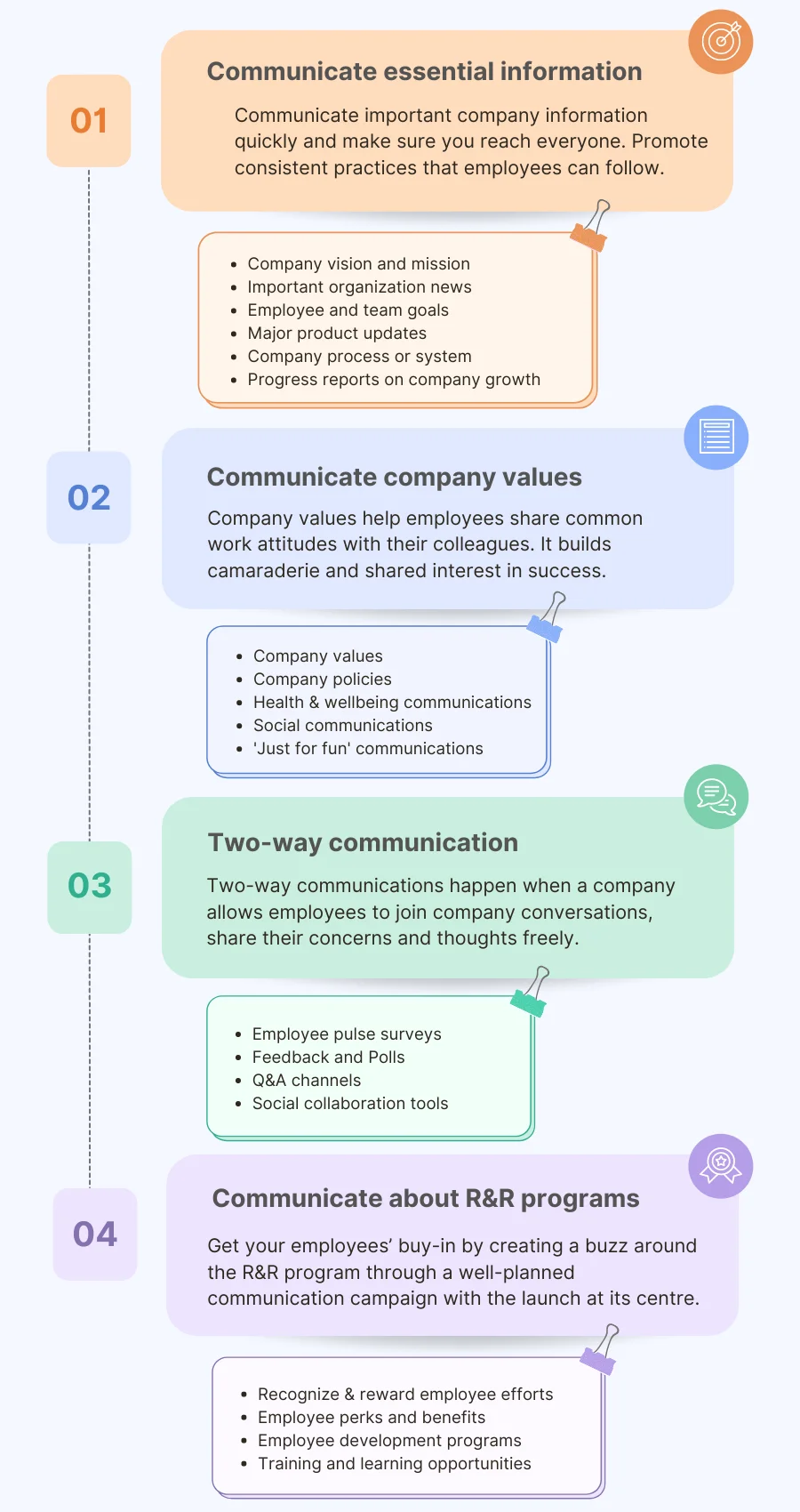
This infographic breaks effective employee communication into four groups: essential company information, company values, two-way communication and rewards and recognition programs. When all four are done right, they drive engagement.
This is where the Empuls social intranet comes in. It serves as a digital hub that brings workplace conversations under one roof:
- Announcements that stand out: Company news, policy updates and customer wins on a central feed, with key messages spotlighted so they do not get lost.
- Groups for every team: Communities for departments, projects, locations and interests, so people connect beyond their own desk.
- Two-way conversation: Polls and quizzes and pulse surveys turn passive readers into participants and show leaders what to act on.
- Recognition in the flow of work: Peer recognition, celebrations and a wishboard make wins and milestones visible to everyone.
Instead of one-way updates, employees can take part, share ideas and celebrate wins on a platform designed for connection. By making company-to-employee communication more accessible and interactive, businesses build a culture of transparency, inclusion and collaboration, which leads to higher productivity and stronger alignment.
Companies of every size and industry need a comprehensive employee communication strategy. The five pillars are the foundation, not the whole building. A cohesive culture where a new hire and the CEO share the same vision is the goal, and effective communication is the most direct way to reach it.
Book your Empuls demo
Frequently asked questions
The five pillars of communication in the workplace are listen, engage, connect, inspire and guide. Leaders listen to employees first, engage them in solving real problems, make them feel part of the conversation, inspire them with a purpose they can picture and guide them with clear direction and guardrails, especially during change.
Effective communication keeps people aligned on goals, reduces mistakes and rework, builds trust and helps teams collaborate. It also drives engagement and retention, because employees who understand what is happening and feel heard are more likely to stay. Poor communication leads to confusion, missed deadlines and lost business.
By direction, workplace communication can be downward from leaders, upward from employees, horizontal between peers and diagonal across teams and levels. By mode, it can be verbal, written, visual or nonverbal, and either synchronous, like meetings and calls, or asynchronous, like email, intranet posts and recorded updates.
The most useful workplace communication skills are active listening, clarity, empathy, giving and receiving feedback, storytelling and adapting your style to your audience. Nonverbal awareness, such as tone and body language, also matters, especially in difficult conversations. Most of these skills improve quickly with practice and regular feedback.
Managers can hold regular one-on-ones, share the reasons behind decisions, keep a consistent weekly update, ask for feedback on their own communication and act on it. Listening without interrupting, recognizing good work publicly and being clear about expectations and priorities make the biggest difference to how informed and valued team members feel.
Common barriers include information overload, unclear messages, too many channels, silos between teams, a lack of trust in leadership, cultural and language differences and remote or frontline employees who are hard to reach. Leaders who never ask for feedback also create a barrier, because problems stay hidden until they grow.
Track reach and engagement on your channels, such as read rates, attendance and replies, and ask employees in pulse surveys whether they get the information they need, understand company goals and feel heard. Watch for fewer repeated questions and less rework. Compare results by team and location to find gaps.





































































































































































































































































































































































































































































































































































