
Key Takeaways
Employee lifecycle surveys are short, event-triggered surveys that collect feedback at key moments, from recruitment and onboarding to promotion and exit.
The seven stages to cover are attraction, recruitment, onboarding, development, retention, offboarding and advocacy.
Start with onboarding check-ins at day 30, 60 and 90 plus an exit survey, then add stay surveys around years two and three, when BambooHR data shows eNPS dips most.
Trigger lifecycle surveys from your HRIS so every employee gets the right survey at the right time without manual lists.
Report small cohorts by quarter or department to protect anonymity, and turn each recurring signal into an owned action.
Employee lifecycle surveys collect feedback at the moments that shape how people feel about work, from the first job ad they see to the day they leave. Instead of one annual snapshot, you ask the right questions at each stage, so you can fix a clumsy hiring process, a confusing first month or a stalled career before it costs you good people. This guide covers the seven stages, when to send each survey and the questions to ask.
Understanding what motivates your workforce is like tuning an orchestra: each note matters. Lifecycle surveys act as a roadmap for leaders and HR teams to create meaningful workplace experiences, and they turn feedback into insights you can act on at exactly the point where they matter.
What employee lifecycle surveys are
Employee lifecycle surveys are short, event-triggered surveys that collect feedback at critical points in the employee journey, such as recruitment, onboarding, development, promotion and exit. They measure satisfaction, identify pain points and improve experiences across every stage, from hiring to offboarding.
Their purpose is to align business goals with employee needs. Because each survey is tied to a specific moment, the answers are contextual: a new hire describes onboarding while it is fresh, and a leaver explains a decision they have just made. Some teams call them employee journey surveys or lifecycle feedback surveys; the idea is the same. Our guide to types of employee surveys shows how they fit alongside engagement and pulse surveys.
| Lifecycle surveys | Pulse surveys | Annual engagement survey | |
|---|---|---|---|
| Trigger | A journey event: start date, day 90, promotion, exit | A fixed schedule: weekly to quarterly | Once a year |
| Audience | Only people at that stage | Everyone or a sample | Everyone |
| Length | 5 to 15 questions | 5 to 15 questions | 30 to 60 questions |
| Best for | Fixing specific moments in the journey | Tracking trends between big surveys | A full baseline across all drivers |
Why employee lifecycle surveys matter
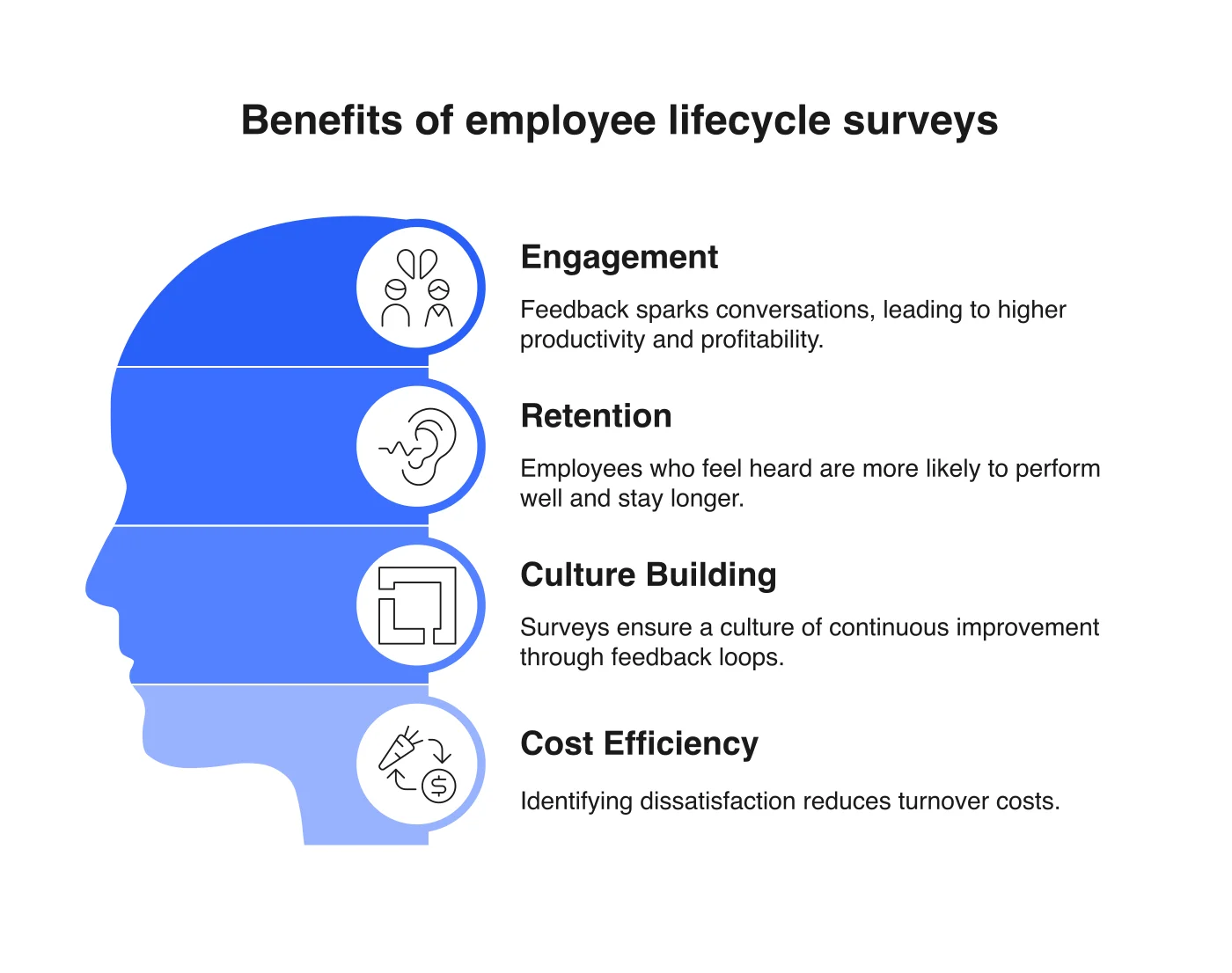
Lifecycle surveys are not just tools: they are mirrors that reflect the health of your workplace at every stage. They help in four ways:
- Engagement: Feedback sparks conversations, and engagement pays off. Gallup's 2024 meta-analysis, summarized in its research on engagement and productivity, found that top-quartile teams achieve 23% higher profitability and 18% higher sales productivity than bottom-quartile teams. Lifecycle surveys show what drives engagement at each stage.
- Retention: Employees who feel heard are more likely to perform at their best and to stay. Most exits can be avoided: Work Institute's 2025 Retention Report found that 75% of employee departures were preventable.
- Culture building: Feedback creates a loop: listen, act, improve and repeat. Surveys at every stage build a culture of continuous improvement.
- Cost efficiency: Turnover is expensive. Gallup's employee retention indicator estimates that voluntary turnover costs US businesses about $1 trillion a year, so pinpointing dissatisfaction early saves money.
Sentiment also changes with tenure, which is why a single annual survey misses so much. The BambooHR 2026 Employee Happiness Index, based on more than 2.5 million eNPS scores, shows new hires start out enthusiastic, dip sharply after two to three years and recover among long-tenured staff:
That dip is a stage your lifecycle program should target with stay surveys and development check-ins, rather than waiting for exit feedback.
Automate surveys at every stage of the journey
Trigger onboarding, stay and exit surveys from your HRIS and see where the employee experience slips.
Talk to our ExpertTrusted by 5,000+ companies
The 7 stages of employee lifecycle surveys, with questions
Below are the seven key stages of the employee lifecycle, each with its purpose, timing and the employee lifecycle survey questions to ask. If you are starting from scratch, begin with onboarding and exit, which give the fastest return, then add the other stages one at a time.
1. Attraction: first impressions matter
Attraction surveys show why people are drawn to your organization in the first place. They decode your employer brand and help you refine how you present yourself to the outside world. Send them to new applicants or to new hires in their first week.
- What caught your attention about our job posting? Shows which parts of your listing stand out, such as salary, growth opportunities or flexible work policies.
- What was your perception of our company culture based on what you saw online? Reveals whether your online persona matches your actual workplace culture.
- Did our employer branding match your expectations? Employer branding should reflect reality. If there is a gap, you will know where to correct course.
- Where did you first hear about this role? Tells you which channels bring in the strongest candidates.
2. Recruitment: making the hiring process smooth
Recruitment surveys highlight what is working, and what is not, in your hiring process. Send them to every candidate after the final interview, including those you did not hire, and use the answers to refine job descriptions and interview formats.
- How was your experience with our application process? Was it straightforward or an endless maze? Simplifying it can make a world of difference.
- Were the job role and expectations clear during recruitment? Misunderstandings here lead to unhappy employees later, so clear communication is key.
- How did you feel about the interview process? Were the questions fair? Did candidates feel heard and respected?
- How quickly did we keep you updated? Slow or silent processes lose good candidates to faster competitors.
3. Onboarding: the first days set the tone
Onboarding surveys make sure new employees feel confident, informed and supported. Split them into short check-ins at day 30, day 60 and day 90, and repeat one manager support question at each point so you can track the trend.
- How would you rate your first weeks at work? Was the start exciting, overwhelming or just plain confusing?
- Did the training adequately prepare you for your role? Effective training means confident employees, so identify gaps early.
- Do you feel supported by your team and manager? A supportive environment is key to retention.
- Does the role match what was described during hiring? A mismatch at day 60 or 90 is an early warning of regretted attrition.
- How likely are you to still be here in a year? Ask at day 90, when intent to stay is easiest to influence.
Focus on clarity, connection and inclusivity to set new hires up for success. Our employee onboarding checklist covers what to fix when these scores dip.
4. Development: growing together
Development surveys show whether employees have access to growth opportunities and feel their skills are used well. Send them after training programs, performance reviews and promotions.
- Are you satisfied with the learning resources available? Continuous learning keeps employees engaged and sharp.
- Is there a clear path for your career progression here? A lack of growth is one of the most common reasons people leave.
- Did your last performance review help you understand how to grow? Measures the review experience itself, not just the outcome.
- After your promotion, do you have the support you need in your new role? New managers in particular need early help.
5. Retention: keeping the spark alive
Retention surveys, often called stay surveys, catch small issues before they become big problems. Send them at work anniversaries, especially around the two to three year mark when sentiment tends to dip.
- What do you love most about your job? Focus on these positives to amplify what is working.
- Are there any barriers to your productivity or satisfaction? Address these roadblocks before they become dealbreakers.
- How likely are you to recommend our company as a great place to work? This 0 to 10 employee Net Promoter Score question is a strong test of engagement.
- What might tempt you to leave? Asked safely, it tells you what to fix while there is still time.
6. Offboarding: graceful goodbyes
People are often most honest on their way out, so use this feedback to learn. Send the exit survey in the employee's final week, before the last day.
- What prompted your decision to leave? Identifying trends helps you prevent future turnover.
- What could we have done differently to retain you? Sometimes simple changes make a huge difference.
- How would you describe your overall experience with us? Their final impression matters, so make it count.
- Would you consider returning in the future? Helps you build a strong alumni network for boomerang hires.
For a complete bank of onboarding and exit survey questions by type of departure, see our employee exit survey guide.
7. Advocacy: turning employees into fans
Advocacy surveys measure how likely current and former employees are to recommend your organization. Engaged employees often become brand ambassadors, advocating for your company even after they move on.
- Would you recommend our organization to others? Why or why not? Their answers reflect your true reputation.
- What is one thing we do exceptionally well? Spotlighting strengths keeps morale high.
- How do you describe our company to friends or family? Shows how your brand lives in the real world.
- Have you referred anyone to work here in the last year? Links advocacy to your employee referral program.
An employee lifecycle survey calendar you can copy
Use this calendar to plan which survey goes out when, how long it should be and who acts on the results. It turns the seven stages into a schedule you can set up once in your survey tool.
| Stage | Trigger and timing | Length | Who acts on results |
|---|---|---|---|
| Attraction | Application or first week | 3 to 5 questions | Talent acquisition, employer brand |
| Recruitment | After final interview, all candidates | 5 to 8 questions | Recruiters, hiring managers |
| Onboarding | Day 30, day 60 and day 90 | 8 to 12 questions each | HR, hiring manager |
| Development | After training, reviews or a promotion | 5 to 10 questions | L&D, managers |
| Retention (stay) | Work anniversaries, especially years 2 and 3 | 8 to 12 questions | Managers, HR business partners |
| Offboarding (exit) | Final week before the last day | 10 to 20 questions | HR, leadership |
| Advocacy | Twice a year, plus alumni after exit | 3 to 5 questions | Employer brand, HR |
How to conduct employee lifecycle surveys
A lifecycle program only works if each survey has a clear job and reaches the right people automatically. These six steps set it up properly:
- Set clear objectives: Before sending any survey, ask what insights you are looking for. Whether it is improving onboarding, understanding why employees leave or improving the overall experience, define your goals first so every question has a purpose.
- Align surveys with key touchpoints: Timing is everything. Run surveys at meaningful stages of the journey, such as day 1, day 30, after probation, after performance reviews and during offboarding. These moments give rich, contextual feedback.
- Automate the triggers: Connect your survey tool to your HRIS so start dates, promotions and exit dates trigger the right survey automatically. Manual lists mean missed employees and late surveys.
- Protect anonymity: Employees share candid answers when they know their identity is protected. Make it clear that feedback is confidential and used only for improvement.
- Keep it focused and concise: People are busy. Aim for 5 to 15 sharp, well-structured questions per survey; ask too much and you lose them halfway through.
- Close the feedback loop: Nothing erodes trust faster than silence. Share results openly, acknowledge what you learned and explain the next steps, so employees see their feedback lead to action.
Using lifecycle survey insights to improve the employee experience
Lifecycle surveys can be a goldmine, but only if you go beyond reading the numbers and listen to what employees are telling you. It is not about ticking a box; it is about turning feedback into meaningful change.
- Analyze trends: Are many employees mentioning a lack of growth opportunities? Time to revisit your learning and development programs.
- Segment feedback: Break responses down by department, tenure, role and manager to find specific pain points.
- Follow a cohort: Compare the same group's day 30, day 90 and first-anniversary answers to see where the experience slips.
- Share the findings: Transparency builds trust. Let employees know their voices matter by sharing survey results.
- Take action: Data without action is just noise. If onboarding feedback is poor, do not just review materials; overhaul the experience. Shadow a new hire for their first week, update your welcome content and assign peer mentors. Small, visible changes matter.
The table below shows how common lifecycle signals translate into actions:
| Signal in the survey | Likely cause | Action to test |
|---|---|---|
| Day 30 scores low on "I know who to go to for help" | No buddy or unclear onboarding owner | Assign a peer buddy for the first 90 days |
| Day 90 role-match score below day 30 | Job ad or interviews oversold the role | Rewrite job descriptions with hiring managers |
| Stay survey career scores drop in years 2 to 3 | No visible next step | Publish career paths and internal mobility rules |
| Exit reasons cluster around one manager | Manager behavior or workload | Coaching, workload review, upward feedback |
Treat every survey as a pulse check, not a report card. When feedback fuels real change and employees can see the results, the whole culture shifts. Lifecycle surveys are one part of a wider employee listening program, and they work best alongside regular employee pulse surveys.
How Empuls helps you run employee lifecycle surveys
Running seven survey types by hand is where most lifecycle programs stall. Empuls lifecycle surveys schedule surveys to each milestone, from onboarding to exit, and stay in sync with your HRIS so no stage gets missed:
- HRIS-triggered surveys: A daily sync with Workday, BambooHR, SAP, Oracle or other systems through the API picks up new joiners, promotions and leavers automatically.
- Flexible trigger rules: Scope each survey by department, location, role, employment type or tenure, for example a different 30-day survey for senior leaders.
- Automatic reminders: Empuls sends a reminder after 48 hours, with an optional second reminder at five days.
- Delivery where people work: Surveys reach employees through Slack, Microsoft Teams and email, and conversational check-ins by the Empuls Agent can run inside Slack or Teams.
- Analysis and action: AI sentiment analysis clusters open comments into themes, and action plans assign owners and deadlines to every fix.
Mastering employee lifecycle surveys is about more than asking questions: it is about turning answers into meaningful change at every stage. See how Empuls supports the full employee lifecycle journey.
Book your Empuls demo
Frequently asked questions
The employee lifecycle is usually described in six or seven stages: attraction, recruitment, onboarding, development, retention, offboarding and, in many models, advocacy or alumni. Each stage shapes how employees feel about the company, so lifecycle surveys ask stage-specific questions at each point rather than relying on one annual survey.
Lifecycle surveys are triggered by events in an individual's journey, such as a start date, a promotion or an exit, and go only to people at that stage. Pulse surveys run on a fixed schedule for everyone, to track engagement trends over time. One is contextual and one is continuous, so most companies use both.
Most companies send short onboarding surveys at day 30, day 60 and day 90. Day 30 covers training, tools and manager support, day 60 covers role fit and team integration, and day 90 adds intent to stay and an eNPS question. Repeat one manager support question at every point so you can track the trend.
Ask whether the first weeks met expectations, whether training prepared the person for the role, whether they feel supported by their manager and team, whether the role matches what was described during hiring, and whether they know who to go to for help. Add one open question about what would have made their start easier.
Lifecycle surveys should be confidential at minimum, and anonymous where cohorts are large enough. Because onboarding and exit groups are often small, report results by quarter or department and only above a minimum group size, such as five responses. If you need to follow up with a specific person, ask permission in a separate optional question.
A stay survey asks current employees what keeps them at the company and what might tempt them to leave. It is the retention stage of the lifecycle and is often sent at work anniversaries. Unlike an exit survey, it gives you the chance to fix problems while the employee is still with you.
Keep most lifecycle surveys to 5 to 15 questions that take under five minutes. Attraction and advocacy surveys can be as short as three to five questions, onboarding check-ins work well with 8 to 12, and exit surveys can run to 20 because departing employees have the most to tell you.





































































































































































































































































































































































































































































































































































