
Key Takeaways
The rules of employee engagement are principles for keeping people motivated and reducing attrition, from long-term strategy and listening to recognition, purpose and growth.
53% of US employees are watching for or actively seeking a new job, and Gallup estimates voluntary turnover costs US businesses about $1 trillion a year.
Engagement must be every leader's job, because managers account for about 70% of the variance in team engagement.
Well-recognized employees were 45% less likely to have left after two years in a Gallup and Workhuman study.
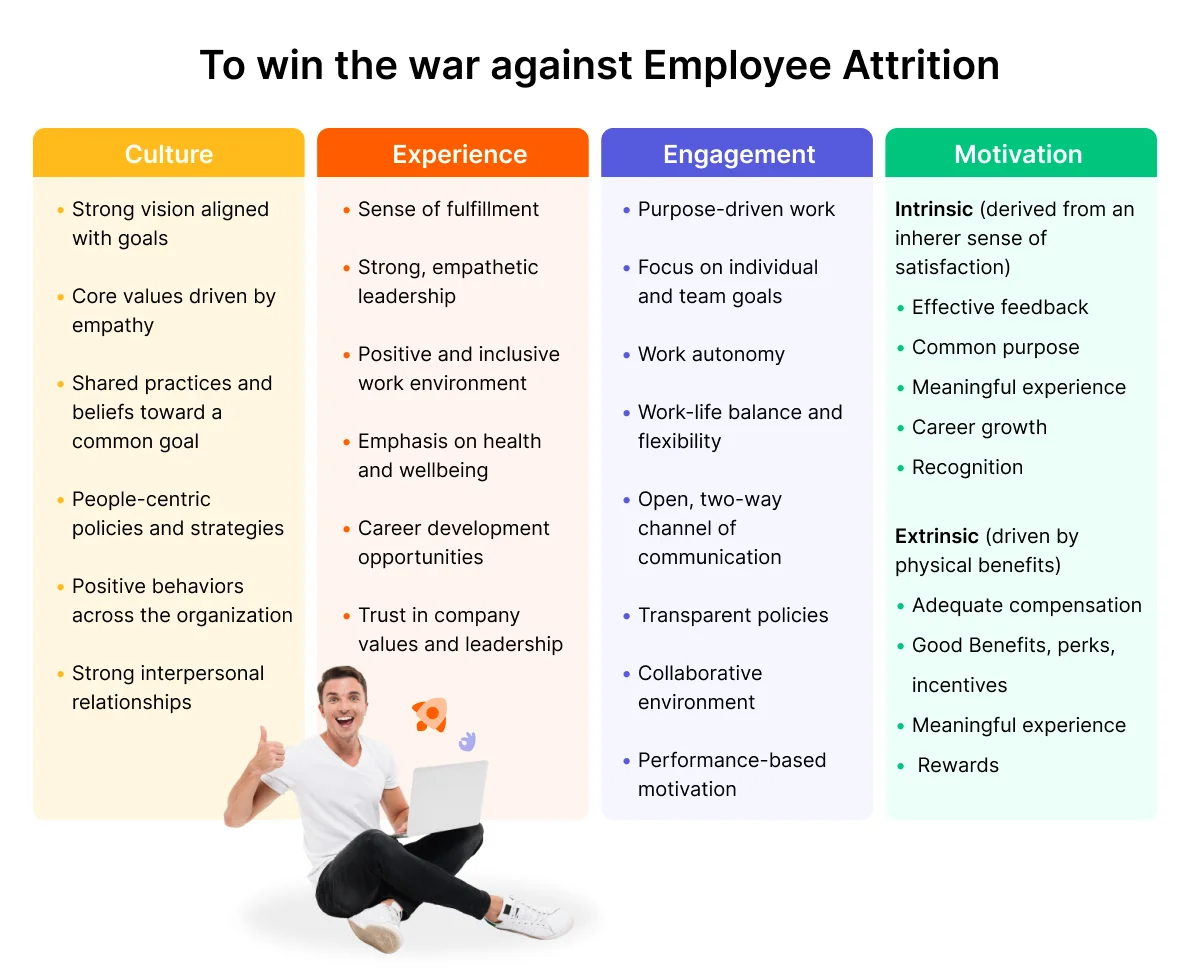
Culture shapes experience, experience drives engagement, engagement fuels motivation and motivation produces retention.
The rules of employee engagement are the principles that keep people motivated and stop them from leaving: build for the long term instead of quick pay fixes, listen continuously and act on what you hear, recognize people often, connect work to purpose and make engagement every leader's job. Follow them consistently and attrition falls, because people rarely quit a workplace where they feel valued, heard and able to grow.
The stakes are high. Gallup's employee retention indicator shows that 53% of US employees are watching for or actively seeking a new job, and estimates that voluntary turnover costs US businesses about $1 trillion a year. This guide explains why the rules of engagement have changed, the 10 rules that matter most and how to put them to work.
Why the rules of employee engagement have changed
For years, many people put up with dead-end jobs, poor pay, little career growth and inflexible working arrangements. The pandemic changed that by showing the value of people as a business investment, and the shift in how employees live, work and earn has continued since. Today's workforce, used to remote and hybrid work, on-demand opportunities and a more open job market, has moved away from the old live-to-work mentality.
Employers who push the old hustle culture now face two kinds of disengagement: the active kind, which shows up as high attrition, and the passive kind, such as quiet quitting, doing only the bare minimum, or moonlighting with a second job. Engagement data reflects the strain. Gallup's State of the Global Workplace research found that only 20% of employees worldwide were engaged in 2025, the second annual decline in a row.
Job security is no longer the top priority for many job seekers either. Younger employees in particular are confident in their abilities, expect to change jobs and want work that is meaningful, balanced and well led. That is why businesses need to revisit the rules of engagement in the workplace, rethinking how they attract, recognize and retain talent, with autonomy, purpose, recognition and flexibility at the center.
Why employee experience is vital for engagement
The old work culture tried to boost productivity without meeting employees' needs for psychological safety, autonomy and flexibility, work-life balance and meaningful appreciation. The pandemic exposed the burnout and disengagement that culture produced, and employees everywhere pushed to change their working conditions.
After a long period of worker shortages and voluntary quits, employers recognized that employee experience and a clear engagement strategy are the keys to curbing attrition and motivating people. Employee experience is everything a person goes through at work, and engagement is largely its result: a good experience builds commitment, while a poor one wears it down. Our guide on why employee experience is important explores that link in depth.
Framing the new rules of employee engagement
The new-generation workforce will not settle for less than it deserves. People want to work for empathetic leaders in jobs that matter, with balance and the right employee experience. The winning equation runs in a chain: culture shapes experience, experience drives engagement, engagement fuels motivation, and motivation produces retention.

Each link depends on the one before it. You cannot fix retention with a pay rise if the culture and experience behind it are broken, which is why the rules below start with how you build engagement and only then turn to how you sustain it. For the foundations each rule rests on, see the pillars of employee engagement.
Put the rules of engagement into practice
Listen, recognize and celebrate your people in one platform with Empuls.
Talk to our ExpertTrusted by 5,000+ companies
10 rules of employee engagement to reduce attrition
These 10 employee engagement rules move from strategy to everyday habits, and together they work as employee engagement strategies to reduce turnover. The first rule carries the most weight because the others fail without it: engagement has to be a long-term strategy owned by every leader, not a short-term perk owned by HR.
Rule 1: Build a long-term strategy, not short-term fixes
Pay rises and one-off perks can delay a resignation, but they rarely change how someone feels about their work. Move from short-term financial fixes to a long-term employee engagement strategy with clear goals, owners and a regular review. Revisit it at least once a year, because what your workforce needs will keep changing.
Rule 2: Make engagement everyone's job
Employee engagement is no longer an HR prerogative. From senior leaders to line managers, there must be a collective effort to tackle the causes of attrition. Managers matter most: Gallup's research on engagement and productivity estimates they account for 70% of the variance in team engagement. Our guide to the role of HR in employee engagement shows how to split responsibilities.
Rule 3: Start with listening
You cannot fix attrition until you know what causes it. Start with a pulse survey to find what is working and where to improve, then go deeper with stay interviews, exit interviews and lifecycle surveys at key moments such as onboarding and promotion. Design an employee experience framework that uses these inputs for continuous improvement.
Rule 4: Act on feedback, visibly
When employers take employee input and act on it, engagement rises across the organization. When they do not, the next survey gets fewer and less honest answers. Share what you heard, what you will change and when, then dig deeper into problem areas with follow-up conversations rather than another survey.
Rule 5: Give frequent, meaningful feedback
Effective and consistent feedback is one of the main drivers of intrinsic motivation, because it builds self-esteem, competence and engagement. Employees who receive frequent, meaningful feedback are more engaged and perform better. Replace once-a-year reviews with regular one-on-ones where expectations, progress and support are discussed openly.
Rule 6: Recognize and reward consistently
Recognition and appreciation with timely, meaningful rewards are among the primary drivers of engagement. Publicly appreciate people for good work, and they will reward you with their best effort. The retention payoff is measurable: a Gallup and Workhuman study found that well-recognized employees were 45% less likely to have left after two years.
Rule 7: Connect work to purpose
Connect what employees do with what they care about. Managers should show each person how their work relates to the organization's purpose, and leaders should explain the why behind decisions, not just the what. People who see the point of their work are far less likely to look elsewhere for meaning.
Rule 8: Communicate consistently and authentically
Train everyone, managers above all, to communicate clearly and honestly. Transparent communication about goals, changes and challenges builds the trust that keeps people through uncertain periods. Use a consistent rhythm, such as weekly team updates and quarterly town halls, and make it two-way.
Rule 9: Offer flexibility and autonomy
Autonomy and flexibility are now central to the employee experience. Give people a say in where, when and how they work wherever the role allows, and trust them with decisions about their own work. Where location cannot flex, offer choice over shifts, schedules or projects.
Rule 10: Invest in growth and culture
Lack of growth is one of the most common reasons people leave. Invest in development, visible career paths and internal moves, and invest in culture from the top down by having stakeholders model the behaviors you want. A viable employee retention strategy keeps you resilient as market conditions change. Our guide to employee retention strategies covers the wider playbook.
Employee engagement rules at a glance
Each rule closes a specific gap that pushes people toward the exit. Use the table to see which attrition risk each rule addresses and the signal that shows it is working.
| Rule | Attrition risk it addresses | Signal it is working |
|---|---|---|
| Long-term strategy | Perks that stop working after the next pay review | Engagement score rises year over year |
| Everyone's job | Engagement stalls outside HR | Managers own team action plans |
| Start with listening | Problems found only in exit interviews | Survey participation and stay interviews |
| Act on feedback | Distrust and survey fatigue | Agreement that action is taken on results |
| Meaningful feedback | Unclear expectations and stalled performance | Regular one-on-ones logged |
| Recognize and reward | Feeling unseen and undervalued | Share of employees recognized each month |
| Connect to purpose | Work that feels pointless | Employees can explain how their work matters |
| Communicate authentically | Rumors and low trust in leaders | Trust in leadership scores |
| Flexibility and autonomy | Burnout and better offers elsewhere | Lower regretted turnover |
| Growth and culture | Leaving for a promotion | Internal mobility and promotion rates |
Employee engagement best practices from early pioneers
Companies like Adobe, Workday and NVIDIA became early pioneers in employee engagement. They read the mood of their workforce, made changes to build an inclusive workplace and were rewarded with high discretionary effort, the desire to go above and beyond, and low attrition. The common thread is listening at scale and acting on it:
- Adobe: Combines advanced analytics with onboarding surveys to understand employee sentiment, then uses those insights to shape the employee experience.
- NVIDIA: Runs frequent surveys across the organization and has built a reputation for a workforce-centric culture and an inclusive environment.
- Workday: Gathers and acts on employee feedback continuously to improve the employee experience across the company, and has long featured on best-workplace lists.
These employee engagement best practices show that building the right engagement strategy goes hand in hand with tackling attrition. For a step-by-step approach to the retention side, read our playbook to reduce employee attrition.
Why intrinsic motivation is the key to retention
The old hustle culture relied on extrinsic motivation, such as compensation and service awards, to hold on to people. Waves of resignations and quiet quitting showed that this is not enough. Intrinsic motivation, where the drive to work comes from an inherent sense of satisfaction or enjoyment, is the key to a high-engagement culture.
Extrinsic rewards still matter: fair pay, good benefits and incentives are the baseline people expect. But they work best alongside what drives intrinsic motivation: effective feedback, a common purpose, meaningful work, career growth and recognition. The common denominator is the employee. If your people are properly motivated, they will stay and commit to the organization's long-term growth. Our guide to intrinsic vs extrinsic motivation explains how to balance the two.
How to reduce employee attrition: a three-step start
If attrition is already a problem, these three steps turn the rules into action within a quarter:
- Start with a pulse survey: Identify what is working and the areas that need improvement, broken down by team, tenure and role.
- Act on the feedback: Improve your workplace by acting on what you learn, and dig deeper with conversations to uncover the real problem areas.
- Invest in culture: Make your managers and senior stakeholders owners of the culture, and drive it from the top down with visible support.
Track voluntary and regretted turnover monthly alongside engagement scores, so you can see whether the actions are working before more people leave. Our guides to employee attrition and how to improve employee engagement go further.
How Empuls helps you apply the rules of employee engagement
Today's workforce wants more than a paycheck: people look for purpose, belonging and recognition. Empuls, Xoxoday's employee engagement platform, helps HR teams and leaders move from transactional tactics to human-centered engagement that builds commitment and long-term retention:
- Recognition: Personalized, values-based recognition programs, peer-to-peer appreciation and long service awards that highlight valuable contributions.
- Listening: Continuous feedback through pulse surveys, eNPS and lifecycle surveys, with real-time insights and action plans.
- Celebrations: Automated celebrations for birthdays and work anniversaries that build a culture of appreciation.
- HR integrations: Automated data sync with HR systems, such as the JustLogin integration, so every employee is included in engagement activities.
With automation and real-time insights, engagement becomes proactive, strategic and part of daily work rather than reactive. That is how you connect, engage and motivate your workforce, and keep your best people as the world of work keeps changing.
Book your Empuls demo
Frequently asked questions
The rules of employee engagement are core principles for keeping employees motivated and committed. The most important are: build a long-term strategy, make engagement every leader's job, start with listening, act on feedback visibly, give frequent feedback, recognize consistently, connect work to purpose, communicate authentically, offer flexibility and invest in growth and culture. Applied together, they reduce attrition.
Employee engagement reduces attrition because engaged employees feel valued, see a future in the organization and have strong ties to their manager and team, so they are less likely to look elsewhere. Gallup's meta-analysis found that top-quartile engagement teams had 21% to 51% lower turnover than bottom-quartile teams, depending on the organization's baseline turnover.
To reduce employee attrition quickly, run a short pulse survey to find the main causes, hold stay interviews with high performers and act visibly on the top two issues. Start recognizing good work regularly and make sure every employee has a recent one-on-one with their manager. These steps can start within weeks, while longer-term fixes to pay, growth and culture follow.
The best employee engagement strategies to reduce turnover are training managers to coach, recognizing employees consistently, offering flexibility, creating clear growth paths and listening continuously through surveys and stay interviews. Recognition is especially powerful: in a Gallup and Workhuman study, well-recognized employees were 45% less likely to have left their organization after two years.
Attrition is when employees leave and the role is not refilled, so headcount shrinks, often through retirement or resignation. Turnover is when employees leave and are replaced. In everyday HR use the terms overlap, and both are tracked as a percentage of headcount. Engagement affects both, because disengaged employees are more likely to resign whether or not the role is refilled.
Intrinsic motivation matters for retention because people driven by satisfaction, purpose and growth in their work are less tempted by a slightly higher offer elsewhere. Extrinsic rewards like pay set the baseline, but meaningful feedback, recognition, autonomy and career growth build the commitment that keeps people. Organizations that rely only on pay rises usually see the effect fade at the next offer.
Everyone in the organization is responsible for employee engagement. Executives set goals and fund them, managers own engagement in their teams through one-on-ones, feedback and recognition, HR designs programs and provides tools and data, and employees contribute honest feedback and peer recognition. Leaving engagement to HR alone is one of the most common reasons programs fail.





































































































































































































































































































































































































































































































































































