
Key Takeaways
An employee sentiment survey measures how employees feel about their work, managers, workload and company, focusing on emotions and attitudes rather than satisfaction alone.
Measure sentiment with short pulse surveys, eNPS and AI analysis of open comments, then confirm the picture with absence and turnover data.
Employee sentiment analysis classifies comments as positive, neutral or negative and groups them into themes; net sentiment is the percent positive minus the percent negative.
Review AI themes against real comments before they reach leadership, because sarcasm, mixed comments and multilingual answers reduce accuracy.
Sentiment data only builds trust when results are shared, owned actions follow and a follow-up pulse checks that mood is improving.
An employee sentiment survey measures how employees feel about their work, managers, workload and company, not just whether they are satisfied. Combined with sentiment analysis of open comments, it shows you the emotions behind the scores, such as frustration with workload or optimism about a new leader, early enough to act. This guide covers what to ask, how to measure and analyze sentiment, and how to turn the results into change.
Employee sentiment surveys give you a clear window into how your team feels about its work environment, roles and culture. They have become a critical tool for keeping people engaged and motivated, and the need is growing: Gallup's State of the Global Workplace 2026 report found that only 20% of employees worldwide were engaged in 2025, the lowest level since 2020. Regular sentiment surveys show what is working and where improvements are needed.
What employee sentiment is
Employee sentiment is the overall emotions, attitudes and perceptions employees have about their workplace, leadership, job responsibilities and company culture. It reflects how employees feel rather than just how engaged or satisfied they are. Tracking it matters for three reasons:
- It reveals workplace morale: Shows whether employees feel valued, motivated or frustrated.
- It predicts engagement and retention: Negative sentiment can signal burnout, dissatisfaction or a higher risk of turnover.
- It drives culture improvements: Tracking sentiment lets you address concerns before they escalate.
Employee sentiment is usually measured through pulse surveys, sentiment analysis of open comments and AI-driven feedback tools, which together help businesses build a healthier, more productive workplace.
What an employee sentiment survey is
An employee sentiment survey is a short, recurring questionnaire that measures how employees feel about their work, leadership, culture and overall job experience. Unlike traditional engagement surveys, sentiment surveys focus on emotions, attitudes and real-time morale, and they rely heavily on open questions whose answers are analyzed for tone and themes.
| Sentiment survey | Engagement survey | Satisfaction survey | |
|---|---|---|---|
| Measures | Emotions and attitudes right now | Commitment, motivation and effort | Contentment with pay, conditions and the job |
| Typical questions | "How do you feel about your work this week?" plus open comments | Driver statements such as "I know what is expected of me" | "I am satisfied with my benefits" |
| Cadence | Weekly to quarterly | Annual with quarterly pulses | Annual or twice a year |
| Main analysis | Sentiment and theme analysis of comments | Driver scores and benchmarks | Percent favorable by factor |
The three overlap, and many companies combine them. For the other two, see our guides to the employee engagement survey and how to conduct employee satisfaction surveys.
Why conduct an employee sentiment survey
Employee sentiment surveys are not just about collecting feedback; they give you insight into the emotional wellbeing of your workforce. When employees feel valued and heard, they tend to perform better and stay longer.
20%
of employees worldwide engaged in 2025
22%
of managers engaged, down from 27%
34%
of employees thriving in their overall lives
52%
say it is a good time to find a job
Source: Gallup, State of the Global Workplace 2026
Surveys show you where employees are satisfied and where challenges exist. For instance, if many employees express frustration over a lack of career development, you can act before it leads to higher turnover. They also improve transparency and trust, because acting on what people tell you shows that their voices matter, and employees want more of it: the Qualtrics 2026 Employee Experience Trends research found that 42% of employees want their leaders to listen more often, while only 25% say their employer increased listening. And with manager engagement falling, sentiment data by team helps you see which managers need support.
Employee sentiment survey best practices
Creating an effective employee sentiment survey involves more than putting together a list of questions. These four best practices decide whether employees answer honestly and whether the results lead anywhere.
01 · 01
Clear, concise questions
Straightforward questions get relevant, thoughtful answers. Avoid jargon, double-barreled questions and leading phrasing.
02 · 02
Anonymity and confidentiality
People share more honest feedback when their identity is protected. Report only for groups of about five or more so responses cannot be traced to individuals.
03 · 03
A regular rhythm
One survey is a snapshot; regular surveys show trends. Run short sentiment pulses monthly or quarterly to spot shifts and test whether initiatives work.
04 · 04
Actionable insights
Design questions that point to areas you can change, and commit to sharing results and actions. Acting on feedback shows employees their opinions are valued.
How to measure employee sentiment
Measuring employee sentiment accurately goes beyond a single survey. Combine the six methods below; the first three give you the core signal, and the last three add context and help you confirm what the surveys suggest.
- Sentiment analysis of open feedback: Use AI tools to analyze open-ended survey responses and classify each comment as positive, neutral or negative, then track how the mix shifts over time.
- Pulse surveys for real-time tracking: Unlike annual surveys, pulse surveys capture short, frequent feedback, weekly or monthly, to track changes in sentiment. For example: "How do you feel about your work this week?" on a scale from very positive to very negative. Emoji-based answers make them fast to complete.
- eNPS as a sentiment indicator: Ask "On a scale of 0 to 10, how likely are you to recommend this company as a great place to work?" Scores of 9 to 10 are promoters, 7 to 8 are passives and 0 to 6 are detractors. Our employee Net Promoter Score guide explains the calculation.
- Behavioral and workplace data: Frequent unplanned absences may signal low morale, high turnover in specific teams can point to leadership or cultural issues, and a drop in performance or collaboration may indicate disengagement.
- Anonymous open feedback channels: Let employees share concerns, frustrations or praise anonymously through a feedback portal or digital suggestion box. Removing fear of repercussions gives more honest insight.
- Benchmarking: Compare your scores with your own past results and with industry benchmarks to see whether sentiment is above, below or level with similar organizations.
See what your employees really feel
Analyze every open comment with AI, in 20+ languages, and see sentiment by team in minutes.
Talk to our ExpertTrusted by 5,000+ companies
How employee sentiment analysis works
Employee sentiment analysis uses natural language processing (NLP) to read open-ended comments, score their emotional tone and group them into themes. It turns hundreds or thousands of comments into a short summary of what people feel and why, which no HR team can do by hand at scale.
The worked example below shows how six comments from a quarterly pulse are classified, and how a simple net sentiment score is calculated:
| Comment | Sentiment | Theme |
|---|---|---|
| "My manager checks in every week and it really helps." | Positive | Manager support |
| "Love the new learning budget." | Positive | Career growth |
| "The hybrid policy is fine, I guess." | Neutral | Flexibility |
| "Workload has been unsustainable since the reorg." | Negative | Workload |
| "Great team, but pay has not kept up with the market." | Mixed, scored negative | Pay |
| "Nobody tells us why priorities keep changing." | Negative | Communication |
A negative net score tells you mood is poor; the themes tell you why. Here, workload, pay and communication are the issues to investigate, while manager check-ins are a strength to protect. Track the same score and themes every cycle and by team, because a fall in one department is often the earliest warning of attrition.
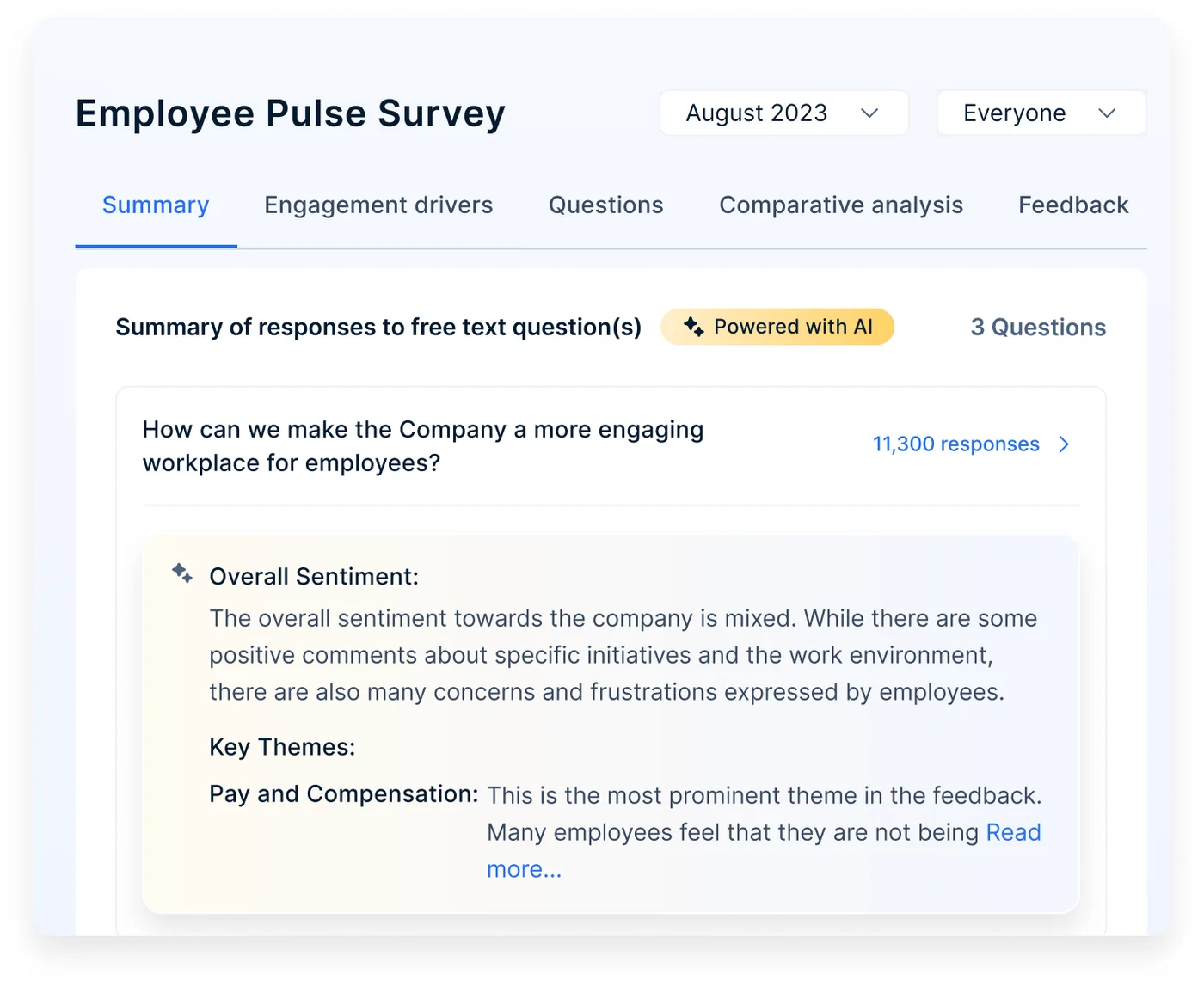
Two caveats apply. Accuracy drops with sarcasm, mixed comments and multilingual answers, so test your tool on real comments before relying on it. And AI themes are a first pass: have someone in HR read a sample of the comments behind each theme before results reach leadership. Our guide to the AI employee engagement survey covers how AI also helps with question design and action planning.
How to design an employee sentiment survey
Designing an employee sentiment survey takes careful planning to get useful feedback. Follow these four steps:
- Select the right questions: Identify the areas you want to explore, such as overall mood, leadership, workload or team dynamics, and write questions for each. Use the bank below as a starting point.
- Mix quantitative and qualitative questions: Ratings give data you can track over time, while open questions let employees explain their feelings in detail. Include at least one or two open questions, because they feed your sentiment analysis.
- Keep the length manageable: A sentiment pulse should take under five minutes; a deeper quarterly survey should take no more than 10 to 15 minutes. Longer surveys lead to incomplete or rushed answers.
- Choose tools that fit: Look for templates, automated distribution in tools like Slack or Microsoft Teams, built-in sentiment analysis and minimum group sizes for reporting. Choose a tool that lets you customize questions and track the same ones over time.
20 employee sentiment survey questions
These 20 sentiment survey questions measure morale, emotional wellbeing and outlook across five areas. Where the original question was yes or no, we suggest a five-point scale instead, because it shows how strongly people feel and makes changes easier to track.
Overall workplace sentiment questions
| Question | Answer format |
|---|---|
| On a scale of 0 to 10, how happy are you at work? | 0 to 10 |
| How would you describe your emotional wellbeing at work? | Happy, neutral, stressed, overwhelmed, frustrated |
| I feel valued and appreciated for my contributions. | Five-point agree scale |
| How likely are you to recommend this company as a great place to work? | 0 to 10 (eNPS) |
Leadership and management sentiment questions
| Question | Answer format |
|---|---|
| Leadership listens to and values employee feedback. | Five-point agree scale |
| How would you rate the transparency of company leadership? | Very transparent to not transparent at all |
| My manager supports my professional growth. | Five-point agree scale |
| How comfortable do you feel approaching your manager with concerns? | Very comfortable to not comfortable at all |
Workload and stress questions
| Question | Answer format |
|---|---|
| How manageable is your workload on a daily basis? | Very manageable to overwhelming |
| How often do you feel stressed or burned out at work? | Often, sometimes, rarely, never |
| I have enough time and resources to complete my tasks well. | Five-point agree scale |
| How well does the company support your work-life balance? | Very well to poorly |
Culture and team dynamics questions
| Question | Answer format |
|---|---|
| I feel included and respected within my team. | Five-point agree scale |
| How would you describe the overall work culture here? | Positive, neutral, negative |
| Teamwork and collaboration are encouraged in my department. | Five-point agree scale |
| How often do you receive recognition for your work? | Frequently, sometimes, rarely, never |
Future outlook and career growth questions
| Question | Answer format |
|---|---|
| I feel excited about my future with this company. | Five-point agree scale |
| How confident are you in the company's direction and future success? | Very confident to not confident at all |
| There are enough opportunities for career growth and advancement here. | Five-point agree scale |
| What is one thing the company could do to improve your overall experience? | Open-ended |
Add one more open question to every pulse, such as "What is one thing that made this month harder than it needed to be?", so your sentiment analysis has enough text to work with. For more ideas, see our 20 pulse survey questions.
From sentiment survey results to action
The value of an employee sentiment survey lies in what you do with the results; collecting feedback alone changes nothing. Work through these six steps after every survey:
- Categorize responses: Sort feedback into areas such as overall mood, leadership, workload and culture, so you can see which areas are thriving and which need attention.
- Identify trends and outliers: Look for themes that appear across many responses, such as communication or growth. Also read the outliers, because unusual comments can point to deeper concerns.
- Share results with employees: Communicate the findings through team meetings, email updates or short reports. Transparency builds trust and shows the company values input.
- Create action plans: Focus on the areas that need improvement, outline specific steps, owners and timelines, and be realistic about what can be done, prioritizing by urgency and impact.
- Equip managers: Give each manager their team's sentiment trend and top themes, and ask them to agree on one action with their team.
- Follow up: Run a follow-up pulse to check whether sentiment in the priority areas is improving, and keep tracking as needs change.
Sentiment surveys work best as one part of a wider employee listening program that also includes lifecycle surveys, one-on-ones and always-on channels.
How Empuls helps you measure and improve employee sentiment
Empuls makes sentiment surveys a continuous, low-effort routine rather than a quarterly project. With Empuls AI sentiment analysis, you can:
- Read every comment automatically: Em, the Empuls AI assistant, uses NLP to find recurring themes and emotional tone in open-ended responses and maps them to four engagement drivers: recognition and growth, relationships and culture, hygiene factors and strategic connect.
- Check the evidence: Every theme links back to the comments that drove it, so you can verify any summary with a click.
- Listen in 20+ languages: Employees answer in their own language, and responses are auto-translated so all feedback is analyzed as one set of themes.
- Slice by any group, safely: Filter by department, designation, grade, location or business unit, with results shown only for groups of about five or more and a heatmap comparing drivers across groups.
- Act on priorities: Get a recommended action plan ranked by priority, with suggested owners, and track it through Empuls action plans.
Run sentiment pulses alongside eNPS and lifecycle surveys with Empuls employee surveys. When employees feel heard and see change, engagement, productivity and retention follow.
Book your Empuls demo
Frequently asked questions
Employee sentiment analysis is the use of natural language processing to read employees' written feedback, score its emotional tone as positive, neutral or negative and group comments into themes such as workload or pay. It turns large volumes of open survey comments into a summary that shows how people feel and why, so HR can prioritize action.
Employee sentiment describes how employees feel right now about their work, leaders and company, and it can change week to week. Employee engagement describes their longer-term commitment, motivation and effort. Sentiment is often an early signal: a sustained fall in sentiment usually shows up later as lower engagement and higher turnover.
Most companies run short sentiment pulses monthly or quarterly, with a deeper engagement survey once a year. During major changes, such as a reorganization, a weekly or biweekly pulse can help. Choose a frequency you can act on, because surveying often without sharing results or making changes quickly erodes trust and participation.
A simple method is net sentiment: the percentage of positive comments minus the percentage of negative comments. For example, 33% positive and 50% negative gives a net sentiment of minus 17. You can also average rated questions or use eNPS. Whichever you choose, use it consistently so you can compare teams and track trends.
Leadership style, the relationship with a direct manager, workload, work-life balance, recognition, pay, career growth opportunities, company culture and communication all shape employee sentiment. Change events, such as reorganizations, layoffs, new policies or new leaders, also cause sharp shifts, which is why sentiment should be measured regularly rather than once a year.
Use a survey tool that hides individual answers from managers and only reports results for groups above a minimum size, usually about five people. Avoid demographic questions that could identify someone in a small team, tell employees exactly how their data is handled and never try to trace comments back to individuals.
A sentiment pulse should take under five minutes, with five to ten questions including one or two open questions. A deeper quarterly sentiment survey can take 10 to 15 minutes. Keeping surveys short and focused improves participation and gives more thoughtful answers, especially when you survey often.
AI sentiment analysis is accurate enough to summarize large volumes of comments and spot themes quickly, but it struggles with sarcasm, mixed comments and some languages. Choose a tool trained on workplace language that links each theme to the original comments, and have HR review a sample before sharing conclusions with leadership.





































































































































































































































































































































































































































































































































































