
Key Takeaways
The role of HR in employee engagement is to design the system of hiring, onboarding, manager enablement, listening, recognition and wellbeing that managers then deliver every day.
Gallup found that only 20% of employees worldwide were engaged in 2025, and falling manager engagement explains most of the recent decline.
Only 44% of managers say they have received management training, and trained managers are half as likely to be actively disengaged, which makes manager training HR's highest-leverage engagement move.
Engagement works best when ownership is shared: HR designs and measures, managers deliver and leaders set direction and fund the work.
HR should track engagement scores, eNPS, survey participation, regretted attrition, recognition reach and internal mobility to see whether its initiatives work.
The role of HR in employee engagement is to design the system that makes engagement possible: hiring for fit, onboarding with purpose, equipping managers, listening to employees, recognizing contributions and supporting wellbeing. Managers deliver engagement day to day, but HR builds the programs, data and habits that let them do it well.
That role has changed a lot in a few years. HR has steered organizations through remote work, hybrid return-to-office plans, rehiring waves and now AI adoption. Through all of it, HR has been responsible not only for keeping productivity steady but also for making sure people stay meaningfully connected to the organization's work.
In this guide, you will learn what employee engagement means in human resource management, how the HR role in engagement has evolved, the core responsibilities HR owns, how HR, managers and leaders share the work, practical HR strategies to improve employee engagement and the metrics that show whether they are working.
What employee engagement means in human resource management
In human resource management, employee engagement goes beyond job satisfaction or surface-level happiness. Employee engagement is the emotional commitment an employee has toward the organization's goals and values. That commitment drives motivation, discretionary effort and loyalty, which are key drivers of productivity and retention.
Engagement is now a strategic pillar that influences every stage of the employee lifecycle, from onboarding and learning to recognition and retention. For a full primer on the concept, read our guide to employee engagement.
The current numbers show why HR cannot treat engagement as a side project. Gallup's State of the Global Workplace 2026 report found that only 20% of employees worldwide were engaged in 2025, that manager engagement has dropped nine points since 2022 and that low engagement cost the world economy about $10 trillion in lost productivity, or 9% of GDP.
20%
of employees worldwide are engaged at work
Gallup, 2026 report
-9 pts
drop in manager engagement since 2022
Gallup, 2026 report
$10T
lost productivity from low engagement
Gallup, 2026 report
Why engagement is an HR priority
How the HR role in engagement has evolved
HR has always been the facilitator between workers, managers and executive leadership, so it has always had a part to play in engagement. What has changed is how deliberate that part has become, and the shift has happened in three stages.
Engagement used to be the manager's duty
Something like employee engagement was present in good organizations long before it had a name. It showed in the way strong managers handled day-to-day affairs, made sure their people were looked after and cultivated close-knit teams that relied on each other to get things done.
Before the 1990s, HR's attention was mostly on employee satisfaction, policies and compliance, and little thought went to whether employees actually cared about the organization. Engagement depended on whether you happened to have a good manager.
HR moved from satisfaction to engagement
Once research showed how much engagement drives performance and retention, HR started to own it. Today HR's job is to make sure every manager, not just the naturally gifted ones, is empowered to create the conditions that encourage engagement.
This also means HR advocates for employees with leadership, not only for leadership with employees. As Lindsay Lagreid of the Limeade Institute put it in a Forbes interview, "HR is the architect of the employee experience and needs to act as the unrelenting advocate of the employee voice to leadership."
HR now architects the whole employee experience
Retaining talent has become harder because people no longer look for a stable job they can hold for life. They want growth, challenge, a rewarding career and a good life outside work, and if a job blocks those, they will make drastic changes.
That pushes HR from policy owner to experience designer, a shift covered in depth in our guide to what employee experience is. Gartner's 2026 CHRO priorities research reflects the same shift: fixing culture problems that hold back performance is one of four top priorities, yet only 47% of CHROs surveyed said their culture drives employee performance today.
| Dimension | Traditional HR | Engagement-focused HR |
|---|---|---|
| Main goal | Compliance, payroll and satisfaction | Commitment, performance and retention |
| Employee voice | Annual satisfaction survey | Continuous listening with visible action |
| Managers | Left to their own style | Trained, coached and given data |
| Recognition | Annual awards and tenure gifts | Frequent, values-linked, peer and manager recognition |
| Wellbeing | Standard benefits package | Flexible benefits, mental health and financial wellness |
| Success measure | Policies in place | Engagement, eNPS, regretted attrition and internal mobility |
Give your HR team one engagement platform
Run surveys, recognition, rewards and wellbeing programs from one place and see where to act by team.
Talk to our ExpertTrusted by 5,000+ companies
Seven responsibilities that define the role of HR in employee engagement
The seven responsibilities below follow the employee lifecycle from hiring to long-term wellbeing. Manager enablement carries the most weight, because managers turn every other program into a daily experience, so give it extra attention when you prioritize.
1. Hiring with purpose and cultural alignment
Modern HR teams are no longer just filling open roles; they are shaping experiences from day one. By hiring people who align with the company's purpose and values, HR lays the foundation for long-term engagement.
Recruiting is not only about skills. It is about finding people who find the work genuinely interesting, connect with the organization's mission and are likely to thrive in its culture, while still welcoming diverse backgrounds and ideas. Our cultural alignment guide explains how to hire for values without hiring for sameness.
2. Designing meaningful onboarding experiences
Onboarding is one of the first opportunities HR has to engage employees. It is where new hires learn not just what to do, but why their work matters and how their contribution furthers the organization's mission.
Structure onboarding to communicate the vision, give access to leaders and encourage early connections with peers. Then follow through on the promises made during hiring, because a gap between the pitch and reality is one of the fastest routes to early disengagement. A thoughtful welcome, such as onboarding gifts for new hires, helps set the tone.
3. Empowering managers to drive engagement
HR designs the engagement strategy, but managers implement it. That is why human resources and employee engagement go hand in hand with leadership enablement.
The data shows how big this gap is. Gallup's State of the Global Workplace 2025 report found that only 44% of managers worldwide say they have received management training, and that half as many trained managers are actively disengaged as untrained ones. HR needs to equip managers with data, tools and training to recognize effort, hold meaningful conversations and build team cohesion. When managers are supported, they become the frontline champions of engagement.
4. Creating opportunities for growth and purpose
One of the main reasons employees disengage is a lack of growth. HR builds clear career paths, promotes internal mobility and offers learning that serves both business goals and employee aspirations.
LinkedIn's 2025 Workplace Learning Report found that 88% of organizations are concerned about retention and that providing learning opportunities is their top retention strategy, yet only 15% of employees say their manager helped them build a career plan in the past six months. HR also enriches jobs by connecting daily tasks to organizational impact, so people see purpose in their work.
5. Measuring and acting on employee feedback
Data-driven HR functions rely on continuous listening. Pulse surveys, engagement surveys, lifecycle surveys and eNPS show how employees feel and why.
The HR role in employee engagement includes analyzing this feedback and driving real change. It is not enough to collect data: HR must act on it, close the feedback loop and communicate progress, and base investment decisions on what employees say they need. Our post on why annual employee surveys fail shows why a yearly survey alone is no longer enough.
6. Recognizing and rewarding contributions
A well-structured recognition and rewards program significantly boosts morale. HR should create frameworks for peer-to-peer recognition, milestone celebrations and values-based acknowledgment.
Recognition does not always have to be monetary. Personalized appreciation, public acknowledgment and meaningful gestures go a long way in building trust. For a step-by-step design, see our guide to a values-based recognition program.
7. Supporting wellbeing through holistic initiatives
The lines between work and life have blurred. Human resources employee engagement strategies now include mental health resources, flexible benefits, financial wellness and wellness programs.
When employees feel supported as people, not just workers, they are more likely to stay engaged and productive. HR designs benefits that meet the diverse needs of a multigenerational workforce, and the latest ideas are in our roundup of employee wellness trends for 2026.
How HR, managers and leaders share engagement
Engagement fails when everyone assumes someone else owns it. HR designs and measures, managers deliver and leaders set direction and fund the work. The table below splits each engagement driver into those three roles so nothing falls through the gaps:
| Engagement driver | HR's role | Manager's role | Leadership's role |
|---|---|---|---|
| Hiring and onboarding | Define values-based hiring and onboarding journeys | Welcome, set expectations, assign a buddy | Share the mission with every new cohort |
| Listening | Run surveys, analyze results, report trends | Discuss results with the team and agree on actions | Act on company-wide themes and say what changed |
| Recognition | Design the program, budgets and values tags | Recognize often and specifically | Model recognition and fund it |
| Growth | Build career paths, learning and mobility | Hold career conversations and coach | Prioritize promoting from within |
| Wellbeing | Design benefits and wellness programs | Watch workload and spot burnout early | Protect time off and set sustainable targets |
If you are building the plan itself, our employee engagement action plan covers ownership and timelines step by step.
HR strategies to improve employee engagement
HR is no longer just about policies, payroll and compliance. It is about engineering employee experience, advocating for people and enabling business growth. These nine HR strategies to improve employee engagement are ordered roughly along the employee lifecycle, so you can start with the stage where your data shows the biggest gap:
- Hire with purpose and cultural fit: Move beyond CVs and skills. Add values-based interview questions and realistic job previews so candidates who resonate with your purpose self-select in.
- Create a human-centric onboarding experience: Replace transactional paperwork with connection-focused onboarding. Introduce new hires to your values, team culture and leaders in the first week, and check in at 30, 60 and 90 days.
- Build a culture of continuous listening: Run regular eNPS, pulse and lifecycle surveys to track how sentiment changes. Share results within weeks and act on feedback visibly to build trust.
- Empower and equip managers: Give every new manager basic role training, then coaching skills, team-level engagement data and simple nudges to recognize and check in with their people.
- Build recognition into the daily workflow: Make recognition frequent, timely and meaningful, both peer to peer and top down, and tie it to core values and milestones.
- Offer purpose-driven growth and learning: Provide internal mobility, learning budgets and mentorship. Ask managers to hold a career conversation with every team member at least twice a year.
- Enable flexible and equitable rewards: Recognize that needs differ by person and country with a flexible rewards catalog that includes experiences, perks, charity and lifestyle benefits.
- Promote wellbeing and financial wellness: Support the whole person, including mental health, family needs and financial stability. Make wellbeing part of how work is planned, not an optional extra.
- Build belonging through communication: Create a transparent, respectful culture with open dialogue. Share company news in one place and celebrate milestones, wins and life events.
For a broader list of tactics beyond HR's direct remit, see our employee engagement strategies guide, and for principles that keep programs on track, read the rules of employee engagement.
Metrics HR should track to measure engagement
How HR can improve employee engagement depends on measuring it the same way every time. Track a small set of metrics that combine what employees say with what they do:
| Metric | What it tells you | How often |
|---|---|---|
| Engagement survey score | Overall commitment and the drivers behind it | Once or twice a year, plus pulses |
| eNPS | How likely employees are to recommend you as an employer | Quarterly |
| Survey participation rate | Whether employees trust that feedback leads to action | Every survey |
| Regretted attrition | Whether you are losing people you wanted to keep | Monthly |
| Recognition frequency and reach | How many employees are recognized and how often | Monthly |
| Internal mobility rate | Whether people can grow without leaving | Quarterly |
| Absenteeism | Early signs of burnout or disengagement | Monthly |
To combine several of these into one number, see how to build an employee engagement index.
Common mistakes HR makes with employee engagement
Even well-run HR teams fall into a few predictable traps. Watch for these:
- Owning engagement alone: If managers and leaders see engagement as an HR program, it stays a program. Share ownership explicitly.
- Surveying without acting: Collecting feedback and going quiet erodes trust faster than not asking at all.
- One-size-fits-all programs: Frontline, remote, office and multigenerational teams need different channels and rewards.
- Measuring activity, not outcomes: Counting events held matters less than tracking engagement, eNPS and regretted attrition.
- Forgetting the managers' own engagement: Managers are under the most strain, and disengaged managers cannot engage their teams.
If engagement is already slipping, our guide to employee disengagement explains the warning signs and how to turn them around.
How Empuls supports HR in driving engagement
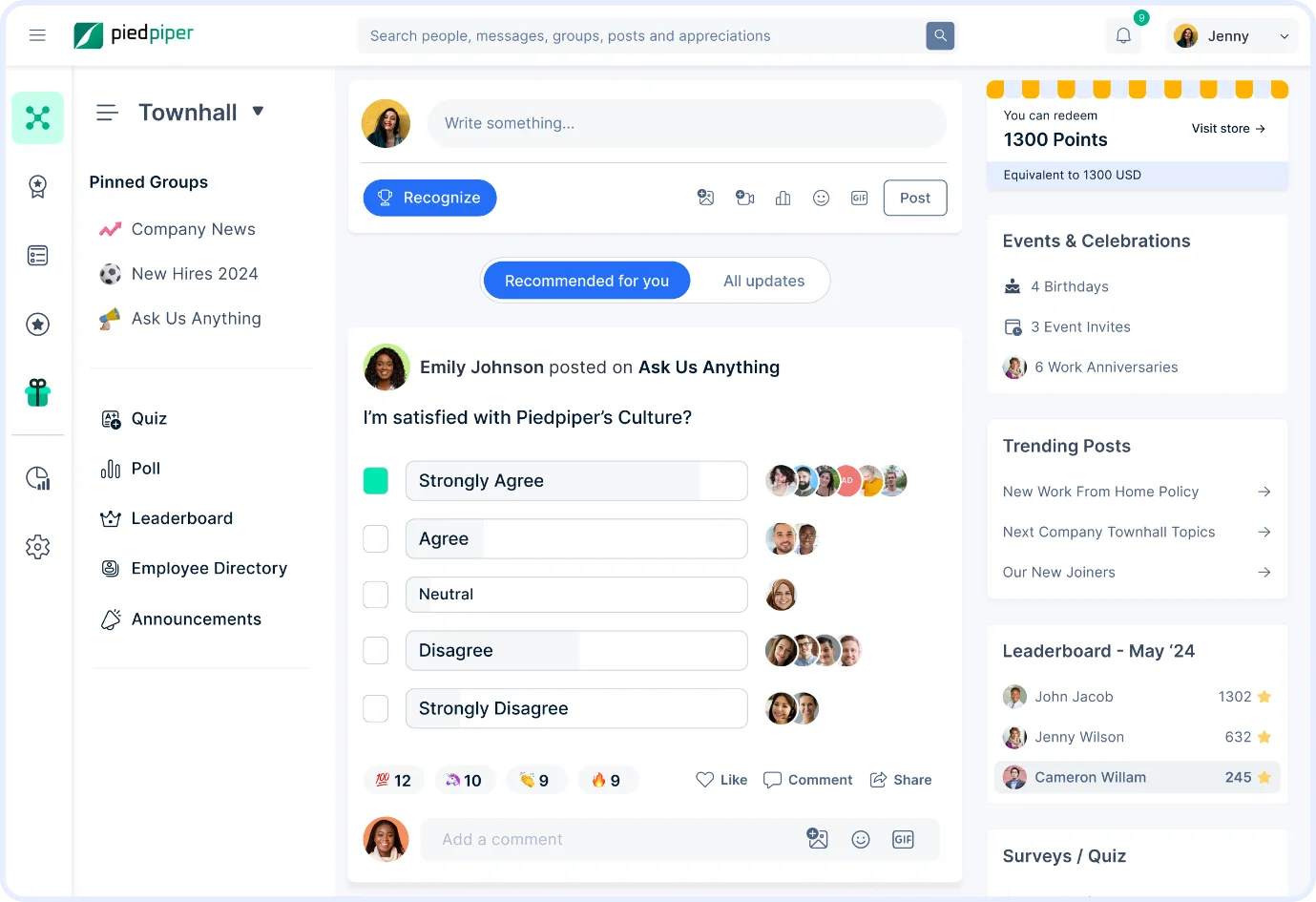
Empuls, Xoxoday's employee engagement platform, gives HR teams one place to run the programs above. Explore the Empuls solution for HR teams or start with these capabilities:
- Onboarding and alignment: A social intranet with town halls, groups, announcements and celebration boards helps new joiners connect with the culture from day one.
- Surveys and feedback: eNPS, pulse and lifecycle surveys with AI-driven insights help HR and managers act on feedback quickly.
- Manager enablement: Nudges and insights help managers recognize team members, close recognition gaps and keep engagement inclusive.
- Recognition and rewards: Spot, peer, team, jury-based and milestone awards through Empuls recognition, linked to values and KPIs, with a global rewards catalog of gift cards, experiences, charity and merchandise.
- Perks and wellbeing: Flexible benefits, perks and discounts and wellness programs support employees' financial and physical wellbeing.
- Analytics: Reports and analytics show engagement and recognition trends by team, location and function, so HR knows where to act.
Empuls is built to help HR move from a compliance-focused function to a strategic engagement partner that designs experiences that drive loyalty, performance and wellbeing.
HR as the architect of engagement
HR teams today work with a workforce that approaches work and careers very differently than it did two decades ago. The end goal is no longer mere employee satisfaction; it is a committed workforce that chooses to stay and do its best work.
The role of HR in employee engagement is to build the system: hire for fit, onboard with purpose, equip managers, listen and act, recognize often and support wellbeing. With some retraining for managers and a focus on employee wellbeing, that system is well within reach.
Book your Empuls demo
Frequently asked questions
HR designs the programs, policies and activities that promote engagement, including values-based hiring, onboarding, manager training, recognition, career development, internal communication and wellbeing benefits. HR also measures engagement through surveys and metrics, shares results with managers and leaders and tracks whether the actions taken are improving how employees feel and how long they stay.
Both, along with senior leaders. HR is responsible for designing engagement programs, giving managers training and data and measuring results. Managers are responsible for delivering engagement every day through recognition, feedback, coaching and fair workloads. Leaders set the direction, fund the work and model the culture. Engagement stalls when any one group assumes another owns it.
HR can measure employee engagement with annual or twice-yearly engagement surveys, short pulse surveys, eNPS, one-on-one feedback and exit and stay interviews. Pair those with behavioral metrics such as regretted attrition, absenteeism, internal mobility and recognition frequency. Comparing results by team and over time shows where engagement is improving and where HR and managers need to act.
A common way to group employees is by four levels of engagement. Highly engaged employees are motivated and committed to the organization. Moderately engaged employees are generally satisfied but not emotionally invested. Disengaged employees are unmotivated and indifferent toward their work. Actively disengaged employees are unhappy and may spread negativity, which makes them the most urgent group for HR and managers to address.
The HR objective of employee engagement is to build a motivated, productive and committed workforce that contributes to organizational goals and stays longer. In practice, that means raising engagement and eNPS scores, reducing regretted attrition and absenteeism and making sure every employee has a manager who recognizes their work, supports their growth and listens to their feedback.
Common HR employee engagement initiatives include structured onboarding journeys, manager training programs, quarterly pulse surveys with visible action plans, peer-to-peer recognition, milestone and service awards, mentorship and internal mobility programs, flexible benefits, wellness challenges and regular town halls. The best initiatives respond directly to survey results, so employees can see that their feedback led to change.
Most organizations run a full engagement survey once or twice a year and short pulse surveys monthly or quarterly. The full survey gives a detailed baseline across all engagement drivers, while pulses track whether specific actions are working. Whatever the rhythm, HR should share results quickly and act on them, because survey fatigue comes from no action, not from frequency.
AI is helping HR analyze survey comments at scale, spot engagement and attrition risks earlier and give managers timely nudges to recognize or check in with their people. It also changes the work itself, so HR is increasingly responsible for helping employees adapt to AI tools. The human parts of engagement, such as trust, coaching and recognition, still depend on managers and leaders.





































































































































































































































































































































































































































































































































































