
Key Takeaways
Sales performance management software automates how a company plans, measures and rewards sales performance, and incentive compensation is still the main reason companies buy it.
Weight incentive calculation accuracy, data integration and seller visibility most heavily, because they decide whether sellers trust their pay.
Bring your hardest real plan to every demo and ask each vendor to build it live and show the seller's statement.
Test the top two vendors on a past period of your own data and compare the result with what you actually paid.
A weighted scorecard with criteria summing to 100 keeps the decision about your needs rather than the most polished demo.
Choosing sales performance management software starts with your hardest incentive plan, not a feature list. Map what you need across incentive compensation, data integration, rep visibility, planning and analytics, test shortlisted tools on your own plan and data, and score them with weighted criteria. This guide gives you the features to look for, a six-step selection process, a ready-to-use vendor scorecard and the questions to ask in every demo.
Sales performance management (SPM) software is a set of applications that automates how a company plans, measures and rewards sales performance. Analyst firm Gartner describes SPM as automating the implementation and administration of incentive compensation plans for sellers, along with the related territory and quota management, and notes that incentive compensation remains the main reason companies buy it. Good SPM software gives leaders visibility, keeps sellers motivated and makes sure every payout is right.
What sales performance management software does
SPM platforms bundle several modules. Few companies need every one on day one, so it helps to know what each does and who uses it before you look at vendors.
| Module | What it does | Main users |
|---|---|---|
| Incentive compensation management (ICM) | Designs plans, credits deals, calculates commissions and bonuses, handles approvals, disputes and payouts | Sales ops, finance, every seller |
| Quota and territory management | Sets and allocates quotas, designs and balances territories, manages mid-year changes | Sales ops, sales leadership |
| Sales planning | Plans revenue, headcount, capacity and coverage for the year | RevOps, finance, leadership |
| Analytics and forecasting | Tracks attainment, payout trends and plan effectiveness, forecasts incentive cost | Leadership, finance, managers |
| Engagement and gamification | Runs leaderboards, contests, SPIFs and recognition on top of the plan | Managers, sellers |
| AI assistance | Recommends plan changes, flags payout anomalies and answers seller earnings questions | Admins, sellers |
If your main pain is inaccurate or slow commissions, ICM is the module to evaluate hardest. If it is territory fairness or capacity planning, weight planning tools higher. For tool lists by use case, see the best sales commission software and the best sales compensation software for broader ICM and planning.
Signs you need sales performance management software
Most companies start with spreadsheets and homegrown tools, and outgrow them as plans, teams and regions multiply. These five signs show it is time to look for a platform.
- Compliance gaps: Homegrown systems struggle with effective dating, personal data handling, commission accounting under ASC 606 and pay rules that differ by state or country. Delays and non-compliance can both get expensive.
- No insight into spend versus performance: You cannot see how incentive spend drives results, or you see it only after the sales period has passed.
- Complexity you cannot manage: Eligibility, crediting rules, splits, overlays and mid-year quota changes break manual processes.
- Slow time to plan: Designing plans, setting quotas and communicating them takes weeks into the new year.
- Eroding trust: Sellers cannot see how they are credited and paid, so they keep shadow spreadsheets and raise disputes.
64%
of companies had commission payout errors
CaptivateIQ, 2026
93%
get rep payout questions every pay period
CaptivateIQ, 2026
39%
take 1 to 2 months to implement plan changes
CaptivateIQ, 2026
74%
of reps want more transparency in pay calculations
Salesforce, 2026
Why spreadsheets and homegrown tools stop scaling
These problems are common. CaptivateIQ's 2026 State of Incentive Compensation report found 64% of organizations had payout errors, 93% receive rep payout questions every pay period and 39% take one to two months to implement plan changes. And Salesforce's 2026 Trends in Sales Compensation report found 74% of reps want more transparency in how their pay is calculated.
See your hardest plan built live
Bring a real incentive plan and watch it calculated, approved and paid.
Talk to our ExpertTrusted by 5,000+ companies
10 sales performance management software features to look for
These 10 features separate a platform that runs your sales compensation from one that just stores it. The first five decide whether payouts are accurate and trusted, so weight them most heavily in your evaluation.
1. Incentive compensation management and accounting
Compensation is the biggest driver of sales behavior, so this is the core of any SPM platform. Check that it covers plan design, credit assignment, payout calculation and exception handling for your real plans: tiers, accelerators, splits, overlays, draws and clawbacks. It should also support commission accounting, with the records finance needs for ASC 606.
Ask how plans are built. A no-code builder lets sales ops change plans without waiting for the vendor or IT, which matters when strategy shifts mid-year.
2. Data integration and validation
Every payout is only as good as the data behind it. The platform should connect to your CRM, ERP, HRIS and billing systems, and to payroll, with automated data flows rather than manual uploads. Look for validation at the source, so missing or mismatched records are caught before they reach a calculation.
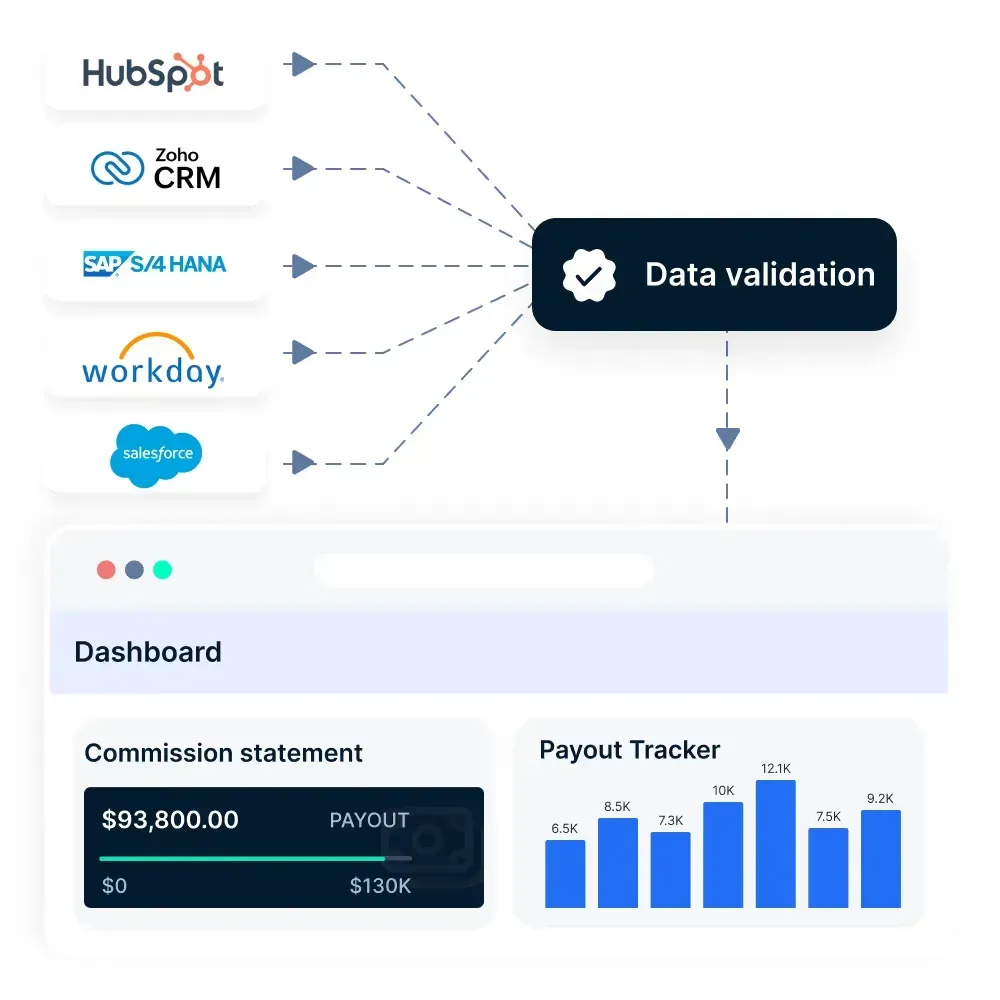
Ask which connectors are native, how often data syncs and what happens when a record changes after a payout has been calculated.
3. Quota planning and management
Quotas decide whether sellers believe the plan is fair, and they are hard to get right. The Alexander Group 2026 Sales Compensation Trends Survey found 57% of companies struggle to set accurate quotas and 46% name allocating quotas on time as their top program management challenge.
Look for top-down and bottom-up quota setting, data from multiple sources, mid-cycle adjustments for territory changes, leave or market shifts, quota relief, and a record of every change.
4. Territory design and management
Territories are a sensitive subject and can hurt morale when reps think they are unfairly assigned. If territory design is a pain point, look for rule-based territories, balancing tools that use account and market data, and a link to quota planning so changes in one update the other.
Not every company needs a dedicated territory tool. Smaller teams often manage territories in the CRM and only need the SPM platform to credit deals correctly across territories and overlay roles.
5. Seller visibility on web and mobile
Transparency is what turns a compensation plan into motivation. Sellers should see their attainment, earnings, commission breakdown and what the next deal adds, in real time and on their phone. Managers need team attainment and a drill-down by rep, with a log of exceptions and disputes.
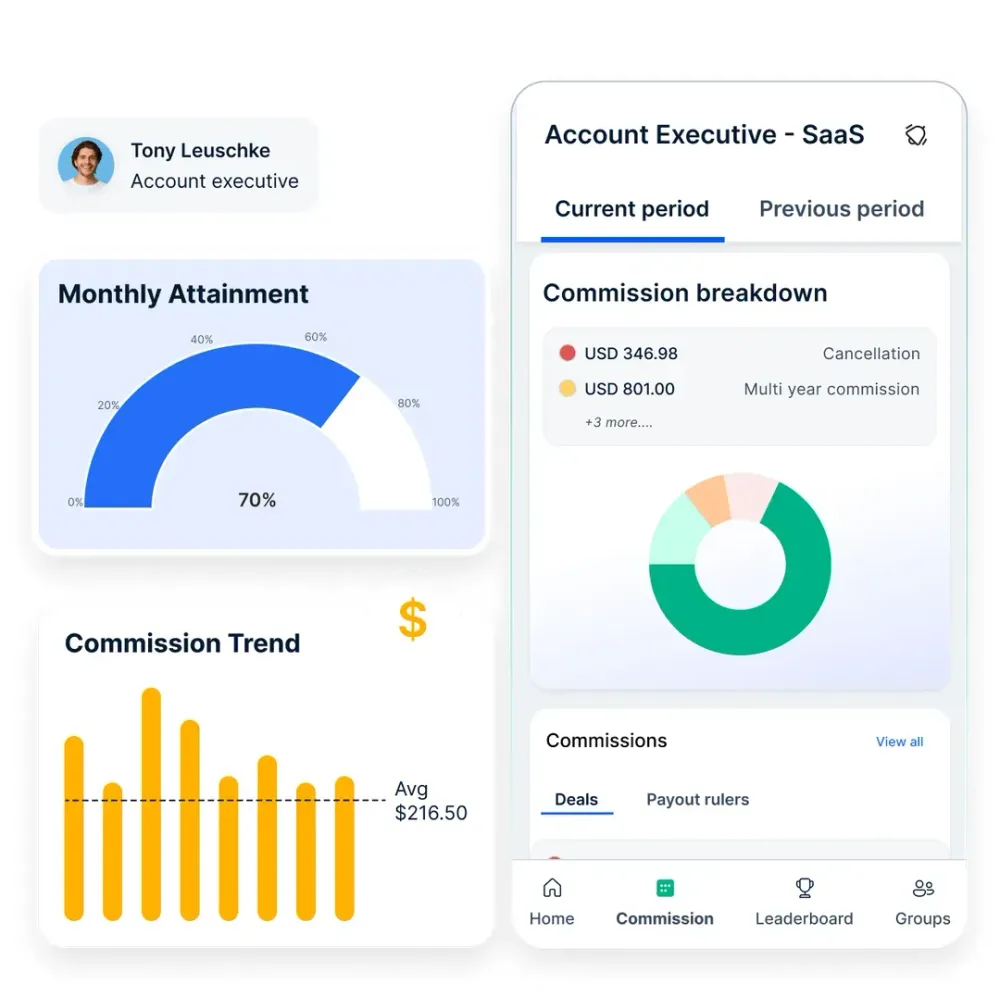
Ask to see the seller experience during the demo, not just the admin console. If sellers cannot follow their own statement, disputes will continue.
6. Performance analytics and plan modeling
Real-time analytics let you see how teams are tracking before the period ends, not after. Look for attainment by team, region or plan, payout trends, incentive spend against revenue and plan comparisons that show which plans pay off.
Modeling is just as important. A good platform simulates the cost and payout impact of a plan change before it goes live, so you can test accelerators or new measures on real data. For the measures to track, see how to improve sales performance.
7. Gamification and recognition
Commission pays at the end of a cycle, so the weeks in between need their own motivation. Leaderboards, SPIFs, contests, badges and recognition keep sellers engaged, and they work best when they run on the same data as the incentive plan, so ranks and rewards are always right.
If you already run gamification in a separate tool, check whether the SPM platform can replace it. One source of truth avoids rankings that disagree with commission statements. For more, see this guide to sales gamification.
8. AI with guardrails
AI is now standard in SPM. Useful applications include plan recommendations, rule tuning, anomaly detection before payouts and plain-language answers to seller questions about earnings. Ask how each AI feature works, what data it uses and whether a human approves any change it suggests.
Governance matters here. The EU's Artificial Intelligence Act treats AI used to make decisions about work relationships or to evaluate worker performance as high-risk, with human oversight and documentation duties. For more, read about AI in sales commission.
9. Security, compliance and audit trail
Compensation data is sensitive. Look for independent certifications such as SOC 2 Type II and ISO 27001, role-based access, encryption and a full audit trail of every calculation, approval and change. Multi-level approvals and pre-payout checks protect against overpayment and fraud.
If you pay sellers in several countries, check payout options, currencies and how local tax requirements are handled in the payout flow.
10. Implementation, training and vendor support
The best platform fails if it takes a year to launch or nobody can use it. Ask for a realistic implementation timeline, who configures the first plans and whether the vendor runs a parallel cycle against your current process before the first live payout. A vendor that offers training by role, online and in person, helps large teams adopt the platform.
Analyst research, such as Gartner's Market Guide for Sales Performance Management, can help you build a longlist. Treat it as a starting point, then judge each vendor on how it handles your plans, data and people.
How to choose sales performance management software in 6 steps
A structured process keeps the decision about your needs, not the best demo. Most teams can complete these six steps in six to ten weeks.
- Define the problems and requirements: List your plans, roles, data sources, payout routes and pain points. Separate must-haves from nice-to-haves, and involve sales ops, finance, HR, IT and two or three sellers.
- Build a shortlist of three to five vendors: Use peer referrals, analyst research and comparison lists such as these commission management tools and this commission tracking software guide.
- Run scripted demos: Send every vendor the same scenarios, including your hardest plan, and score each demo with the scorecard below.
- Test on your own data: Ask the top two vendors to calculate a past period from your real data and compare the results with what you actually paid.
- Check references: Speak to customers of similar size, industry and plan complexity, and ask what took longer than expected.
- Compare total cost and return: Include licenses, implementation, integrations and internal time, against savings in admin hours, payout errors and disputes.
Sales performance management software scorecard
Use this weighted scorecard to compare vendors side by side. Score each criterion from 1 to 5, multiply by the weight and add up the totals; adjust the weights to your priorities, but keep them summing to 100.
| Criterion | Weight | What a 5 looks like |
|---|---|---|
| Incentive calculation accuracy and plan flexibility | 20 | Builds your hardest plan live in a no-code builder, including splits, clawbacks and mid-cycle changes |
| Data integration and validation | 15 | Native CRM, ERP, HRIS and payroll connectors with validation before calculation |
| Seller and manager visibility | 15 | Real-time earnings, attainment and next-deal impact on web and mobile; manager drill-down |
| Payouts and finance controls | 10 | Multi-level approvals, anomaly checks, payroll integration and ASC 606 support |
| Analytics and plan modeling | 10 | Plan simulation, payout forecasting and plan comparison on live data |
| Quota and territory management | 10 | Quota setting and adjustment with history; territory crediting or design as needed |
| Engagement and gamification | 5 | Leaderboards, contests and SPIFs running on plan data |
| Security and compliance | 10 | SOC 2 Type II, ISO 27001, role-based access, full audit trail |
| Implementation and support | 5 | Go-live in weeks with a parallel run, role-based training and named support |
A vendor that scores below 3 on any of the top three criteria is a risk, however strong the rest of its score. Those three decide whether sellers trust their pay.
Questions to ask sales performance management vendors
Bring these questions to every demo and reference call. The answers often reveal more than the feature list:
- Plan changes: Can our admins build and change plans without your team, and how long does a typical change take?
- Accuracy: How do you validate data before calculation, and what accuracy have similar customers achieved?
- Disputes: How do sellers raise a dispute, and how is it tracked to resolution?
- Retroactive changes: What happens when a deal is cancelled or a record changes after payout?
- Payouts: Which payroll systems, countries and currencies do you support?
- AI: What do your AI features do, what data do they use and who approves their suggestions?
- Implementation: What is the typical go-live time for a team our size, and will you run a parallel cycle?
- Pricing: What drives the price: payees, plans, modules or integrations?
Why Empuls belongs on your SPM shortlist
Empuls covers the part of sales performance management that decides whether sellers trust the system: incentive compensation, payouts, visibility and motivation, on one platform. Admins build commission, target and milestone plans, with tiers, slabs, splits, overlays and clawbacks, in a no-code plan builder. Calculations run automatically from CRM, ERP and HRMS data validated at the source, and every result traces back to the data and rules behind it.
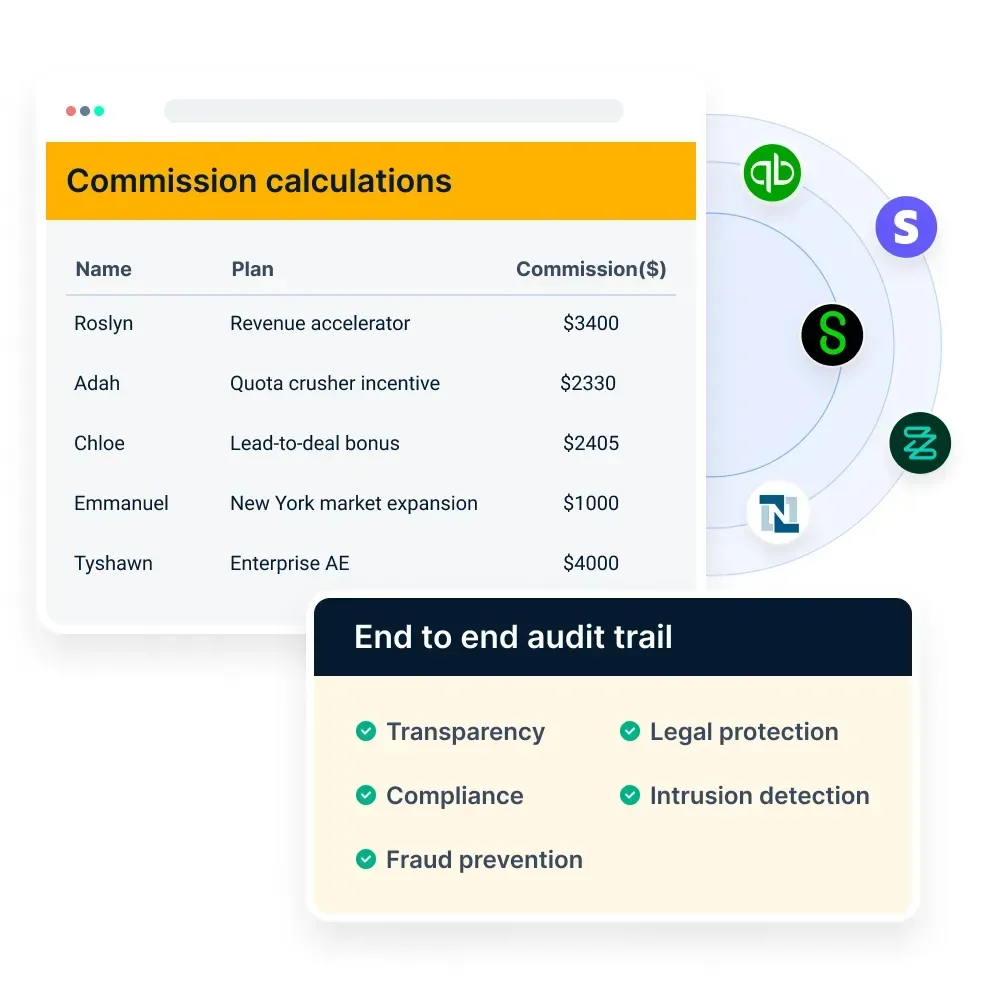
Here is how Empuls maps to the scorecard:
- Calculation and plans: No-code plan builder, multi-tier and multi-rule logic, crediting by percentage or primary and secondary rules, quota relief and mid-cycle target adjustments with a record of every change. See plans and calculations.
- Payouts and finance: Multi-level approvals, pre-payout anomaly checks, payroll integration including ADP, Workday and SAP SuccessFactors, disbursal in 50+ currencies across 150+ countries and ASC 606 support. See payouts and disbursal.
- Visibility: Sellers get a KPI scorecard, earnings estimator, leaderboard rank and nudges on how far the next slab is; managers get team attainment and an exception and dispute log.
- Analytics: Payout accuracy checks, attainment by team, region or plan, plan simulation and payout forecasting. See sales intelligence.
- Engagement: Live leaderboards, SPIFs, contests, badges and streaks tied to real plans. See sales gamification.
- AI: Plan recommendations and overpayment guardrails for admins, plain-language earnings answers for sellers and MCP access for admins in Microsoft Copilot, Claude and ChatGPT. See AI for incentive management.
- Security and rollout: SOC 2 Type II and ISO 27001:2022 certified, with most enterprise teams live in 4 to 8 weeks after a parallel run alongside the existing spreadsheet.
The results show up in trust and time. Mercedes-Benz India automated incentives across 33 franchises and reached 99.9% calculation accuracy, 75% less processing time and 40% fewer payment disputes, according to the Mercedes-Benz India case study. Mahindra Finance moved 20,000+ sales professionals across 12 lines of business onto the platform and reports 99% faster incentive processing and 85% fewer incentive queries.
To be clear about fit: Empuls is built around incentive compensation, performance visibility and motivation. If you need dedicated territory carving or headcount capacity planning, check how those will be covered alongside it. To estimate the return for your team, try the sales incentive ROI calculator.
Choose for trust, not just features
The right sales performance management software is the one your sellers trust and your admins can run without help. Start from your hardest plan, test vendors on your own data, and score them with weights that reflect what is broken today.
Get that right and the platform pays back through fewer errors, faster cycles and a sales team that spends its time selling. For the wider strategy behind the tools, read this guide to sales incentives and the live roundup of incentive management software.
Book your Empuls demo
Frequently asked questions
Sales performance management software is a set of applications that automates how companies plan, measure and reward sales performance. It typically covers incentive compensation management, quota and territory management, sales planning, analytics and engagement tools such as leaderboards. It connects to CRM, ERP, HR and payroll systems so calculations and reports run on the same data.
Incentive compensation management (ICM) is one part of sales performance management. ICM covers plan design, crediting, commission calculation, approvals and payouts. SPM is the broader category that adds quota and territory management, sales planning, performance analytics and sometimes gamification. Many companies start with ICM, which is the most common reason to buy SPM software.
Invest when spreadsheets start causing payout errors, slow plan changes or frequent disputes, or when you add roles, regions, overlays or complex rules such as splits and clawbacks. A common trigger is when sales ops or finance spends days each cycle calculating commissions, or when sellers keep their own spreadsheets because they do not trust their statements.
It depends on plan complexity, the number of data sources and the vendor. Focused incentive compensation deployments can go live in a few weeks, while full SPM suites with territory and capacity planning can take several months. Ask vendors for timelines from customers of similar size, and plan a parallel run before the first live payout.
Pricing usually depends on the number of payees, the modules you need, plan complexity and integrations, and many enterprise vendors quote on request. Beyond licenses, budget for implementation, integration work and internal admin time. Compare the total cost against the savings from fewer payout errors, fewer disputes and less manual calculation time.
The features that matter most are accurate, flexible incentive calculation, reliable data integration with validation, and real-time visibility for sellers and managers. After those come payout controls, analytics and plan modeling, quota and territory tools, security certifications and gamification. Weight them by your biggest current problem rather than the length of the feature list.
Yes. Smaller teams usually need the incentive compensation and visibility parts of SPM rather than advanced territory or capacity planning. Look for a tool with a no-code plan builder, CRM integration and a clear seller view that you can set up quickly. As the team grows, check that the platform can handle more roles, plans and regions.





































































































































































































































































































































































































































































































































































