
Key Takeaways
Employee morale is the overall attitude, satisfaction and outlook employees have at work, and it directly shapes motivation and productivity.
Global employee engagement fell to 20% in 2025 and manager engagement to 22%, according to Gallup's State of the Global Workplace 2026 report.
Lack of recognition, poor leadership, unfair pay, no growth, overload and unclear expectations are the most common low employee morale causes.
The fastest ways to improve employee morale cost little: frequent specific recognition, acting on feedback, clear communication and respecting time off.
A 30-day reset that listens, removes friction, recognizes people and commits to one longer-term fix shows employees visible progress quickly.
To boost employee morale, find out what is draining it, then act on the biggest causes first: recognize people often, keep workloads realistic, communicate openly, give people room to grow and protect their time off. Employee morale is the overall attitude, satisfaction and outlook employees have at work, and when it rises, motivation, collaboration and productivity follow.
Morale is the energy behind motivation, the difference between someone who brings their best and someone who is just clocking in and out. This guide shows how to boost employee morale step by step: how morale affects productivity, the signs and causes of low morale, 12 ways to improve employee morale, morale building activities by budget and a 30-day morale reset plan.
Why employee morale matters for productivity
There is a direct link between employee morale and productivity. High morale makes people motivated, committed and willing to go the extra mile; low morale shows up as disengagement, more errors, missed deadlines and a lack of initiative that spreads through a team.
20%
of employees worldwide are engaged at work
Gallup, 2025 data
22%
of managers are engaged, down from 27%
Gallup, 2025 data
$10T
in lost productivity from low engagement
Gallup
48%
of employees say work feels chaotic and fragmented
Microsoft, 2025
Why morale is a business issue
Gallup's State of the Global Workplace 2026 report found global engagement fell to 20% in 2025, its lowest since 2020, and estimates low engagement costs the world economy about $10 trillion in lost productivity. Manager engagement dropped to 22%, which matters because managers set the tone for team morale. Microsoft's 2025 Work Trend Index adds that 48% of employees say their work feels chaotic and fragmented.
Signs of low employee morale
Spotting low morale early lets you act before it turns into resignations. Watch for five signs:
- Increased absenteeism: More sick days and unplanned absences can signal disengagement or burnout, not just illness. See these strategies to reduce employee absenteeism.
- Declining productivity: Lower quality or quantity of work, missed deadlines and more errors.
- Less communication: People who used to share ideas go quiet, skip meetings or stop contributing.
- A negative attitude: More complaints, tension between colleagues and a general pessimism that can turn a team toxic.
- Higher turnover: People leave to find a better environment. Track your employee turnover rate by team to see where morale is weakest.
Low employee morale causes and quick fixes
Several causes of low morale usually feed one another, most of them rooted in management, culture and the work itself. The table links each cause to the fix that addresses it fastest.
| Cause of low morale | How it feels to employees | Quick fix |
|---|---|---|
| Lack of recognition | "Nobody notices what I do." | Weekly, specific recognition from managers and peers |
| Poor leadership | Unclear direction, micromanagement, little feedback | Regular one-on-ones and manager coaching |
| Unfair pay or benefits | "I'm underpaid for what I do." | Benchmark pay and explain how it is set |
| No growth | Feeling stuck in a dead-end job | Development plans, stretch projects, internal moves |
| Poor work-life balance | Always on, exhausted | After-hours norms and realistic workloads |
| Toxic culture | Gossip, favoritism, low trust | Clear conduct standards and fair decisions |
| Unclear expectations | Anxiety about what good looks like | Written goals and frequent check-ins |
| Chaotic workload | Constant interruptions and shifting priorities | Fewer priorities and protected focus time |
Make recognition a daily habit
Give managers and peers an easy way to recognize, reward and celebrate each other, and track morale by team.
Talk to our ExpertTrusted by 5,000+ companies
How to boost employee morale: 12 strategies
These 12 ways to improve employee morale run from everyday management habits to longer-term investments. The first four cost little and work fastest, so start there before adding programs or budgets.
1. Recognize achievements often
Morale dips when people put everything into a project and nobody notices. Show appreciation one-to-one and in front of the team, and make it specific: name what the person did and why it mattered. Recognizing efforts big and small is what makes a leader inspiring, and a rewards and recognition platform makes the habit easier to keep.
2. Build peer recognition
Formal recognition matters, but appreciation from colleagues is just as powerful. Let employees thank and nominate each other for achievements, teamwork and positive behavior, and add small rewards such as gift cards or extra time off. Peer-to-peer recognition builds camaraderie and spreads appreciation beyond the manager. This guide to peer-to-peer recognition shows how to set it up.
3. Give meaningful work and autonomy
When employees see how their work connects to the company's goals and values, morale improves. Giving people a say in how they do their work, rather than approving every step, builds ownership and job satisfaction.
4. Ask for feedback and act on it
Saying "my door is always open" relies on employees being brave enough to raise hard topics with a superior. Make asking part of your routine instead: build it into one-on-ones, hold stay interviews to learn what keeps people and run anonymous pulse surveys for honest input. Then share what you changed, because feedback that disappears lowers morale further.
5. Keep communication flowing
Employees expect to know what is happening, good news and bad. Share decisions and the reasons behind them, explain changes early and keep a single place where people can find updates. Transparency builds trust: some companies, such as Buffer, have published their salary formula and salaries since 2013 so people can see how pay is set.
6. Show the broader impact of people's work
Regularly share how the company is doing, where it is gaining traction and what difference each team is making. Feeling part of something bigger, with a clear role to play, keeps people going even in hard times.
7. Respect time outside working hours
A culture that expects out-of-hours availability is one of the surest ways to stress people out, even if no one says it out loud. Microsoft found the average employee sends or receives more than 50 messages outside core hours and that meetings after 8 pm rose 16% in a year. Set norms for after-hours messages, use scheduled send and lead by example. Some countries now legislate this: Australia's right to disconnect has covered all employers since 26 August 2025.
8. Fix workload and resourcing
No morale initiative survives chronic overload. Review workloads regularly, cut or delay low-value work and hire or redistribute before people burn out. Clear priorities and protected focus time also reduce the fragmented, interrupt-driven days that drain energy. See these ways to prevent burnout.
9. Offer professional development
Opportunities to grow show that you care about people's long-term goals. Offer workshops, training, mentoring, stretch assignments and support for courses or certifications, and talk about career paths in one-on-ones, not just at review time.
10. Celebrate milestones and achievements
Mark personal and professional milestones such as birthdays, work anniversaries, project completions and targets hit. Celebrating publicly in team meetings or company channels reinforces belonging and shows people their contributions count.
11. Support wellbeing and stress management
Offer wellness programs that cover physical and mental health, workshops on stress management and resilience and confidential support through counseling or an employee assistance program (EAP). Supporting people's health beyond their job roles shows you care about them as people. For more, read about mental health in the workplace.
12. Support remote, hybrid and frontline teams
Distributed and frontline employees can feel forgotten. Include them in recognition and celebrations, schedule meetings that work across shifts and time zones and send occasional care packages, such as snack boxes or gifts tailored to their interests, as a reminder to take a break and a sign that you see their work.
Morale building activities by budget
Activities do not fix deep problems such as overload or poor management, but once those are in hand, they rebuild connection and energy. Pick activities that fit your team's size, location and budget.
| Budget | Morale building activities | Best for |
|---|---|---|
| Free | Shout-out rounds in team meetings, thank-you notes, "wins of the week" channel, walking one-on-ones | Every team, starting this week |
| Low | Team lunches, coffee vouchers, small peer awards, recognition points, virtual games | Quick boosts and remote teams |
| Medium | Volunteering days, skills workshops, wellness challenges, milestone gifts | Building connection and growth |
| High | Team offsites, experience rewards, learning budgets, extra paid days off | Celebrating big wins and long-term loyalty |
For a full list of engagement ideas, see these employee motivation strategies. If you manage a sales team, these ways to improve sales team morale cover quota pressure and commission issues.
30-day morale reset plan
Use this plan when morale has clearly dipped and you need visible progress within a month. Each week builds on the last, so do not skip the listening step.
| Week | Focus | Actions |
|---|---|---|
| Week 1 | Listen | Run a 5-question anonymous pulse survey and hold short one-on-ones asking: what drains you, what energizes you, what one change would help most. |
| Week 2 | Remove friction | Share the top three themes openly. Remove one low-value meeting or task and agree after-hours messaging norms. |
| Week 3 | Recognize and connect | Start a weekly recognition habit, launch peer shout-outs and hold one low-cost team activity. |
| Week 4 | Commit and measure | Agree one longer-term fix (workload, growth or pay review), announce the owner and date, and re-run the pulse survey. |
Five pulse questions work well for weeks 1 and 4, each on a 5-point agree scale: "I feel recognized for good work", "My workload is manageable", "I know what is expected of me", "I can see a future for myself here" and "I would recommend my team as a place to work." Compare scores by team and track the change.
How Empuls helps boost employee morale
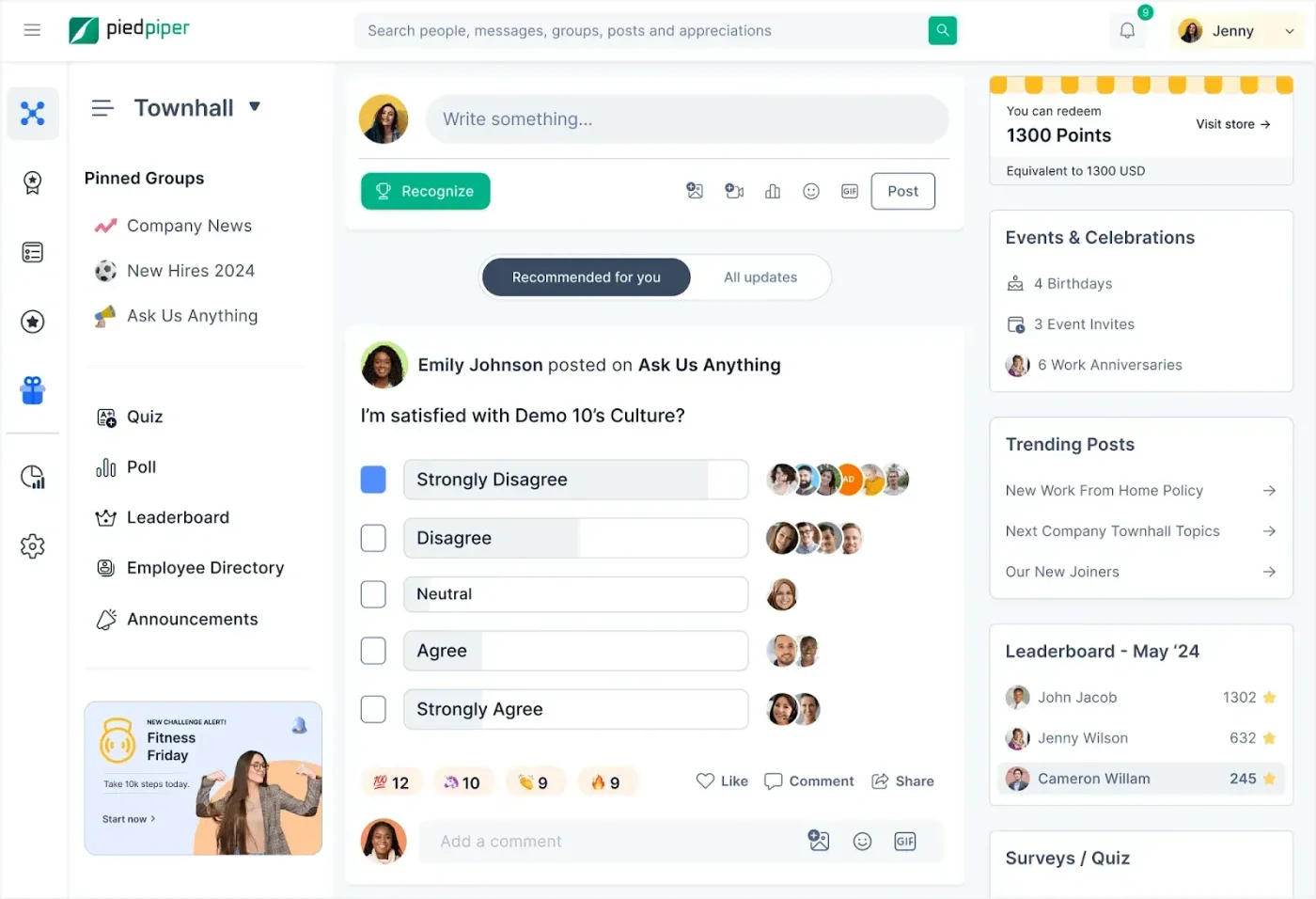
Morale rises when recognition, communication and support are part of daily work, not occasional events. Empuls brings them together in one place.
- Everyday recognition: Empuls recognition makes peer and manager appreciation quick, public and rewarding, and milestone rewards automate birthdays and work anniversaries.
- Listening: Pulse surveys and action plans show how morale is trending by team and help managers act on it.
- Communication and connection: The social intranet gives everyone one place for news, polls, celebrations and conversations, including frontline teams.
- Wellbeing and financial support: Empuls Wellness and financial wellness benefits, including earned wage access, reduce the stress that drags morale down.
Sustaining high morale for long-term productivity
Boosting employee morale is not a one-time fix. It takes steady attention to what makes people feel valued: recognition, fair pay, growth, manageable work and honest communication.
Start with the cause table and the 30-day plan, measure morale every month and keep listening. When employees feel motivated, recognized and connected to the company's goals, they contribute more and stay longer.
Book your Empuls demo
Frequently asked questions
Employee morale is the overall attitude, satisfaction and outlook employees have toward their work and workplace. High morale shows up as energy, cooperation and commitment, while low morale shows up as disengagement, complaints, absence and turnover. It is shaped mainly by recognition, leadership, pay, growth, workload and culture.
To boost employee morale quickly, start recognizing good work specifically and often, ask the team what is draining them and remove one frustration they name, set clear after-hours norms and share more about decisions and progress. These steps cost little, show visible change within weeks and build trust for longer-term fixes.
Low employee morale is usually caused by a lack of recognition, poor leadership or micromanagement, pay or benefits seen as unfair, limited growth, poor work-life balance, a toxic culture, unclear expectations and chaotic workloads. Causes often reinforce each other, so ask employees directly which ones matter most in your team.
High morale makes employees more motivated and committed, so they work with more focus, make fewer errors and contribute ideas. Low morale leads to disengagement, missed deadlines and more absence and turnover. Gallup estimates low engagement costs the global economy about $10 trillion in lost productivity.
Good employee morale boosters include specific recognition, peer shout-outs, celebrating milestones, flexible schedules, learning opportunities, team lunches, volunteering days, wellness challenges and extra time off for big wins. The best boosters fit your team and follow real fixes to workload and management, not replace them.
Measure employee morale with short, regular pulse surveys on recognition, workload, clarity and future prospects, plus eNPS. Track related signals such as absence, turnover, participation in recognition and meeting engagement. Compare results by team over time, and re-survey after changes to see whether morale has improved.
Managers have the biggest influence on day-to-day morale. They set workloads, give feedback and recognition, share information and decide how much autonomy people get. Supportive managers who communicate openly and appreciate effort raise morale, so training and supporting managers is one of the best investments in morale.





































































































































































































































































































































































































































































































































































