
Key Takeaways
Culture is how the organization operates, experience is what it delivers to each employee, engagement is the emotional response and motivation is the drive behind effort.
Employees who strongly feel connected to their culture are 4.3 times as likely to be engaged, yet Gallup finds only 20% of U.S. employees feel that connection.
Employee experience is the input the organization designs, and engagement is the output employees give back, so improve experiences rather than chase scores.
Motivation can swing within a day, while engagement is a steadier attachment; engagement makes motivation durable and motivation turns engagement into results.
When engagement drops, check culture and experience before adding incentives, because a motivation boost fades if the upstream problem stays.
In the culture vs experience vs engagement vs motivation question, each term sits at a different layer. Culture is how the organization operates, employee experience is what that culture delivers to each person, engagement is the emotional commitment that results when culture and experience line up, and motivation is the drive that turns that commitment into effort.
Put simply, culture is the cause, experience is the delivery, engagement is the response and motivation is the fuel. Knowing which layer you are working on tells you what to measure, who owns it and which fix will actually move the needle.
Just like the combination of salt, caramel and chocolate creates a delightful experience, the right mix of culture, experience, engagement and motivation can turn an average workplace into a high-performing one. Think of culture as the chocolate, the foundation that shapes everything. Experience is the caramel and salt, adding depth and flavor to the journey. When combined, they create engagement, that irresistible salted caramel effect that makes employees feel connected and invested. And the final kick, the rush of satisfaction when you take a bite, is motivation: the drive that pushes employees to perform at their best.
Culture vs experience vs engagement vs motivation at a glance
While culture, experience, engagement and motivation may seem interchangeable, each brings something unique to the table. This table compares them side by side, including the simple question each one answers and how you can measure it.
| Aspect | What it means | Question it answers | How to measure it | Example |
|---|---|---|---|---|
| Culture | The organization's DNA: its values, beliefs, norms and unspoken rules | How does the company operate? | Culture surveys, values-in-action ratings, focus groups | A company that champions innovation fosters open discussion, creative freedom and smart risk-taking. |
| Experience | The journey an employee takes from candidate to alumnus | What does the culture offer each employee? | Lifecycle surveys at onboarding, milestones and exit | A company that prioritizes career growth ensures smooth onboarding, skill-building and meaningful feedback. |
| Engagement | The emotional connection an employee has with their work and the company | When do people commit beyond the job description? | Engagement surveys, eNPS, retention of high performers | An engaged employee proactively looks for ways to improve processes and help the team succeed. |
| Motivation | The internal or external force that pushes employees to excel | Why do people put in the effort? | Pulse questions on energy and goals, recognition and goal data | An employee motivated by growth takes the initiative to upskill and move into a leadership role. |
Think of a thriving workplace as a well-functioning ecosystem in which each element plays a crucial role in shaping the overall employee journey:
- Culture lays the foundation: Without it, employees feel lost.
- Experience builds the journey: Good or bad, it shapes how people see the workplace.
- Engagement fuels the fire: Without it, productivity and retention drop.
- Motivation keeps the engine running: Even the best culture needs daily drive.
The secret to a high-performing workplace is getting all four working in harmony. The sections below take each element in turn, in the order they build on one another, and then show how to tell which one is holding your team back.
Culture is how the organization operates
Culture is the collection of consistent, observable patterns of behavior, attitude and mindset that define how employees interact with the company and with each other. In the chocolate metaphor, culture is the chocolate. It is the tacit social order of a company, reflected in its practices, shared values and beliefs and expressed through its purpose. For a deeper look at the definition and types, see what organizational culture is.
Culture has two sides, and the gap between them is where most problems start:
- Theoretical culture: The vision, mission, policies, strategies and core values a company writes down.
- Experiential culture: The behaviors, attitudes, relationships, norms and daily practices people actually see and live.
When the written culture and the lived culture match, employees trust it. That connection pays off: Gallup's organizational culture indicator reports that employees who strongly feel connected to their culture are 4.3 times as likely to be engaged, 47% less likely to be looking for another job and 62% less likely to feel burned out often. Yet only 20% of U.S. employees strongly agree they feel that connection, so most organizations have a wide gap to close.
Find out which layer needs your attention
Run engagement, eNPS and lifecycle surveys and see where culture and experience fall short.
Talk to our ExpertTrusted by 5,000+ companies
Experience is what your culture offers employees
Gallup defines employee experience as the journey an employee takes with your organization. It is the sum of every interaction during a person's tenure, from the first job ad to the exit interview, and each of those moments reflects the workplace culture. Experience is the caramel and salt in the chocolate bar.
The difference between culture and employee experience is the difference between intent and delivery. Culture says "we value growth"; experience is whether the employee actually got a development plan, a mentor and a stretch project this year. A strong experience usually rests on six areas:
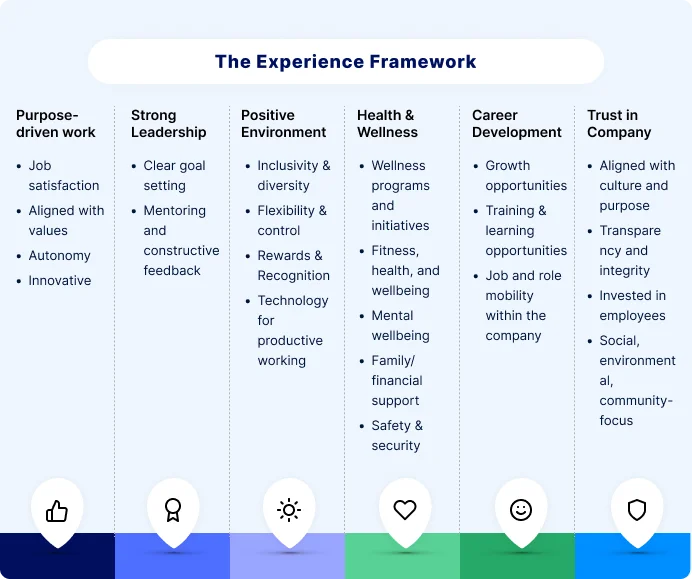
- Purpose-driven work: Job satisfaction, alignment with values, autonomy and room to innovate.
- Strong leadership: Clear goals, mentoring and constructive feedback.
- Positive environment: Inclusion, flexibility, rewards and recognition, and technology that makes work easier.
- Health and wellness: Physical, mental, family and financial wellbeing, plus safety and security.
- Career development: Growth opportunities, training and mobility within the company.
- Trust in the company: Transparency, integrity and visible investment in people and the community.
For the stages and types of experience in detail, read what employee experience is.
Engagement results when culture and experience meet
Engagement happens when a company achieves the right combination of culture and employee experience, just as you get the salted caramel bar when chocolate meets sea salt and caramel. It is measured by employees' emotional commitment to their work and to the company's success, and it shows in discretionary effort: the extra work people do because they care, not because they are told.
Employee experience vs engagement is a question of input and output. Experience is what the organization designs and delivers; engagement is how employees respond to it. You cannot survey your way to engagement, but you can improve the experiences that produce it. The payoff is well documented, and the current baseline shows how much room most teams have.
20%
of employees worldwide were engaged in 2025
Gallup, 2026
23%
higher profitability in top-quartile engagement teams
Gallup Q12, 2024
18%
higher sales productivity in top-quartile teams
Gallup Q12, 2024
78%
lower absenteeism in top-quartile teams
Gallup Q12, 2024
Why engagement is worth the effort
The global figure comes from Gallup's State of the Global Workplace 2026, which also puts the cost of low engagement at about $10 trillion in lost productivity. The team-level gains come from Gallup's 11th Q12 meta-analysis, which compares top-quartile and bottom-quartile business units.
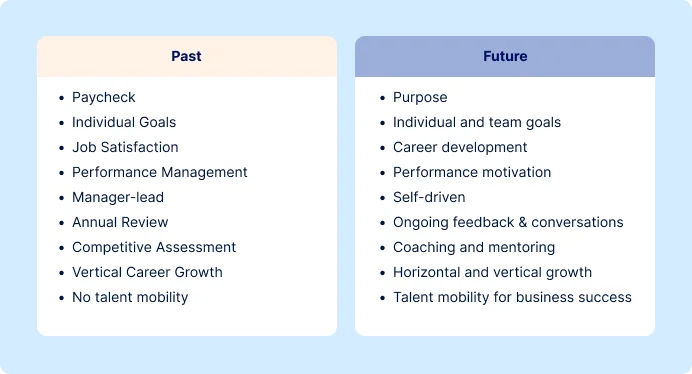
What drives engagement has also changed. Older models leaned on the paycheck, individual goals and an annual review; today people expect purpose, ongoing conversations, coaching and room to grow in more than one direction.
Culture and engagement are often confused because one shapes the other. For a full side-by-side on just those two, read culture vs engagement.
Motivation is why employees put in the effort
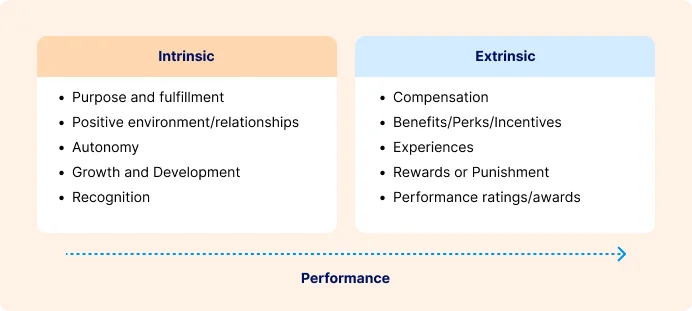
Motivation is the reason employees want to do the work in front of them. To return to the chocolate metaphor, motivation is the pleasure you get from the salted caramel bar. It can be intrinsic, where a person's own drive and sense of meaning lead to high performance, or extrinsic, where pay, perks, rewards and experiences provide the incentive.
Engagement vs motivation is the distinction that trips up most teams. Motivation is about effort on a task and can rise and fall within a day; engagement is a steadier attachment to the work, the team and the company. A new hire can be highly motivated by a bonus and still not be engaged, and an engaged veteran can have a low-motivation week after a setback. Engagement makes motivation more durable, and motivation turns engagement into results.
Recognition is one of the few levers that feeds both. Gallup and Workhuman's 2024 recognition study found that well-recognized employees were 45% less likely to have changed organizations two years later. For the theories behind it, see what employee motivation is and intrinsic vs extrinsic motivation.
Diagnose which layer is holding your team back
When engagement scores drop, teams often reach for a motivation fix such as a contest or a bonus, when the real problem sits further upstream. Use this diagnostic to trace a symptom to the layer it most likely comes from, then start with the check in the third column before spending on a fix.
| Symptom you notice | Likely layer | What to check first | First fix to try |
|---|---|---|---|
| People say the values are "just posters" | Culture | Do leaders and promotion decisions reflect the stated values? | Name three behaviors per value and recognize them publicly |
| New hires leave within six months | Experience | Onboarding and 30, 60 and 90 day survey results | Fix the onboarding steps with the lowest scores |
| Good scores on pay and perks, low eNPS | Engagement | Manager relationships, growth and recognition items | Coach managers on regular one-on-ones and feedback |
| Strong team spirit, missed targets | Motivation | Goal clarity and how effort is rewarded | Clarify goals and tie timely rewards to them |
| Burnout and absenteeism climbing | Experience | Workload, flexibility and wellbeing items | Rebalance workload and widen wellbeing support |
| Only one team is struggling | Culture (team level) | That team's norms, manager and recent changes | Run a team pulse and a facilitated listening session |
How to improve culture, engagement, motivation and experience together
Because the four build on one another, the order of work matters. These five steps move from foundation to fuel, so each one makes the next easier to sustain:
- Define the culture in behaviors: Turn each core value into two or three observable behaviors so everyone knows what good looks like.
- Map the employee journey: List the key moments from hiring to exit and ask employees which ones help or hurt, using lifecycle surveys.
- Equip managers: Managers shape most of the daily experience, so train them on one-on-ones, feedback and recognition.
- Recognize and reward the right things: Tie timely, specific recognition and fair rewards to the behaviors and results the culture asks for.
- Listen, act and repeat: Run short pulse surveys, share what you heard, act on one or two themes and measure again next quarter.
The connection between culture, engagement, motivation and experience is a loop, not a line. Better experiences raise engagement, engaged employees reinforce the culture for the next hire, and that stronger culture makes motivation easier to sustain.
How Empuls helps you connect culture, experience, engagement and motivation
Empuls brings the listening and recognition tools for all four layers into one platform, so you can see where the gap is and act on it in the flow of work:
- Measure engagement and experience: Run engagement and eNPS surveys plus lifecycle surveys at the moments that shape how people feel about work.
- Turn feedback into action: Use action plans so managers own and close the gaps surveys reveal.
- Make culture visible: Peer and manager recognition tied to your values shows everyone what the culture rewards.
- Keep motivation high: Rewards and milestone celebrations give extrinsic motivation a meaningful, timely form.
Ready, set, go
Every organization is unique, and its culture tells you a lot about employees' experience within the company, their level of engagement and their motivation to achieve the organization's goals. Treat them as four separate layers with separate owners and measures, and you will stop applying the wrong fix to the right problem.
You can turn the tide on attrition by hiring, developing and retaining top talent. All it takes is the kind of care that goes into making a salted caramel chocolate bar: nurture your culture, curate experiences, boost engagement and motivate your teams.
Book your Empuls demo
Frequently asked questions
Culture is the shared values, norms and behaviors that define how an organization operates. Employee experience is how each person actually lives that culture through every interaction, from hiring and onboarding to development and exit. Culture is the intent; experience is the delivery. A company can claim to value growth, but the experience shows whether people really get coaching, training and new opportunities.
No. Employee experience is what the organization designs and delivers across the employee lifecycle, while employee engagement is how employees respond to it emotionally. Experience is the input and engagement is the output. Improving onboarding, management, tools, wellbeing and growth opportunities raises engagement over time, whereas trying to raise engagement scores directly rarely works.
Motivation is the drive to put effort into a specific task or goal, and it can change quickly with rewards, deadlines or mood. Engagement is a steadier emotional commitment to the work, the team and the organization. An employee can be motivated by a bonus without being engaged. Engagement makes motivation last, while motivation turns engagement into visible results.
Culture comes first. It shapes the experiences employees have, and those experiences drive engagement. Engagement then feeds back into culture, because engaged employees model the behaviors that new hires copy. That is why fixing a weak culture or a poor employee experience usually does more for engagement than adding perks or contests on top.
Yes. A salesperson chasing a commission can be highly motivated to close deals while feeling no attachment to the company and planning to leave. That pattern is common when extrinsic rewards are strong but culture, management or growth opportunities are weak. Engagement adds the emotional commitment that keeps people performing and staying after the reward is paid.
Measure culture with values-in-action surveys and focus groups, experience with lifecycle surveys at key moments such as onboarding and exit, engagement with an engagement survey and eNPS, and motivation with pulse questions on energy and goal clarity alongside recognition data. Tracking all four separately shows which layer is causing a problem instead of one blended score.
Culture sets what is rewarded, how much autonomy people have and whether effort feels meaningful, which are core drivers of intrinsic motivation. A culture that recognizes contributions, trusts people and connects work to purpose sustains motivation without constant incentives. A culture that ignores effort or punishes mistakes drains motivation, however generous the rewards are.





































































































































































































































































































































































































































































































































































