
Key Takeaways
Non-monetary employee recognition shows people their work is valued through praise, time, growth, status and trust rather than cash.
It works on intrinsic motivation, so it can be given daily, reaches every employee and does not depend on budget.
Well-recognized employees were 45% less likely to have left after two years in Gallup and Workhuman's 2022 to 2024 study.
The strongest non-monetary rewards give people something they value: flexible time, a stretch assignment, visibility to leaders or a voice in decisions.
Non-monetary recognition complements fair pay and monetary rewards; it cannot replace pay that is below market.
Non-monetary employee recognition means showing people their work is valued through words, time, trust, growth and visibility rather than cash. It works because it speaks to intrinsic motivation, the need to be seen and valued, and it can be given every day at little or no cost. Below are 15 non-monetary rewards ideas and a six-step way to roll them out.
A well-defined recognition strategy can carry out many of a company's goals. The key to a supportive culture of appreciation is to tie company values to non-monetary recognition, so that what gets praised is what the business needs more of. Read on to find out why and how.
What non-monetary employee recognition is
Non-monetary recognition in the workplace acknowledges an employee's value and efforts toward the company's goals without a monetary stimulus. It relies on verbal or written appreciation, and on non-cash rewards such as time, opportunities and status, to show employees that their contribution is seen.
Companies use non-cash employee recognition to motivate people and show that their work matters. It can be verbal or written, public or private, formal or informal, peer-to-peer or top-down. When companies appreciate their employees this way, they build a culture of appreciation and a positive environment oriented toward growth, mutual support and respect. For the wider picture of types and practices, read the employee recognition guide.
Non-monetary recognition is close to, but not the same as, non-monetary compensation. Compensation covers standing policies such as remote work or learning stipends that everyone receives; recognition is earned for a specific contribution. For the policy side, see these non-monetary compensation examples.
The difference between recognition and rewards
Recognition shares a goal with rewards: both motivate employees, lift morale and encourage people to be their best. But they work in different ways, and the table below sets out the main differences before the detail that follows.
| Non-monetary recognition | Monetary rewards | |
|---|---|---|
| What it is | Praise, trust, time, growth or status tied to a specific contribution | Cash, bonuses, gift cards or points with cash value |
| Motivation it uses | Intrinsic: the need to be seen and valued | Extrinsic: the desire for a specific reward or status |
| Cost | Free to low | Direct budget cost |
| Frequency | Daily or weekly | Periodic, tied to targets or milestones |
| Best for | Behaviors, effort, values, everyday wins | Hitting targets, big milestones, sales results |
| Main risk | Feels hollow if vague or used to avoid fair pay | Feels transactional and goes unnoticed |
Non-monetary recognition is intangible and non-transactional. A written or spoken message of appreciation carries real weight despite having no cash value. Rewards are tangible, whether they are experiential rewards, gift cards or swag. Recognition plays on employees' intrinsic motivation, their need to be seen and valued for excellent work, while rewards play on extrinsic motivation, the desire to earn something specific. This explainer on intrinsic vs extrinsic motivation goes deeper, and the best programs use both.
Where monetary rewards fall short
Money is not the enemy. Fair pay is the foundation, and no amount of recognition can fix pay that falls below the market. As a recognition tool, though, cash has five weaknesses, and the first one is the reason most leaders look beyond it.
1. Money is a blunt instrument
They say you can never have enough money, but it can cause plenty of grief for a leader or manager trying to design the perfect carrot for a team. A cash reward is easy to give and just as easy to get wrong.
2. Money is not always fair
Money is not the best judge of competency, commitment and the everyday heroism that makes work succeed. It flattens every contribution onto one scale, underrating some and overrating others, and creates the resentment that comes with a sense of injustice.
3. Money does not feel special
A cash reward can feel cold and transactional, like a box ticked on HR's checklist. When an incentive is credited automatically every time a target is met, it sails past like a monthly bill payment we barely notice, and a perfectly good chance to make an emotional impact is lost.
Compare that with a non-monetary moment, such as a trophy handed to a beaming winner in front of colleagues at an awards evening. The second setting carries a meaning that cash alone struggles to match.
4. Money does not say anything
The strongest message cash sends to the stars on your team is that you have an efficient accounting department. A non-monetary reward makes a warm, personal statement. It shows you thought about what the person values and took the time to recognize them in a way that fits. That feeling usually turns into attachment to the organization, which is a big win for your culture.
5. Money is not engaging
Non-monetary recognition is an opportunity to involve your teams in co-creating the recognition strategy. Ask people what would mean the most to them, and the ideas arrive pre-filtered by the people who will receive them. The process itself builds camaraderie, and the morale boost can last for months.
Benefits of non-monetary recognition
Non-monetary recognition shapes company culture and brings a set of connected benefits to companies that do it well. The figures below come from current research on recognition, and the eight benefits that follow start with retention because it is the easiest to measure and the most expensive to ignore.
45%
less likely to leave
well-recognized employees after two years (Gallup and Workhuman, 2024)
9x
more likely to be engaged
with high-quality recognition (Gallup and Workhuman, 2024)
8x
more likely to trust the organization
when awards feel intentional (O.C. Tanner, 2026)
25x
more likely to produce great work
with integrated recognition (O.C. Tanner, 2026)
What good recognition does, with or without money
1. Improved retention
Non-monetary recognition improves employee retention because feeling valued shapes whether people want to stay. In a longitudinal study of nearly 3,500 employees, Gallup and Workhuman found that well-recognized employees were 45% less likely to have left after two years. Celebrating service anniversaries early in an employee's time at the company is one concrete way to start; this guide to long service awards covers the bigger milestones.
2. Increased engagement
Non-monetary recognition lifts engagement by highlighting the behaviors companies want to see more of. The same Gallup and Workhuman research found employees whose recognition met at least four of its five pillars were nine times as likely to be engaged as those whose recognition met none.
The key to a successful non-monetary recognition program is to tie recognition to company values. If a company wants to improve customer experience, for example, the program should feature a value that targets behaviors with good results for customers. Employees soon learn what gets noticed, and the more they see their efforts recognized, the more they repeat them.
3. Boosted productivity and performance
Engagement matters for culture, but employees also need to hit the goals their managers set. Recognition helps here too. The O.C. Tanner Institute's 2026 State of Employee Recognition report, based on 4,243 employees in 10 countries, found employees with integrated, community-building recognition were 25x more likely to produce great work. When teams are encouraged to recognize each other's efforts, they also help each other more, which gets goals done faster.
4. Elevated employee experience
When companies do more for employees beyond standard compensation and total rewards, it improves how people feel about working there. Non-monetary recognition signals a positive culture and shows that employers care about and respect their people. When recognition is reasonable, transparent and fair, it builds trust in the employer and makes time at the company more meaningful.
5. Improved customer satisfaction
Excellent customer service is about going above and beyond. Because businesses depend on their people, how employees feel shows up in how customers are treated. Satisfied, engaged employees do more to make customer interactions pleasant and are more resilient when things get hard. Gallup's 2024 Q12 meta-analysis found top-quartile engaged teams score 10% higher on customer loyalty than bottom-quartile teams.
6. Better profitability
Better profitability is the combined outcome of the other benefits: higher productivity reaches goals faster, better retention saves the cost of replacing people, a stronger employee experience attracts talent and happier customers stay loyal. The same Gallup meta-analysis found top-quartile engaged teams show 23% higher profitability.
Bonuses and incentives can serve the bottom line too. But non-monetary recognition hits a sweet spot: it makes employees want the company to do well because they enjoy contributing, not just because they are paid to.
7. Better workplace relationships
People thrive in supportive environments, and most would rather work where colleagues help each other than compete. Peer-to-peer recognition in particular encourages healthy, mutually supportive connections, and seeing the good in one another makes everyone who contributes feel valued. Read how to run peer-to-peer recognition well.
Top-down recognition builds trust between employees and managers. O.C. Tanner's 2026 research found that when appreciation and awards feel intentional, employees are 8x more likely to trust their organization. When employees trust each other and their leaders, they are set up for success.
8. Improved agility
Recognized, content employees are more motivated to do their jobs well. Organizations that value teamwork, which non-monetary recognition supports, see better coordination and faster problem-solving. A content, collaborative workforce has the resilience to weather challenges.
Recognition tied to values such as innovation adds to this. Employees who are recognized for new solutions keep producing them, which helps the company pivot when the market changes.
Make recognition without money feel personal
Give every employee a simple way to praise, nominate and celebrate colleagues, with insights that keep recognition fair.
Talk to our ExpertTrusted by 5,000+ companies
How to introduce a non-monetary recognition program in the workplace
Non-monetary recognition programs are highly beneficial, but they work best when introduced step by step. These six steps take you from approval to a social, visible program, and the first step matters most because a program without leadership and manager support rarely survives its first quarter.
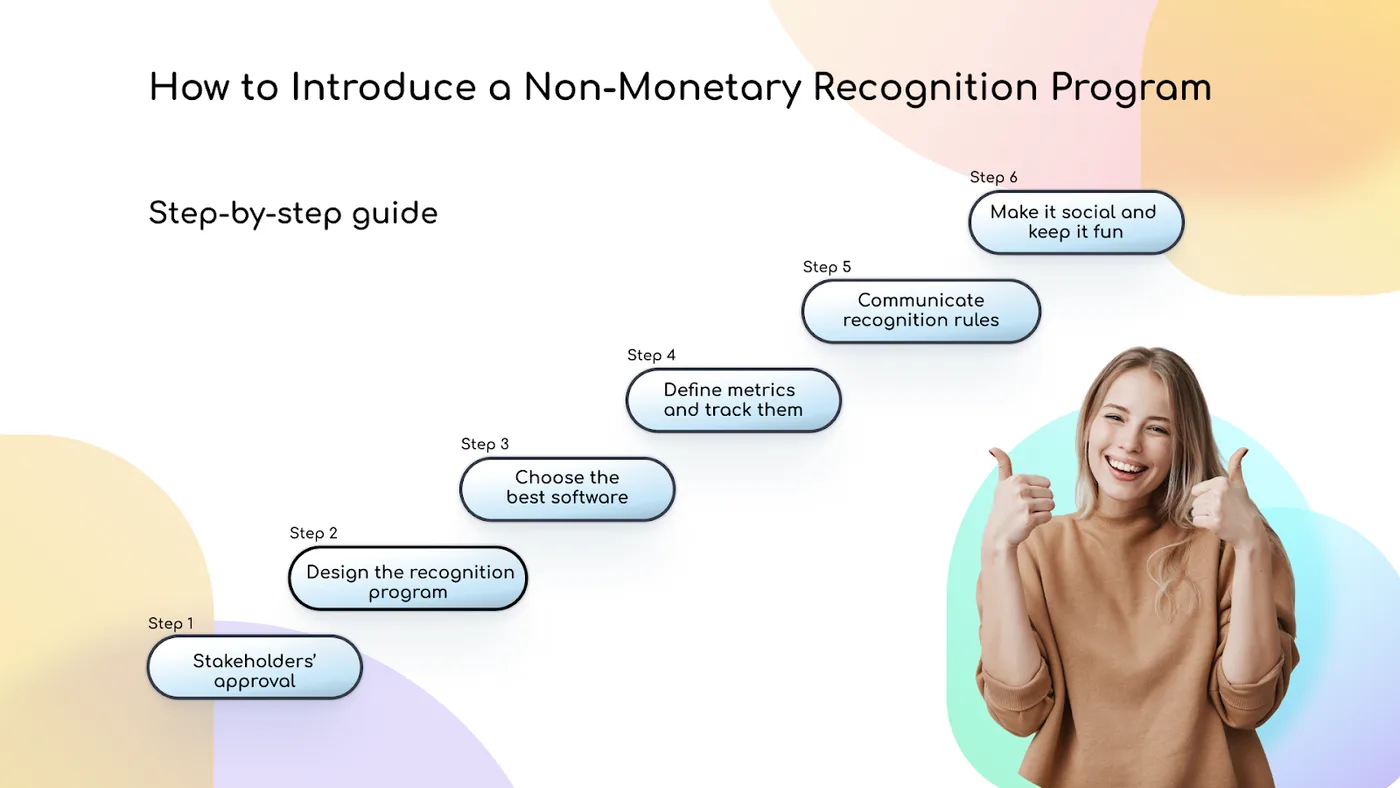
1. Get stakeholder approval
Stakeholders for recognition programs are spread across the company. Employees are the beneficiaries and end users. Managers carry company culture and are essential for adoption. HR is the most critical stakeholder, because it spots the need, designs the program and runs the introduction. Senior leadership also needs to understand the benefits; this explainer on the importance of employee rewards and recognition gives you the business case.
2. Design the recognition program
The first and most important design decision is to connect recognition to company values, so the culture you build matches your mission, vision and goals. Most companies combine several programs, non-monetary and monetary, peer-to-peer and nomination-based, each tied to specific goals.
Every company is different, and its needs change as it grows, so build in flexibility. For timing, budget and stakeholders, follow this guide to planning an employee rewards and recognition program.
3. Choose the right recognition software
The HR tech market is full of tools, and they are not built the same way. Smaller companies and enterprises have different needs. Some tools offer only a recognition feed with little integration; ideally, choose one connected to your core HR system so recognition can be scaled, automated and personalized. This guide to choosing the right employee rewards and recognition platform lists the criteria.
4. Define your metrics and track them
HR knows what the workforce needs most from surveys, feedback programs and exit interviews. Once the goals are clear, such as better engagement or customer satisfaction, choose the metrics to track: turnover rate, employee satisfaction, productivity, employer review ratings and, for frontline and blue-collar teams, safety. Over time you will see how recognition affects these areas and where to fine-tune. These metrics for employee recognition programs explain what to measure.
5. Make recognition well-communicated, accessible and fair
Define the procedures: who can recognize whom, what gets recognized and when nominations happen. Communicate the program systematically, make sure employees know how to access it and give everyone equal access regardless of how or where they work.
Ideally, recognition happens in the flow of work, inside tools people already use, such as Microsoft Teams or Slack, and on mobile for employees without desks. Check regularly that recognition is spread fairly; this guide shows how to prevent bias in recognition programs.
6. Make recognition social and interactive
An internal social wall where everyone can see recognition as it happens multiplies its effect, because colleagues add their own reactions and comments. When someone receives kudos from a peer they respect, they may also want to share it on LinkedIn, which strengthens your employer brand. Make sharing easy, but always the employee's choice.
15 non-monetary recognition ideas to inspire your workforce
Non-monetary rewards and recognition do not have to be complicated or costly. The 15 ideas below are grouped by what they give people, time, growth, status, voice and care, and growth ideas tend to matter most to high performers because they signal a future at the company, not just thanks for the past.
1. A flexible schedule as a thank-you
Let a high-performing employee start later, finish earlier or work a flexible week after a demanding project. Tied to a specific contribution, flexibility becomes recognition rather than a standing policy, and it directly supports work-life balance.
2. A recharge day after a big push
Offer a bonus day off after a launch, an audit or a peak season so the person can rest. With burnout a constant risk, a recharge day sends a clear message that you value wellbeing as much as output.
3. First pick of shifts or vacation dates
For shift-based and frontline teams, first choice of shifts or holiday dates is one of the most valued non-monetary rewards for employees. It costs nothing, and it gives people control over the thing that affects their lives most.
4. A skill-building opportunity of their choice
Offer access to a training course, certification or conference the employee picks. It promotes professional growth and tells the person you see a future for them.
5. Passion project time
Give employees protected time to work on a project they care about, even if it sits outside their role. It is a rewarding form of recognition and often sparks innovation the business would not otherwise get.
6. A stretch assignment or project lead role
Recognize strong work with a bigger challenge: leading a project, owning a client or heading a working group. Trusting someone with more responsibility is one of the clearest signals of confidence a manager can give. Pair it with support so it feels like a reward, not just more work.
7. An executive shadow day
Invite an employee to spend a day shadowing a senior leader in meetings and decisions. It recognizes their potential, broadens their view of the business and builds a relationship with leadership.
8. Job title enhancements
Recognize growth in scope with a title that reflects it, such as "Senior Associate" or "Team Lead." A title gives status and external credibility. Use it honestly: a new title without new scope, or one that should come with a pay review and does not, will feel hollow.
9. Present the work to leadership
Ask the person who did the work to present it to the leadership team or at an all-hands, instead of their manager presenting on their behalf. Visibility to senior leaders is a powerful form of recognition and a career boost.
10. Represent the company externally
Nominate standout employees to speak at an industry event, join a key customer meeting or sit on a recruiting panel. Being chosen to represent the company shows trust and lets the employee build their own reputation.
11. Naming rights
Let a team or person name something they made possible: a product release, a process, a meeting room or an internal tool. It is playful, lasting and a daily reminder of their contribution.
12. A seat at the table on a decision
Invite an employee whose judgment you value into a decision that matters, such as a hiring panel, a product review or a planning session. Asking for someone's opinion is recognition of their expertise.
13. More autonomy on the next project
Recognize a job well done by giving the person more freedom on the next one: choice of approach, tools or teammates. Autonomy is a core intrinsic motivator, and earned autonomy tells people you trust them.
14. A dedicated parking spot
A premium parking space for a week or a month is a practical, visible reward. It feels exclusive, it is useful every single day and it costs almost nothing.
15. A thank-you letter to their family
For a major contribution, such as weeks of extra hours during a crunch, send a short letter to the employee's family thanking them for their support. It recognizes that big efforts at work often come with sacrifices at home, and it is remembered for years.
Use the table below to pick the ideas that fit your budget, effort and team. It is the non-monetary recognition menu to share with managers.
| Idea | Gives people | Cost | Manager effort | Best for |
|---|---|---|---|---|
| Flexible schedule as a thank-you | Time | Free | Low | After demanding projects |
| Recharge day | Time | Low | Low | After peaks and launches |
| First pick of shifts or dates | Time | Free | Low | Frontline and shift teams |
| Skill-building of their choice | Growth | Low to medium | Medium | Ambitious employees |
| Passion project time | Growth | Free | Medium | Creative and technical roles |
| Stretch assignment | Growth | Free | Medium | High performers ready for more |
| Executive shadow day | Growth | Free | Medium | Future leaders |
| Job title enhancement | Status | Free | Medium | Growth in scope |
| Present to leadership | Status | Free | Low | Behind-the-scenes contributors |
| Represent the company | Status | Low | Medium | Experts and client-facing staff |
| Naming rights | Status | Free | Low | Teams that built something new |
| Seat on a decision | Voice | Free | Low | Experienced specialists |
| More autonomy | Voice | Free | Low | Proven, self-directed people |
| Dedicated parking spot | Care | Free to low | Low | On-site teams |
| Letter to their family | Care | Free | Low | Major efforts with personal sacrifice |
Looking for everyday gestures instead? Shout-outs in team meetings, newsletter features, handwritten notes, social media mentions, a wall of fame, lunch with leaders, peer-nominated awards, kudos boards and birthday spotlights are all covered in these employee recognition ideas.
Why non-monetary recognition matters more than ever
Many organizations rely on bonuses and incentives, but more are realizing the power of recognition without money. It can be given every day, it reaches every employee regardless of budget, and its effects on morale and retention last well beyond a single payout. That matters when recognition is in short supply: Gallup and Workhuman found only 22% of US employees get the right amount of recognition.
It is not about choosing non-monetary over monetary rewards, but about striking the right balance. A thoughtful mix lets companies meet different employee needs: everyday non-monetary recognition for effort and behavior, and monetary rewards for targets and milestones. For the reward side, browse these employee reward ideas.
How Empuls supports non-monetary employee recognition
Empuls is built to make meaningful, non-monetary recognition easy, personal and visible, inside the tools employees already use:
- Public appreciation: Shout-outs, value badges and awards appear on a social feed where colleagues react and comment, through Empuls recognition.
- Peer nominations: Approval-based nominations with jury panels keep peer awards fair and visible.
- Milestones on time: Birthdays and work anniversaries trigger automatically with milestone rewards, so no one is forgotten.
- Choice when rewards make sense: When you do add points, employees redeem them across a global catalog, so monetary and non-monetary recognition run from one place.
- Fairness insights: Reports show who is recognized often and who is being missed, so managers can spread recognition more evenly.
Final words
Non-monetary recognition has many benefits companies can use to raise their employee experience. A well-run program boosts engagement and profits, improves productivity, strengthens relationships and makes the organization more agile. When you decide it fits your goals, follow the six steps above, start with two or three ideas from the menu and ask your people what matters most to them.
Book your Empuls demo
Frequently asked questions
Non-monetary forms of recognition include verbal praise, written thank-you notes, public shout-outs, awards and certificates, peer-to-peer recognition, flexible schedules, extra time off, development opportunities, stretch assignments, title changes and visibility to senior leaders. What they share is that the value lies in the acknowledgment and opportunity, not in cash or a cash equivalent.
For everyday motivation, non-monetary recognition can be just as effective, because people want to feel seen and valued. Money still matters: fair pay is the foundation, and cash rewards work well for targets and milestones. The strongest programs combine frequent non-monetary recognition with occasional monetary rewards rather than choosing one over the other.
Common examples of non-monetary compensation are flexible or remote work, extra vacation days, learning and certification programs, mentorship and wellbeing support. Compensation usually applies to everyone as a policy, while non-monetary recognition is earned for a specific contribution, such as a recharge day after a big project or a chance to present to leadership.
Reward employees without money by giving them something they value: time, such as a flexible schedule or recharge day; growth, such as training or a stretch assignment; status, such as presenting to leadership; or voice, such as a seat on a decision. Pair each reward with specific praise so the person knows exactly what earned it.
Good non-monetary rewards for frontline employees include first pick of shifts or vacation dates, a dedicated parking spot, public recognition at shift briefings, badges or pins they can wear, skill training that leads to promotion and a chance to train new hires. Mobile-friendly recognition matters, because frontline staff rarely sit at a computer.
Make non-monetary recognition meaningful by being specific about what the person did and why it mattered, recognizing them soon after the moment, matching the format to their preferences and linking it to company values. Ask employees which forms of recognition they value most, and check regularly that recognition reaches every team fairly.
Non-monetary means anything that does not involve money or a direct financial value. In the workplace, it describes recognition, rewards or benefits such as appreciation, time off, flexibility, learning opportunities or added responsibility, which employees value for what they mean rather than for their cash worth.





































































































































































































































































































































































































































































































































































