
Key Takeaways
Commission based sales reps earn some or all of their pay from the sales they close; salary plus commission is the most common structure.
The BLS reports a median wage of $76,460 for wholesale and manufacturing sales reps in May 2025, with most employers combining salary and commission or bonuses.
In the US, commission only sales reps who work from an office generally still need to earn minimum wage, because the outside sales exemption applies only to reps who sell away from the employer's premises.
A written commission plan should define pay mix, quota, rates, crediting, clawbacks, ramp support, exit terms and how disputes are resolved.
Accurate, on-time payouts and real-time earnings visibility do more to keep commission-based reps motivated than a higher commission rate.
Commission based sales reps earn some or all of their pay from the sales they close, which ties their income directly to the revenue they bring in. Most are paid a base salary plus commission; a smaller group works commission only. Managed well, they drive growth at a cost that rises and falls with revenue. Managed badly, they burn out, chase the wrong deals or leave.
This guide covers what commission-based sales reps do, what they earn, the main commission structures with worked examples, the legal points for commission-only roles, the pros and cons, a one-page commission plan template and practical tips on how to manage commission based sales teams.
Understanding commission-based sales reps
A commission-based sales representative is a sales professional who earns a portion of their income, or all of it, based on the sales they generate. Unlike a fully salaried role with fixed income, a commission-based rep can earn more by selling more, which links pay directly to the value they bring to the company.
Commission-based sales reps carry several core duties that drive revenue for their employers:
- Prospecting: Identifying potential customers and generating leads.
- Presenting: Demonstrating and explaining products or services to prospects.
- Negotiating: Agreeing terms and pricing that work for both sides.
- Closing sales: Finalizing deals and completing paperwork and contracts.
- Building relationships: Staying close to clients to earn loyalty and repeat business.
- Achieving targets: Meeting or exceeding the sales targets the employer sets.
Commission based sales jobs show up across industries: software, insurance, real estate, automotive, retail, financial services, wholesale and manufacturing. The structure differs by industry, but the principle is the same: the more value the rep creates, the more they earn.
How much commission-based sales reps earn
Earnings depend on the role, the industry, the pay mix and how close reps get to quota. Current benchmarks show how wide the range is and how much depends on the variable portion of pay.
68:32
median SDR base to variable pay mix
on $80K median OTE, The Bridge Group 2025
$76,460
median pay, wholesale and manufacturing sales reps
BLS, May 2025
$104,920
median for technical and scientific products
vs $72,080 for other products
Sources: US Bureau of Labor Statistics Occupational Outlook Handbook; The Bridge Group 2025 SDR Metrics Report
The US Bureau of Labor Statistics' Occupational Outlook Handbook reports a median annual wage of $76,460 for wholesale and manufacturing sales representatives in May 2025, and notes that most employers combine a salary with commissions or bonuses. Reps selling technical and scientific products earned a median of $104,920.
For early-career reps, The Bridge Group's 2025 SDR Metrics Report, based on 351 B2B companies, found median SDR on-target earnings of $80,000 with a 68:32 split between base and variable pay. It also found only 60% of SDRs reached quota, the lowest in the study's history, which is why plan design and quota setting matter as much as the commission rate itself.
Types of commission structures
Five commission structures cover most commission-based sales roles, and each one balances income security against earning potential differently. Salary plus commission is the most common, so start there unless you have a clear reason to choose another.
1. Straight commission
In a straight commission structure, reps earn income only from the sales they make, with no base salary. It offers the highest earning potential and the most risk.
Example: A real estate agent earns 3% of the sale price of each property they sell. On a $300,000 house, that is $9,000.
2. Salary plus commission
This structure combines a base salary with commission, balancing security with a performance incentive.
Example: A car salesperson receives a base salary of $2,000 a month plus 5% commission on cars sold. Selling $50,000 of cars in a month adds $2,500, for total earnings of $4,500.
3. Tiered commission
Tiered commission raises the rate as reps hit higher sales levels, which encourages them to exceed quota.
Example: A software rep earns 5% on sales up to $10,000, 7% on sales from $10,001 to $20,000 and 10% above $20,000. On $25,000 of sales, they earn $500 (5% of $10,000) plus $700 (7% of $10,000) plus $500 (10% of $5,000), a total of $1,700.
4. Residual commission
With residual commission, reps keep earning for as long as their customers continue to buy or subscribe.
Example: An insurance agent earns 2% of the premiums clients pay each year. On a $2,000 annual policy, that is $40 every year the client renews.
5. Draw against commission
A draw is an advance on future commission that is repaid from commissions earned. A recoverable draw must be paid back; a non-recoverable draw is a guaranteed minimum that is not.
Example: A rep receives a $3,000 monthly recoverable draw. If they earn $4,000 in commission, they keep $1,000 after repaying the draw. If they earn $2,000, the $1,000 shortfall carries forward against next month's commission.
| Structure | Income security for the rep | Cost risk for the employer | Best for |
|---|---|---|---|
| Straight commission | Low | Lowest, pay only on sales | Real estate, independent agents, experienced closers |
| Salary plus commission | Medium to high | Medium | Most B2B and retail sales roles |
| Tiered commission | Medium | Rises with overachievement | Teams where exceeding quota matters |
| Residual commission | Grows over time | Ongoing cost tied to retention | Insurance, subscriptions, financial services |
| Draw against commission | Medium during ramp | Advances may not be recovered | New hires and long sales cycles |
To work out payouts for each structure step by step, see our guide on how to calculate sales commissions, and for a wider look at plan types, read our guide to sales commission and incentive plans.
Pay commission-based reps accurately, every time
Empuls calculates every commission structure automatically and shows reps what they have earned as deals close.
Talk to our ExpertTrusted by 5,000+ companies
Commission only sales reps: legal and practical points
Commission only sales reps carry all the income risk, so the rules around them are stricter than for salary-plus-commission roles. Two questions decide most of it: is the rep an employee or an independent contractor, and does a minimum wage or overtime rule still apply?
| Question | Commission-only employee | Independent contractor (sales agent) |
|---|---|---|
| Who controls how the work is done | Employer sets hours, territory, process | Agent decides how, when and where to sell |
| Minimum wage and overtime | Usually apply in the US unless an exemption such as outside sales fits | Do not apply |
| Taxes and benefits | Employer withholds tax and may owe benefits | Agent handles own taxes and benefits |
| Typical agreement | Employment contract with a written commission plan | Agency or independent sales agreement |
| Typical fit | Field sales, retail and auto sales with high earnings | Manufacturer reps, insurance and real estate agents |
In the US, the Department of Labor's outside sales exemption removes minimum wage and overtime duties only when a rep's primary duty is making sales and they are customarily and regularly away from the employer's place of business. Inside reps selling mainly by phone or online from an office generally do not qualify, so a commission-only plan for them still has to clear minimum wage for every hour worked.
Several states, including California and New York, also require commission plans for employees to be in writing and signed. Whatever the location, put the rules in a written plan: how commission is earned, when it is paid, what happens to commission on returns or cancellations and what happens when a rep leaves.
Commission based sales pros and cons
Commission-based pay has five main benefits and five main drawbacks, and most of the drawbacks can be designed out. Motivation and cost flexibility are the strongest pros; income variability and pressure to perform are the cons that most often drive reps away.
Benefit 1: Motivation and performance
Linking earnings to sales performance creates a strong incentive to work harder and get better. A rep who exceeds target earns substantially more, which pushes them to keep sharpening their technique.
Benefit 2: Flexibility for employers
Commission lets businesses manage costs because they pay mainly when sales happen, aligning expense with revenue. A startup with limited cash can hire commission-based reps to drive growth without committing to high fixed salaries.
Benefit 3: Potential for high earnings
Reps can earn far more than a fixed salary, especially with tiered or uncapped plans. A top real estate agent closing several high-value deals can out-earn most salaried roles in the same market.
Benefit 4: Entrepreneurial ownership
Commission builds a sense of ownership because earnings follow effort. An insurance agent who grows a large book through networking and good service earns residual commission year after year, effectively running a business within the company.
Benefit 5: Focus on results
Because income depends on closing deals and hitting targets, reps prioritize the activities that produce revenue, which makes the sales process more efficient.
Drawback 1: Income variability
Earnings can swing sharply from month to month, which makes personal financial planning hard. A base salary, a draw during ramp or more frequent payouts can smooth this out.
Drawback 2: Pressure to perform
The direct link between results and pay creates a high-pressure environment that can lead to stress and burnout. Salesforce's State of Sales research, a 2024 survey of 5,500 sales professionals, found 67% of reps did not expect to hit quota that year. Realistic quotas and real coaching matter as much as the commission rate.
Drawback 3: Complex plans
Designing a plan that motivates reps and stays affordable is hard, and complex plans breed confusion and disputes. Clear, transparent calculations are essential.
Drawback 4: Risk of unethical behavior
Heavy emphasis on sales can tempt reps to misrepresent products or push customers into the wrong deal. Clear ethical guidelines, deal reviews and clawbacks on cancelled or mis-sold deals reduce the risk.
Drawback 5: Weaker team collaboration
Individual commission can create a competitive culture that discourages sharing leads and knowledge. Add team goals, split credit for shared deals and recognize collaborative wins to keep the balance.
How to design an effective commission plan
An effective commission plan motivates reps, supports business goals and stays fair and transparent. The six principles below come first, followed by a one-page template you can fill in for each role.
1. Align with business goals
The plan should pay for the outcomes the business needs most, such as new logos, margin, multi-year deals or a priority product. Define clear, achievable targets that contribute to growth and profitability.
2. Keep it clear and transparent
Reps should be able to calculate their own commission. Explain the formula with worked examples and show them exactly what they need to achieve to earn more.
3. Make it fair and competitive
Benchmark on-target earnings against the market, set realistic targets and review the plan regularly so it keeps attracting and retaining top talent.
4. Review and adjust regularly
A commission plan is not static. Review it at least once a year against market conditions, business performance and rep feedback, and avoid mid-year changes unless you explain and model them first.
5. Build in flexibility and scale
Use different rates for different products or services, and make sure the structure still works as the team, territories and product lines grow.
6. Reward long-term success
Encourage retention and repeat business, not just the next deal, with residual commission on ongoing accounts, renewal incentives or bonuses for multi-year goals.
| Plan element | What to define | Example |
|---|---|---|
| Role and eligibility | Which roles are on the plan and from when | Account executives, from their first full month |
| Plan period | How often commission is calculated and paid | Calculated monthly, paid with next month's payroll |
| On-target earnings and pay mix | Total target pay and base to variable split | $100,000 OTE at 60:40 |
| Quota | The target and how it was set | $600,000 annual bookings, set from territory potential |
| Commission rate | Base rate and any tiers or accelerators | 6.7% to quota, 10% above quota |
| Crediting rules | When a deal counts and how splits work | Credited on signed contract; 50:50 split for shared deals |
| Caps and thresholds | Any minimum to start earning or maximum payout | No cap; commission starts at 50% of quota |
| Clawbacks | What happens on cancellations or refunds | Recovered if the customer cancels within 90 days |
| Draw or ramp | Support for new hires | Non-recoverable draw of $2,000 a month for three months |
| Exit terms | Commission owed after a rep leaves | Paid on deals closed before the last working day |
| Disputes | How to raise and resolve a query | Raised within 30 days, resolved within 10 working days |
Many plan failures trace back to a few common mistakes, covered in our guide to the signs of a bad sales incentive plan.
How to manage commission based sales reps
Knowing how to manage commission based sales is mostly about trust: reps need to believe the numbers, the targets and the payout date. These eight practices, in order of impact, keep commission-based reps motivated and productive.
- Pay accurately and on time: Late or wrong payouts destroy trust faster than anything else. Automate calculations and publish the payout calendar.
- Show earnings in real time: Give reps a live view of attainment and earned commission so they never wait until payday to find out where they stand.
- Set realistic quotas: Build targets from territory potential and historical data, not just the revenue plan, and review them when the market shifts.
- Support new hires through ramp: Use a draw or reduced quota for the first months so new reps are not judged before they can sell.
- Coach on behavior, not just numbers: Review calls and deals with reps, and copy what top performers do so the whole team improves.
- Recognize wins in public: Celebrate closed deals, milestones and team wins, not only the top of the leaderboard.
- Guard against bad deals: Use deal reviews, clear ethics rules and clawbacks so reps are never rewarded for mis-selling.
- Watch for flight risk: Commission disputes, missed quotas and silence in team meetings are early signs a rep may leave. See our sales team retention strategies for a flight-risk scorecard.
Between payouts, contests and leaderboards keep energy up during long sales cycles. Our guide to sales gamification covers how to run them without hurting collaboration.
Tools and technologies for managing commission-based sales
Managing commission-based sales at any scale needs tools that keep data accurate, calculations consistent and reps informed. Six types of technology do most of the work, with commission software at the center.
- Commission tracking software: Automates calculation and payout, handles complex structures and gives real-time insight into earnings. Our guide to commission tracking software covers what to look for.
- CRM integration: Pulls deals straight from the CRM so commission is calculated on the same data reps see.
- Performance analytics: Shows sales trends, individual performance and plan effectiveness so managers can coach and refine plans.
- HR and payroll integration: Sends approved commission to payroll so payments are accurate and on time.
- Communication and collaboration platforms: Share plan updates, training and recognition so every rep stays informed.
- Mobile apps: Let field reps check performance and commission on the go.
How Empuls helps manage commission-based sales reps
Empuls sales incentives automates commission and incentive calculations from your CRM, ERP and HRMS data and gives every sales professional a live view of what they have earned. It is built for the problems that frustrate commission-based reps most: unclear plans, late payouts and no visibility mid-cycle.
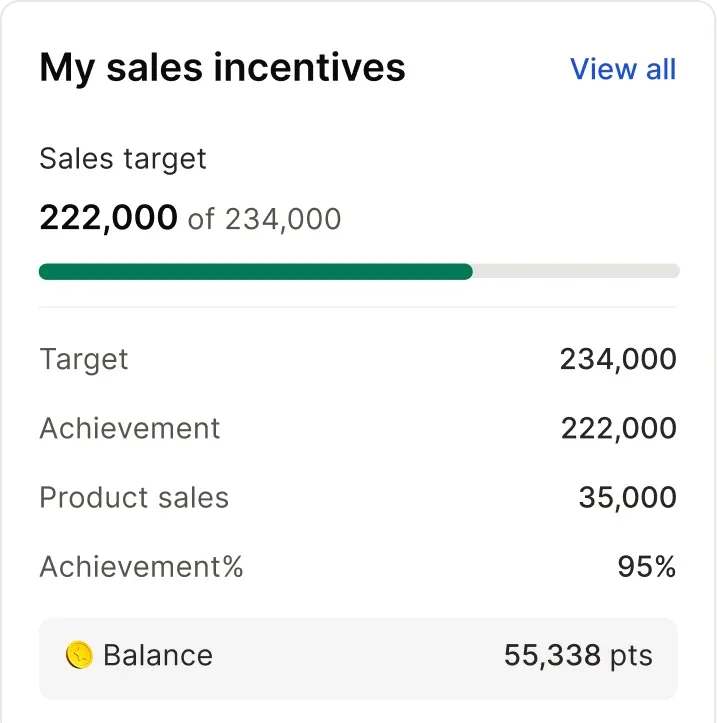
- Any commission structure: Plans and calculations supports flat, tiered, milestone-based and product-mix weighted plans in a no-code builder, plus advances against future earnings and clawbacks for cancelled deals.
- Accurate, on-time payouts: Payouts route earnings through multi-level approvals and anomaly checks, then push them to payroll, or by bank transfer, UPI or rewards where payroll is not the route.
- Real-time earnings for reps: Sales professionals see attainment and earnings as deals close, and can ask AI plain-language questions about what they have earned.
- Motivation between payouts: Sales gamification adds live leaderboards, SPIFs, contests, badges and streaks tied to real incentive plans.
Chaipoint, which runs incentive programs for 120+ business development users and distributors across 43 cities, replaced manual commission tracking with Empuls and saw a 115% increase in incentive qualifiers in under six months, as reps could finally see exactly where they stood.
Get the most from commission-based sales reps
Commission-based sales reps are central to growth because their pay is tied to the results the business needs. To get the best from them, choose the right commission structure, put it in a clear written plan, set realistic quotas, pay accurately and on time and give reps real-time visibility into what they are earning.
Use the one-page template to document each plan, review it every year and back it with the coaching, recognition and tools that keep good reps selling with you.
Book your Empuls demo
Frequently asked questions
A commission-based sales job is a role in which some or all of the rep's pay comes from commission on the sales they generate rather than a fixed salary alone. Most commission based sales jobs pay a base salary plus commission, while commission-only roles pay nothing unless the rep sells. They are common in software, insurance, real estate, automotive and retail.
Commission-only pay is legal in many places, but rules apply. In the US, employees paid commission only must usually still earn at least minimum wage for all hours worked, unless an exemption such as outside sales applies. Independent contractors can be paid commission only, but they must genuinely control their own work. Check local law before you hire.
A good commission rate depends on margin, deal size and pay mix rather than a single number. Many teams work backward from on-target earnings: divide the variable pay target by the quota to get the rate. For example, $40,000 of variable pay on a $600,000 quota gives a rate of about 6.7%, with higher rates above quota.
The main pros are strong motivation, lower fixed costs for employers, high earning potential, a sense of ownership and a sharp focus on results. The main cons are unpredictable income, high pressure, complex plans, the risk of pushy or unethical selling and weaker collaboration. A base salary, clear rules, clawbacks and team goals reduce most of the downsides.
Motivate commission-based reps by paying accurately and on time, showing earnings in real time, setting realistic quotas and rewarding overachievement with accelerators. Add public recognition, coaching and short contests or SPIFs between payouts. Ask each rep what matters to them, because some value earnings most while others want career growth or flexibility.
A draw against commission is an advance paid to a sales rep that is later offset against the commission they earn. A recoverable draw must be paid back from future commission, while a non-recoverable draw is a guaranteed minimum that is not repaid. Draws are common for new hires and long sales cycles, where commission takes months to arrive.
Prevent unethical selling with clear written ethics rules, training, deal reviews and clawbacks that recover commission on cancelled or mis-sold deals. Pay part of the incentive on customer outcomes such as retention or satisfaction, not just bookings. A transparent commission structure and a culture that rewards integrity also reduce the temptation to cut corners.
Yes. A written commission agreement protects both sides and is legally required for employees in some US states, including California and New York. It should explain how commission is earned and calculated, when it is paid, how splits, returns and cancellations are handled, what happens when the rep leaves and how disputes are resolved.





































































































































































































































































































































































































































































































































































