
Key Takeaways
Employee engagement activities for blue collar workers work best when they fit inside paid shift time, reach people on mobile and reward safety, skill and teamwork.
Workvivo's 2025 Frontline Gap research found half of frontline workers feel their company cares more about desk workers, and 20% have never been recognized.
Blue-collar engagement rests on five pillars: safety and dignity, two-way communication, recognition and rewards, skills and growth, and wellbeing and flexibility.
Shift-start huddles, safety recognition and peer recognition are the cheapest activities to launch and build the trust other programs need.
Measure blue-collar engagement by shift: participation, recognition reach, safety reporting, absenteeism and early attrition.
The most effective employee engagement activities for blue collar workers fit inside the shift, reach people on their phones and reward what matters on the floor: safety recognition, shift-start huddles, peer mentoring, skills competitions, improvement challenges and predictable schedules. This guide explains what blue-collar engagement is, the challenges behind it, a five-pillar framework, 14 activities you can run and a six-step plan to roll them out.
Keeping blue-collar employees engaged takes more than competitive wages. A positive work environment, recognition, safety and growth opportunities play a major role in job satisfaction and productivity. Unlike office employees, frontline workers need activities that fit their daily routines and work settings, whether you manage teams in manufacturing, logistics, warehousing or construction.
What blue-collar employee engagement is
Blue-collar employee engagement is the commitment, energy and sense of belonging that workers in manual, technical and operational roles feel toward their work, team and employer, and the practices that build it. Blue-collar workers perform manual or skilled trade work and are usually grouped as unskilled, semi-skilled or skilled, depending on the nature of the operation. They work in manufacturing plants, construction sites, warehouses and distribution centers, utilities, maintenance, facilities, transport and delivery.
Engagement for this group looks different from office engagement. Most blue-collar employees are deskless, many have no corporate email, shifts rotate and the work is physical. So the activities that work are short, in person or on mobile, tied to safety and skill, and held during paid time. For the wider frontline view, including retail and service roles, see our guide on how to motivate and engage frontline employees.
Why engaging blue-collar workers matters
Blue-collar workers keep production, logistics and infrastructure running, yet they are often the least visible people in an engagement program. Workvivo's Frontline Gap research, published in June 2025 and based on more than 7,500 frontline workers worldwide, found that half feel their company cares more about desk workers than about them, and 20% say they have never received any form of recognition.
50%
of frontline workers
feel their company cares more about desk workers (Workvivo, 2025)
20%
have never been recognized
in any form at work (Workvivo, 2025)
39%
value public praise
more than a bonus as a way to feel valued (Workvivo, 2025)
5,070
fatal work injuries
in the US in 2024, one every 104 minutes (BLS, 2025)
The engagement and safety stakes for blue-collar teams
The feeling of being second-class is strongest in the Americas. The same study found the share of frontline workers who believe their employer cares more about desk workers rises well above the global average in North and Latin America:
Safety raises the stakes further. The US Bureau of Labor Statistics' Census of Fatal Occupational Injuries recorded 5,070 fatal work injuries in 2024, with transportation and material moving occupations the group with the most deaths (1,391) and construction and extraction workers recording 1,032. Engaged crews speak up about hazards, follow procedures and look out for each other, so engagement and safety reinforce each other.
Disengagement in this layer is also more visible and more costly than in an office. It shows up as absenteeism, quality defects, accidents, high turnover and, in the worst cases, labor unrest that stops production. Companies that redefine engagement for the floor, rather than copying office programs, see the benefits in output, safety and retention.
Challenges blue-collar workers face and how engagement helps
Blue-collar roles come with specific challenges that generic engagement programs miss. This table pairs the seven most common ones with what engagement can do about each:
| Challenge | What it looks like | How engagement helps |
|---|---|---|
| Physical demands and fatigue | Strenuous, repetitive work and long shifts that wear people down | Engaged workers take pride in their work, follow safety guidelines and speak up when they need help or accommodations |
| Lack of career development | No visible path beyond the current role, leading to stagnation | Training, skill badges and clear progression show people a future inside the company |
| Limited access to technology | No corporate email or laptop, so updates and recognition never arrive | Shift huddles, notice boards and mobile apps bridge the gap and open access to training |
| Lack of recognition | Contributions are less visible than office work, so people feel unappreciated | Spot awards, shout-outs at huddles and peer recognition make effort visible |
| High turnover | Workers leave for small pay differences, raising hiring and training costs | Wellbeing, skill growth and a positive culture give people reasons to stay |
| Unpredictable schedules | Short-notice shift changes that disrupt family life and second jobs | Advance rosters, shift swaps and input on scheduling build trust |
| Language and literacy barriers | Multilingual crews and written-only communication | Visual, spoken and translated communication so everyone understands |
Five pillars of blue-collar employee engagement
Every activity in this guide supports one of five pillars. Safety and communication come first, because without them recognition and growth programs feel hollow:
01 · Pillar 1
Safety and dignity
Safe conditions, proper equipment, clean break areas and respect from supervisors are the foundation. Recognize safe behaviors, not just low incident counts.
02 · Pillar 2
Two-way communication
Shift huddles, mobile updates in local languages and real channels to raise concerns, with visible follow-up.
03 · Pillar 3
Recognition and rewards
Timely, specific and public appreciation, with rewards that matter in daily life, such as grocery, fuel or mobile recharge.
04 · Pillar 4
Skills and growth
Training, certifications, mentoring and clear paths from operator to lead to supervisor.
05 · Pillar 5
Wellbeing and flexibility
Fatigue management, health support, predictable rosters and shift swaps that respect life outside work.
Reach every worker on every shift
Recognition, rewards and pulse surveys over WhatsApp, SMS and mobile, with no corporate email needed.
Talk to our ExpertTrusted by 5,000+ companies
14 employee engagement activities for blue collar workers
These 14 blue collar employee engagement ideas boost morale, productivity and retention in industries that rely on physical and skilled work. Start with the first four, because they are the cheapest to launch and they build the trust the others need.
1. Safety recognition programs
Safety recognition programs reward and acknowledge workers who consistently prioritize safety. They build a culture of safety awareness and encourage everyone to help create a safer workplace. Recognize leading behaviors, such as reporting hazards and near misses, wearing protective equipment and stopping unsafe work, rather than rewarding only injury-free days, which can discourage reporting. Our guide to blue collar worker recognition covers how to do this within US OSHA guidance.
2. Shift-start huddles with two-way communication
A five to ten minute huddle at the start of each shift is the most reliable engagement channel on the floor. Share the day's priorities and safety focus, recognize one person or crew from the previous shift and ask one question: what is getting in your way? Log the answers and report back on what changed.
3. Employee-led training and skill development
Empowering workers to own their skill development and share knowledge is highly engaging. Invite experienced operators and technicians to lead short sessions or workshops in areas where they excel, which creates peer-to-peer learning and recognizes expertise at the same time.
4. Peer mentorship programs
Peer mentorship pairs experienced workers with newcomers. These relationships transfer knowledge and skills, speed up onboarding, reduce early attrition and build strong working relationships. Recognize mentors publicly when their mentees pass key milestones.
5. Workplace improvement challenges and continuous improvement teams
Invite workers to propose and implement ideas that make work more efficient, safer or more sustainable, and give small teams the autonomy to test changes in their own area. Toyota's long-standing kaizen practice, where employees suggest and implement improvements at their own workstations, is the best-known model. Reward adopted ideas and share the results, so people see their input matters.
6. Skills competitions
Friendly competitions in welding, machining, forklift handling, quality inspection or first aid let skilled workers show their craft and learn from each other. Hold internal rounds by shift, celebrate the winners at a plant-wide event and support the best performers to enter regional or national skills competitions and trade shows.
7. Peer recognition programs
Peer recognition lets workers appreciate colleagues' contributions, from covering a shift to spotting a hazard. Make it simple enough to do in 30 seconds on a phone or at a kiosk, and read out the week's best shout-outs at huddles. In Workvivo's research, 39% of frontline workers said public praise would make them feel more valued than a bonus.
8. Employee appreciation days with personalized gifts
Dedicate days to thanking workers for their hard work, and personalize gifts based on each person's interests or achievements. Invite families for a plant open day, serve a good meal on every shift, including nights, and let people choose rewards that matter to them rather than branded merchandise. For a calendar of occasions, see these Employee Appreciation Day ideas.
9. Flexible shift scheduling and shift swaps
Full remote work is rarely possible for blue-collar roles, but schedule flexibility often is. Publish rosters well in advance, allow workers to swap shifts with approval, offer self-scheduling for some hours and give people a say in overtime. Predictability is one of the most valued and least expensive engagement levers.
10. Job rotation and cross-training
Rotating workers across stations or tasks adds variety, reduces repetitive strain and builds a more flexible workforce. Pair rotations with cross-training and skill badges, so the variety also counts toward progression and pay.
11. Employee ownership and profit-sharing
Employee ownership and profit-sharing let eligible workers share in the company's success through stock ownership or a share of profits. This rewards people financially and creates a strong sense of ownership. Simpler versions, such as team bonuses tied to plant output, quality or safety targets, work well where ownership plans are not practical.
12. Employee-driven community service projects
Community projects benefit local areas and strengthen team bonds. Blue-collar crews often have the exact skills communities need, such as building, repairing or cleaning up, so let teams choose a project and do it in paid time.
13. Engagement surveys and feedback loops
Regular surveys and feedback loops reveal workers' needs and concerns about safety, scheduling, supervisors and facilities. Keep pulse surveys short, available on mobile in local languages and anonymous, and close the loop by sharing what you heard and what will change. Our guide to the employee pulse survey has question ideas.
14. Wellness challenges and incentive programs
Wellness programs for physical workers should focus on fatigue, hydration, heat, musculoskeletal health, sleep for night-shift workers and mental health. Run team step or hydration challenges, offer health checkups on site and reward participation. Our guide to employee wellbeing programs covers program design.
How to build a blue-collar engagement plan in 6 steps
A list of activities is not a plan. These six steps turn the ideas above into a program that lasts, and the first step matters most because it tells you which activities to start with.
- Listen first: Hold short floor walks and a mobile pulse survey to learn what frustrates workers most, such as schedules, equipment, supervisors or pay timing.
- Fix the basics: Address the top two safety, equipment or facility issues quickly and say publicly that you did.
- Train supervisors: Supervisors deliver most of the experience, so train them on huddles, recognition and listening before launching programs.
- Pick three activities: Start with shift huddles, safety recognition and peer recognition, then add growth and wellbeing activities.
- Choose the right channels: Use huddles, notice boards, screens in break rooms and a mobile app or messaging channel that needs no corporate email.
- Measure and adjust: Track participation by shift, recognition reach, absenteeism, safety reporting and early attrition every month.
For specific roles, see our guides on motivating last-mile delivery executives and employee engagement in manufacturing.
How Empuls helps you engage blue-collar employees
Most engagement tools assume an inbox and a laptop, which blue-collar workers do not have. Empuls is built to reach deskless teams where they are:
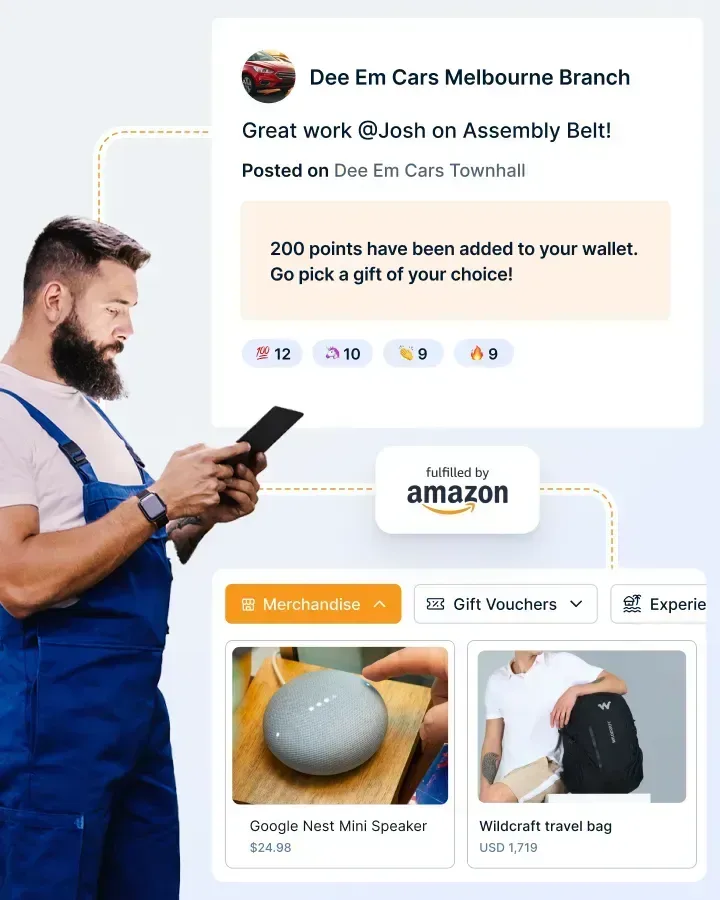
- Reach without email: Empuls for frontline workforces delivers recognition and rewards through WhatsApp, SMS and a lightweight mobile app, with no corporate email, laptop or bank account required.
- Recognition and rewards: Managers and peers recognize each other instantly with Empuls recognition, and workers redeem points for rewards they choose. Reward codes can also be printed or sent for offline recognition.
- Contests and challenges: Turn safety, quality and attendance goals into leaderboards with Empuls challenges and contests.
- Listening and communication: Run mobile pulse surveys, share town hall messages and celebrate birthdays and anniversaries across shifts and sites.
Engage the people who keep operations running
Engaging blue-collar workers takes creativity and a genuine commitment to their safety, growth and wellbeing. Fix the basics, communicate in ways that reach the floor, recognize effort quickly and publicly, offer paths to grow and respect life outside the shift. When activities fit how blue-collar employees actually work, they feel valued and motivated to excel, and that investment pays back across the whole organization.
Book your Empuls demo
Frequently asked questions
Engage blue-collar workers by fixing safety and facility basics first, holding short shift-start huddles, recognizing effort quickly and publicly, offering training and clear progression, giving input on schedules and supporting wellbeing. Run activities in paid time for every shift and use mobile or messaging channels, since most blue-collar workers have no corporate email.
Blue-collar employees are motivated by fair and timely pay, safe working conditions, respect from supervisors, recognition that is specific and public, predictable schedules, chances to learn new skills and move up, and rewards that help in daily life. Feeling that their work is valued as much as office work matters as much as any single incentive.
Good engagement activities for factory workers include safety recognition programs, shift-start huddles, kaizen-style improvement challenges, skills competitions, peer mentoring, job rotation with cross-training, team wellness challenges and family open days. Keep each activity short, repeat it across shifts and connect it to safety, quality or skill growth.
Engage deskless workers without email by using shift huddles, notice boards and screens in break areas, plus a mobile app, WhatsApp or SMS channel that works with a phone number login. Keep messages short and visual, translate them into local languages and make recognition and surveys possible in under a minute on a phone.
Blue-collar workers do manual, technical or skilled trade work, such as manufacturing, construction, maintenance and logistics. Frontline workers are any employees who work directly with customers, products or operations rather than at a desk, which includes blue-collar roles plus retail, hospitality, healthcare and service staff. Most blue-collar workers are frontline, but not all frontline workers are blue-collar.
Recognize safe behaviors rather than injury-free days. Reward hazard and near-miss reporting, wearing protective equipment, completing safety training and stopping unsafe work. Avoid prizes that depend on zero reported injuries, which can pressure people to hide incidents. In the US, OSHA warns that withholding rewards because someone reported an injury can violate anti-retaliation rules.
Measure blue-collar engagement with short mobile pulse surveys by shift and site, plus operational signals: participation in activities, recognition reach, absenteeism, safety and near-miss reporting, quality defects and turnover in the first 90 days. Compare shifts and sites, because night shifts and remote sites often trail and need targeted action.





































































































































































































































































































































































































































































































































































