
Key Takeaways
To calculate employee benefits, list every benefit and employer payroll tax, assign an annual cost to each, add them up and add the total to salary.
Benefits as a percentage of salary equals total benefits divided by base salary, multiplied by 100.
US private employers spent 30% of total compensation on benefits in June 2026, according to the Bureau of Labor Statistics.
Leaving out payroll taxes, paid leave or admin fees is the most common reason benefits cost calculations come in too low.
Discounts, tax-saving benefits, lifestyle spending accounts and utilization tracking lower cost per employee without cutting value.
To calculate employee benefits, list every benefit and employer-paid tax, assign an annual cost to each, add them up and divide by base salary to get benefits as a percentage of salary. Adding that total to salary gives total compensation, the true cost of one employee. In the US, benefits average 30% of total compensation for private employers.
Knowing how to calculate employee benefits is crucial to building competitive compensation packages that attract and retain talent without overspending. Employee satisfaction is central to business success, so employers are offering more comprehensive benefits, and those benefits are a real expense that needs to be measured, optimized and explained.
This handbook walks through the employee benefits cost calculation from both sides: how an employee can work out the full value of their package and how a business can calculate the cost of its benefits, benchmark it and get more value from every dollar. If you need the basics first, start with this guide to employee benefits.
Types of employee benefits to include in your calculation
Before calculating employee benefits, you need to know what counts. There are three broad types, statutory, fringe and no-cost benefits, and statutory benefits come first because they are mandatory and are the line most often left out of benefits budgets.
1. Statutory benefits
Statutory or mandatory benefits are legal requirements every business must comply with. Employers pay contributions to government welfare schemes, social insurance and retirement funds, no matter what. Most countries have such requirements, but they differ.
In the US, employers pay Social Security tax of 6.2% on wages up to the 2026 wage base of $184,500 and Medicare tax of 1.45% on all wages, plus federal unemployment tax (FUTA) of 6.0% on the first $7,000 of each employee's wages, which usually drops to an effective 0.6% after the state credit, according to the IRS. State unemployment insurance and workers' compensation are added on top.
In India, the Employees' Provident Fund requires employers and employees to each contribute 12% of the employee's basic wages every month. The government ratified an interest rate of 8.25% for 2025-26, unchanged for the third year.
2. Fringe benefits
Fringe benefits are additional benefits given to employees beyond salary, many of them non-cash. The term was popularized by the Internal Revenue Service (IRS) in the US. Employers are not required by law to offer them, but they do so to keep employees motivated and to encourage long careers with the business. Examples include:
- Health, dental and vision insurance beyond legal minimums
- Retirement plan matching
- Tuition reimbursement
- Company transportation
- Product discounts
- Paid vacations
HubSpot is a well-known example. Its benefits page lists flexible time off with a company-wide week of rest, a five-year sabbatical, parental benefits including fertility and adoption support, a remote work monthly stipend, tuition reimbursement and employee resource groups such as Women@HubSpot and the LGBTQ+ Alliance. For how each fringe benefit is taxed, see this guide to the types of fringe benefits.
3. No-cost benefits
These benefits cost the business little or nothing, hence the name. They sit alongside statutory and fringe benefits, and although they add almost nothing to the calculation, they can make a big difference to quality of work, personal life and performance. Common examples include:
- Flexible scheduling
- Location flexibility
- Casual dress code
- Access to legal assistance or advice networks
No-cost benefits matter in the calculation for a different reason: they raise the perceived value of the package without raising its cost. For more ideas, see these non-monetary compensation examples.
How to calculate employee benefits as an employee
As an employee, calculating your benefits shows the total value of your compensation, not just your take-home pay. Many people do not realize how much their employer contributes through insurance, retirement funds and time off. The process takes four steps, and step 2, assigning a value to each benefit, is where most of the work is.
Step 1: List all the benefits you receive
Start by listing everything your employer provides in addition to your base salary, such as:
- Employer-paid health, dental and vision insurance
- Retirement plan contributions (like a 401(k) match or Provident Fund)
- Paid time off (vacation, sick days, holidays)
- Bonuses or stock options
- Wellness programs (gym reimbursements, therapy access)
- Educational support or learning stipends
- Commuter, travel or meal benefits
Step 2: Assign a monetary value to each benefit
Use your benefits statement, payslip or HR portal to find what your employer pays. Here is how to estimate the annual value of each benefit for an employee earning $60,000 a year:
| Benefit type | How to value it | Example value |
|---|---|---|
| Health insurance | Employer's monthly premium share × 12 | $500 × 12 = $6,000 |
| 401(k) match (4%) | Salary × match rate | $60,000 × 4% = $2,400 |
| Paid time off (15 days) | (Salary ÷ 260 workdays) × paid days off | ($60,000 ÷ 260) × 15 = about $3,460 |
| Gym stipend | Monthly stipend × 12 | $50 × 12 = $600 |
| Learning stipend | Annual allocation | $1,000 |
Step 3: Add it all together
Add the values to find your total annual benefits value:
Total benefits = $6,000 + $2,400 + $3,460 + $600 + $1,000 = $13,460
Step 4: Add the total to your base salary
Now calculate your total compensation:
Total compensation = $60,000 base salary + $13,460 benefits = $73,460 a year
This matters when you compare job offers, negotiate pay or decide which benefits to enroll in. A lower salary with strong benefits can be worth more than a higher salary with few, so compare offers on total compensation, not salary alone.
See where your benefits budget really goes
Track utilization and spend for every benefit, by team and location, in one platform.
Talk to our ExpertTrusted by 5,000+ companies
How to calculate employee benefits for your business
Understanding the actual cost of employee benefits is essential for business planning, HR budgeting and designing a competitive employee benefits package. The process has six steps, and the most important is step 2, because benefits cost calculations go wrong when employer payroll taxes, paid leave or admin fees are left out.
Several factors affect the calculation:
- Type of employees: Full-time, part-time and contract employees are eligible for different benefits.
- Number of employees: Headcount affects insurance pricing and which legal requirements apply.
- Employer contribution: The share of each premium or plan your business pays.
- Location: Statutory contributions and tax-free limits vary by country and state.
Step 1: List all the benefits your company offers
Compile a full list of every benefit your organization provides, grouped by category:
- Statutory contributions: Social Security and Medicare, federal and state unemployment taxes, workers' compensation, or Provident Fund and state insurance outside the US.
- Health and insurance benefits: Employer-paid health, dental and vision premiums, life insurance and short-term and long-term disability insurance.
- Retirement and financial benefits: 401(k) or Provident Fund matches, profit-sharing or stock options, bonuses and financial wellness programs.
- Time-off benefits: Paid vacation, sick leave, paid holidays, parental or bereavement leave, sabbaticals and volunteer time off.
- Learning and development: Tuition reimbursement, certifications, upskilling programs and conference sponsorships.
- Lifestyle and wellbeing perks: Gym memberships or wellness stipends, meal subsidies, travel or relocation allowances, commuter benefits and mental health support.
- Other non-traditional benefits: Remote work setup allowances, employee recognition and reward programs, subscriptions and cultural engagement perks.
Step 2: Determine the annual cost of each benefit
For every benefit, calculate the cost per employee per year using actual data from your payroll system, benefits provider or HR platform. Use these methods:
| Benefit | Cost methodology |
|---|---|
| Health insurance | Employer premium share per employee × 12 months |
| 401(k) or Provident Fund match | Match rate × eligible salary |
| Paid time off | (Salary ÷ workdays) × total paid days off |
| Employer payroll taxes | Social Security 6.2% up to the wage base + Medicare 1.45% + FUTA and state unemployment |
| Meal subsidy | Average daily subsidy × working days per year |
| Wellness stipend | Monthly stipend × 12 |
| Learning budget | Annual allocation per employee |
| Platform and admin fees | Annual fees ÷ number of covered employees |
If benefits vary by department, location or seniority, segment your calculations so each group's figure is accurate.
Step 3: Add up the total annual benefit cost per employee
Once you have a cost for each benefit, add them to get the total cost of benefits per employee per year. In this example for a $60,000 employee, the voluntary benefits come first and the statutory costs are added separately so you can see both:
| Cost item | Annual cost |
|---|---|
| Health insurance (employer share) | $8,000 |
| 401(k) match (4%) | $2,400 |
| Paid time off (15 days) | $3,462 |
| Gym stipend | $600 |
| Learning budget | $1,000 |
| Voluntary benefits subtotal | $15,462 |
| Social Security and Medicare (7.65% of $60,000) | $4,590 |
| FUTA (0.6% of $7,000) | $42 |
| Total benefits cost | $20,094 |
Step 4: Add benefits to salary to calculate total compensation
To understand the total employment cost, add the annual salary to the benefits cost. This is the number a total compensation calculator produces:
Total compensation = $60,000 salary + $20,094 benefits = $80,094 a year
This number reflects what your business actually spends on one employee each year. Leave out payroll taxes and the figure drops to $75,462, which understates the real cost by more than $4,600.
Step 5: Calculate benefits as a percentage of salary
Expressing employee benefits as a percentage of salary lets you benchmark your investment and compare departments or industries:
Benefits % of salary = (Total benefits ÷ Base salary) × 100
In the example, $20,094 ÷ $60,000 × 100 = 33.5% of salary spent on benefits, or 25.8% if you count voluntary benefits only.
For a national benchmark, the Bureau of Labor Statistics reports that in June 2026, US private employers spent $14.07 per hour worked on benefits against $32.82 on wages and salaries. That is 30.0% of total compensation, or about 43% on top of wages, because the BLS figure also counts supplemental pay such as overtime and bonuses.
Step 6: Apply the calculations across your organization
Now scale the process to the whole company:
- Calculate total benefits spend across the company
- Compare cost per employee by team, location or department
- Forecast benefits expenses for future hiring or policy changes
- Model the effect of plan changes, such as a higher match or a new wellness stipend
Health costs deserve special attention in forecasts. Mercer's 2026 National Survey of Employer-Sponsored Health Plans projects health benefit cost per employee will rise 8.2% in 2027, so build that increase into next year's budget rather than using this year's premium.
Employee benefits cost benchmarks
Benchmarks help you judge whether your benefits package cost is in line with the market. These figures come from the BLS Employer Costs for Employee Compensation data for June 2026 and the KFF 2026 Employer Health Benefits Survey:
| Benchmark | Figure | Source |
|---|---|---|
| Benefits share of total compensation, private industry | 30.0% ($14.07 of $46.89 per hour) | BLS, June 2026 |
| Benefits share of total compensation, state and local government | 38.8% ($25.78 of $66.45 per hour) | BLS, June 2026 |
| Insurance share of total compensation, private industry | 7.9% | BLS, June 2026 |
| Paid leave share of total compensation, private industry | 7.5% | BLS, June 2026 |
| Legally required benefits share, private industry | 7.2% | BLS, June 2026 |
| Retirement and savings share, private industry | 3.3% | BLS, June 2026 |
| Average annual family health premium (employer plus worker) | $28,303, of which workers pay $7,471 | KFF, 2026 |
The category shares come from the BLS cost breakdown table, and the premium figures from the KFF 2026 Employer Health Benefits Survey. Your own mix will differ by industry, location and workforce, so use benchmarks as a range, not a target.
Pro tips for calculating employee benefits accurately
A few habits make benefit calculations more accurate and more useful for decisions:
- Track usage against cost: Not all perks are used equally. Check utilization data, such as how many employees redeem wellness stipends or attend learning programs, to optimize spend.
- Include hidden costs: Do not forget administrative costs, platform subscriptions and employer tax contributions in your total.
- Audit annually: Employee needs change. Review benefit costs, feedback and ROI every year so you offer high-value, relevant benefits.
- Communicate benefits clearly: Employees often undervalue benefits because they do not know about them. A personal total compensation statement makes the value visible and supports retention.
Why employee benefit costs are worth the investment
Employee benefits come at a cost, and as a business you need to understand it. Instead of treating it as an expense, treat it as an investment in growth, which is exactly why calculating employee benefits and their ROI matters. Benefits help your business in four ways:
- Boosts employee retention: The talent crunch remains a real problem, and benefits are a top way to build loyalty. Satisfied employees stay longer, and MetLife's 2026 Employee Benefit Trends Study puts employee loyalty at 77%, up from 73% in 2025. For more tactics, see these employee retention strategies.
- Helps attract top talent: Candidates compare benefits before they accept an offer, and happy employees refer friends and family, which is one of the most efficient ways to hire.
- Improves productivity: Benefits make employees feel valued and rewarded. MetLife reports that holistically healthy employees are 25% more productive and loyal, and that employers expect $2.30 back for every $1 invested in employee health.
- Keeps you compliant: Businesses have legal obligations to provide certain benefits. Prioritizing employee welfare and budgeting for statutory costs reduces the risk of penalties and disputes.
How to optimize benefit costs without sacrificing value
Offering employee benefits does not have to drain your budget. The key is maximizing impact per dollar by tailoring benefits to employee needs, automating delivery and tracking effectiveness, and the five levers below are ordered from the quickest win (everyday savings) to the one that guides all the others (measurement).
1. Offer curated perks and exclusive discounts at scale
Rather than building your own vendor network or paying for costly one-off perks, give employees access to a discounts marketplace. Cashback and discounts on essentials, travel, electronics, wellness and food stretch every paycheck at little cost to the employer. For how these platforms work, see this guide to employee discount platforms.
2. Enable tax-saving benefits
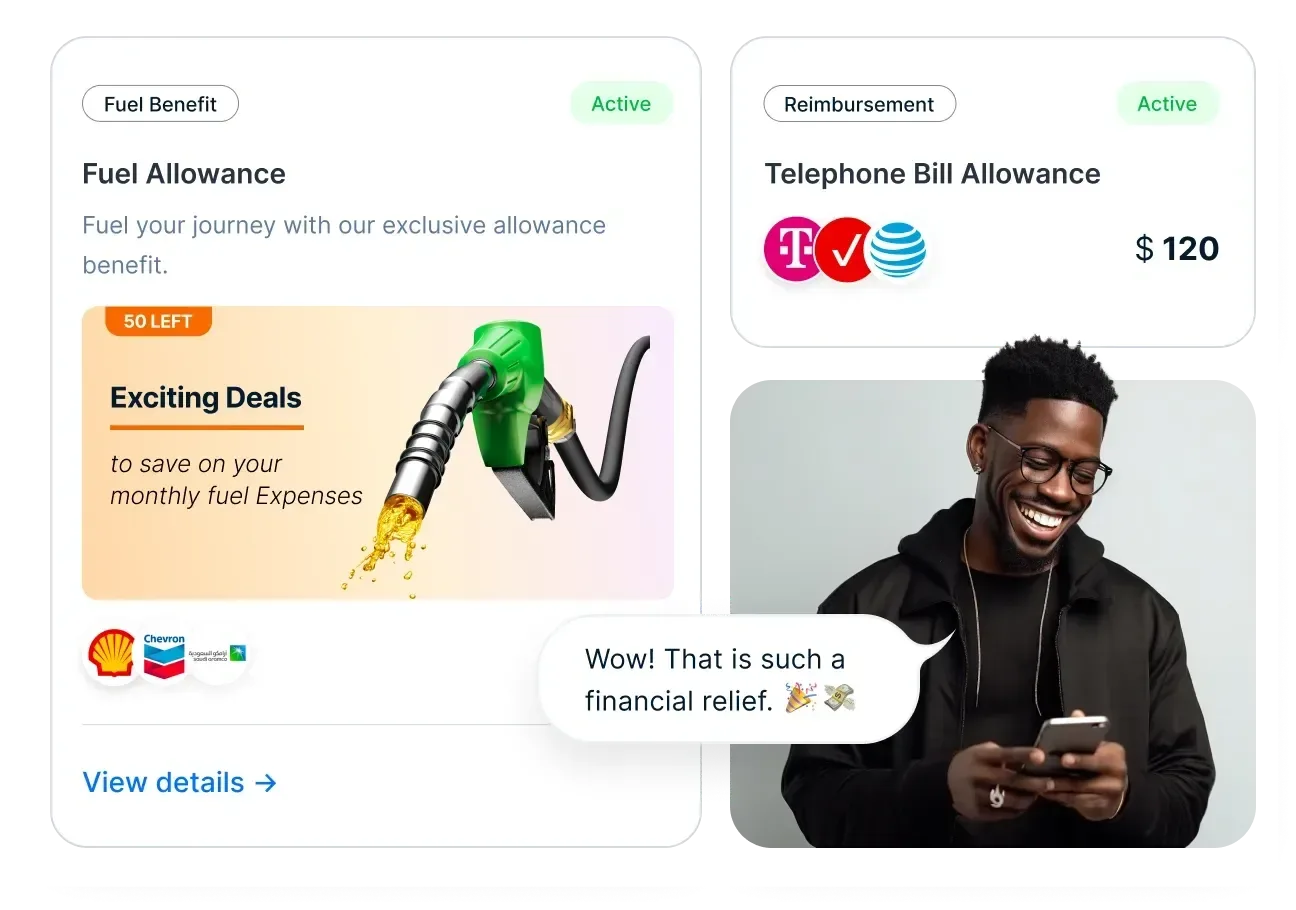
One of the most effective ways to reduce costs for both the company and employees is to offer tax-saving benefits that comply with local rules. In India, flexible benefit plans commonly cover meals, fuel, books and periodicals and telecom; in the US, pre-tax options include HSAs, FSAs and commuter benefits up to IRS limits. Delivering them through one multi-wallet card simplifies administration and maximizes savings.
For a full breakdown, read about tax saving benefits for employees.
3. Provide flexible benefits with lifestyle spending accounts
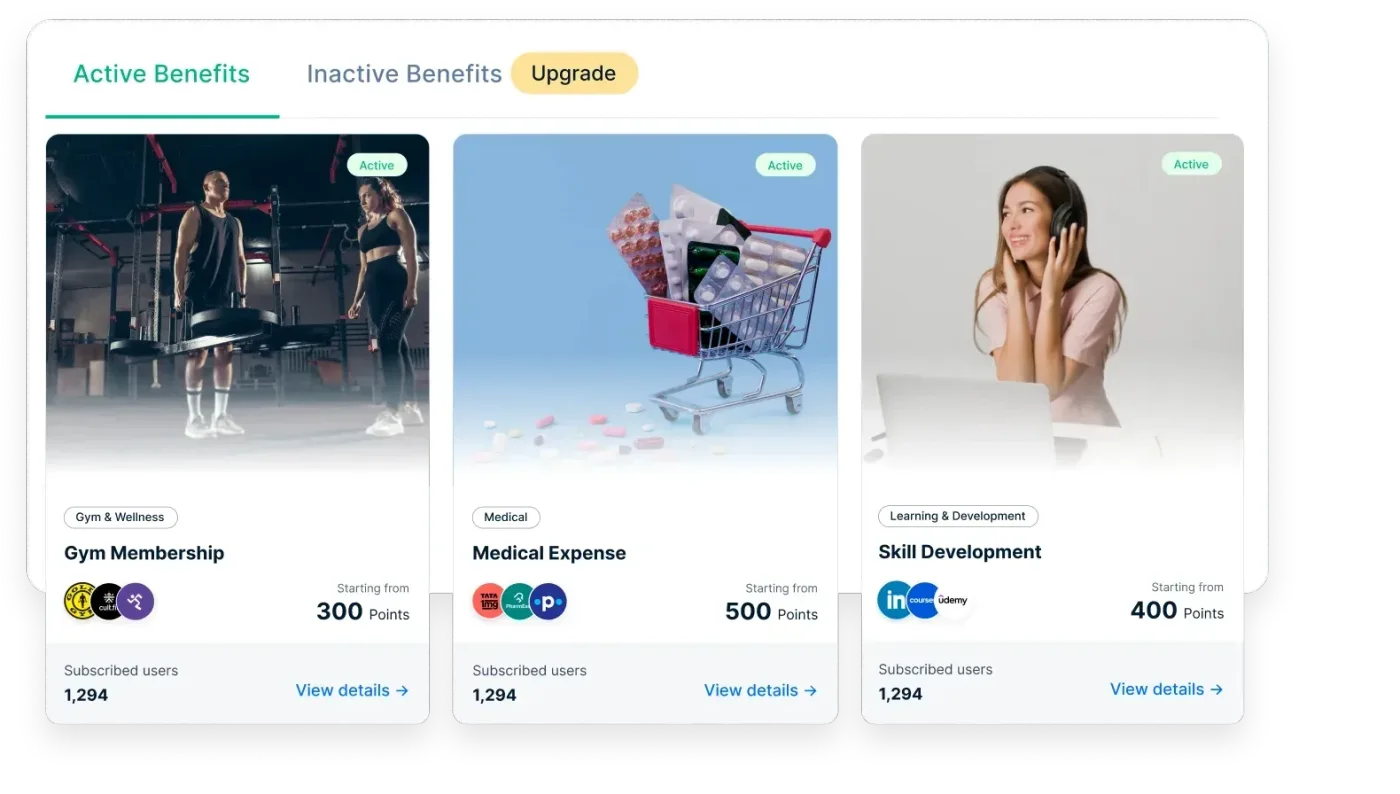
Modern workforces are diverse, and so are their needs. Lifestyle spending accounts (LSAs) give each employee a fixed budget to spend across categories that matter to them, such as fitness and wellness, learning, family care, remote work setup and mental health. The cost is predictable, and unused balances do not become wasted spend on benefits nobody wanted.
4. Offer salary advances and earned wage access
Short-term financial stress hurts productivity, mental health and retention. Instead of leaving employees to high-interest loans, give them access to wages they have already earned before payday, so they can avoid debt traps and unnecessary strain. Short-term emergency loan programs serve a similar purpose for larger needs.
5. Track utilization and ROI with real-time insights
Many companies offer perks without knowing whether anyone uses them. Track which benefits are claimed most, savings generated per employee, adoption rates by department and the overall return on your benefits budget. This is the data that tells you which of the other four levers to pull.
How Empuls helps you calculate and control benefits costs
Empuls, Xoxoday's employee engagement platform, brings these levers into one place: employee discounts, a tax-saving benefits card, lifestyle spending accounts and financial wellness support, all claimed through one app.
Because every benefit runs through one platform, reports and analytics show utilization and spend by benefit, team and location. That makes it easier to reduce benefits wastage, raise usage and satisfaction and stretch your budget with measurable ROI.
Treat employee benefits as a measurable investment
The importance of employee benefits cannot be overstated. They look like an expense, but the advantages of these programs far outweigh the costs when you measure them properly.
That is why calculating employee benefits is so important: knowing the full cost, including payroll taxes and paid leave, lets you benchmark it, find the ROI and optimize it. Treat benefits as a long-term investment and strategy rather than a line item, and revisit the numbers every year as employee benefits trends and costs change.
Book your Empuls demo
Frequently asked questions
List every benefit the employee receives, such as health insurance, retirement contributions, paid time off and stipends, plus employer payroll taxes. Assign an annual cost to each, using premiums, match rates and daily pay for leave, then add them together. That sum is the employee's total annual benefits cost or value.
Divide the total annual cost of benefits by the employee's annual base salary, then multiply by 100. For example, benefits worth ₹1,00,000 on a salary of ₹5,00,000 equal 20% of salary, and $20,094 of benefits on a $60,000 salary equals 33.5%. Use the same method for every employee so comparisons stay consistent.
There is no single correct percentage. As a reference point, BLS data for June 2026 shows US private employers spent 30% of total compensation on benefits, which is roughly 43% on top of wages and salaries, while state and local governments spent 38.8%. Your own figure will depend on industry, location, workforce mix and health plan design.
Include employer health, dental and vision premiums, life and disability insurance, retirement contributions, paid time off, bonuses, wellness and learning stipends, commuter or meal benefits, employer payroll taxes, unemployment insurance, workers' compensation and the admin or platform fees needed to run the program. Missing any of these understates the true cost.
Total compensation equals base salary plus the annual value of all benefits and employer-paid costs. Some calculations also add bonuses and equity. For example, a $60,000 salary with $20,094 in benefits and employer taxes gives total compensation of $80,094. A total compensation calculator simply automates this addition for each employee.
Divide the employee's annual salary by the number of working days in the year, usually 260, to get a daily rate. Multiply the daily rate by the number of paid days off, including vacation, sick days and holidays. For a $60,000 salary, 15 paid days off cost about $3,460 a year.
Yes. Benefit costs vary by full-time, part-time or contract status, seniority, job role and location, because eligibility rules, statutory contributions and tax-free limits differ. Insurance premiums also change by region and family coverage tier. Segment your calculations by these groups so each cost per employee figure is accurate.





































































































































































































































































































































































































































































































































































