
Key Takeaways
An employee survey is a structured, usually anonymous questionnaire that measures how employees feel about their work, manager, culture and organization.
The 12 common types of employee surveys are engagement, pulse, satisfaction, eNPS, onboarding, stay, exit, culture and inclusion, training, wellbeing, benefits and 360-degree feedback.
Most organizations need an annual engagement survey, regular pulse surveys and a few lifecycle surveys rather than every survey type.
Perceptyx data shows 71% of employees see survey results shared but only 51% see real improvements, so action planning matters more than the questionnaire.
Define the decision a survey will inform, protect anonymity with a minimum group size and tell employees what changed after every cycle.
The main types of employee surveys are engagement, pulse, satisfaction, eNPS, onboarding, exit, stay, culture and inclusion, training, wellbeing, benefits and 360-degree feedback surveys. Each one answers a different question, so the right choice depends on what you need to learn, how often you need to know it and who will act on the answers.
An employee survey is a structured questionnaire that collects feedback from employees about their work, their manager, the culture and the organization, usually anonymously, so leaders can measure sentiment and decide what to change. When it is done right, a survey is not a form. It is a promise that someone will listen and act.
That promise matters more than ever. Gallup's State of the Global Workplace 2026 report found that global employee engagement fell to 20% in 2025, down from a peak of 23% in 2022, and that manager engagement dropped from 27% to 22% in a single year. Gallup estimates low engagement costs the world economy about $10 trillion in lost productivity. Surveys are how you find out where your own organization sits and why.
This guide breaks down the types of employee surveys, when to run each one, sample questions, the do's and don'ts, employee survey best practices for every stage, and a ready-to-use bank of 30 questions about management.
What an employee survey is and what it gives you
An employee survey is a tool containing a questionnaire, designed to gather feedback from employees about their work experience. Organizations use it to gauge employee sentiment on the many parts of working life: managers, workload, growth, pay and benefits, recognition, tools and culture.
A well-run employee survey program gives you five things you cannot get from dashboards alone:
- Better decisions: Survey data shows where satisfaction and dissatisfaction actually sit, so HR and leadership can make evidence-based calls on compensation and benefits, learning programs and performance practices. If results reveal a strong desire for professional development, for example, HR can build targeted programs instead of guessing.
- Higher engagement: Asking for input shows that management values it. When employees see their voice lead to change, they feel more connected to their work and more invested in the organization's success.
- Lower turnover: Surveys act as an early warning system. Low scores on workload, manager support or growth often show up months before resignations do, which gives you time to fix the cause of employee attrition rather than react to it.
- Two-way communication: Soliciting feedback and responding to it builds trust. Over time, that dialogue creates a more collaborative workplace where people feel safe to share ideas.
- A stronger employer brand: Positive, credible results on culture, flexibility or growth are proof points you can use in recruiting, as long as they are real and shared honestly.
The catch is the follow-through. Perceptyx benchmark data shared in its 2025 employee listening analysis shows that 71% of employees say survey results were shared with them and 59% say action plans were created, but only 51% see actual improvements resulting from their feedback. Choosing the right survey type is the first step to closing that gap.
20%
of employees worldwide are engaged
Gallup, 2025 data
22%
of managers are engaged
down from 27% a year earlier (Gallup)
51%
of employees see real improvements
after giving survey feedback (Perceptyx)
Why employee surveys need a clear purpose and a follow-up plan
Run every employee survey type in one place
Pulse, lifecycle and engagement surveys with AI comment analysis and manager action plans.
Talk to our ExpertTrusted by 5,000+ companies
12 types of employee surveys and when to use each
There are 12 common types of employee surveys, and most organizations need four or five of them, not all twelve. Start with the table to match each type to the question you need answered, then read the details and sample questions for the ones you plan to run.
| Survey type | What it measures | When to run it | Typical length |
|---|---|---|---|
| Engagement survey | Emotional commitment, motivation and the drivers behind them | Once or twice a year | 30 to 60 questions |
| Pulse survey | Sentiment on a few focused topics, tracked over time | Weekly, monthly or quarterly | 5 to 15 questions |
| Satisfaction survey | Contentment with pay, benefits, workload and conditions | Once a year | 20 to 40 questions |
| eNPS survey | Likelihood to recommend the company as a place to work | Quarterly, often inside a pulse | 1 question plus a follow-up |
| Onboarding survey | How well new hires are set up to succeed | Day 30, 60 and 90 | 8 to 15 questions |
| Stay survey | Why valued people stay and what might make them leave | Yearly for key talent | 8 to 12 questions |
| Exit survey | Why people leave and what would have kept them | At resignation | 10 to 15 questions |
| Culture and inclusion survey | Belonging, fairness, respect and psychological safety | Once a year | 15 to 25 questions |
| Training survey | Whether learning programs meet their goals | After each program | 5 to 10 questions |
| Wellbeing survey | Stress, workload, burnout risk and support | Twice a year or after major change | 10 to 20 questions |
| Benefits survey | Which benefits people value, use and miss | Before renewal or open enrollment | 10 to 20 questions |
| 360-degree feedback | One person's behaviors as seen by peers, reports and managers | Yearly, for development | 15 to 30 questions |
Engagement and pulse surveys come first below because they are the backbone of most listening programs. The rest are triggered by a moment (joining, leaving, training) or a specific topic (benefits, inclusion, wellbeing).
1. Employee engagement surveys
Employee engagement refers to an employee's level of emotional commitment and connection to their work and organization. Engaged employees are motivated, productive and loyal. Several factors contribute to engagement:
- Meaningful work: Employees feel their work has a purpose and contributes to the organization's success.
- Growth opportunities: Employees have access to training and development that helps them build skills and careers.
- Recognition and rewards: Employees feel appreciated for their contributions and are rewarded for their accomplishments.
- A supportive environment: Employees feel valued and respected by colleagues and managers, and they have the resources they need.
Engagement surveys are ideal for segmenting your workforce into engaged, neutral and disengaged groups, finding the drivers behind each, and measuring progress against your engagement initiatives over time. Sample questions, rated on a 5-point agreement scale:
- I feel valued at work.
- My manager recognizes my efforts regularly.
- I have adequate access to learning and development tools.
- Management gives me enough autonomy to work independently.
For a full question set and a step-by-step plan, read the guide to running an employee engagement survey. To turn the results into one number you can track, see the employee engagement index.
2. Pulse surveys
Pulse surveys are short, frequent surveys designed to gather real-time feedback on specific topics. They offer three advantages over a long annual survey:
- Timeliness: You collect feedback quickly and address issues before they escalate.
- Actionable insights: The narrow focus produces targeted insights that can lead to immediate action.
- Higher participation: Because they take a few minutes, pulse surveys usually see better participation than long surveys.
Pulse surveys are ideal for gauging reaction to a new program or policy and for tracking sentiment during mergers, restructuring or leadership changes. Sample questions:
- On a scale of 1 to 5, how satisfied are you with the recent team-building activity?
- Do you have the resources and support you need to move to the new workflow?
- How confident are you in the direction of the company after the recent leadership changes?
For cadence, question sets and ways to avoid survey fatigue, see the full guide to the employee pulse survey.
3. Employee satisfaction surveys
Employee satisfaction refers to an employee's overall contentment with their job and workplace. Satisfaction is not the same as engagement: a person can be content with pay and conditions yet feel little commitment. Low satisfaction leads to lower morale, reduced motivation and higher turnover.
Satisfaction surveys are ideal for measuring views on compensation and benefits, assessing work-life balance and workload, and evaluating culture, leadership style and communication. Sample questions:
- Do you like the company's culture?
- Do you feel connected to your colleagues?
- Is your feedback valued here?
- Do you feel that management is transparent?
- Is the work distribution equitable in your team?
For the drivers of satisfaction and how to raise it, read this guide to employee satisfaction.
4. Employee Net Promoter Score (eNPS) surveys
An eNPS survey asks one question: how likely are you to recommend this company as a place to work, on a scale of 0 to 10. Subtract the share of detractors (0 to 6) from the share of promoters (9 and 10) to get a score from minus 100 to plus 100. It is fast and easy to trend, but it tells you what people feel, not why, so always add an open follow-up question. The employee net promoter score guide covers the calculation and benchmarks.
5. Onboarding surveys
Onboarding surveys check whether new hires have the clarity, tools and relationships they need, usually at 30, 60 and 90 days. They catch early-tenure problems while they are still easy to fix. Sample questions: "My role was explained clearly before I started," "I had the equipment and access I needed in my first week," and "I know who to go to when I am stuck."
6. Stay surveys
A stay survey, or stay interview, asks current employees why they stay and what might tempt them to leave. Unlike an exit survey, it gives you time to act. Run it with high performers and people in hard-to-fill roles. Sample questions: "What keeps you here?" "What would make you consider another offer?" and "What is one thing we could change to make your job better?"
7. Exit surveys
Exit surveys and interviews are conducted with departing employees to understand why they are leaving and gather feedback on their overall experience. Conduct them with every leaver, whatever the reason, so patterns show up across teams. Open-ended questions encourage honest answers:
- What triggered you to start looking for another job?
- Were your efforts and contributions fully recognized here?
- What did you like most about working here?
- What could the organization improve?
- What changes would make you consider coming back?
For a complete question set and how to act on the answers, see the guide to the employee exit survey.
8. Culture and inclusion surveys
These surveys assess how employees experience your work environment, values and inclusivity. Questions address respect, fairness, opportunities for advancement and a sense of belonging for everyone. They help you find where the culture needs strengthening so all employees feel they can contribute. Sample questions:
- I feel a sense of belonging within my team and the organization.
- Everyone here has equal opportunities for career advancement.
- I can express my opinions without fear of negative consequences.
- Leadership acts on issues of fairness and respect when they are raised.
Inclusion questions are sensitive, so set a minimum group size before results are shown and report only aggregated data. For practical next steps, see this guide to inclusion and diversity in the workplace.
9. Training surveys
Training surveys assess whether learning programs meet their objectives and equip employees with the knowledge and skills they need. Use them to measure learning outcomes, gauge satisfaction with content and delivery, and refine future programs. Sample questions:
- Did the content of the training meet your expectations?
- Was the trainer able to answer your questions effectively?
- How relevant was the training to your day-to-day work?
- How often should we run sessions like this?
10. Wellbeing surveys
Wellbeing surveys measure stress, workload, energy and access to support. With manager engagement falling, they are an early signal of burnout in teams that look fine on output. Pair the results with practical support, such as the ideas in these employee wellbeing programs and ways to prevent burnout.
11. Benefits surveys
Benefits surveys show which benefits employees value, which they use and which they miss, so budget goes where it counts. Run them before renewal or open enrollment. The employee benefits survey guide includes a full question set.
12. 360-degree feedback surveys
360-degree feedback surveys evaluate one person's performance and behaviors by gathering input from peers, managers, direct reports and sometimes customers. They give a rounded view of strengths and development areas and work best for development rather than pay decisions. Sample questions:
- How effectively does this person communicate with the team and other departments?
- How well does this person handle constructive feedback and use it to improve?
- How effectively does this person contribute to team goals?
- What is one strength and one area for improvement for this person?
For templates and rollout advice, read the full guide to 360-degree feedback.
Lifecycle surveys connect the moments that matter
Several of these types belong together. Onboarding, training, performance review, manager effectiveness, inclusion and exit surveys follow the employee journey, so it helps to schedule them as one lifecycle program rather than as separate projects.
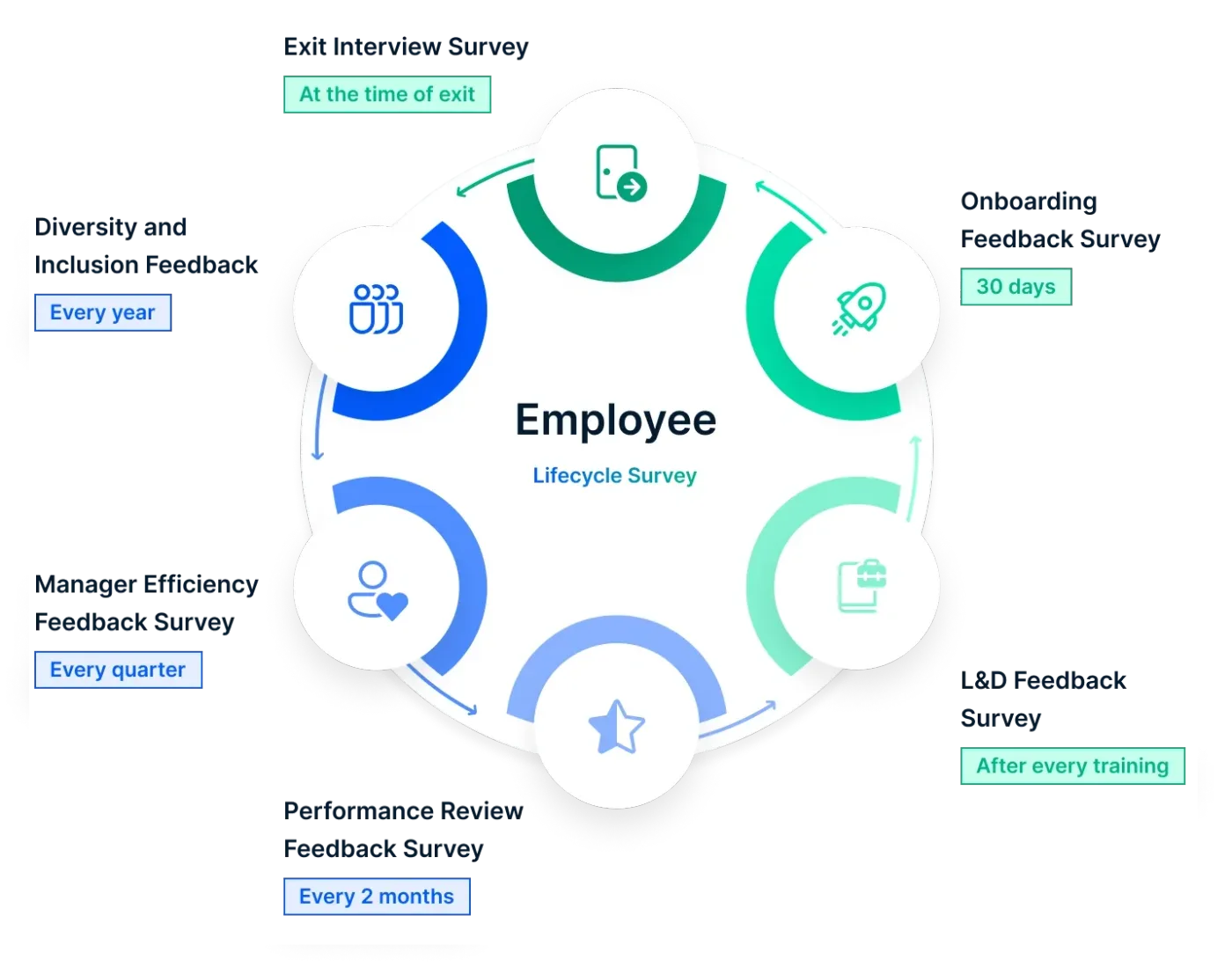
Automating these triggers, for example sending the onboarding survey on day 30 and the exit survey when a resignation is logged, is what keeps the program running without adding work for HR. This is where an employee lifecycle journey view becomes useful.
Pulse vs annual employee surveys
The pulse vs annual employee survey debate is usually framed as a choice, but most mature programs use both. The annual survey gives depth, benchmarks and a full picture of drivers. Pulse surveys show whether things are getting better or worse between those snapshots.
| Annual engagement survey | Pulse survey | |
|---|---|---|
| Purpose | Deep diagnosis of engagement and its drivers | Track a few priorities and react to change |
| Frequency | Once, sometimes twice a year | Weekly, monthly or quarterly |
| Length | 30 to 60 questions, 15 to 25 minutes | 5 to 15 questions, under 5 minutes |
| Best for | Strategy, benchmarking and multi-year trends | Checking progress on action plans and spotting dips early |
| Main risk | Results arrive too late to act on | Survey fatigue if nothing changes between pulses |
If your annual survey keeps producing the same results with little change, read why annual employee surveys fail and how a continuous listening rhythm fixes it.
The do's and don'ts of employee surveys
Most survey failures come from a handful of avoidable mistakes. The table pairs each habit to build with the mistake it prevents.
| Do | Don't |
|---|---|
| Explain why you are asking for feedback and how it will be used | Launch a survey with no stated purpose |
| Guarantee anonymity and say how it is protected | Show results for groups so small that people can be identified |
| Use clear, unbiased questions in the language employees use | Ask leading questions that nudge people toward an answer |
| Keep it short and focused on what you will act on | Overwhelm people with questions you will never use |
| State an honest completion time | Understate how long the survey takes |
| Add one or two open-ended questions for detail | Rely only on yes or no answers |
| Share results, including what is going well | Keep results within the leadership team |
| Act on the feedback and say what changed | Survey again before anything has changed, which creates survey fatigue |
Treat every survey as an interaction with your brand. A clumsy, long or ignored survey tells employees how much their voice really counts.
How to conduct an employee survey in 7 steps
Knowing how to conduct an employee survey comes down to seven steps across three stages: before, during and after. The first step, defining your goal, matters most because it decides which survey type you run, which questions you ask and who owns the follow-up.
- Define your goal: Decide what you need to learn, such as engagement drivers, reaction to a new policy or why people leave. A focused goal guides the survey type and every question.
- Build trust and protect anonymity: Tell employees who will see the data and in what form. Set a minimum group size (5 is common) before any team-level result is shown.
- Write clear questions: Use concise, neutral wording without jargon. Mix a consistent rating scale with one or two open-ended questions, and keep core questions identical between cycles so you can trend them.
- Communicate before launch: Share the purpose, timeline and how the feedback will be used. Ask managers to encourage participation without pressuring anyone.
- Choose an accessible platform and keep it short: Make the survey easy to complete on mobile and in the channels people already use, including for frontline staff without a corporate email. Send reminders that stop once someone responds.
- Analyze and share the findings: Look for trends by team, tenure and location, read the open comments for themes, and share the key results with everyone within a few weeks.
- Act and close the loop: Pick two or three priorities, assign owners and dates, and tell employees what changed because of their feedback. Then use a short pulse to check whether it worked.
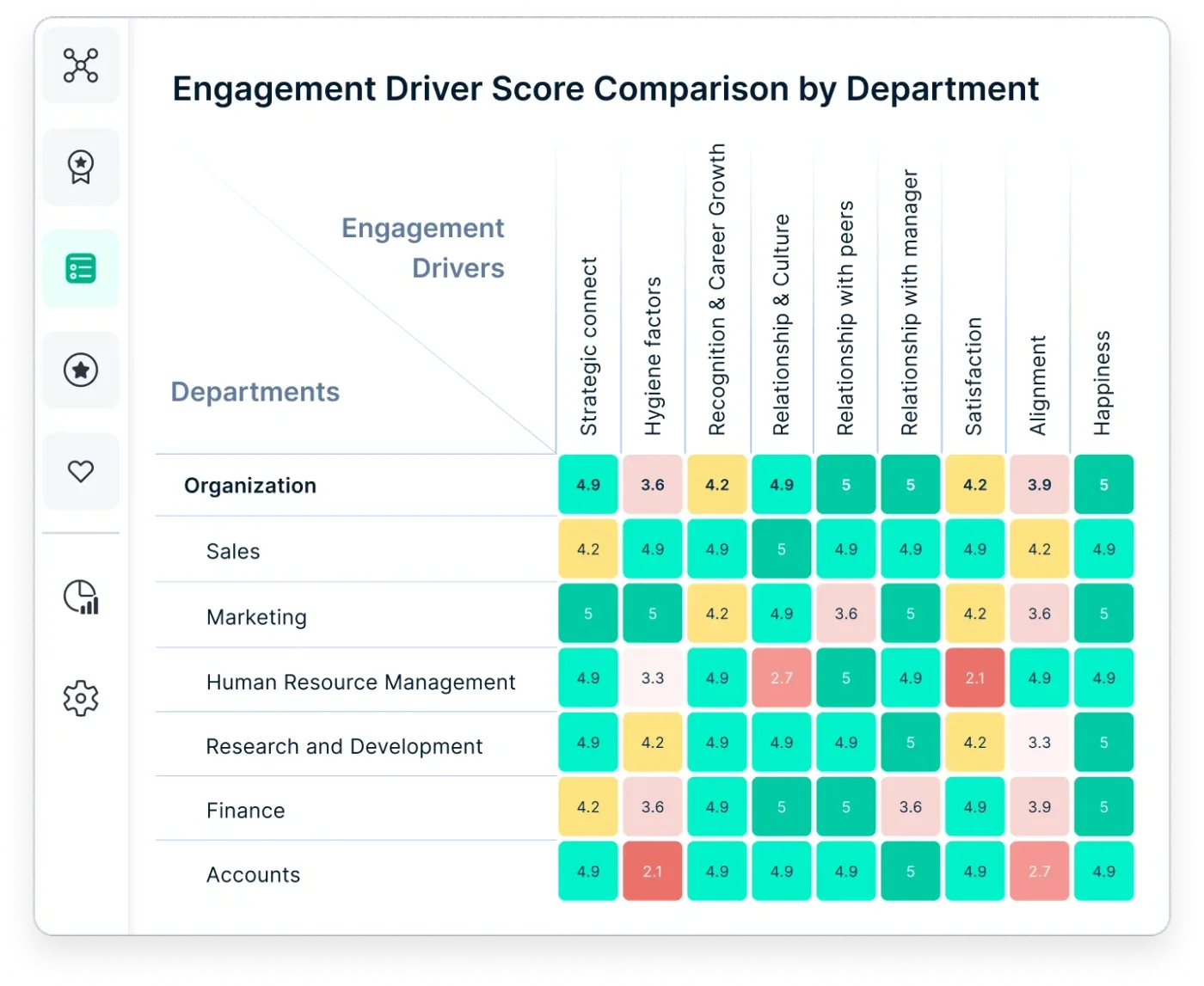
A driver heatmap like the one above makes step six faster: instead of one average score, you see which drivers are low in which teams, so each manager knows where to focus. For a full method, follow this employee engagement action plan guide.
Employee survey best practices that lift trust and participation
The steps above cover the mechanics. These employee survey best practices are the habits that make employees answer honestly year after year:
- Celebrate what is going well: Share strengths alongside problems. It boosts morale and shows the survey is not only a fault-finding exercise.
- Equip managers to act: Most engagement drivers sit with the manager, so give each one a team-level report and a simple plan template.
- Fix one thing fast: A visible quick win within a month of the survey does more for the next response rate than any reminder email.
- Use open-text analysis: Comments explain the scores. Tools that group comments into themes, such as AI sentiment analysis, save hours of reading. See how AI employee engagement surveys handle this.
- Do not over-survey: Match frequency to your ability to act. Asking monthly and changing nothing is worse than asking quarterly and acting.
30 employee survey questions about management
This question bank covers five areas of management: communication, trust and respect, effectiveness, career development and work-life balance. Ask employees to rate each statement on a 5-point scale (1 = strongly disagree, 5 = strongly agree), and start with communication and trust, because problems there tend to drag down every other score.
| # | Communication |
|---|---|
| 1 | Management has clearly communicated performance expectations. |
| 2 | My manager shares the information I need to do my job. |
| 3 | Management explains the reasons for its decisions. |
| 4 | Managers resolve differences professionally. |
| 5 | My manager explains how the organization's plans affect me. |
| 6 | I hear about changes to company practices or benefits from my manager. |
| 7 | My manager recognizes my work regularly. |
| 8 | I was recognized the last time I finished a significant project. |
| # | Trust and respect |
|---|---|
| 9 | My manager creates a trusting and open environment. |
| 10 | My manager treats all team members fairly. |
| 11 | My manager is responsive to ideas, requests and suggestions. |
| 12 | When I bring a problem to my manager, I trust them to listen. |
| 13 | My manager makes me feel like a valuable part of the team. |
| # | Effectiveness |
|---|---|
| 14 | Our leaders lead the organization effectively. |
| 15 | Managers have the skills, training and resources to succeed. |
| 16 | I have confidence in my immediate manager. |
| 17 | My manager has the knowledge to help our team succeed. |
| 18 | My manager maintains high standards of behavior. |
| 19 | My manager has tried to improve things in the past year. |
| 20 | My manager consistently makes effective decisions. |
| # | Career development |
|---|---|
| 21 | My manager and I discuss my career in this organization. |
| 22 | I am growing and developing my career here. |
| 23 | I know the steps I need to take to move up next year. |
| 24 | I believe I can reach my full potential here. |
| 25 | I have enough learning opportunities at work. |
| # | Work-life balance |
|---|---|
| 26 | My manager understands the importance of my personal and family life. |
| 27 | My manager cares about my wellbeing. |
| 28 | My workload is reasonable for my role. |
| 29 | My manager sets fair deadlines. |
| 30 | I feel supported by my manager. |
Finish with two open-ended questions: "What is one thing your manager does that helps you most?" and "What is one thing you would like your manager to do differently?" For more phrasing ideas on giving and asking for feedback, see these employee feedback examples.
How Empuls helps you run every type of employee survey
Running several survey types by hand means separate tools, spreadsheets and reminder emails. Empuls Surveys brings them into one listening program and focuses on the part most tools skip: acting on the results.
- Pulse and engagement surveys: Run recurring pulse surveys weekly, monthly or quarterly through Slack, Microsoft Teams or email, with nudges that stop once someone responds.
- Lifecycle surveys: Trigger lifecycle surveys automatically at onboarding, milestones and exit.
- AI sentiment analysis: AI sentiment analysis groups open-ended comments into themes and gives managers ready-to-read summaries.
- Action plans: Turn insights into action plans with owners and deadlines, and track them to completion.
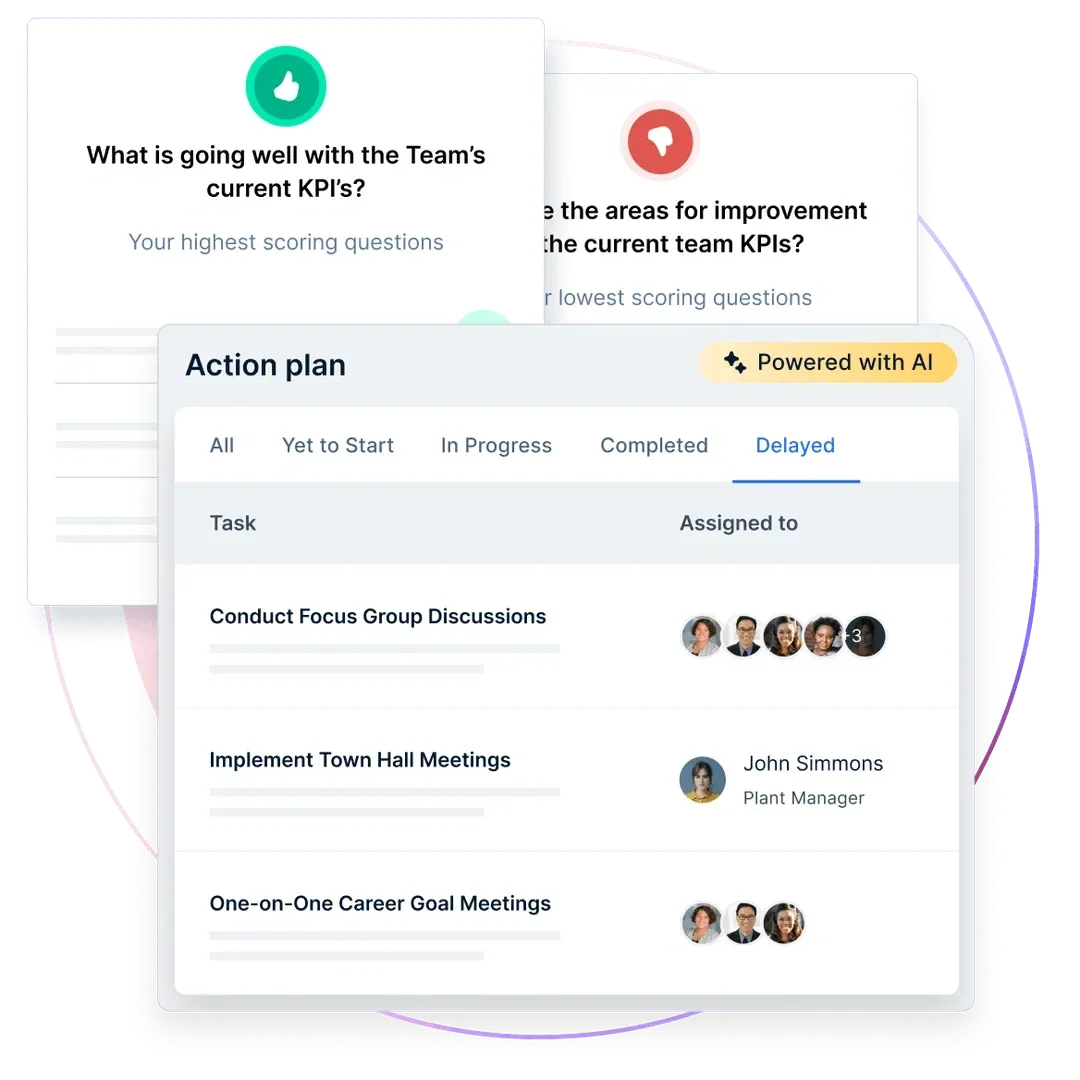
Responses stay anonymous, and team breakdowns only appear above a minimum group size, so managers see patterns, not individuals. If you are comparing platforms, start with this list of the best employee engagement survey tools.
The right employee survey is the one you act on
There is no single best employee survey. An annual engagement survey, regular pulses and a few lifecycle surveys cover what most organizations need, and the other types fill specific gaps. What separates useful programs from ignored ones is a clear goal, real anonymity and visible action after every cycle.
Pick the types that answer your most urgent questions, keep them short, and tell people what changed. To see how engagement connects to the rest of the employee journey, read the guide on measuring employee experience.
Book your Empuls demo
Frequently asked questions
The most common types of employee surveys are engagement surveys, pulse surveys, satisfaction surveys and eNPS surveys, followed by lifecycle surveys such as onboarding and exit surveys. Many organizations also run culture and inclusion, wellbeing, benefits, training and 360-degree feedback surveys when they need answers on a specific topic or moment.
Good employee survey questions are short, neutral and tied to something you can act on. Examples include "I feel valued at work," "My manager gives me useful feedback," "I see a path to grow here" and "How likely are you to recommend this company as a place to work?" Add one open question, such as what would most improve your work.
Most companies run a full engagement survey once or twice a year and shorter pulse surveys monthly or quarterly. Lifecycle surveys are triggered by events, such as day 30 for onboarding or a resignation for an exit survey. The right frequency is the one you can act on, because surveying without visible change causes survey fatigue.
Employee surveys can be truly anonymous when the platform hides individual responses and only shows results for groups above a minimum size, often 5 people. Confidential surveys are different: HR can link answers to people but promises not to share them. Tell employees which approach you use, who sees the data and in what form.
An engagement survey measures emotional commitment and motivation, meaning how much people care about their work and the company's goals. A satisfaction survey measures contentment with pay, benefits, workload and conditions. Someone can be satisfied but not engaged, so engagement surveys are better at predicting effort and retention.
A pulse survey usually has 5 to 15 questions and takes under five minutes. A full engagement survey typically has 30 to 60 questions and takes 15 to 25 minutes. Lifecycle surveys sit in between at about 8 to 15 questions. Cut any question whose answer will not lead to a decision or action.
Encourage honest feedback by protecting anonymity, explaining exactly how responses will be used and acting visibly on what you hear. Share results with everyone, including the uncomfortable ones, and report back on what changed. Over time, employees answer more honestly when they have seen earlier feedback lead to real improvements.
After an employee survey, analyze results by team and theme, share the key findings with all employees within a few weeks and pick two or three priorities. Assign each one an owner and a deadline, give managers their team results, and run a short pulse survey later to check whether the changes made a difference.





































































































































































































































































































































































































































































































































































