
Key Takeaways
Measure an employee recognition program in two layers: monthly program metrics such as participation, reach and peer share, and quarterly business outcomes such as retention and engagement.
Quality matters as much as volume: Gallup found employees whose recognition meets at least four of five pillars are nine times as likely to be engaged.
Employee recognition ROI equals total return minus investment, divided by investment, where return comes mainly from lower turnover, absenteeism and onboarding costs.
Comparing recognized and unrecognized employees, or high and low recognition teams, is the most convincing way to link recognition to outcomes.
Data only pays off when you act on it: replicate what works, close participation gaps and report results to leadership every quarter.
To measure an employee recognition program, track a small set of KPIs in two layers: program metrics you can see monthly (participation, frequency, peer share, reach and recognition quality) and business outcomes you review quarterly (engagement, retention, absenteeism and performance). Then put a value on the outcomes and compare it with what the program costs to get ROI. This guide gives you a KPI scorecard with formulas and targets, an ROI method with a worked example and a plan for acting on the data.
Measuring employee recognition programs means connecting recognition activity to the outcomes it is meant to change, so you can prove the program's value, find where it is not reaching people and improve it. Without measurement, recognition stays an act of faith that is easy to cut when budgets tighten.
How to measure employee recognition programs, and why it matters
The success of your business depends on your people, and that ties directly to the strength of your employee rewards and recognition program. Yet recognition and engagement feel intangible, so knowing how to measure employee recognition is where the real challenge begins. Leaders usually want answers to three questions:
- Is the recognition program worth the investment?
- Do the benefits of our engagement initiatives outweigh the costs?
- Can we quantify the return on the program?
Leaders are increasingly asking. In Gallup's 2024 recognition research, 42% of senior leaders strongly agreed with the value of recognition, up from 28% in 2022, yet only 22% of employees said they get the right amount of recognition. Measurement is how you close that gap with evidence instead of opinion.
Recognition program KPIs: leading and lagging indicators
Recognition program KPIs fall into two groups. Engagement metrics are short-term leading indicators tied directly to the program, while business metrics are long-term lagging indicators that recognition influences alongside other factors. Track both, because leading indicators tell you early whether the lagging ones are likely to move.
Engagement metrics (leading)
These move within weeks of launch, and the more engaged employees are with the program, the higher the return. They include:
- Program participation: Adoption and active use by employees and managers.
- Survey results: Recognition items in engagement and pulse surveys are a direct measure of program effectiveness.
- Peer-to-peer and manager recognition: The mix shows whether recognition is part of the culture or only a manager task.
- Employee satisfaction scores: Including eNPS and satisfaction with recognition.
- Reduction in HR effort: Less time spent on manual awards, gift purchasing and tracking.
Business metrics (lagging)
These are long-term, tangible metrics that can be verified and tied to business results when calculating recognition ROI:
- Attendance: Changes in absenteeism among recognized teams.
- Turnover: Lower voluntary turnover, especially among high performers.
- Productivity: Output, quality or sales per employee.
- Profitability: Results against sales and margin targets.
- Referrals and advocacy: Employee referrals and how employees speak about the company on job boards and social media.
Advocacy and intent to stay are worth tracking because the links are strong. O.C. Tanner's 2026 State of Employee Recognition report, a survey of more than 4,200 employees in 10 countries, found employees with integrated recognition programs were 13 times more likely to give a high Net Promoter Score and 26 times more likely to stay another year. These are associations, not proof of cause, which is why cohort comparisons matter.
Want recognition KPIs without the spreadsheets?
See how Empuls tracks participation, reach, peer share and equity automatically and ties them to engagement.
Talk to our ExpertTrusted by 5,000+ companies
Key recognition program metrics to track
Measuring the success of your recognition program is not about collecting every data point. It is about the six metrics that show how recognition is shaping culture, motivation and connection, starting with participation because nothing else matters if people are not using the program.
- Participation rate: How many employees regularly give and receive recognition? High participation means the program feels accessible and relevant, not something driven only by HR. Low participation signals a need for better visibility, more manager involvement or easier access.
- Frequency of recognition: Recognition should be consistent, not a once-a-quarter event. Track how often people are recognized and whether it happens in real time or only at reviews and anniversaries.
- Recognition type and source: How much comes from managers and how much from peers? Peer recognition reflects a healthy culture where employees celebrate one another. If most recognition is top-down, encourage more peer-led appreciation.
- Recognition equity: Recognition should not go only to the loudest voices or most visible roles. Track who is recognized and who is not, by team, function, level and location, to reveal unconscious bias and design more inclusive campaigns. This guide to recognition equity explains the method.
- Impact on engagement and morale: Use engagement surveys or short pulse polls with simple questions such as whether people feel valued at work and whether recognition feels meaningful.
- Retention and performance trends: Recognition is not the only factor in retention, but it plays a big role. Compare turnover with recognition activity. Are your most appreciated employees more likely to stay? Are high performers recognized regularly?
Use the scorecard below to turn those six metrics into numbers you can report. Targets are starting points to adapt to your size and maturity, not industry benchmarks.
| KPI | How to calculate it | Healthy signal | Review |
|---|---|---|---|
| Participation rate | Employees who gave or received recognition in the period / total eligible employees | Rising each month after launch; most employees active within a quarter | Monthly |
| Reach | Employees recognized at least once in the last 90 days / total employees | Every team and location represented | Monthly |
| Frequency | Total recognitions / active employees / month | Most people recognized at least monthly | Monthly |
| Peer share | Recognitions sent by non-managers / total recognitions | Peers send the majority | Quarterly |
| Manager activity | Managers who recognized someone this month / total managers | Close to all managers active | Monthly |
| Values coverage | Recognitions tagged to a company value / total recognitions | Every value appears, none dominates | Quarterly |
| Equity gap | Recognition rate of lowest-recognized group / company average | Gap narrowing each quarter | Quarterly |
| Redemption rate | Points redeemed / points issued | Steady redemption, no large unused balances | Quarterly |
| Recognition sentiment | Share agreeing they get meaningful recognition (pulse item) | Up year on year | Quarterly |
| Retention of recognized employees | Turnover of recognized vs. unrecognized employees | Recognized employees leave less | Twice a year |
Recognition quality matters as much as quantity
Counting recognitions is not enough, because a generic thank-you does far less than recognition people find meaningful. Gallup's 2024 research shows how sharply engagement rises as recognition meets more of its five pillars of strategic recognition: fulfilling, authentic, equitable, embedded in the culture and personalized.
The same study found employees whose recognition met at least four pillars were 65% less likely to be looking or watching for another job. To measure quality, add a few recognition questions to your pulse surveys and track them each quarter:
- In the last week, I received recognition or praise for good work.
- The recognition I receive feels sincere and specific.
- Recognition here is fair: the right people get recognized for the right reasons.
- I am recognized in a way I personally value.
- Recognition here reflects our company values.
Frequency still matters within quality. A Gallup study of more than 20,000 workers found 61% of employees who get feedback and recognition from their manager at least weekly are engaged, compared with 38% of those who get weekly feedback but less frequent recognition.
How to calculate employee recognition ROI
Employee recognition ROI compares the value of the outcomes recognition improves with what the program costs: ROI = (total return minus investment) / investment x 100. The formulas below break both sides into parts you can estimate from HR and finance data.
Measure the return
An effective recognition program raises productivity and reduces turnover, absenteeism and onboarding costs. Add up the savings:
- Total return = productivity gain + turnover savings + absenteeism savings + onboarding savings.
- Productivity gain = number of employees x average annual salary x % productivity increase.
- Turnover savings = (number of employees x turnover rate) x (average salary x replacement cost %) x % reduction in turnover.
- Absenteeism savings = number of employees x (average salary / working days) x days of absence avoided per employee.
- Onboarding savings = (training period x salary) x savings % x number of new hires avoided.
Measure the investment
The investment side is simpler. Include everything the program costs, not only the rewards:
- Investment = cost of rewards + platform fees + administration time.
- Cost of rewards = number of employees x planned annual reward value per employee.
- Platform fees = number of employees x fee per employee per month x 12.
A worked example of recognition program ROI
Here is how the formulas work for a hypothetical 500-person company. The assumptions are illustrative, not benchmarks or vendor pricing, and productivity gains are left out because they are the hardest to attribute.
| Line | Assumption | Value |
|---|---|---|
| Turnover savings | 500 employees, 15% turnover, $60,000 salary, replacement at 40% of salary, turnover cut by 10% | $180,000 |
| Absenteeism savings | 500 employees, $240 daily salary cost, half a day of absence avoided per person | $60,000 |
| Total return | Turnover plus absenteeism | $240,000 |
| Reward cost | $100 per employee per year | $50,000 |
| Platform fees | $4 per employee per month (hypothetical) | $24,000 |
| Total investment | Rewards plus platform | $74,000 |
| ROI | ($240,000 - $74,000) / $74,000 | 224% |
The 40% replacement cost matches Gallup's estimate for frontline workers; technical roles cost about 80% of salary to replace and leaders about 200%, so use the mix that fits your workforce. Run your own numbers in the recognition ROI calculator, and for a CFO-ready business case see this guide to employee rewarding ROI.
Intangible impacts on experience and culture
Business impact is only part of the picture. Two other areas are harder to put a number on, but together with the business impact they show the full return on your recognition program.
- Experience impact: A great recognition program creates positive moments across the employee lifecycle, from onboarding to exit. The recognition experience affects motivation, satisfaction and wellbeing, which in turn affect productivity. Track adoption, usage and satisfaction with the program to gauge it: the better the experience, the higher the return.
- Culture impact: A thriving culture is built on company values, and your program should recognize people who live those values every day. Analyze which values are recognized often and which rarely, and you get an accurate picture of how recognition is shaping your culture. A values-based recognition program makes this easy to track.
How to act on the data you collect
Collecting data is only half the job. The impact comes from using it to make your recognition program more inclusive, consistent and meaningful, and these five actions turn insights into improvement:
- Spot what is working and double down: If certain departments have high recognition rates and positive feedback, find out why. Is it strong manager involvement or peer-led shout-outs? Replicate it elsewhere and use those teams as internal benchmarks.
- Find and fix participation gaps: If recognition is not reaching certain teams or roles, such as remote teams, support functions or frontline staff, run focused campaigns there. These ideas for recognizing remote and frontline teams can help.
- Share results with leadership: Data-backed reports keep leaders invested. Show how recognition links to engagement, retention or productivity and highlight wins, such as a rise in morale after a new initiative. This turns recognition from an HR effort into a business priority.
- Use employee feedback to improve the experience: If employees say recognition feels forced or manager-only, course-correct. Try peer voting, celebration walls or value-based badges to make it feel more natural.
- Celebrate progress: Share the metrics, not just track them. Celebrate when you hit recognition goals or engagement improves, which reminds everyone why the program exists.
How Empuls makes measuring recognition simple
When you are working out how to measure employee recognition, the right tool takes the calculation burden off your team. Empuls runs your rewards and recognition program and tracks its effectiveness in the same place, so the KPIs above come from live data rather than spreadsheets.
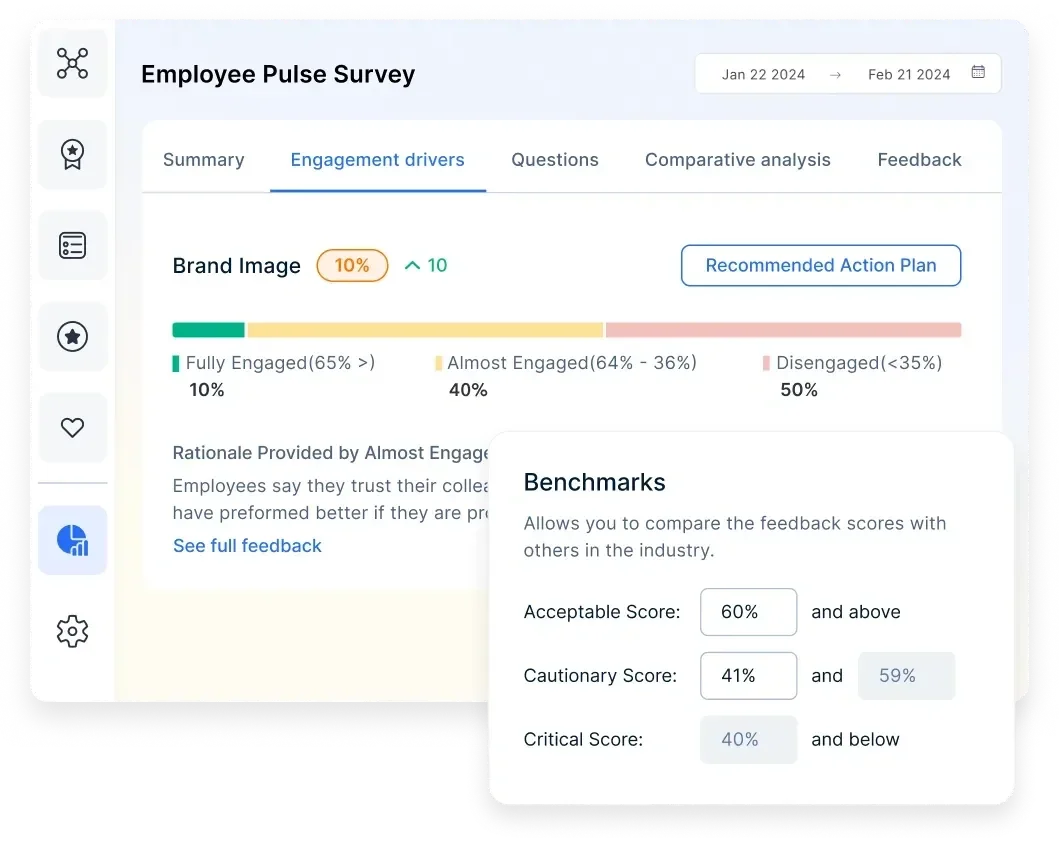
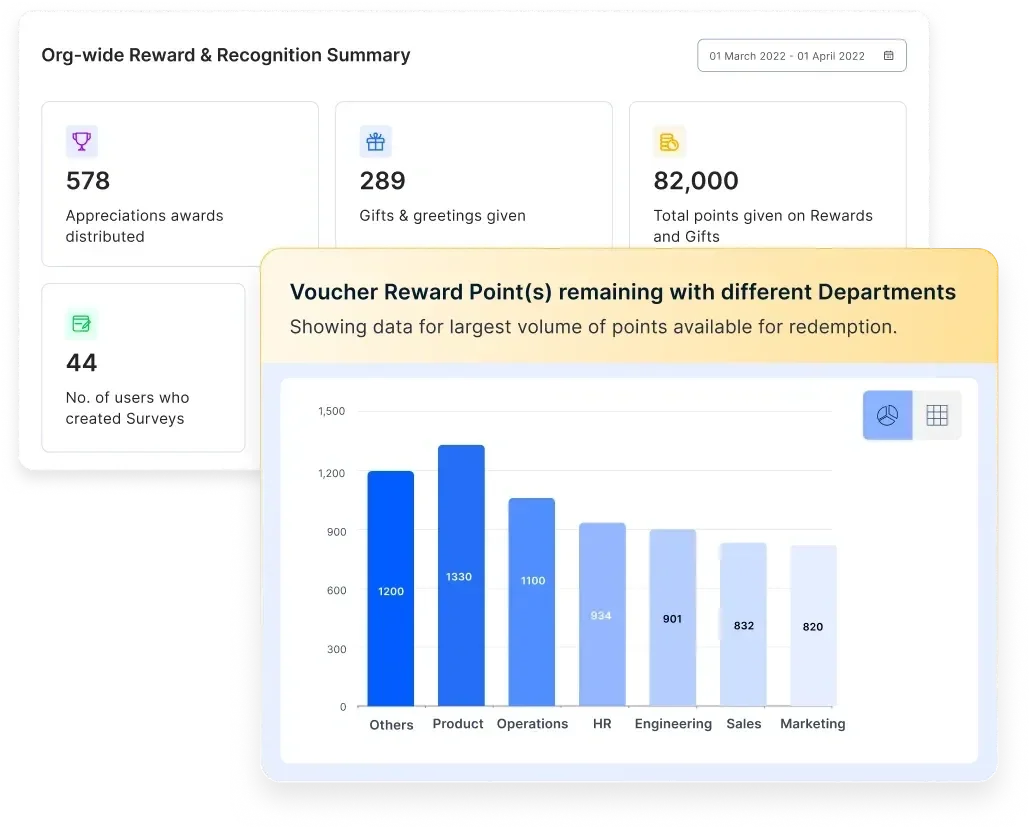
- Track key recognition metrics: See participation, frequency and the peer versus manager mix by team, department and location.
- Monitor recognition equity: Spot teams, roles and individuals who are not being recognized and act before they disengage.
- Understand impact on engagement: Built-in pulse surveys show how recognition influences sentiment, morale and belonging.
- Correlate recognition with outcomes: Reports and analytics connect recognition activity with engagement and retention, and Empuls AI answers questions about trends and budget use in plain language.
- Share easy reports: Export recognition data for HR and leadership to show how the program supports culture and performance goals.
For a quick baseline before you set targets, take the free recognition program scorecard. In one AI recognition insights case study, a global organization used these insights to grow recognition participation from 56% to 82%.
Next steps
Once your program is live and your KPIs are set, measure results against your business goals, turn the insights into an action plan and repeat the cycle every quarter. Recurring review keeps the program aligned with changing engagement goals, and tracking progress over time is how you grow the return.
A mix of quantitative and qualitative measures gives the most complete picture of your recognition program's ROI. If you are still setting up, start with planning your program and the steps to implement it, and read the employee recognition guide for the full picture.
Book your Empuls demo
Frequently asked questions
Compare program metrics and business outcomes against goals set before launch. Track participation, reach, frequency, peer share and recognition equity monthly, and survey employees on whether recognition feels meaningful. Each quarter, compare engagement, retention and absenteeism for recognized and unrecognized employees, then calculate ROI by setting the value of those outcomes against program costs.
The most important are participation rate, reach (share of employees recognized in the last 90 days), frequency, peer versus manager share, recognition equity across groups and recognition sentiment from surveys. Together they show whether recognition is used, spread fairly and valued. Retention and engagement of recognized employees then show whether it is changing outcomes.
Use ROI = (total return minus investment) / investment x 100. Return is the value of lower turnover, reduced absenteeism, faster onboarding and any productivity gain you can attribute. Investment is reward cost plus platform fees and administration time. Use conservative assumptions, and leave out gains you cannot reasonably link to recognition.
There is no universal benchmark, so set your own target and track the trend. A healthy program usually shows participation rising every month after launch and most employees active within the first quarter. Look below the company average too: a strong overall rate can hide teams, shifts or locations where almost no one is recognized.
Review program metrics such as participation, frequency and manager activity monthly, because they change quickly and reveal problems early. Review peer share, values coverage, equity and recognition sentiment quarterly. Look at retention and ROI twice a year or annually, since turnover takes longer to move and needs a large enough sample to be meaningful.
Ask whether employees received recognition or praise for good work in the last week, whether recognition feels sincere and specific, whether it is fair, whether they are recognized in a way they personally value and whether recognition reflects company values. Use the same agreement scale each quarter so you can track change over time.
Compare turnover between employees who were recognized regularly and those who were not, or between teams with high and low recognition activity, over the same period. Control for obvious differences such as role and tenure. Gallup's 2024 research found well-recognized employees were 45% less likely to have left two years later, which gives a useful reference point.
Recognition equity means recognition reaches people fairly across teams, levels, locations, work arrangements and demographic groups. Measure it by comparing each group's recognition rate with the company average and tracking the gap over time. A widening gap signals bias or access problems, such as frontline or remote employees missing out on recognition.





































































































































































































































































































































































































































































































































































