
Key Takeaways
Most of what keeps sellers motivated sits with their manager: trust, goals, coaching and recognition matter as much as the commission plan.
A monthly one-on-one that asks about goals, energy, support, recognition, rewards, wellbeing and the future reveals what motivates each rep.
If one rep is struggling, look at the person; if three or more struggle at once, look at targets, pay, tools or management.
Letting reps choose their rewards and celebrating wins as a group are low-cost ways to boost sales team performance.
Test new motivation tactics with a small pilot group against a similar control group before rolling them out to the whole team.
Here is how to motivate a sales team: earn their trust, learn what each rep wants, set goals they believe in, coach more than you inspect, and celebrate wins as a team. Most of what keeps sellers motivated sits with their manager, not in the commission plan. The 12 strategies below focus on those management, coaching and culture levers, with a one-on-one template you can use this week.
Motivating a sales team means creating the conditions in which sellers want to give their best effort every day, through how they are led, coached, recognized and rewarded. There are a million opinions on how to do it, from prizes and competitions to threats of replacement. There is no single right way, but there are approaches that consistently work better than others.
Why managers hold the key to sales team motivation
A company's ability to hit revenue targets relies on a strong, motivated sales team, and the pressure on sellers is heavier than ever. The manager is the person who can relieve or add to that pressure every day, which makes management the biggest lever on motivation.
46%
of sellers rarely get feedback on their sales conversations
Salesforce, 2026
52%
of millennial sellers have left a job over a manager
SalesFuel, 2025
42%
of voluntary leavers say their exit was preventable
Gallup, 2024
70%
of B2B sellers struggle with work-life balance
SalesFuel, 2025
Where sales motivation is won or lost
The data backs this up. Salesforce's 2026 State of Sales research found 46% of sellers rarely get feedback on their sales conversations. In SalesFuel's 2025 Voice of the Sales Rep study, 52% of millennial and 41% of boomer sellers had already left a job because of dissatisfaction with a manager. And Gallup found 42% of employees who quit said their manager or organization could have done something to prevent it.
Give reps something to chase every week
Run leaderboards, contests and recognition on your real sales data.
Talk to our ExpertTrusted by 5,000+ companies
How to motivate a sales team: 12 strategies that work
These 12 sales team motivation strategies move from the relationship between manager and rep, to goals and coaching, to rewards and team culture. Start with the first three: without trust and a real understanding of what each rep wants, the rest will not land.
1. Build trust through honesty and transparency
Trust is the foundation of motivation. Reps who lack faith in their leadership are unlikely to achieve inspired results, however good the plan. Build trust from the first week of the relationship and keep earning it: share the reasons behind decisions, admit what you do not know and follow through on what you promise.
Transparency about numbers matters just as much. Reps should know how targets were set, how territories were assigned and how their pay is calculated. When the logic is hidden, people assume the worst.
2. Adapt your management style to each rep
Every rep is different, so a single management style will motivate some and frustrate others. A seasoned closer may want autonomy and a weekly check-in, while a new SDR needs daily guidance and fast feedback. Some people want public praise; others would rather get a private note.
Ask each rep how they like to be managed, how often they want to check in and how they prefer feedback. Team members appreciate a manager willing to adapt to their needs and personality, and it costs nothing.
3. Learn what each rep wants to achieve
You need to know what drives each person before you can motivate them. Understand what each rep wants to accomplish in their career and in their personal life. That gives you a better picture of the person you manage and tells you which rewards, goals and growth paths will genuinely motivate them.
A structured monthly one-on-one is the simplest way to do this. Use these questions as a template and keep notes so you can track how answers change over time:
| Topic | Question to ask | What to listen for |
|---|---|---|
| Goals | What do you want to have achieved by the end of this year? | Income targets, promotion, new skills or a move to bigger accounts |
| Energy | What part of the job gives you the most energy right now, and what drains it? | Admin load, difficult accounts, territory frustrations |
| Support | Where would coaching help you most this month? | A specific skill, such as discovery, negotiation or forecasting |
| Recognition | How do you like your wins to be recognized? | Public shout-outs, a private note, a call from leadership |
| Rewards | If you could pick your reward for a great quarter, what would it be? | Cash, time off, travel, gear, learning |
| Wellbeing | How are you managing workload and life outside work? | Signs of burnout, family pressure, health |
| Future | What would make you want to stay here for the next two years? | Career path, flexibility, pay, the team |
4. Protect wellbeing and basic needs
Effort suffers when people neglect their basic needs. When reps become consumed by targets, eating, sleep and exercise are often the first things to go, and over time even simple tasks feel heavier. SalesFuel's 2025 study found 70% of B2B sellers struggle with work-life balance and nearly 40% experienced job stress in the past year.
Model healthy habits yourself, avoid late-night messages that imply an expectation to reply, and watch for signs of burnout such as longer hours with falling results. Flexible schedules and time off after a big push tell the team you see them as people, not just numbers.
5. Set regular, short-cycle goals
Different goals drive different people. Some respond to contests, some to their role in the team's success and some simply to money. Setting regular goals, daily, weekly and monthly, keeps reps on track and gives them frequent chances to win, which matters most when the quarterly target feels far away.
Break the big number into activities reps control, such as meetings booked, proposals sent or pipeline created. Hitting a weekly activity goal builds momentum long before the deal closes.
6. Set dynamic, realistic quotas
Quotas that are too high discourage the team, while quotas that are too low fail to push anyone. Dynamic quotas, adjusted for market trends, seasonality, territory potential and past performance, keep goals challenging but attainable. This keeps morale high and prevents burnout.
Quota setting is hard even for large companies: the Alexander Group 2026 Sales Compensation Trends Survey found 57% struggle to set accurate quotas. Explain the method behind each number so reps can see it is fair, and agree in advance when and how targets can change.
7. Find out whether the issue is individual or team-wide
A sales manager is responsible for two kinds of motivation: each individual's and the group's. When sales sag, first work out how many people seem discouraged. If it is one or two, they probably have individual issues to address in private. If more than a couple of reps are low, there is likely a team-wide cause, such as a quota change, a pay dispute, a lost key account or a policy that is not working.
8. Coach often and reward skill growth
Coaching is the most underused motivation lever in sales. Salesforce's 2026 research also found 47% of sellers do not get enough roleplay before customer calls. Listen to calls with reps, review deals together and practice tough conversations before they happen. Ask questions that help reps find the answer rather than handing it to them.
Then reward the growth, not just the numbers. Offer recognition, bonuses or a path to promotion for reps who complete advanced training, earn certifications or show leadership by mentoring others. This boosts motivation and raises the skill level of the whole team.
9. Let reps choose their rewards
Recognizing and rewarding your sales force is one of the easiest and most effective ways to motivate them. Who better to pick rewards for high performers than the salespeople themselves? A rep who helps set a stretch target, the time frame and a reasonable reward has plenty of reason to reach the goal.
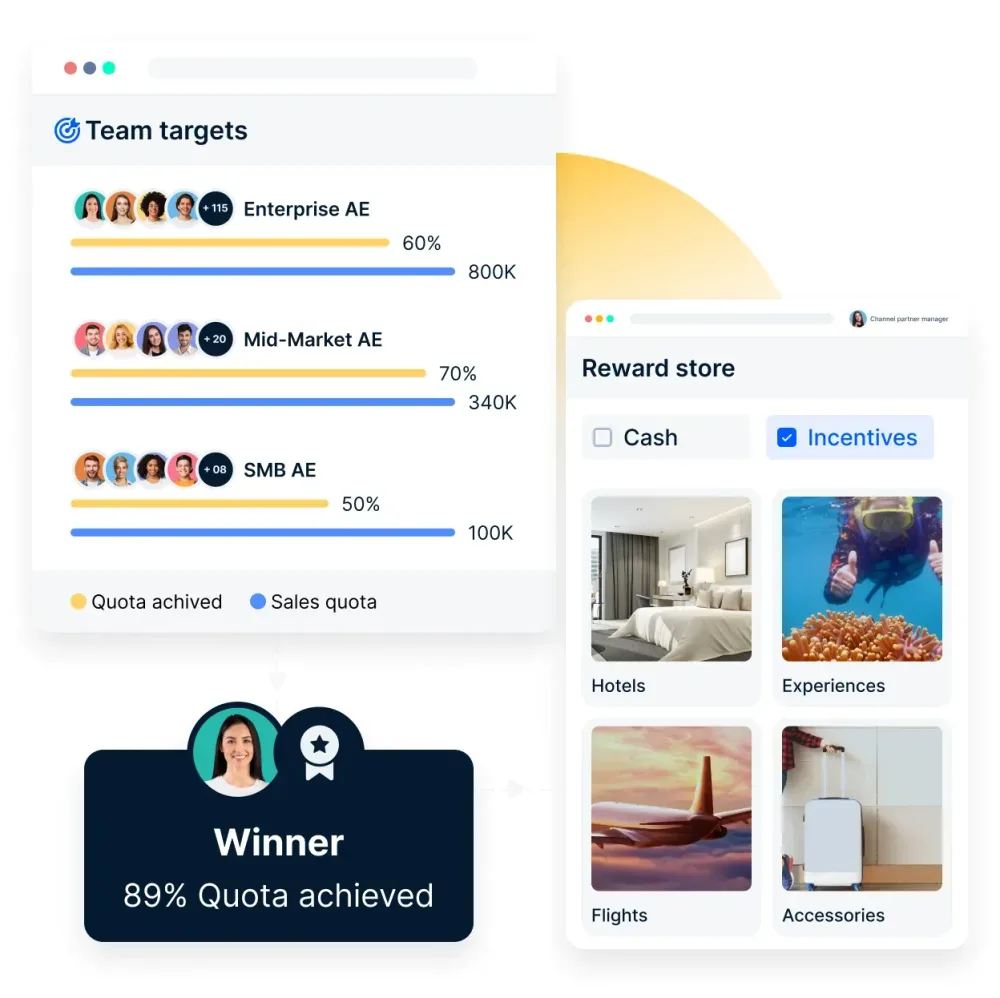
Choice matters because people value different things. A 2025 Incentive Research Foundation study of 500 reward-eligible employees and channel partners found personalization and reward choice make incentive programs more appealing. A reward catalog with travel, experiences and gear lets each rep pick what matters to them.
10. Celebrate wins as a group
Sometimes the best rewards are the ones the team enjoys together, such as a team lunch, an outing or an awards evening. Acknowledging the group's effort, not only individual stars, builds pride and a shared standard the team wants to maintain.
Recognition between rewards keeps that pride alive. Gallup's 2024 research with Workhuman found well-recognized employees were 45% less likely to have left after two years. Make it specific: name the deal, the behavior and why it mattered, and encourage reps to recognize each other for help on deals.
11. Use gamification to build competitive spirit
Gamification adds game elements such as points, badges, levels and leaderboards to everyday work, so progress becomes visible and small wins are rewarded as they happen. It builds a winning mindset by recognizing positive behaviors step by step.
Leaderboards also help managers spot where reps are stuck and coach them before the quarter is lost. Scope rankings to similar peers so the middle of the team has something to chase, and rotate the metric so the same names do not always win. For formats and rules, see this guide to sales gamification.
12. Test what works with small pilots
Not every strategy works for every team. Test a new tactic with one group while a similar group continues as before, then compare the results. This data-driven approach shows which incentives, coaching formats or contest designs actually move your team, so you invest in what works.
Here is how a simple pilot could look:
- Question: Do weekly activity goals with a small reward lift pipeline creation?
- Setup: Team A (10 reps) gets weekly goals and a recognition shout-out for hitting them; Team B (10 reps in a similar territory) carries on as usual for eight weeks.
- Measure: Pipeline created per rep, meetings booked and a short pulse survey on motivation, compared with the eight weeks before.
- Decide: If Team A's pipeline grows clearly faster than Team B's, roll the tactic out; if not, try a different lever.
Sales team motivation strategies at a glance
Use this summary to pick where to start. Strategies that cost little and show results quickly are a good first move for most teams.
| Strategy | What it fixes | Cost | Time to impact |
|---|---|---|---|
| Build trust | Doubt about leadership and decisions | Low | Months, then lasting |
| Adapt your style | Reps feeling micromanaged or ignored | Low | Weeks |
| Learn each rep's goals | Rewards and goals that miss the mark | Low | Weeks |
| Protect wellbeing | Burnout and absenteeism | Low to medium | Weeks |
| Short-cycle goals | Mid-quarter slumps | Low | Days |
| Dynamic quotas | Targets that feel unfair or unreachable | Low | Next cycle |
| Individual vs team diagnosis | Fixing the wrong problem | Low | Days |
| Coaching and skill rewards | Stalled win rates and growth | Medium | One to two quarters |
| Reward choice | Rewards nobody values | Medium | One quarter |
| Group celebrations and recognition | Low morale and isolation | Low to medium | Days |
| Gamification | A disengaged middle of the team | Low to medium | Weeks |
| Small pilots | Spending on tactics that do not work | Low | One to two months |
These strategies focus on management and culture. For the financial side, including commissions, accelerators and SPIFs, read how to incentivize a sales team and this guide to sales incentives. For the bigger picture of what drives reps, see this sales motivation guide.
How Empuls helps you motivate your sales team
Empuls gives managers the tools to put these strategies into practice on the same data that calculates incentives. Live leaderboards scoped by team, region or plan, SPIFs, sales contests, badges, streaks and gamified milestone journeys keep reps competing between payouts, on web, mobile, Slack, Teams and the sales-floor screen.
Every sales professional sees earnings, target, gap and what the next deal adds next to their rank, and goal-aware nudges arrive in the app or on WhatsApp, Slack or Teams. Contest prizes can be paid in cash or as rewards from the marketplace, so reps choose what they value, and peer-to-peer recognition lets the team celebrate wins together. Chaipoint gave 120+ sales users real-time incentive visibility and saw a 115% increase in incentive qualifiers in under six months, as covered in the Chaipoint case study.
Explore sales gamification, Empuls sales incentives and employee recognition.
Motivation starts with the manager
There are many ways to motivate a sales team, and these 12 are a strong place to start. Some, such as building trust and a culture of recognition, take time. Others, such as short-cycle goals and group celebrations, work within days.
Avoid motivating everyone the same way. Learn what drives each rep, test what works, and keep the strategies that move your team. Motivation that comes from within spreads, and it makes reps eager to work even harder next time.
Book your Empuls demo
Frequently asked questions
Combine good management with fair rewards. Build trust, learn what each rep wants, set short-cycle goals and realistic quotas, coach regularly and recognize specific wins. Add gamification and reward choice to keep energy up between payouts, and make sure the commission plan is clear and paid accurately, because pay problems undo every other effort.
Use recognition, growth, autonomy and team spirit. Publicly praise specific wins, give reps a say in how they work their territory, invest in coaching and certifications, offer stretch accounts or mentoring roles, and celebrate as a team. Extra time off after a big push and flexible schedules also motivate without touching the commission budget.
Open with a specific shout-out for a recent win or a helpful colleague, share one short customer success story, and let a rep demo a technique that worked. Launch a two-week mini contest with clear rules, review a leaderboard scoped to peers, and end with one commitment from each rep for the week ahead.
First find out whether the problem is individual or team-wide. Talk to reps one on one, look for shared causes such as quota changes, pay disputes or lost accounts, and fix those openly. Then rebuild momentum with short, reachable goals, visible recognition for progress and more coaching time, and tell the team what you changed.
The fastest levers are short-cycle goals, a focused contest or SPIF on one priority, and live visibility of where each rep stands against target. Pair them with call coaching on one skill and public recognition of the behaviors you want. These can lift activity within days, while quota and pay changes take a full cycle.
Most sales managers hold one-on-ones weekly or every two weeks, with a deeper monthly conversation about goals, growth and wellbeing. New reps and those who are struggling benefit from more frequent check-ins. Keep pipeline reviews separate where possible, so the one-on-one stays focused on the person rather than only on deals.
Most salespeople are motivated by earning potential, recognition, progress and a manager they trust. The mix varies: some value income above all, others promotion, learning or flexibility. That is why asking each rep what they want, and letting them choose rewards where possible, works better than assuming one motivator fits everyone.





































































































































































































































































































































































































































































































































































