
Key Takeaways
Employee appreciation is the practice of valuing people for who they are and what they bring, while recognition rewards specific results and behaviors.
Gallup and Workhuman found that well-recognized employees were 45% less likely to leave over two years, yet only 22% of US employees get the right amount of recognition.
The main types of employee appreciation are micro, informal, formal, and monetary or non-monetary, and a strong program uses all of them.
Appreciation works best when it is frequent, specific, fair across teams and matched to how each person prefers to be thanked.
Measure an appreciation program with retention, recognition reach, frequency, giver participation, an appreciation score and eNPS, compared against a pre-launch baseline.
Employee appreciation is the practice of showing people that they are valued for who they are and what they bring to the team, not only for the results they hit. It costs little, works best when it is frequent and specific, and is one of the most reliable levers you have for retention and engagement.
Employees are the driving force behind every milestone a company reaches. While competitive pay and good benefits attract talent, they do not guarantee loyalty. What often makes the difference is how valued employees feel once they are part of the team. A well-structured approach to appreciation can turn occasional praise into a consistent experience that builds trust and loyalty.
That is where employee appreciation programs come in. These initiatives go beyond generic thank-you notes or annual awards. They are intentional, ongoing efforts to recognize contributions, celebrate wins and show appreciation to employees in ways that matter to them.
In this guide, you will learn what employee appreciation really means, the different types of employee appreciation and why it plays a key role in retention and morale. You will also find practical ideas for appreciating employees meaningfully, a step-by-step way to build a program that fits your culture and a scorecard to measure whether it is working.
What is employee appreciation
Employee appreciation is the act of acknowledging employees and thanking them for their contributions to the workplace. Instead of focusing only on their performance, it celebrates their worth as members of the team and as human beings. A manager thanking someone for always being the calm voice in a crisis, a peer shout-out for help on a tough deadline and a handwritten note after a hard quarter are all forms of employee appreciation.
Appreciation is also celebrated once a year on Employee Appreciation Day, which falls on the first Friday of March. The next one is on Friday, March 5, 2027. The day is a useful prompt, but the practice works only when it continues all year. For ways to mark the day itself, see these employee appreciation day ideas and employee appreciation day event themes.
Employee appreciation vs recognition: the difference
While the two often go hand in hand, recognition and appreciation are not the same thing. Recognition usually highlights specific actions or results, like hitting targets or completing a big project. It is often tied to performance and can be public or formal.
Appreciation, on the other hand, is more personal. It is about valuing someone for who they are, not just what they do. A quick "thank you" for always being reliable or a note for being a positive influence on the team is appreciation in action.
| Employee appreciation | Employee recognition | |
|---|---|---|
| Focus | The person: character, effort, attitude and presence | The outcome: results, behaviors and achievements |
| Trigger | Can happen any time, even when nothing went to plan | Usually follows a specific win or milestone |
| Typical form | Thank-you notes, check-ins, flexibility, personal gestures | Awards, shout-outs, points, bonuses, certificates |
| Who gives it | Anyone, especially managers and close peers | Managers, peers and formal programs run by HR |
| What it builds | Trust, belonging and psychological safety | Clarity about what good work looks like |
A strong reward system balances both. Recognition fuels achievement, while appreciation strengthens relationships. Together, they help create a workplace where people feel truly valued. If you are designing the recognition side, start with this guide to building an employee recognition program.
The importance of employee appreciation in 2026
Employee recognition has always been a fundamental part of good management. As the competition for talent intensifies and engagement keeps falling, the way organizations show appreciation has become more important, not less.
20%
of employees worldwide
were engaged in 2025 (Gallup)
22%
of US employees
get the right amount of recognition (Gallup, 2024)
45%
less likely to leave
for well-recognized employees over two years (Gallup)
8x
more likely to trust
their organization with intentional appreciation (O.C. Tanner, 2026)
Why employee appreciation deserves a strategy, not a once-a-year gesture
The importance of employee appreciation shows up in six areas that every HR leader tracks. Retention and engagement have the strongest evidence, so they come first.
1. Retention
Appreciated employees stay longer. Gallup and Workhuman followed nearly 3,500 US employees from 2022 to 2024 and found that well-recognized employees were 45% less likely to have left after two years. The same research put the cost of replacing a manager at around 200% of salary and a frontline worker at about 40%, which makes appreciation one of the cheapest employee retention strategies you have.
2. Engagement and productivity
Engagement is under pressure. Gallup's 2026 State of the Global Workplace release reports that global employee engagement fell to 20% in 2025, and that low engagement cost the world economy about $10 trillion in lost productivity. Appreciation is a direct counterweight: in the Gallup and Workhuman study, employees whose recognition met at least four of Gallup's five pillars of strategic recognition were nine times as likely to be engaged as those whose recognition met none.
3. Recruiting
People want to work for employers that value their people. With enhanced employee satisfaction and experience, appreciated employees become employer brand ambassadors, recommend you to friends and speak well of you on review sites, which lowers the cost of every future hire.
4. Work relationships
Appreciation is the glue between colleagues. When peers thank each other for help, cross-team work gets easier and silos soften. The O.C. Tanner Institute's State of Employee Recognition 2026 found that geographically dispersed teams with connection-building recognition programs were 51 times more likely to excel at collaboration.
5. Management
Managers' ability to inspire their teams is one of the skills that most separates high-performing teams from the rest, and appreciation is a big part of it. Leaders are catching on: in Gallup's research, 42% of senior leaders strongly agreed that recognition is valuable in 2024, up from 28% in 2022. Managers need support too, since Gallup reports manager engagement dropped from 27% to 22% in 2025 alone.
6. Employee trust and morale
How a company treats its people is one of the clearest signals of whether it can be trusted. O.C. Tanner found that intentional appreciation and awards make employees eight times more likely to trust their organization, while employees who feel their leaders do not know how they like to be recognized see their odds of thriving at work drop by 89%.
Types of employee appreciation
Employee appreciation can take many forms, from instant gestures to planned programs, and it can be broadly divided into four types. Micro, informal and formal appreciation differ by how often and how structured they are, while the fourth type, monetary and non-monetary appreciation, describes what the gesture is worth.
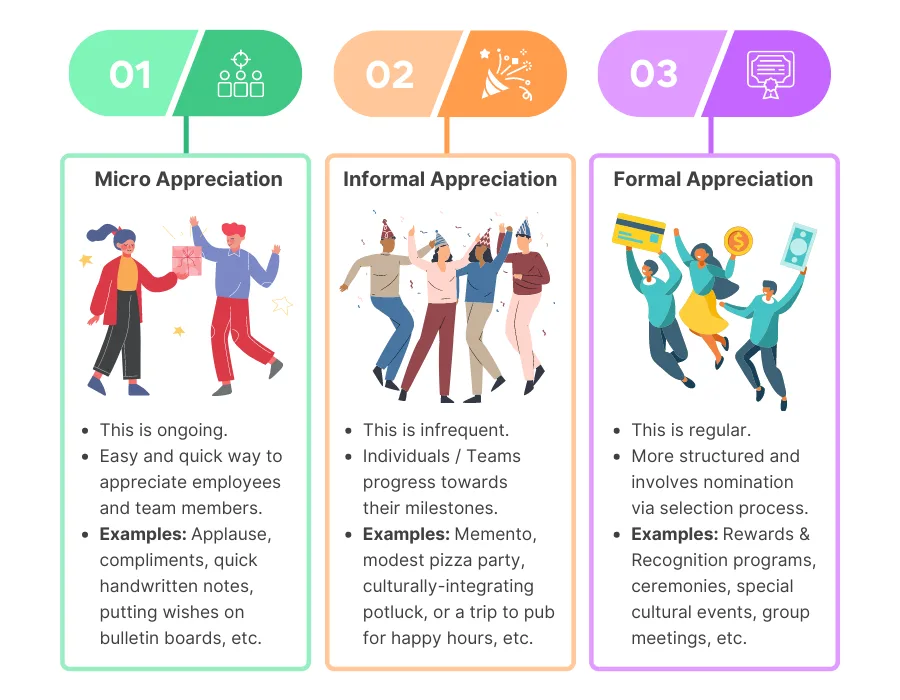
1. Micro appreciation
Micro appreciation, also known as day-to-day appreciation, is frequent and ongoing. It generally takes a simple form: a handwritten note, a card, a wish on the team channel or anything that helps you appreciate employees quickly and easily. A simple thank-you note can make a staff member feel valued on a daily basis.
Though less showy, micro appreciation is best suited to reinforcing your organizational values often and making employees feel valued without large amounts of time or money.
2. Informal appreciation
Informal appreciation refers to spontaneous, personal expressions of gratitude from colleagues and supervisors. This can include verbal thank-yous, a modest team lunch or a small gift when someone reaches a milestone.
Informal appreciation is immediate and can be given at any time to acknowledge everyday efforts and accomplishments. Both formal and informal appreciation are essential to a balanced strategy that makes employees feel appreciated and valued.
3. Formal appreciation
Formal appreciation refers to structured programs and rewards, typically run by management or HR. These programs may include employee of the month, quarter or year awards, bonuses, long service awards and promotions.
Formal appreciation is often part of a larger employee appreciation program and is designed to recognize significant achievements and contributions in a systematic way. If you need names for your categories, browse these employee award titles.
4. Monetary and non-monetary appreciation
Monetary appreciation refers to rewards with a financial value, such as bonuses, raises, reward points and gift cards. These rewards are tangible and provide immediate gratification, which is why they are often used for exceptional performance, significant achievements or milestones.
Non-monetary appreciation refers to rewards without a direct financial value, such as public recognition, additional time off and opportunities for career growth. It can be equally powerful because it speaks to intrinsic motivations: the desire for recognition, personal growth and a sense of belonging. For more on this side, read about the future of non-monetary rewards.
Make employee appreciation an everyday habit
Give managers and peers one place to thank, recognize and reward each other, with data that shows who is being missed.
Talk to our ExpertTrusted by 5,000+ companies
Employee appreciation strategies and ideas
Appreciation is a culture and therefore a year-long activity, so it should not cost an arm and a leg. At the same time, it should still have the power to surprise and delight. The seven strategies below move from free, everyday gestures to bigger investments, and the first two deliver the most value for the least effort.
1. Small, simple yet powerful gestures
Low-cost, high-impact gestures are perfectly capable of making people feel appreciated. For a longer list of ideas you can use this week, see these employee appreciation ideas.
- Say thanks more often: Research consistently shows that appreciation makes people feel happy and worthy, so your whole strategy should rest on finding more ways to say thank you. Give sincere, specific compliments when the moment arrives. More than a policy, it should be a habit.
- Establish a company thanks feed: Whatever your way of announcing things internally, whether it is a recognition tool, a team channel or a regular email, make a public thanks feed part of your cadence. It soon becomes the bedrock of your appreciation culture.
- Hand out simple certificates: When an employee truly goes beyond the call of duty, a certificate marks the moment. Used in moderation, certificates boost pride and satisfaction, and by staying on desks or walls they become a visible, lasting part of your appreciation drive. Think of a wall of fame.
2. Tactical time-outs
One of the biggest challenges at work is a poor work-life balance, mostly due to not having enough time. Giving employees time to relax can make a big difference to their happiness and wellbeing.
- Extended breaks: Extra screen breaks or movement breaks during the day help people reset. Switching to something different from official tasks breaks the monotony and brings people back sharper.
- Power naps: When employees grind day in and day out, focus eventually collapses. A short rest of 10 to 20 minutes in a quiet room gives a quick and effective jolt of alertness.
- Recharge days: An unexpected day off after a big launch or a heavy season says thank you in the currency many people value most: time.
3. Team appreciation
Every leader is only as good as their team. Patting the whole team on the back is as important as putting one person in the spotlight.
- Team lunches and outings: These achieve two things. They let employees step away from the usual routine, and they build teamwork by breaking the ice and encouraging friendships among colleagues.
- Create an annual yearbook: It may seem old-fashioned, but a yearbook highlights each person's hard work, achievements and ideas so they are remembered. Pick the best photo of each employee, write a unique line about them and pair it with their achievements for a durable, branded keepsake.
- Feature teams on your About Us page: Giving teams a space on your website enhances feelings of appreciation and doubles as employer branding. It is a low-cost initiative worth trying, especially around Employee Appreciation Day.
- Have a team trophy: A trophy with the team's name engraved on it is a simple, lasting reward. Let the winning team display it until the next round, and pair it with digital value badges for instant recognition between ceremonies.
4. Get personal
Personalization is not about printing an employee's name on a gift. It means the gesture resonates with the person. Find out which musician they like and give them tickets to a show. Find out their hobbies and give them vouchers for those classes. If appreciation gifts are not meaningful, they are mere accessories. This guide to personalized employee rewards covers how to do it at scale.
- Ask how people like to be appreciated: Some people love a public shout-out, others would rather get a private note. Add one preference question to onboarding and check-ins so you stop guessing.
- Ask for feedback: You will not find an easier way to make employees feel valued than asking for their opinions and acting on them. A short pulse survey tells people their voice matters and tells you what they want.
5. Get professional
Investing in someone's career is one of the clearest ways to show you believe in their capacity. Growth opportunities say "we see a future for you here" more convincingly than any speech.
- Provide training and learning opportunities: Training people in the skills they are passionate about is a win-win. They feel taken seriously, and their upskilling improves the quality of their work.
- Let employees pitch ideas to leadership: Time with senior leaders is rare for most employees. Take a leaf out of the TV show Dragons' Den and let people pitch their ideas to the leadership team.
- Offer role shadowing: A day shadowing a role someone is curious about deepens their understanding and helps them plan their next move. Since it is demanding on the person being shadowed, limit it to about one day per quarter.
- Write a LinkedIn recommendation: It may sound counterproductive, but a strong recommendation helps you retain people. It shows that you trust their skills and are genuinely interested in their growth.
6. Go public
To keep talented employees, create an environment where they feel valued and find meaning in their work. Making appreciation public, and saying why someone is being appreciated, amplifies its effect and shows everyone what good looks like.
- Social media shout-outs: A shout-out on your company's social channels is simple, cost-effective and memorable, and the congratulatory comments it attracts add to the feel-good effect.
- Mentions in newsletters: A round-up in your internal or customer newsletter makes appreciation public in a way people can share with their families.
- Publish it on the company website: A feature on your website makes appreciation official, since the website is the first point of contact most people have with your company.
7. Go big
Since appreciation helps build your brand and attract talent, it is worth thinking big now and then. These initiatives cost more than usual, but they are memorable in a way goods rarely are.
- Once-in-a-lifetime experiences: Goods are easily forgotten, while experiences create stories people retell. Think vouchers for a hot air balloon ride, a weekend getaway, a race day, or time at a spa or yoga retreat. Here is more on why experiential rewards land so well.
- Annual holiday or retreat: Treat your workforce, or a long-serving group, to time away in nature. It is a strong way to thank people who have stayed with you through a significant stretch.
How to implement an employee appreciation program
Creating an employee appreciation program that resonates requires thoughtful planning and execution. Follow these five steps in order, because clear objectives and visible leadership support decide whether the rest of the program gets used.
- Set clear objectives: Before launching, define what you want to achieve. Are you aiming to boost morale, reduce turnover or raise productivity? Clear objectives guide the design and tell you what to measure. For example, if your goal is retention, your program might focus on milestone and long-term rewards.
- Involve leadership: An appreciation program needs strong support from leaders who do not just endorse it but take part. When employees see appreciation valued at every level, they are more likely to join in, and leaders set the tone for the behaviors you want.
- Create a recognition culture: Make appreciation part of the daily routine rather than an occasional event. Build it into team meetings, one-on-ones, performance reviews and casual conversations, and invite every employee, not just managers, to take part. Here is a full guide to creating a culture of recognition.
- Communicate the program: When you launch, make sure everyone understands how the program works, which behaviors and achievements will be recognized and how they can take part. Regular reminders keep it top of mind. This guide to communicating the launch of an employee recognition program includes templates.
- Gather feedback and adjust: No program is perfect from the start. Collect feedback through surveys, focus groups or informal check-ins, and adjust so the program keeps meeting the needs of your people and the goals of your organization.
Fairness matters as much as frequency. Check that appreciation reaches remote, frontline and quieter employees, not only the most visible people. These guides on preventing bias in recognition programs and recognition equity show how.
How to measure the impact of employee appreciation
Launching an employee appreciation program is just the beginning. To know whether it works, and to keep improving it, measure its impact on a regular schedule and compare against a baseline taken before launch.
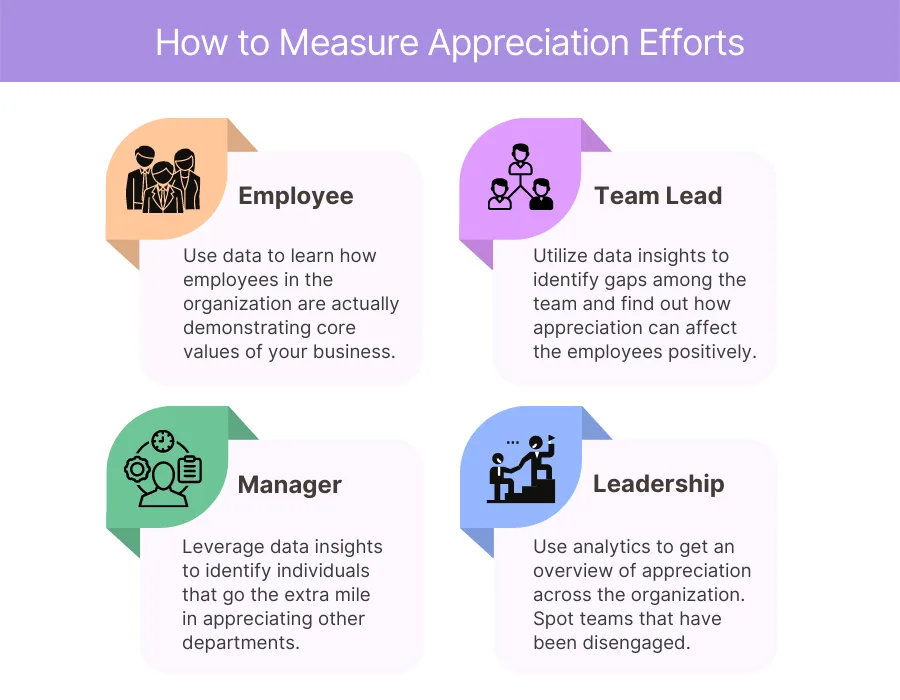
Use this employee appreciation scorecard as your starting point. Each metric has a formula and a worked example, so you can fill it in from your HRIS, survey and recognition data in under an hour.
| Metric | Formula | Worked example | What to look for |
|---|---|---|---|
| Retention rate | (Employees at end of period minus new hires in the period) ÷ employees at start × 100 | (210 − 30) ÷ 200 × 100 = 90% | Rising year on year, especially in teams with high recognition reach |
| Recognition reach | Employees recognized at least once ÷ total employees × 100 | 140 ÷ 200 × 100 = 70% | No team or location far below the company average |
| Recognition frequency | Recognitions given in the month ÷ total employees | 300 ÷ 200 = 1.5 per person per month | Steady or rising, not a spike around one event |
| Giver participation | Employees who gave recognition ÷ total employees × 100 | 90 ÷ 200 × 100 = 45% | Peers giving, not only managers |
| Appreciation score | Average score on "I feel appreciated for the work I do" (1 to 5) | Sum of 180 responses 702 ÷ 180 = 3.9 | Moving up after launch and after manager training |
| Employee Net Promoter Score | % promoters (9 to 10) minus % detractors (0 to 6) | 40% − 25% = +15 | Improving alongside the appreciation score |
Here is how to use each source of evidence:
- Employee feedback: Run short surveys with specific questions, such as "On a scale of 1 to 10, how appreciated do you feel at work?", "Which part of the appreciation program do you find most meaningful?" and "What would you change about how we recognize people?". Add an employee Net Promoter Score question to track overall advocacy.
- Retention and engagement metrics: Compare retention and engagement scores before and after the program. This guide on how to measure employee engagement explains the survey side.
- Participation rates: Low participation usually means the program needs better communication or more appealing rewards. High participation suggests people value it.
- Behavioral changes: Ask managers whether employees take on new projects more willingly, whether teamwork has improved and whether the culture feels more positive. 360-degree feedback gives peers a structured way to report these shifts.
- Business outcomes: Track output per employee, project completion rates and customer satisfaction, since appreciated employees tend to deliver better customer experiences.
Examples of successful employee appreciation programs
These four organizations show what employee appreciation looks like when it is built into the culture rather than added on. Two are well-known brands with long-running traditions, and two are Empuls customers that moved from manual programs to everyday appreciation.
1. Patagonia
Patagonia, the outdoor clothing and gear company, has long been known for its commitment to the planet and to its employees. Its appreciation efforts are deeply ingrained in its culture and reflect its broader mission of caring for people and the planet.
Its best-known policy is "Let My People Go Surfing", which lets employees adjust their working hours to surf or spend time outdoors when conditions are right, as long as the work gets done. The policy reflects the belief that a strong connection to nature fuels creativity and wellbeing, and it shows employees that the company trusts them and respects their passions.
Patagonia also offers on-site child care at its headquarters, which eases stress for working parents, along with flexible hours and paid time off for employees to volunteer with environmental organizations. Together these make employees feel deeply connected to the company's mission, a clear example of how aligning company values with employee wellbeing creates a thriving workplace.
2. Southwest Airlines
Southwest Airlines is another company that has embedded appreciation into its culture. Known for its customer service and strong employee relationships, it has built a reputation as a company that truly values its people.
Its Winning Spirit award recognizes employees who go above and beyond, and its Heroes of the Heart award, presented each year around Valentine's Day, honors a behind-the-scenes team whose work keeps the airline running. Winners are celebrated in front of company leaders and across the organization, which reinforces the teamwork and service at the center of Southwest's culture.
Southwest also emphasizes fun and connection through regular company-wide events. Combined with its formal recognition programs, these create an environment where employees feel valued and motivated to contribute their best.
3. Quixy
Quixy, a software company, did not have a structured rewards and recognition process, and engagement and morale suffered. It adopted Empuls as one platform for recognizing high performers, sharing organizational updates and gathering feedback, then extended it into Microsoft Teams so employees could recognize peers, celebrate milestones, join watercooler chats and redeem points without leaving their workflow.
Putting appreciation where work already happens lifted participation and reduced the HR team's workload, since every recognition activity now runs on one platform.
4. A global digital healthcare enterprise
A digital healthcare company with 1,200 to 1,500 employees ran a manual rewards program that relied on meetings, email follow-ups and long delays. It moved to Empuls, connected it with Slack and Zoho People, and automated jury workflows for its awards.
Within a year, it reached 97% active adoption, active engagement doubled from 38% to 76% and awards and gift points distributed rose fivefold. More than 1,000 appreciations were tied to core values, a sign that appreciation had become a cultural habit rather than a transaction.
How Empuls helps you make employee appreciation a daily habit
Empuls, Xoxoday's employee engagement platform, gives managers and peers simple ways to appreciate each other every day and gives HR the controls and data to run formal programs on top. Recognition flows in every direction, with public celebration on a Wall of Fame and points employees redeem from a global rewards catalog.
- Everyday and formal appreciation in one place: Instant spot awards for everyday wins, plus nominations with jury workflows for formal awards.
- Milestones that never slip: Automated celebrations for birthdays, work anniversaries and life events.
- AI that helps people appreciate well: An AI recognition coach suggests who to appreciate next, and AI-assisted messages turn a few words into a specific thank-you.
- Proof that it works: Reports and analytics track adoption, participation and reach by team, so you can fill in the scorecard above without spreadsheets.
Empuls also works inside Slack and Microsoft Teams, so appreciation happens where your people already talk.
Appreciation is not an event, it is a culture
Employee Appreciation Day is worth celebrating, but employee appreciation should not be bound to a single day. It should grow into a habit and then into a lasting part of your company culture.
Start by designing an appreciation program around your business goals and your people's preferences. Mix everyday thanks with formal awards, make sure it reaches everyone fairly and measure it with the scorecard above. To decide what to appreciate, this list of employee behaviors to recognize is a good place to begin.
Book your Empuls demo
Frequently asked questions
A good appreciation message is specific, sincere and timely. For example: "Thank you for staying calm and organized during the client escalation last week. Your clear updates kept the whole team focused, and the client noticed. We are lucky to have you." Name what the person did, explain the impact it had and say thank you in your own words.
Show appreciation to employees by thanking them often and specifically, recognizing their work in public when they are comfortable with it, and backing words with actions such as flexibility, growth opportunities and meaningful rewards. Ask each person how they prefer to be appreciated, celebrate milestones on time and make sure appreciation reaches remote and frontline staff as well as office teams.
Employee Appreciation Day falls on the first Friday of March every year. In 2027 it is on Friday, March 5. Many companies stretch it into a full week of activities. The day is a useful reminder, but appreciation has the most impact when it continues all year rather than appearing once in March.
Employee appreciation is a shared responsibility. Managers and team leads have the biggest influence because they see daily work, and HR designs formal programs, budgets and awards. Peers matter too: appreciation between colleagues builds trust across teams and catches contributions managers miss. Senior leaders set the tone by appreciating people visibly themselves.
Aim for appreciation that feels regular rather than rare, with most employees thanked or recognized at least every few weeks. Frequent, small gestures matter more than an annual award, because they connect the thanks to recent work. Track recognition frequency and reach in your data so no team goes months without hearing that their work is valued.
Good employee appreciation gifts reflect the person's interests and the size of the contribution. Options include experiences such as concert tickets or a spa day, personalized items, extra time off, learning budgets, wellness packages and reward points employees can redeem for what they choose. Giving people choice usually beats a one-size-fits-all gift.
It depends on the person and the moment. Public appreciation in team meetings or on a recognition feed amplifies the message and shows others what good looks like, while private thanks in a one-on-one or a handwritten note can feel more personal. Ask employees which they prefer, and use both so quieter people are not overlooked.
Employee appreciation improves retention because people who feel valued are less likely to look elsewhere. Gallup and Workhuman research found that well-recognized employees were 45% less likely to have left their company after two years. Appreciation also builds trust in managers and a sense of belonging, both of which keep people committed during difficult periods.





































































































































































































































































































































































































































































































































































