
Key Takeaways
The best gamification examples, from Duolingo to Starbucks, make progress visible and reward it quickly with streaks, tiers, challenges and badges.
Duolingo passed 50 million daily active users in 2025, showing how small daily goals and streaks can sustain a habit at scale.
Gamification incentive programs tie game mechanics to real rewards, so employees see progress and earnings while the work is still happening.
Workplace programs work best with live dashboards, scoped leaderboards, small milestones, timely nudges and rewards people choose for themselves.
Start with one business goal, borrow one proven mechanic, pilot it with a single team and refresh the game before the novelty fades.
The best gamification examples, from Duolingo streaks and Starbucks Rewards to help desk quests and frontline attendance points, share one design idea: they make progress visible and reward it quickly. Brands use game mechanics to bring customers back, and employers use the same mechanics, tied to real incentives, to lift performance at work.
This guide walks through 15 gamification examples from popular companies, split into customer-facing and workplace programs, then shows how gamification incentive programs work and gives you a playbook that turns each example into a program you can run with your own teams.
What gamification is and why companies use it
Gamification is the use of game elements, such as points, badges, levels, streaks, challenges and leaderboards, in non-game settings to motivate people to take specific actions. In business, those actions range from buying again or practicing a language every day to resolving tickets, completing training or hitting a sales target.
Gamification in the workplace matters because engagement is low. Gallup's State of the Global Workplace report found that only 20% of employees worldwide were engaged in 2025, and estimates that low engagement costs the global economy about $10 trillion in lost productivity. Game mechanics will not fix poor management, but they are a low-cost way to make goals, progress and recognition visible every day.
Gamification works because it taps into how people already think and react. Three behavioral triggers do most of the work.
- Achievement bias: People thrive on a sense of progress. Scorecards, progress bars and milestones show improvement at a glance.
- Loss aversion: The fear of missing out is a strong motivator. Streaks, limited-time challenges and expiring bonuses create urgency.
- Instant gratification: Unlike monthly reports or annual reviews, game mechanics respond immediately, which reinforces the behavior while it is fresh.
Good designs also balance two kinds of motivation. Intrinsic motivation comes from the activity itself: mastery, curiosity or the thrill of a challenge. Extrinsic motivation comes from external rewards such as points, prizes and recognition. A program that relies only on prizes fades when the prizes stop; one that also builds mastery and belonging keeps people playing. Our guide to intrinsic vs extrinsic motivation explains that balance in more depth.
15 gamification examples at a glance
The table summarizes all 15 company gamification examples in this guide, who each one targets and the core mechanic it relies on. Ten are customer-facing and five are workplace programs, and the workplace ones are the most directly reusable for HR and sales leaders.
| # | Company | Audience | Core mechanics | What it drives |
|---|---|---|---|---|
| 1 | Duolingo | Customers | Streaks, XP, leagues, badges | Daily habit and retention |
| 2 | Starbucks | Customers | Stars, membership levels, bonus challenges | Visit frequency and spend |
| 3 | Nike | Customers | Challenges, milestones, achievements | Exercise habit and brand loyalty |
| 4 | Microsoft | Customers | Points, daily sets, streaks, achievements | Product usage |
| 5 | Headspace | Customers | Run streaks, progress stats | Daily practice |
| 6 | T-Mobile | Customers | Weekly surprise rewards | Anticipation and loyalty |
| 7 | Sephora | Customers | Spend-based tiers, rewards bazaar | Repeat purchases |
| 8 | Accor | Customers | Status tiers, points | Repeat stays |
| 9 | L'Oréal | Customers | Virtual try-on play | Product discovery |
| 10 | Molton Brown | Customers | Quiz-style finders | Confident purchase decisions |
| 11 | Freshdesk | Support agents | Points, quests, trophies | Ticket speed and quality |
| 12 | KFC | Kitchen trainees | VR escape room | Training mastery |
| 13 | IT consultancy | Employees | Social sharing points, rewards | Employee advocacy |
| 14 | Chaipoint | Sales teams | Real-time targets, milestone rewards | Incentive qualifiers |
| 15 | SPI Cinemas | Frontline staff | Attendance points, rewards | Lower absenteeism |
Customer-facing gamification examples from popular brands
The first ten gamification examples in business target customers, and Duolingo comes first because it is the clearest proof that streaks and leagues can sustain a daily habit at scale. Each example ends with the lesson you can borrow for a workplace program.
1. Duolingo: streaks, XP and leagues
Duolingo, the language learning platform, is the most cited example of gamification done well. Learners earn XP for completing lessons, build streaks for consecutive days of practice, compete in weekly leagues with other learners and collect badges for milestones such as finishing a unit. Interactive stories add narrative so practice feels less like drilling.
The results show what consistent, well-designed mechanics can do. In its third quarter 2025 results, Duolingo reported more than 50 million daily active users, up 36% year over year. The lesson: Small daily goals plus a streak build habits faster than big, distant targets.
2. Starbucks: stars, membership levels and bonus challenges
Starbucks Rewards gives members stars for purchases that unlock free drinks, food and merchandise, with bonus star challenges that encourage extra visits or new products. In 2026 the company relaunched the program with three membership levels, Green, Gold and Reserve, adding a visible status ladder.
The program is central to the business. Starbucks' investor dashboard for the second quarter of fiscal 2026 reports 35.6 million 90-day active U.S. Rewards members, whose spending made up 59% of tender in U.S. company-operated stores. The lesson: Tiered status gives people a reason to keep going after the first reward. For more loyalty program designs, see our guide to gamification in loyalty programs.
3. Nike: challenges and milestones in Nike Run Club
Nike has used gamification for more than a decade. The Nike Run Club app offers guided runs, monthly distance challenges, personal records and achievements for milestones, and lets runners share results with friends. Nike Training Club applies similar challenges and progress tracking to workouts. Earlier, Nike tracked activity across its products with a single points currency, an idea later folded into its apps.
The lesson: Challenges with a clear finish line and a shareable result turn a solo activity into a social one, which is exactly what team step challenges do at work.
4. Microsoft: Microsoft Rewards and Xbox achievements
Microsoft Rewards gives users points for searching with Bing, browsing with Microsoft Edge, completing daily sets of quizzes and playing on Xbox, with streak bonuses for coming back. Points can be redeemed for gift cards, games and donations. Xbox achievements, badges earned for completing specific challenges in games, add to a public gamerscore that players show off to friends.
The lesson: Points that convert into rewards people choose for themselves, from gift cards to charity, are more motivating than a single fixed prize.
5. Headspace: streaks for a healthy habit
Headspace, the meditation and mindfulness app, tracks a run streak of consecutive days of practice and shows progress statistics such as total sessions and minutes. Short, playful mindfulness exercises lower the barrier to starting each day.
Headspace also reminds users that a broken streak does not erase the benefits of practice, an important design choice. The lesson: Streaks motivate, but punishing a single missed day can push people to fake activity or quit, so build in forgiveness.
6. T-Mobile: weekly surprise rewards
T-Mobile Tuesdays, now delivered through the T-Life app, gives customers free perks, discounts and occasional prize draws every week. The reward is small but regular, and the variety creates anticipation, a classic game mechanic known as variable rewards.
The lesson: A predictable rhythm with unpredictable rewards keeps people checking in. Weekly spot awards and surprise recognition use the same principle with employees.
7. Sephora: tiers in Beauty Insider
Sephora's Beauty Insider program gives members points on purchases and moves them through Insider, VIB and Rouge tiers based on annual spend, with richer perks at each level. Members spend points in a rewards bazaar of samples and experiences. Sephora has also used swipe-style quizzes to simplify product discovery and make recommendations feel more like play.
The lesson: Visible tiers and a choice of rewards give people a goal beyond the next transaction.
8. Accor: status tiers in ALL Accor
Accor, the multinational hospitality group, runs ALL Accor, a loyalty program in which members earn points on stays and dining and climb from Classic through Silver, Gold, Platinum and Diamond status, with perks such as upgrades and late checkout at higher levels. Bonus point promotions add short-term challenges on top.
The lesson: Long-term status combined with short-term bonus challenges keeps both loyal and occasional members engaged.
9. L'Oréal: virtual try-on as play
L'Oréal, the global beauty company, was an early adopter of augmented reality try-on, letting customers apply makeup looks and hair colors to their own faces on screen. Through its ModiFace technology, virtual try-on now appears across L'Oréal brands and retail partners. Trying on dozens of looks in seconds turns shopping into experimentation.
The lesson: Letting people explore without risk increases engagement before a decision, which is the same logic behind simulations and sandboxes in training.
10. Molton Brown: quiz-style finders
Molton Brown, the luxury fragrance and body care brand, uses online finders that ask a short series of questions about preferences and then recommend fragrances or gifts. The quiz format makes a hard decision, choosing a scent online, feel quick and personal. Sephora's swipe quiz, mentioned above, follows the same model.
The lesson: Quizzes are a light, low-pressure game mechanic. At work, they make onboarding and compliance checks far more engaging than a slide deck.
For more consumer campaigns, including spin-the-wheel, scratch cards and instant-win promotions, see our guide to gamified consumer promotions.
Turn these gamification examples into a program your team will play
Launch contests, milestones and leaderboards tied to rewards employees actually redeem.
Talk to our ExpertTrusted by 5,000+ companies
Gamification examples in the workplace
The next five examples show gamification in the workplace, where the audience is employees and the payoff is performance. The two Empuls customer stories at the end matter most, because they tie game mechanics directly to incentives and measurable results.
11. Freshdesk: points, quests and trophies for support agents
Freshdesk, the customer support software, built a gamification module called Arcade for help desk agents. Agents earn points for resolving tickets quickly and well, complete admin-defined quests that come with badges, and compete for monthly trophies such as Most Valuable Player, Customer Wow Champion, Sharpshooter and Speed Racer. Levels show agents how they are progressing over time.
The lesson: Trophies for different strengths, such as speed, quality and customer delight, let more than one type of agent win. Our guide to customer service incentive programs builds on this idea.
12. KFC: a virtual reality escape room for training
In 2017, KFC introduced The Hard Way, a virtual reality escape room for new kitchen trainees. To escape, trainees complete the five steps of KFC's chicken preparation process, inspecting, rinsing, breading, racking and pressure frying, with hints from a virtual Colonel Sanders. KFC positioned it as a supplement to hands-on training, not a replacement.
The lesson: Turning a procedure into a puzzle with a clear escape condition makes practice memorable. Our guide to gamification in learning covers more training examples.
13. An IT consultancy: points for employee advocacy
A digital transformation consultancy, later acquired by a large technology company, ran an internal program that encouraged employees to share company content on their own social networks. Every post was tracked for reach and clicks, and the employees whose posts performed best earned points and rewards. The same firm used badges and leaderboards to drive adoption of its sales software among clients.
The lesson: Gamification can reward behaviors that sit outside a job description, such as advocacy or adopting a new tool, as long as the rules are transparent.
14. Chaipoint: real-time incentive visibility for sales teams
Chaipoint, a chai-led beverage platform with more than 180 stores across 43 cities in India, replaced manual commission tracking with real-time incentive visibility in Empuls. Business development users and distributors see their live targets, achievement and earnings, and milestones such as machine deployments automatically trigger recognition and rewards.
According to the Chaipoint case study, incentive qualifiers rose 115% in under six months, and machine deployments grew 40% in the same period. The lesson: For sales teams, the scoreboard that matters most is their own earnings, updated as they work. Our guide to sales gamification goes deeper.
15. SPI Cinemas: attendance points for frontline staff
SPI Cinemas, a cinema chain with about 1,200 frontline employees across 10 states, most of them working weekends in customer-facing roles, used Empuls goal-setting and gamification to link attendance directly to reward points. Staff accumulated points toward bigger rewards from a catalog of gift cards, vouchers and merchandise.
The SPI Cinemas case study reports lower absenteeism within a short span of deployment and a 90% reduction in the time it took to run rewards and recognition. The lesson: Simple, visible point goals work for frontline teams who never sit at a desk.
Gamification incentive programs and how they work
A gamification incentive program combines game mechanics with real rewards: people earn points, badges or rank for target behaviors, and those achievements convert into incentives such as cash, gift cards or recognition. It differs from a traditional incentive scheme in one important way: feedback and rewards arrive while the work is happening, not weeks after the period closes.
Traditional incentive programs often rely on manual tracking, delayed payouts and rigid rules, so people only discover where they stand when it is too late to change the result. A gamified incentive program fixes that with live progress, smaller milestones and instant recognition. Gamification for business performance shows up in five areas, listed here from the most to the least common.
- Sales performance: Real-time leaderboards, milestone-based rewards and short contests keep sales teams focused on the products and behaviors that matter this month.
- Training and development: Points, levels and badges for completed modules make learning paths feel like progress rather than a checklist.
- Customer engagement: Loyalty points, tiers and challenges, as in the Starbucks and Sephora examples, encourage repeat purchases.
- Innovation and collaboration: Badges, peer voting and rewards for ideas encourage people to contribute and build on each other's work.
- Compliance and quality: Streaks and team challenges for incident-free days, completed checks or audit scores turn routine obligations into achievable goals.
Core components of a gamified incentive program
Five components turn game mechanics into a working incentive program, and real-time dashboards come first because every other mechanic depends on people seeing accurate data. Leave one out and the program usually stalls.
- Performance dashboards: Employees see their KPIs, incentive earnings and the next reward threshold at any time, instead of waiting for a monthly report. When people can see progress at a glance, they self-correct early.
- Leaderboards: Well-designed leaderboards recognize top performers, show mid-tier performers how close they are to the next rank and give lower-ranked participants clear actions to move up. Scope them to comparable peers so the middle of the team has something to chase.
- Milestones and badges: Big goals feel overwhelming, so break them into steps. A rep may not close 50 deals this month, but five this week feels achievable, and a badge on each milestone makes progress public.
- Gamified nudges: Timely, personal prompts such as "Two more sales to reach your next milestone" or "Your team is in the top 10% this week" drive action without feeling like a manager's directive.
- Interactive challenges: Game templates keep routine work interesting, including bingo-style trackers where people complete a set of tasks, race-to-goal competitions and point counters that reward consistent effort, especially in quieter periods.
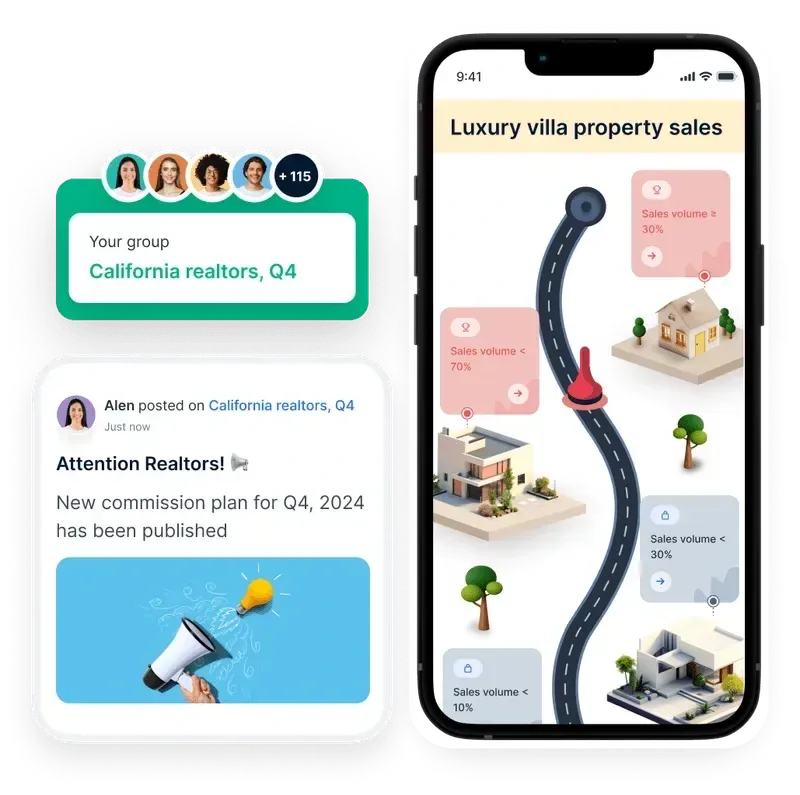
Many teams also give gamification its own space, a dedicated dashboard or app view, so achievements and nudges are not buried among routine alerts and the game feels like an opportunity rather than another task.
Gamification playbook: copy the example, not just the mechanic
The playbook below translates eight of the examples above into incentive gamification examples you can run with employees, each with a metric that proves whether it worked. Start with the one that matches your most pressing goal, and pilot it with a single team before rolling it out.
| Borrowed from | Mechanic | Workplace program to run | Reward | Metric to track |
|---|---|---|---|---|
| Duolingo | Daily streak | Daily learning or coaching streak with a weekly goal | Badge plus points at 5, 20 and 50 days | Active learners per week |
| Starbucks | Membership levels | Recognition tiers that unlock as people give and receive appreciation | Higher tiers unlock bigger reward choices | Share of employees recognized monthly |
| Nike | Monthly challenge | Team step or wellness challenge synced to wearables | Team prize plus individual finisher badge | Participation and active days |
| T-Mobile | Variable weekly rewards | Weekly spot awards for behaviors tied to company values | Surprise points or gift cards | Recognitions per manager per month |
| Freshdesk | Trophies for different strengths | Support trophies for speed, quality and customer delight | Monthly trophy plus points | First-contact resolution and CSAT |
| KFC | Escape-room training | Scenario quiz to unlock the next onboarding module | Certification badge | Time to productivity |
| Chaipoint | Live earnings and milestones | Sales milestones with instant rewards on top of commission | Cash or catalog rewards per milestone | Incentive qualifiers and target attainment |
| SPI Cinemas | Attendance points | Points for full attendance and shift cover | Points redeemable from a rewards catalog | Absenteeism rate |
For a step-by-step design template with a worked example, see our guide to employee gamification.
How to launch a gamification incentive program
Six steps take a gamification incentive program from idea to results, and defining the business goal comes first because every mechanic and reward should trace back to it. Skip it and you get a fun game that moves nothing.
- Define the business goal: Decide what you want to change, such as sales of a new product, training completion, customer satisfaction or compliance, and set a baseline.
- Understand your audience: Employees and customers have different motivations. Sales teams often respond to leaderboards and milestone rewards, frontline teams to simple point goals, and knowledge workers to mastery and recognition.
- Choose the right game elements: Pick two or three mechanics, such as points, badges, challenges or leaderboards, that support the goal. Too many mechanics overwhelm people.
- Use gamification software: A platform tracks progress, calculates rewards and sends nudges automatically, which keeps the game accurate and saves managers from spreadsheets.
- Test with a small group: Pilot with one team for two to four weeks, gather feedback and adjust thresholds, rewards and rules before rolling out company-wide.
- Monitor and refresh: Track participation, performance against the baseline, reward cost and engagement scores, then refresh challenges and rewards when interest drops.
Short competitions work when they feel enjoyable. A 2025 field experiment in the Journal of Personal Selling and Sales Management with 147 telecom sales agents found that adding a competitive quiz after virtual training raised enjoyment, which increased training motivation and the sales knowledge agents retained.
Common gamification challenges and how to overcome them
Five challenges cause most gamification incentive programs to lose momentum, and the first one, a lack of purpose, is the hardest to fix later. Each comes with a practical remedy.
01 · Purpose
Keep every mechanic relevant
Points and badges without a clear purpose lead to disengagement. Reward meaningful actions that contribute to the goal, not easy-to-inflate activity such as logins.
02 · Balance
Mix competition with collaboration
Excessive rivalry creates stress and discourages teamwork. Pair leaderboards with team challenges and peer recognition so helping others also earns points.
03 · Longevity
Refresh before novelty fades
Any game becomes background noise if it never changes. Rotate themes, metrics and rewards every few weeks and personalize incentives where you can.
04 · Simplicity
Keep the rules easy to explain
Complex scoring confuses people and invites disputes. If you cannot explain how to win in two sentences, simplify the design.
05 · Trust
Show accurate, real-time results
Delayed or wrong incentive tracking frustrates people quickly. Use live, auditable data so everyone always knows where they stand and why.
How Empuls helps you run gamification incentive programs
Empuls connects game mechanics to the recognition, rewards and incentives employees actually value, so gamification is tied to real outcomes rather than vanity points. HR, sales and frontline leaders can launch contests and challenges, track progress live and deliver rewards from a global catalog.
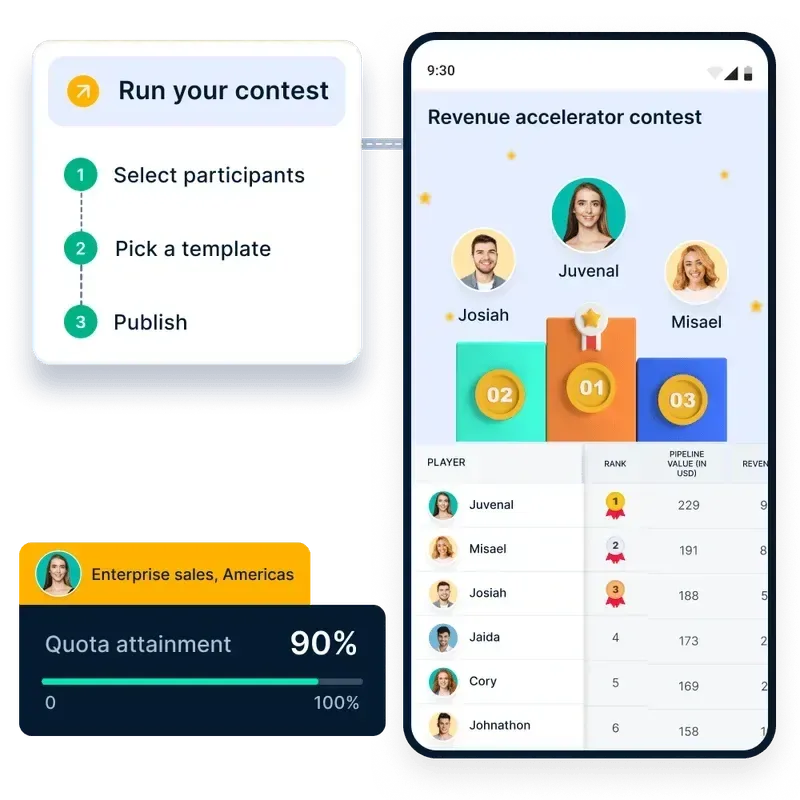
- Run sales contests, SPIFs, live leaderboards, badges and streaks tied to real incentive plans with Empuls sales gamification.
- Launch challenges and contests for any team, with leaderboards and instant rewards, through Empuls challenges and contests.
- Make recognition routine with points, badges and social appreciation in Empuls recognition.
- Engage deskless teams with mobile-first recognition and rewards built for frontline workforces.
Turning gamification examples into results
The gamification examples that last, from Duolingo's streaks to Chaipoint's live incentive milestones, all make progress visible, reward it quickly and give more than a handful of people a realistic chance to win. Pick one example from the playbook, tie it to a single business goal, pilot it with one team and measure the outcome, not just participation. Then refresh it before the novelty wears off.
Book your Empuls demo
Frequently asked questions
Well-known examples include Duolingo's streaks, XP and weekly leagues, Starbucks Rewards stars and membership levels, Nike Run Club challenges, Microsoft Rewards points and Xbox achievements. In the workplace, examples include help desk points and trophies for support agents, virtual reality training games and sales contests with live leaderboards and milestone rewards.
A common example is a sales milestone program where reps see live targets and earnings and receive instant rewards for each milestone, as Chaipoint did with Empuls. Others include points and monthly trophies for support agents, attendance points for frontline staff, onboarding quests with badges and team step challenges synced to wearables.
A gamified incentive program combines game mechanics, such as points, badges, milestones and leaderboards, with real rewards such as cash, gift cards or recognition. Participants see their progress and earnings in real time and earn rewards as they hit milestones, rather than waiting for a payout at the end of the period.
Duolingo is the most widely cited example. Its streaks, XP, weekly leagues and badges turn language practice into a daily habit, and the company reported more than 50 million daily active users in the third quarter of 2025. Starbucks Rewards and Nike Run Club are also frequently cited consumer examples.
Gamification is often grouped into four player motivations: achievement, through points, badges and levels; competition, through leaderboards and contests; collaboration, through team challenges and shared goals; and exploration, through quizzes, stories and unlockable content. Strong programs combine at least two so different personalities all find a reason to take part.
It can, when it is tied to a clear business goal and real rewards. Field research from 2025 found that a competitive quiz after sales training raised enjoyment, motivation and knowledge retention, and Empuls customer Chaipoint saw incentive qualifiers rise 115% in under six months after adding real-time incentive visibility and milestone rewards.
The main risks are unhealthy competition, people gaming easy metrics, privacy concerns and novelty wearing off. Leaderboards can discourage people who never reach the top, and streaks that punish a single missed day can push people to fake activity. Scoped leaderboards, quality-based scoring and regular refreshes reduce these risks.
Choose rewards that are proportionate to the effort, delivered quickly and chosen by the participant where possible, such as points redeemable for gift cards, experiences or donations. Combine them with public recognition and badges so the program does not depend only on prizes, and review redemption data to see which rewards people value.





































































































































































































































































































































































































































































































































































