
Key Takeaways
Good employee feedback names a specific situation, describes the behavior and explains its impact, then says what should continue or change.
The SBI model (situation, behavior, impact) works for both praise and criticism, while the X, Y, Z model adds an explicit next step.
Employees who strongly agree they receive valuable feedback are five times as likely to be engaged, according to Gallup's 2024 research.
Constructive feedback should be private, direct and specific, without hiding the message inside a compliment sandwich.
Performance review phrases only carry weight when each one is backed by a real example the employee has already heard about.
Employee feedback examples are ready-made phrases and short scripts managers can adapt to praise good work or address a problem clearly and kindly. The best ones name a specific situation, describe the behavior and explain its impact, then point to what should continue or change. This post gives you 30 employee feedback examples, 20 positive and 10 constructive, plus two frameworks and a phrase bank for performance reviews.
Do your employees know what they are doing right and where they need to improve, on an ongoing basis? Regular feedback keeps people on track, engaged and aligned with company goals, and it gives them a clearer understanding of their role. It also pays off: Gallup's 2024 research found that employees who strongly agree they receive valuable feedback are five times as likely to be engaged, yet only one in four say they do.
Feedback only works when it is delivered the right way. Without structure, it is like sending employees on a road trip with an outdated map and no signposts: it creates confusion, frustration and wasted effort. The key is to balance positive feedback that reinforces good behavior with constructive feedback that guides necessary improvement.
How to give employee feedback with proven frameworks
Two widely used models make feedback clear and fact-based: the Situation, Behavior, Impact (SBI) model and the X, Y, Z model often associated with McKinsey. Both keep the focus on behavior rather than personality, which is what reduces defensiveness, and SBI is the easier one to start with.
The SBI model: situation, behavior, impact
The SBI model, developed by the Center for Creative Leadership, helps managers deliver both positive and constructive feedback by focusing on three elements:
- Situation: Say when and where the behavior happened, such as a recent client presentation or team meeting, so the person can recall it clearly.
- Behavior: Describe what the person did, without judgment. Instead of "You were careless," say "You missed a few key data points in your report."
- Impact: Explain how the behavior affected the team, project or customer. This shows why the feedback matters and motivates change or repetition.
Positive example using SBI: “In Monday's client meeting (S), you presented the revised proposal with confidence and answered every concern clearly (B). As a result, the client is now more confident about increasing their investment with us (I). Great job.”
Constructive example using SBI: “During yesterday's brainstorming session (S), you interrupted a colleague several times while they were sharing ideas (B). That made it hard for them to contribute fully (I). Next time, let's make sure everyone has a chance to finish.”
The X, Y, Z model: what happened, impact, expected change
The X, Y, Z model adds an explicit next step, which makes it useful for constructive feedback:
- X, what happened: Describe the specific action or event.
- Y, the impact: Explain how it affected others or the outcome.
- Z, the change: State clearly what should happen differently from now on.
Example using X, Y, Z: “Last Friday, when you arrived late to our weekly team meeting (X), we had to rush the agenda and missed two discussion points (Y). Going forward, please let us know in advance if you expect to be late so we can adjust (Z).”
Both frameworks work for three reasons:
- They reduce defensiveness: People are less likely to take feedback personally when it is about specific behavior and its effect.
- They encourage discussion: Feedback becomes a two-way conversation in which the employee can reflect and respond.
- They set clear expectations: Employees know exactly what to keep doing or change.
20 positive feedback examples for employees
The 20 positive feedback examples below are grouped into four themes: effort and resilience, results and initiative, teamwork and leadership, and growth and change. Recognition for effort that goes unnoticed matters most, because those are the people most at risk of quietly disengaging.
Effort and resilience
These five examples recognize people whose effort is high but not always visible. Name the specific work, not just the attitude.
- An employee carrying a heavy responsibility with dedication: Team members who train new hires deal with many questions from many people. Say: “You have onboarded four new joiners this quarter while keeping up with your own work. They are productive faster because of you, and I want you to know it has not gone unnoticed.”
- An employee who resolved a conflict: Teammates can clash over different approaches. When someone moves past the conflict and finds a practical way forward, say: “When the design and engineering leads disagreed last week, you brought them together, laid out both options and agreed on a plan in one meeting. That kept the release on schedule.”
- An employee overloaded with extra work: During staff shortages, people with capacity often take on more, which can lead to stress and disengagement if no one notices. Say: “You have covered two roles since Priya went on leave. Thank you. Let's look at your list together today and decide what can wait, so this stays sustainable.”
- An employee whose hard work has gone unnoticed: Some people consistently deliver quality work without asking for attention. Say: “Your weekly reports are always accurate and on time, and the leadership team relies on them for decisions. I should have said this sooner: thank you for the consistency.”
- An employee feeling underappreciated: Hardworking people sometimes feel their effort does not matter. Say: “Over the past few weeks, you have not only completed your own tasks but also made a major contribution to our latest project. You are setting a great example for the team.”
Results and initiative
These five examples reward outcomes and the choices behind them. Link the result to its business impact so the person knows why it mattered.
- An employee who exceeded expectations: When a teammate researches a problem and comes back with several strong options, say: “You found three workable strategies in a very short time, and your research made our decision much easier. Thank you for your commitment to the team's goals.”
- An employee who consistently hits targets: When someone meets every goal on time, say: “You have met all of your targets on or before the deadline for the past quarter. Your planning, and your honesty about what is realistic, set an excellent example for the team.”
- An employee who saved time or money: When someone solves an issue that could have hurt the company, say: “Your quick fix to the billing error stopped duplicate charges before they reached customers. That saved us money and protected our reputation. I am glad you are on this team.”
- An employee who went beyond capacity to meet a deadline: When people stretch to deliver on time, say: “You delivered the launch assets two days early despite the tight timeline. Thank you. Next time, flag it if the load gets too heavy so we can share it.”
- An employee with excellent customer reviews: When someone earns several positive customer reviews in a row, say: “I read every review your clients left this month. You went above and beyond to make sure customers had a great experience. Keep up the excellent work.”
Teamwork and leadership
These five examples reinforce behaviors that make the whole team better. They are especially worth saying in public, with the person's permission.
- An employee who brought the team together: Hybrid and remote work can reduce chances to connect. When someone organizes regular team socials, say: “People were feeling disconnected, and your monthly virtual sessions have really helped the team get to know each other. Thank you for bringing us closer.”
- An employee who kept everyone informed: Strong communicators save everyone time. Say: “Thanks for keeping me updated on progress all week. It cut the time I needed to spend coordinating with stakeholders. Your communication made this project much smoother.”
- An employee who stepped up as a leader: When someone runs a meeting in your absence, say: “Thank you for leading today's meeting at short notice. You kept it on track and made sure everyone was heard. That is exactly the kind of leadership we need.”
- An employee who chose to help others: When someone helps a teammate succeed instead of competing, say: “I noticed you spent part of last week helping Sam finish his presentation. That generosity makes the whole team stronger, and people notice it.”
- An employee who helped overcome a roadblock: When creative problem-solving gets a stuck project moving, say: “Your idea to split the migration into two phases got us past a problem we had been stuck on for weeks. Thank you for staying positive throughout.”
Growth and change
These five examples recognize learning and adaptability. They encourage people to keep stretching, especially during change.
- An employee who showed perseverance: Say: “I am proud of what you achieved this month. You stayed motivated through some tough weeks and still hit your targets. Thank you for the effort you put in.”
- A new employee who learned fast: Say: “You joined without experience in this area, yet you picked it up quickly and manage your work with real care. That is hard to do in the first few months, and we are glad to have you.”
- An employee who learned a new skill: When someone upskills to meet changing needs, say: “Learning SQL on your own time shows real initiative. I am looking forward to seeing how it helps you and the team over the next few months.”
- An employee adapting to organizational change: During a change in leadership or processes, say: “I know these last few weeks have been stressful. You handled the new structure with maturity and calm, and that steadied the rest of the team. Thank you.”
- An employee who grew into a promotion: People in new roles need to know if they are on track. Say: “Promoting you was the right decision. You have already resolved our biggest sales operations issues and earned the team's trust. Keep it up.”
Positive feedback has the most effect when it comes with regular recognition. In Gallup's research, employees who received both feedback and recognition from their manager at least weekly were far more likely to be engaged (61%) than those who received feedback weekly but recognition less often (38%). Tools for peer and manager recognition make that weekly rhythm easier to keep.
Make recognition and feedback a weekly habit
Help managers appreciate good work in the moment and hear from their teams through quick pulse surveys.
Talk to our ExpertTrusted by 5,000+ companies
How to give constructive feedback
It is natural to feel uneasy about delivering difficult feedback, but letting someone continue down the wrong path is less kind in the long run. Think of it as a GPS calmly correcting a wrong turn. Four habits make these conversations more effective, and clarity of purpose comes first.
- Clarify your objective: Decide what you want the conversation to achieve before you start. It helps you stay direct and clear.
- Use I-statements: Instead of "You made me upset," try "I was concerned when the report went out with errors." It makes people less defensive and more likely to listen.
- Lead with empathy: Acknowledge that the conversation may be hard to hear and remind the person you are raising it because you care about their success.
- Avoid the feedback sandwich: Wrapping criticism between two compliments confuses the message, and people tend to remember the praise and miss the point. Be honest and direct, and give praise separately when it is earned.
For the traps that most often derail these conversations, see our guide to employee feedback mistakes.
10 constructive feedback examples
The ten constructive feedback examples below cover the most common performance and behavior issues, each with a situation and a script. Every script follows the same pattern: a specific example, its impact and a clear next step, because feedback without a next step rarely changes anything.
Missed deadlines affecting the team
An employee has missed two key deliverables in three weeks without flagging problems in advance, which disrupted reviews and forced others to work under pressure.
Say: “In the past three weeks, two critical deadlines were missed, which delayed the team. When the client report came in late last Friday, it held up the internal review and created extra work for others. If you see a delay coming, tell me early so we can adjust and keep the project on track. What would help you plan the next one?”
Frequent late arrivals to meetings
An employee has arrived late to the morning meeting at least three times this month, so the team has had to start without them or repeat updates.
Say: “You have arrived late to our 9 AM meeting three times this month. Last Monday we started without you and you missed key project updates. Being on time shows respect for everyone's time. Can you adjust your schedule so you are there from the start?”
Poor communication causing confusion
An employee did not share a revised client request, so the team kept working from outdated instructions and had to redo work.
Say: “In last week's handoff, the revised client request was not shared, so the team kept working from the old brief and had to redo part of it. From now on, please post complete updates in the project channel the same day so everyone stays aligned.”
Errors from lack of attention to detail
An employee's reports have repeatedly contained errors, including miscalculations in a recent financial summary that had to be fixed before it went out.
Say: “I have noticed recurring errors in your reports this month. Last Tuesday's financial summary had several miscalculations that we had to fix before sending. These slow us down and can affect decisions. Please use the internal checklist before submitting, and let me know if the timelines are too tight.”
Negative attitude affecting morale
An employee has dismissed colleagues' ideas in meetings without offering alternatives, which discourages others from contributing.
Say: “In Thursday's meeting, when a colleague proposed a new approach, you dismissed it without explaining why. That kind of response makes people less likely to share ideas. If you have concerns, please share them along with a suggestion, so we can improve the idea together.”
Poor customer interaction
A client complained that their question about a delay received a short reply that did not address their concern.
Say: “A client told me they felt their concern about the delay was brushed off on your last call. Strong client relationships depend on people feeling heard. Next time, acknowledge the concern, explain what is happening and confirm the next step. Would it help to role-play a tricky call together?”
Lack of initiative
An employee completes assigned tasks well but did not offer help when the team was stuck on a problem they had the expertise to solve.
Say: “Your assigned work is consistently solid. Last week, though, when the team hit a bottleneck you had the experience to fix, you did not step in. Being proactive would help the team and show your leadership potential. I would like to see you share ideas more often in our discussions.”
Not acting on previous feedback
An employee rushed through key details again in a client pitch, despite discussing presentation skills in the last two check-ins.
Say: “In our last two check-ins we talked about slowing down in presentations. In Friday's pitch, the key details were rushed again, and the client found it hard to follow. I want to help you get this right. Let's rehearse your next presentation together and agree on two specific changes.”
Interrupting others in meetings
An employee frequently speaks over colleagues, including twice during the last strategy session, which frustrates the group.
Say: “In Monday's strategy session, you spoke over colleagues twice while they were presenting. Everyone needs a chance to contribute fully. Please let people finish before adding your view, and jot down your point so you do not lose it.”
Poor time management
An employee submitted a report just before the deadline, but it was missing key details that had to be fixed in a hurry, which hurt its quality.
Say: “Your last report arrived just before the deadline and was missing key sections, so we had to fix it in a rush. Let's agree on a midpoint check-in for the next one, so we catch gaps early. What usually gets in the way of finishing earlier?”
Feedback phrases for performance reviews
Performance reviews need wording that is specific, fair and easy to compare across the team. The phrase bank below covers eight common competencies, with one positive and one constructive phrase each; replace the brackets with a real example, because a phrase without evidence reads as an opinion.
| Competency | Positive phrase | Constructive phrase |
|---|---|---|
| Communication | Keeps stakeholders informed with clear, timely updates, for example [project]. | Needs to share changes with the team the same day; in [example], a delay in updating others caused rework. |
| Teamwork | Readily helps colleagues meet shared goals, as shown when [example]. | Could involve teammates earlier; in [example], working alone led to duplicated effort. |
| Quality of work | Delivers accurate, well-checked work that others rely on, such as [example]. | Should review work against the checklist before submitting; [example] needed corrections. |
| Time management | Plans ahead and meets deadlines consistently, including [example]. | Needs to flag risks to deadlines early; [example] was submitted late without notice. |
| Problem solving | Finds practical solutions under pressure, for example [example]. | Could explore root causes before fixing symptoms; [example] recurred twice. |
| Leadership | Steps up to guide the team when needed, as in [example]. | Has an opportunity to delegate more; taking on [example] alone limited team growth. |
| Customer focus | Earns strong customer feedback by listening and following through, for example [example]. | Should confirm next steps with customers in writing; [example] led to a complaint. |
| Adaptability | Adjusts quickly to change and helps others do the same, as during [example]. | Could engage earlier with new processes; delays in adopting [example] slowed the team. |
Reviews should summarize feedback people have already heard, not introduce it. If your review cycle produces surprises, it is a sign that everyday feedback needs to happen more often.
How to plan your own feedback conversation
Now that you have seen examples, think of an upcoming conversation you need to have. A simple four-step flow helps, and scripting the opening and close is especially useful for new managers or anyone who dreads these talks.
- Set the purpose: Open by explaining what the conversation is about, so the employee knows what to expect.
- Use a framework: Share the feedback using SBI or X, Y, Z, mapped out in advance with a specific example.
- Listen: Ask for their view, questions and concerns. You may learn context that changes the next step.
- Agree and support: Agree on one or two actions, thank them for listening, acknowledge if it was uncomfortable and say how you will support them.
When to give employee feedback
Feedback should not wait for the annual review. Waiting a year leads to surprises, frustration and missed chances to improve, and unexpected criticism in a review can damage morale.
The best time is regularly and close to the moment. Timely feedback lets people adjust before small issues become big ones, and it recognizes good work while it is still fresh. Build feedback into daily interactions, weekly one-on-ones and project debriefs, and give critical feedback in private. To make this the norm across your organization, see our guide to building a culture of feedback, and for structured input from peers and managers, our guide to 360-degree feedback.
How Empuls helps managers give better feedback
A strong feedback culture is built with intention, trust and the right tools. Empuls helps managers recognize good work in the moment and hear from their teams regularly, so feedback flows in both directions.
- Recognition in the moment: Peers and managers can appreciate each other on a shared Wall of Fame, and AI can help turn a few words into a clear recognition message with Empuls recognition.
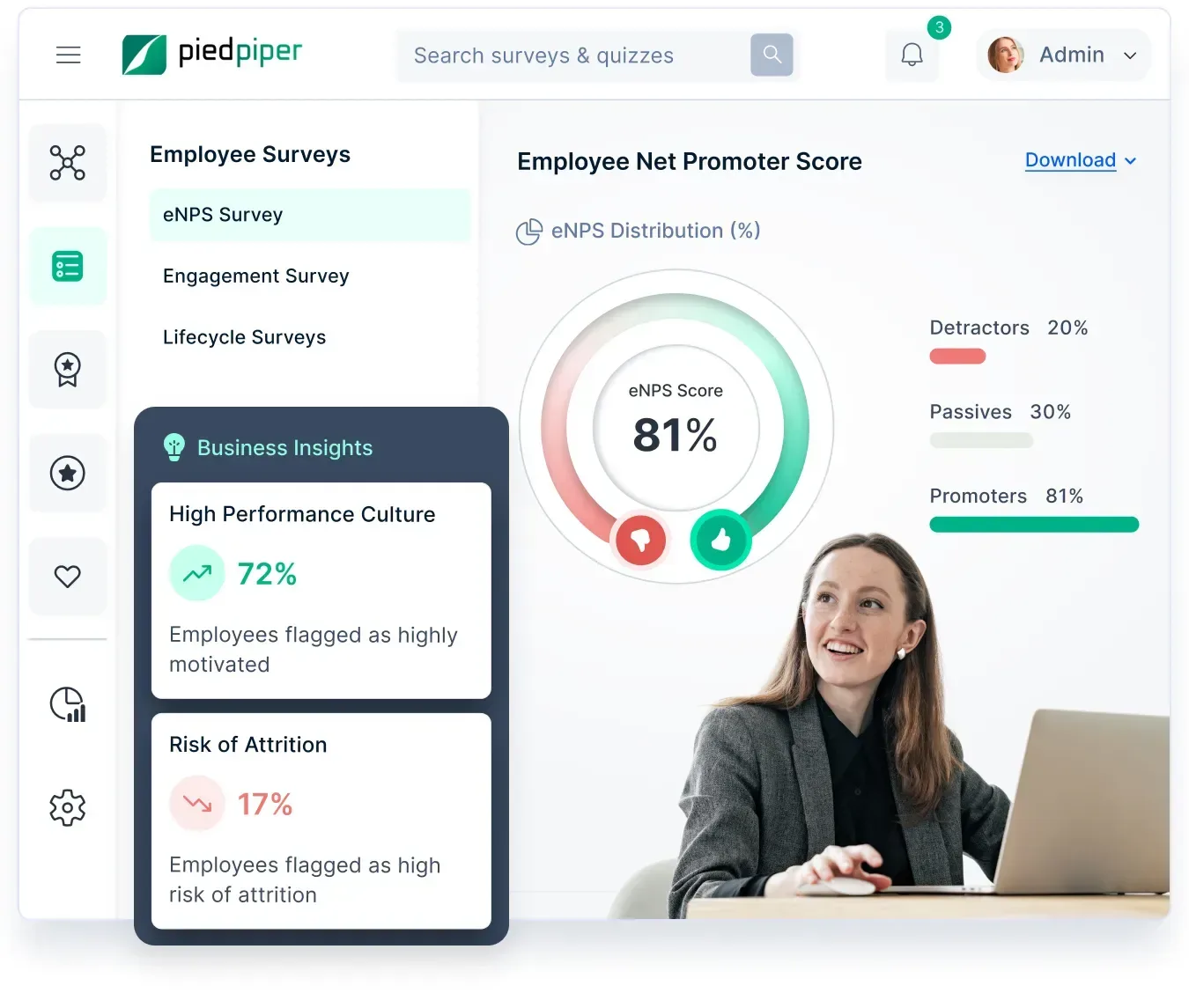
- Feedback from your team: Run pulse surveys and eNPS to learn how people feel about their work, managers and culture.
- Insight from comments: AI sentiment analysis groups open feedback into themes so you know what to address first.
- Follow-through: Turn what you hear into action plans and show employees their feedback leads to change.
Book your Empuls demo
Frequently asked questions
A good example is specific and links the behavior to its impact: “In Monday's client meeting, you answered every concern clearly, and the client has now agreed to expand the project. Great work.” It names the situation, the behavior and the result, so the employee knows exactly what to repeat.
An example of constructive feedback is: “Last Friday's client report arrived late, which held up the internal review and created extra work for the team. If you see a delay coming, tell me early so we can adjust.” It is specific, explains the impact and gives a clear next step without attacking the person.
The three types usually described are appreciation, which recognizes effort and results; coaching, which helps someone improve or grow a skill; and evaluation, which assesses performance against expectations, as in a review. Most everyday feedback should be appreciation and coaching, so formal evaluations hold no surprises.
Meet privately, describe specific examples of the gap and their impact, and ask for the employee's view, since there may be causes you do not know about. Agree on one or two clear goals, the support you will provide and a date to review progress. Follow up as planned and recognize improvement when you see it.
Managers should give some feedback every week or two through quick conversations, recognition and regular one-on-ones, rather than saving it for an annual review. Gallup's 2024 research found that employees who receive feedback and recognition from their manager at least weekly are much more likely to be engaged.
Avoid vague comments such as “good job” or “be more proactive,” judgments about personality, criticizing someone in public, waiting months to raise an issue and hiding criticism between two compliments. Also avoid one-way lectures: ask for the employee's perspective and agree on next steps together.
Use phrases tied to a competency and a real example, such as “Keeps stakeholders informed with clear, timely updates, for example during the Q2 launch,” or “Needs to flag deadline risks early; the September report was late without notice.” Specific phrases are fairer, easier to act on and easier to compare across the team.
Thank your manager simply and sincerely, for example: “Thank you, I really appreciate you noticing. I enjoyed working on it.” If others contributed, credit them too. You can also ask what made the work valuable, which helps you repeat it, and mention any goals you would like to build on next.





































































































































































































































































































































































































































































































































































