
Key Takeaways
On-the-spot recognition is appreciation given right after an employee does something worth noticing, while the moment is still fresh.
Gallup found 61% of employees who get weekly feedback and recognition from their manager are engaged, compared with 38% who get recognition less often.
The best spot awards are specific: they name the action, its impact and the company value it reflects.
A one-page spot award policy covering eligibility, budget, limits and timing keeps an instant recognition program fair and consistent.
In the US, cash and gift card spot awards are generally taxable wages, so agree tax handling with payroll before launch.
On-the-spot recognition is appreciation given immediately after an employee does something worth noticing, while the moment is still fresh. It can be a public shout-out, a value-based badge or a small spot award, and its power comes from timing: the closer the thank-you is to the action, the more clearly it tells people what to repeat. This guide covers 10 on the spot recognition ideas, when to use them and a policy template for running an instant recognition program.
On-the-spot recognition is the act of acknowledging and appreciating an employee's effort or achievement right after it happens, instead of waiting for a formal review, a monthly meeting or an annual award. Spot awards for employees are its most structured form: a small, unplanned reward such as points, a voucher or a gift card that comes with a specific message.
Some effective on-the-spot recognition ideas, each covered in detail below, include:
- Shout-outs in team huddles: Publicly appreciate employees during stand-ups or reviews.
- Thank-you notes or emails: Send quick, personalized appreciation messages.
- Recognition in Slack or Microsoft Teams: Recognize people in the tools they already use.
- Peer spot awards on a digital wall: Let colleagues appreciate each other in real time.
- Instant vouchers or e-gift cards: Send small, meaningful rewards for great work.
- Wall of Fame features: Spotlight standout work on screens and internal platforms.
- Surprise desk drops or home deliveries: Send a personalized gift or snack box.
- Value badges: Award badges that reflect company values.
- Manager video appreciation: Share short, personal thank-you videos.
- Gamified spot awards: Use badges and leaderboards to celebrate recurring good behavior.
What on-the-spot recognition is and why it matters
On-the-spot recognition is not about formal reviews or annual awards. It is about celebrating meaningful actions in real time, when they are most impactful, and it delivers four measurable benefits for workplace culture:
- Reinforces positive behavior: Recognizing the right actions as they happen makes them more likely to be repeated.
- Boosts motivation: Employees feel seen and valued, which directly lifts performance and morale.
- Increases engagement and retention: Consistent, immediate appreciation builds belonging and reduces turnover.
- Builds a culture of appreciation: It encourages peer recognition and spreads positivity across teams.
The research on frequency backs this up. In Gallup's 2024 study of more than 20,000 workers, 61% of employees who get feedback and recognition from their manager at least weekly were engaged, compared with 38% of those who get weekly feedback but less frequent recognition. Yet real-time employee recognition is still rare: the Achievers 2026 State of Recognition Report, a January 2026 survey of 3,000 employees, found only 17% are recognized weekly, while those who are recognized weekly are 3.1 times more likely to be engaged and 5.2 times more likely to see a long-term future with their company.
Quality matters as much as speed. Gallup and Workhuman found that well-recognized employees were 45% less likely to have left their organization two years later, so a spot award works best when the message is specific and sincere, not just quick.
How on-the-spot recognition fits with other recognition
On-the-spot recognition is one layer of a recognition program, not the whole program. The table shows how it differs from the three formats it is most often confused with, so you can use each for the right job.
| Format | When it happens | Who gives it | What it rewards |
|---|---|---|---|
| On-the-spot recognition and spot awards | Immediately, any day | Managers and often peers | A specific action or behavior just observed |
| Peer-to-peer recognition | Continuously | Any colleague | Everyday help and collaboration |
| Employee of the month | Monthly, on a schedule | Nomination and selection panel | Sustained contribution over a period |
| Service and milestone awards | On fixed dates | The company, usually automated | Tenure, birthdays and life events |
For the scheduled formats, see these guides to peer to peer recognition, running an employee of the month program and long service awards.
Recognize great work the moment it happens
Give managers and peers a 30-second way to send value-based spot awards from Slack, Teams or mobile.
Talk to our ExpertTrusted by 5,000+ companies
When to give on-the-spot recognition
Knowing when to recognize someone is just as important as knowing how. On-the-spot recognition is most effective when it is timely, specific and tied to an observable action or behavior, and these seven moments are the clearest triggers:
- Exceeding expectations: An employee goes beyond their responsibilities to deliver exceptional results.
- Demonstrating core values: Someone shows the behaviors your culture stands for, such as collaboration, ownership or empathy.
- Solving a critical problem: Quick thinking or innovation fixes an issue or prevents a setback.
- Helping a teammate: Someone steps in to support a colleague without being asked.
- Customer praise: An employee receives positive feedback from a customer or client. Customer praise can also feed an external recognition program.
- Completing a challenging task: A project or milestone is finished under tight deadlines or complex conditions.
- Lifting team morale: An employee uplifts the team through communication, energy or support.
Building these moments into a structured spot recognition program makes sure appreciation is not left to chance. This list of employee behaviors to recognize helps you define triggers for your own teams.
10 on the spot recognition ideas
A well-designed instant recognition program mixes free, verbal recognition with a few small rewards. The table compares all 10 ideas by cost, speed and best fit, and the first three cost nothing, so start there if you have no budget yet.
| Idea | Cost | Time to deliver | Best for |
|---|---|---|---|
| Shout-out in a team huddle | Free | Same day | Co-located and hybrid teams |
| Thank-you note or email | Free | Minutes | Every role, especially quieter employees |
| Recognition in Slack or Microsoft Teams | Free | Seconds | Desk-based and remote teams |
| Peer spot award on a digital wall | Low | Seconds | Organizations scaling recognition |
| Instant voucher or e-gift card | Budgeted | Minutes | Rewarding a clear extra effort |
| Wall of Fame feature | Free | Same day | Frontline sites with screens |
| Surprise desk drop or home delivery | Low to medium | 1 to 3 days | Remote employees and big wins |
| Value badge | Free | Seconds | Reinforcing culture |
| Manager video appreciation | Free | Minutes | Hybrid and distributed teams |
| Gamified spot awards and leaderboards | Low | Ongoing | Sales, support and operations |
1. Give shout-outs during team huddles or stand-ups
Catch people doing great work and call it out in your daily or weekly meetings. Public praise reinforces the behavior for everyone in the room and lifts team morale. Keep it short: name the person, the action and the impact, then move on. For shift teams, use the shift handover briefing so night and weekend staff hear it too.
2. Send quick thank-you notes or emails
A short, sincere message from a manager can be surprisingly powerful. Make it specific by mentioning the action and its impact, and send it the same day. A handwritten card on someone's desk works especially well for employees who would rather not be praised in public.
3. Recognize people in Slack or Microsoft Teams
Use the collaboration tools your teams already live in to deliver real-time appreciation. A recognition app inside chat means nobody has to switch tools, so recognition happens in the flow of work rather than at the end of the week when the details are forgotten.
4. Run peer spot awards on a digital wall
Let employees give small spot awards to each other for big and small contributions through a shared digital wall or feed. This spreads appreciation beyond managers and creates a culture where everyone contributes. Keep peer award values small and equal so the message stays at the center.
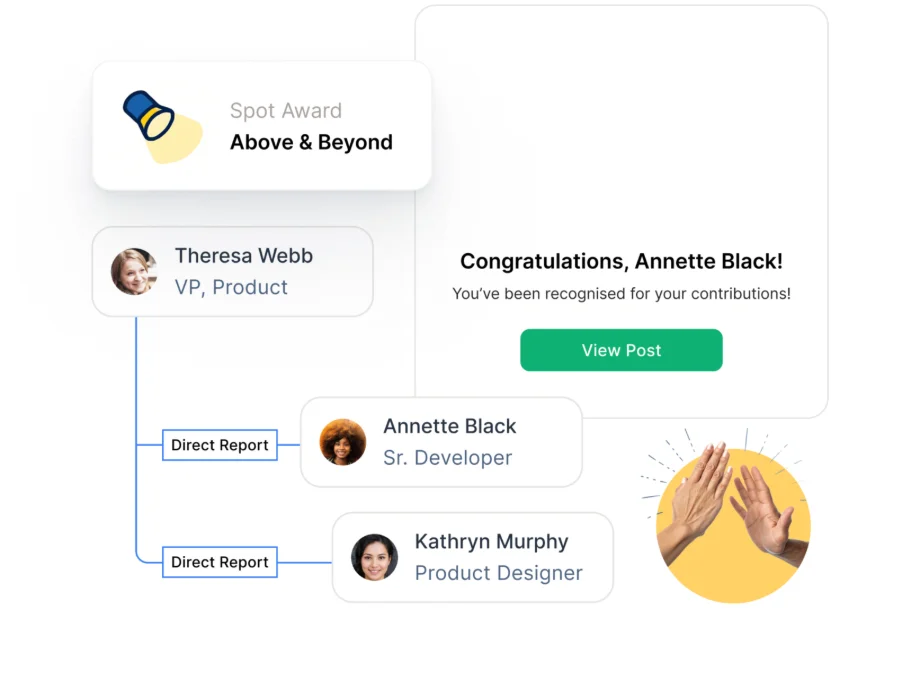
5. Send instant vouchers or e-gift cards
Tie recognition to small, meaningful rewards such as coffee, meal or streaming vouchers. Instant gratification reinforces the value of the behavior. Digital rewards arrive in minutes, and these employee gift card programs explain how to run them at scale.
6. Feature people on a Wall of Fame
Feature standout contributors on a virtual Wall of Fame or on screens in break rooms and plant floors. It adds visibility and turns individual appreciation into a company-wide celebration, which matters for frontline staff who rarely sit at a desk.
7. Arrange surprise desk drops or remote deliveries
Send a small token of appreciation, such as a personalized note, branded swag or a snack box, to someone's desk or home. A physical surprise creates a tangible connection to the recognition and works well for remote employees who miss office celebrations.
8. Award badges tied to core values
Create a set of badges that reflect your organization's values, such as "Customer Champion" or "Team Hero," and let peers and managers award them in real time. Every badge then teaches what the company stands for. A values-based recognition program shows how to set this up.
9. Record a manager video message
A quick video from a manager or team lead adds a personal touch and shows effort. It is especially powerful in hybrid and remote setups, and a 30-second clip recorded on a phone is enough. Share it with the team, or privately if the person prefers.
10. Use gamified spot awards and leaderboards
Recognize recurring behaviors such as knowledge sharing, innovation or helping others with badges and leaderboards. Friendly competition motivates engagement, but reset leaderboards often and reward effort as well as outcomes so the same people do not always win. For incentives tied to targets rather than moments, see these employee incentive ideas.
Mixing several of these ideas makes appreciation part of everyday culture rather than an afterthought. For recognition gestures beyond in-the-moment awards, browse these employee recognition ideas.
How to run an on-the-spot recognition program
A successful spot recognition program needs more than good intentions: it must be easy, timely, inclusive and measurable. These six steps take you from framework to a running program, and the first two decide whether employees see it as fair.
- Configure your recognition framework: Define spot award categories, such as "Above and Beyond," "Team Hero" and "Customer Champion," and tie each to a company value.
- Set budgets and permissions: Decide who can give spot awards, how much each person or manager can give per month or quarter and whether any award needs approval.
- Customize communication workflows: Create branded badges and message templates, connect Slack, Microsoft Teams or your HR system, and automate recurring moments such as birthdays and work anniversaries so spot awards can focus on actions.
- Train and onboard users: Run short demos for managers and employees, show what a good recognition message looks like and give everyone access to the recognition feed.
- Use automation and nudges: Set reminders that prompt managers to recognize their teams and surface people who have not been recognized lately.
- Track, measure and refine: Monitor recognition frequency, reach and budget use, close gaps by team and location and adjust categories based on adoption and feedback.
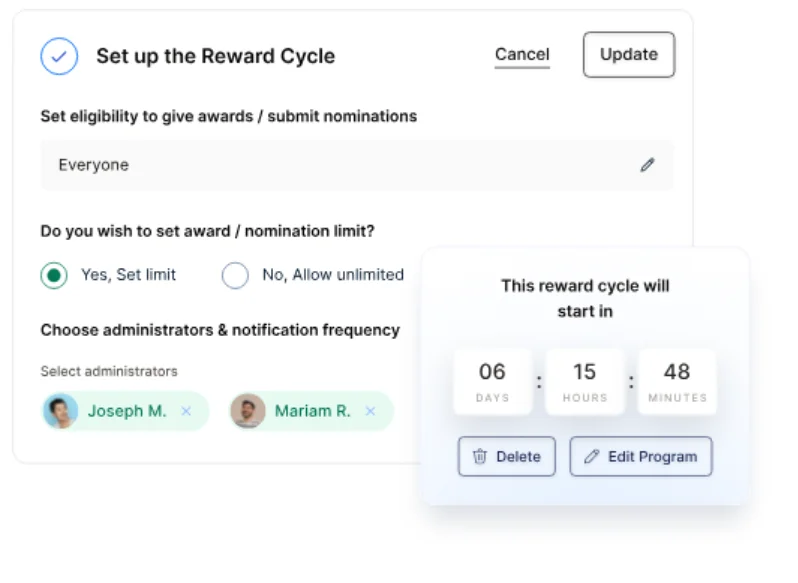
Use the template below to write your spot award policy before launch. It turns the six steps into one page managers can follow, and the example settings show a typical starting point you can adapt.
| Policy element | What to decide | Example setting |
|---|---|---|
| Purpose | What behavior the program should reinforce | Reward actions that live our values, in the moment |
| Eligibility | Who can receive spot awards | All employees, including part-time and contract staff |
| Who can give | Managers only, or peers too | Managers give points; all employees give badges and small peer awards |
| Award categories | Named awards tied to values | Above and Beyond, Team Hero, Customer Champion, Problem Solver |
| Reward type | Praise only, points, vouchers or gifts | Points redeemable for gift cards, experiences or charity |
| Budget | Allowance per giver and period | A fixed monthly points allowance per manager, smaller allowance per employee |
| Limits | Caps to prevent overuse and bias | No more than one award to the same person per month from the same giver |
| Approval | When approval is needed | None below the standard amount; second-level approval above it |
| Timing | How soon after the action | Within 48 hours of the action |
| Message standard | What every award must say | Name the action, its impact and the value it reflects |
| Tax handling | How cash and gift cards are reported | Agreed with payroll before launch |
| Review | How the program is measured | Quarterly review of reach, frequency and budget use |
Once the program runs, measure it like any other investment. This guide on how to measure employee recognition programs covers the metrics, and the recognition ROI calculator estimates the business impact.
Common on-the-spot recognition mistakes
Speed is the point of on-the-spot recognition, but speed without care creates problems. Avoid these four mistakes, and watch the first one most closely because it erodes trust fastest:
- Recognizing the same few people: Visible roles get noticed while support, remote and night-shift staff are missed. Review who is recognized by team and location, and read about recognition equity.
- Generic messages: "Great job!" with no detail does not teach anyone what to repeat.
- Letting the reward replace the words: A gift card without a sincere message feels transactional.
- Waiting too long: Recognition two weeks later is no longer on the spot. Aim for the same day, and within 48 hours at most.
How Empuls helps you run on-the-spot recognition
Running on-the-spot recognition at scale takes tools that make it fast to give, fair to distribute and easy to measure. Empuls spot awards are built for exactly this, as part of the wider Empuls recognition platform:
- Recognize in seconds: Find a colleague, pick an award tied to a company value and send it with points from Empuls or directly in Slack and Microsoft Teams.
- AI recognition coach: Smart insights suggest who might be overdue for appreciation, and Improve with AI turns a rough thought into a specific, personal message.
- Budgets and controls: HR sets monthly or quarterly point budgets by department or manager, with configurable approval rules, limits and visibility.
- Rewards people choose: Points redeem for gift cards, experiences, merchandise and charity donations, with local options by country.
- Analytics: Dashboards track recognition frequency by team, value alignment, budget use and adoption, so you can see who is being missed.
Milestones such as work anniversaries and birthdays run separately through milestone rewards, so spot awards stay focused on the moments that deserve instant thanks.
Recognition works best in the moment
The power of appreciation lies in its timing. On-the-spot recognition makes people feel valued exactly when it matters, whether for a small win or a big breakthrough, and every timely thank-you builds trust, drives motivation and reinforces company values.
Running a spot recognition program does not need to be complex. Start with free shout-outs and value badges, write a one-page policy, add a small budget for spot awards and review reach every quarter. When recognition is real-time, so is its impact.
Book your Empuls demo
Frequently asked questions
An on-the-spot award is a spontaneous form of recognition given immediately after an employee shows exceptional performance or behavior. It can be verbal praise, a digital badge, reward points, a voucher or a small gift, always delivered with a specific message. Its value comes from timing, because it connects the reward directly to the action.
A spot recognition program reinforces the behaviors you want while they are fresh, lifts motivation and morale, and supports engagement and retention. It also spreads recognition beyond annual awards, so more people are appreciated more often. Gallup research links weekly recognition from managers with substantially higher engagement than less frequent recognition.
Spot prizes are surprise rewards given during meetings, contests, events or regular workdays. Unlike planned rewards, they are unannounced and used to recognize effort, participation or achievement instantly. Common spot prizes include gift cards, meal vouchers, extra time off, company swag and points that can be redeemed in a rewards catalog.
There is no standard amount, and many effective spot awards are free, such as a public shout-out or a value badge. When you add rewards, keep them small enough to give often and set a fixed allowance per manager per month or quarter. Larger amounts should need approval so the program stays fair and within budget.
In the US, cash and cash equivalents such as gift cards are taxable wages, however small, according to IRS Publication 15-B. Only tangible awards for length of service or safety can qualify for the employee achievement award exclusion, within annual limits. Rules differ by country, so agree on tax handling with payroll before you launch.
Managers should always be able to give it, and most programs also let peers recognize each other with badges or small point awards. Opening recognition to peers catches everyday help managers miss and raises reach across the organization. HR usually sets budgets, limits and approval rules so peer awards stay modest and fair.
Remote teams rely on digital channels: shout-outs in video stand-ups, recognition posts in Slack or Microsoft Teams, e-gift cards and short manager video messages. Home deliveries add a physical touch for bigger wins. Because remote work is less visible, use reminders and reports to make sure remote employees are recognized as often as office staff.





































































































































































































































































































































































































































































































































































