
Key Takeaways
Peer to peer recognition is coworkers acknowledging each other's work directly, and it catches the everyday effort that managers rarely see.
Gallup's 2024 research found employees who get valuable feedback from coworkers are five times as likely to be engaged and 48% less likely to be job hunting.
Peer recognition works best alongside manager recognition, not instead of it, because each reinforces different things.
A strong peer recognition message names the person, the specific action and its impact, then ties it to a company value.
Programs last when recognition is easy to give in daily tools, leaders model it and you track reach so no team is left out.
Peer to peer recognition is when coworkers acknowledge and appreciate each other's work directly, without waiting for a manager to notice. It works because peers see the everyday effort managers miss, and it turns appreciation into a daily habit instead of an annual event. This guide covers the benefits, 10 peer recognition program ideas, message examples you can copy and a step-by-step way to launch a program.
Peer-to-peer recognition is the genuine acknowledgment and appreciation exchanged between coworkers at any level, from teammate to teammate, across departments and even from employees to their managers. Social acknowledgment is a basic human need, and being thanked by the people you work beside every day is one of the most direct ways to meet it.
Employee retention is about making people feel they truly belong in your company's culture, and peer recognition is a crucial part of employee recognition that does exactly that. A traditional recognition program is usually run from the top, by managers and senior leaders. Peer recognition goes further: it becomes a habit for every employee, so when someone does something good, the person who benefited says so, publicly and specifically.
What peer to peer recognition means at work
Generally, recognition comes from managers and senior leaders, but being recognized by peers and colleagues is highly motivating. Peers work alongside you, understand what the work actually took and notice the quiet help that never reaches a manager's dashboard. That is why peer recognition often feels more personal and credible than top-down praise.
Peer recognition does not replace manager recognition. The two work best together, and each does a different job:
| Aspect | Peer to peer recognition | Manager recognition |
|---|---|---|
| Who gives it | Any employee, to any colleague | Managers and leaders, to their teams |
| What it notices best | Everyday help, collaboration and behind-the-scenes effort | Results, goals met and performance against expectations |
| Frequency | High: daily or weekly, in the flow of work | Lower: tied to one-to-ones, reviews and milestones |
| Typical format | Shout-outs, kudos, badges, small point awards | Spot awards, nominations, bonuses, formal awards |
| Main effect | Belonging, trust and team spirit | Direction, career signals and reinforcement of priorities |
| Main risk | Popularity contests and reciprocal back-patting | Bottlenecks and favoritism if managers forget or play favorites |
Peer recognition statistics that show why it matters
Several older figures about peer recognition still circulate online, but the most useful current evidence comes from Gallup's 2024 research on coworker feedback and recognition quality. Three numbers stand out:
5x
as likely to be engaged
when employees strongly agree they get valuable feedback from coworkers
48%
less likely to be job hunting
for employees who get valuable coworker feedback
45%
less likely to leave
for well-recognized employees over two years
Sources: Gallup and Workhuman 2024 research
In a 2024 Gallup analysis of feedback and recognition, employees who strongly agree they receive valuable feedback from the people they work with were five times as likely to be engaged, 57% less likely to be burned out and 48% less likely to be looking or watching for another job. Yet only 25% strongly agreed they get that kind of feedback from colleagues, so there is a lot of room to grow.
Recognition quality matters as much as volume. Gallup and Workhuman found that well-recognized employees were 45% less likely to have left their organization two years later, while only 22% of employees said they get the right amount of recognition. Opening recognition up to peers is the fastest way to raise both how often and how widely people are appreciated.
Benefits of peer recognition in the workplace
Peer recognition programs pay off for culture, teams and individuals. Here are 12 benefits of peer recognition, starting with the culture-level effects and moving to what each employee gains.
- It defines your company culture: Peer recognition programs start as an initiative and become a true representation of the company itself. They give employees the tools to praise others, give feedback and reward great work, which quickly creates a warmer atmosphere where people perform out of passion rather than obligation.
- It builds team spirit: In sports, the more united of two evenly matched teams usually wins. Work is the same: when employees see themselves as one team that cheers each other on, they gain energy and reach results they would not reach alone.
- It makes work more collaborative: Teamwork only helps when it feels genuine. A peer recognition culture fosters real companionship, so collaboration happens because people want to help, not because it is imposed. Independent workers still have room to work alone, while the same recognition principles apply to everyone.
- It improves happiness and fulfillment: Appreciation, positivity and compassion are contagious. When some employees are visibly helpful and grateful to each other, others naturally follow, and the whole team feels more fulfilled.
- It supports wellbeing: Feeling valued by colleagues lowers the stress and isolation that wear people down. Gallup's 2024 data links valuable coworker feedback with being 57% less likely to be burned out.
- It raises standards: When feedback is linked to rewards, employees see what good looks like and believe they can do it too. Direct that energy toward beating competitors and serving customers, not toward beating colleagues.
- It encourages transparency and openness: Without transparency, trust is a faraway concept, and without trust a team cannot function. Public peer recognition shows who is helping whom, and it gives leaders a clear view of the team's dynamics and informal leaders.
- It builds loyal teams: People rarely walk away from colleagues who value them. An effective peer culture builds loyalty by default, and loyal employees are more likely to raise concerns early, give notice properly and help train their successors.
- It makes rewards and recognition feel natural: Rewarding someone can feel awkward when it is rare or only comes from the top. An organized program makes it routine: managers recognize important wins, and every employee has an easy way, such as points or badges, to thank peers.
- It fosters friendships: By recognizing each other often, colleagues learn how to cooperate and discover what they have in common. Many professional relationships grow into real friendships, which strengthens the team's collective resilience.
- It encourages learning and skills growth: Employees in a recognition culture are less afraid to ask for help. When marketers learn from designers and engineers learn from support, every team does better work, and your open roles become more attractive to candidates.
- It works as a feedback mechanism: Peer recognition tells people what to keep doing, in specific terms, from the people closest to the work. It also builds the trust that makes constructive feedback easier to give and receive. For more on this, see how to build a culture of feedback.
Make peer recognition a daily habit
Let every employee thank a colleague in seconds from Slack, Teams or mobile, with values-based badges and points.
Talk to our ExpertTrusted by 5,000+ companies
Peer recognition program ideas and examples
Peer recognition works best with a mix of quick, free gestures and a few structured formats. The table compares 10 peer recognition program ideas by cost, effort and best fit, and the details for each follow it.
| Idea | Cost | Effort | Best for |
|---|---|---|---|
| Shout-outs on a social feed | Free | Low | Every team, daily wins |
| Sticky notes and handwritten cards | Very low | Low | Office and shift teams |
| Virtual celebration | Low | Medium | Remote and hybrid teams |
| Feature on the company website | Free | Medium | Employer brand and hiring |
| Breakroom boss of the week | Low | Low | On-site teams |
| Homemade treats plus points | Low | Low | Small teams |
| Social media recognition | Free | Low | Client-facing and visible roles |
| Birthdays, anniversaries and life events | Low | Low with automation | All teams |
| Personalized trophy or memento | Low | Medium | Project wraps and team awards |
| Gift of choice with points | Budgeted | Low with a platform | Scaling peer recognition company-wide |
1. Give them a shout-out
A shout-out for quick help on a project, a "good luck" before a big sales pitch or congratulations on a strong write-up keeps colleagues engaged. Posting it on a shared recognition feed lets the whole organization see it, which multiplies its effect. Name the action and its impact, such as "your test plan caught the billing bug before launch," so others learn what to repeat.
2. Leave sticky notes and handwritten cards
A handwritten note has a persuasive, personal quality that a chat message lacks. Sticky notes are a great way to recognize peers for anything from a great presentation to covering a shift, and the creativity is limitless. Keep a stack of cards near shared spaces so recognition is always within reach.
3. Host a virtual celebration
With remote and hybrid work here to stay, short virtual celebrations for wins big and small give distributed teams a shared moment. Open with peer shout-outs, let the person being celebrated say a few words and keep it under 20 minutes. Virtual badges, GIFs and comments on a social feed help remote employees feel just as seen as people in the office. For more on distributed teams, read this guide to recognizing remote and frontline teams.
4. Feature colleagues on the company website
Your website is the front door for candidates, customers and partners. When it showcases team members beyond senior leadership, with their names, photos and the story of what they did, it is a big morale boost and a strong employer brand signal. Let peers nominate who gets featured each month. A Wall of Fame on office screens does the same job internally.
5. Crown a breakroom boss of the week
This creative idea brings in the fun. Let peers vote for the colleague who helped them most that week and crown them breakroom boss: they choose the lunch menu, pick the snacks and control the playlist. It celebrates recognition and forges new relationships across teams.
6. Share homemade treats
Peer recognition is about companionship, and homemade treats are a great icebreaker that breaks down hierarchy as everyone digs in. Pair the gesture with a small points award so the colleague can also choose a treat of their own from a rewards catalog.
7. Recognize peers on social media
Most employees are connected with colleagues on LinkedIn, and a public post about a teammate's work is organic publicity for them and for your culture. Encourage people to tag colleagues when they share project wins, conference talks or certifications, with a simple guideline on what is fine to share publicly. This kind of visibility also helps attract candidates who want to work in a culture of appreciation.
8. Celebrate birthdays, anniversaries and life events
From a decorated desk on a birthday to a group card for a new baby, celebrations are the essence of culture. Peers usually know about these moments first, so let them lead, and give extra points when management pitches in. Automated reminders make sure no one is forgotten, and these employee milestone gift ideas help when a moment deserves more.
9. Give a personalized trophy
Traditional trophies can feel stale, but a personalized memento revives them. Give peers a small figure or object that reflects their work style, personality or a team inside joke. It becomes a story the team retells, and core value badges or custom award types can make the same gesture digital.
10. Offer the gift of choice
Peer recognition paired with a reward the receiver chooses is a memorable way to top it off. Gift vouchers or points that can be spent in a broad catalog let each person pick what matters to them. Keep peer point amounts small and frequent so the focus stays on the message, not the money. These employee reward gift ideas cover what people like to redeem.
Not every gesture belongs in a peer program. For manager-led and company-wide gestures, browse these employee recognition ideas, and for in-the-moment awards from managers, see these on-the-spot recognition ideas.
Peer to peer recognition examples you can copy
The most common reason peer recognition fades is that people do not know what to write. Use these peer to peer recognition examples as starting points, then swap in the specific action and its impact.
| Situation | Example message | Value it reinforces |
|---|---|---|
| A colleague covered for you | "Thanks for taking my client calls while I was out sick, Priya. Both renewals closed on time because you stepped in." | Teamwork |
| Help on a deadline | "Marcus, you stayed to rebuild the dashboard before the board meeting. The CFO used it to make the budget call. Thank you." | Ownership |
| Cross-team support | "Shout-out to Lena in IT for fixing the warehouse scanners in under an hour. Night shift shipped every order." | Customer focus |
| Mentoring a new hire | "Sam, your walkthrough of our codebase cut my onboarding in half. I shipped my first feature in week two." | Growth |
| A great idea | "Aisha's idea to move standups to async saved the team about three hours a week. Brilliant." | Innovation |
| Handling a tough customer | "Jordan turned an angry escalation into a five-star review today. Calm, patient and clear. That is how it is done." | Customer focus |
| Quiet, steady work | "Nobody sees how clean our data is, but it is because Chen checks every import. Thank you for the invisible work." | Quality |
| Upward recognition | "Thanks, Ravi, for shielding the team from scope creep this sprint. We hit the release without a single late night." | Leadership |
How to launch a peer recognition program
A peer recognition program needs a little structure so it starts strong and does not fade after launch. Follow these seven steps in order, because the first two decide whether people trust the program at all.
- Set the purpose: Decide what you want peer recognition to change, such as cross-team collaboration, onboarding or frontline morale, and pick two or three metrics to track it.
- Tie recognition to values: Map recognition to your company values so every thank-you also teaches what the organization stands for. A values-based recognition program shows how.
- Choose formats and budget: Combine free formats, such as shout-outs and badges, with a small monthly points allowance per employee. Keep peer amounts modest and equal for everyone.
- Make it easy to give: Put recognition where people already work, such as Slack, Microsoft Teams, email or a mobile app for deskless staff. If it takes more than a minute, people stop.
- Set simple guardrails: Ask for specific messages, cap how often the same pair can exchange points and review patterns for reciprocal back-patting. This guide explains how to prevent bias in recognition programs.
- Launch with leaders modeling it: Senior leaders and managers should post the first wave of recognition. Plan how you will communicate the launch of your recognition program so everyone knows why it exists and how to take part.
- Measure and adjust: Track participation, reach, the share of recognition sent by non-managers and who has not been recognized lately. Review quarterly, and use this guide on how to measure employee recognition programs for the full metric set.
Choosing a tool is the last step, not the first. Once you know your goals and formats, compare options in this roundup of peer-to-peer employee recognition software.
Common peer recognition mistakes to avoid
Most peer recognition programs that fail do so for one of five reasons, and the first is by far the most common. Check your program against each:
- Launch and forget: Energy fades within months without rituals such as a weekly shout-out slot in team meetings.
- Generic messages: "Thanks!" with no detail feels hollow and teaches nothing. Prompt people for the action and impact.
- Popularity contests: The same visible people collect most of the recognition while support and frontline roles are missed. Check reach by team and location.
- Points over praise: Large peer budgets can turn recognition into trading. Keep rewards small and the message central.
- Optional for leaders: If managers never take part, employees conclude it does not matter. Leaders should recognize often and visibly.
How Empuls supports peer to peer recognition
Peer recognition is about building a culture where employees feel seen, valued and motivated every day. Empuls recognition makes it an everyday habit by bringing appreciation into the tools people already use, including Slack, Microsoft Teams and email, so a thank-you takes seconds:
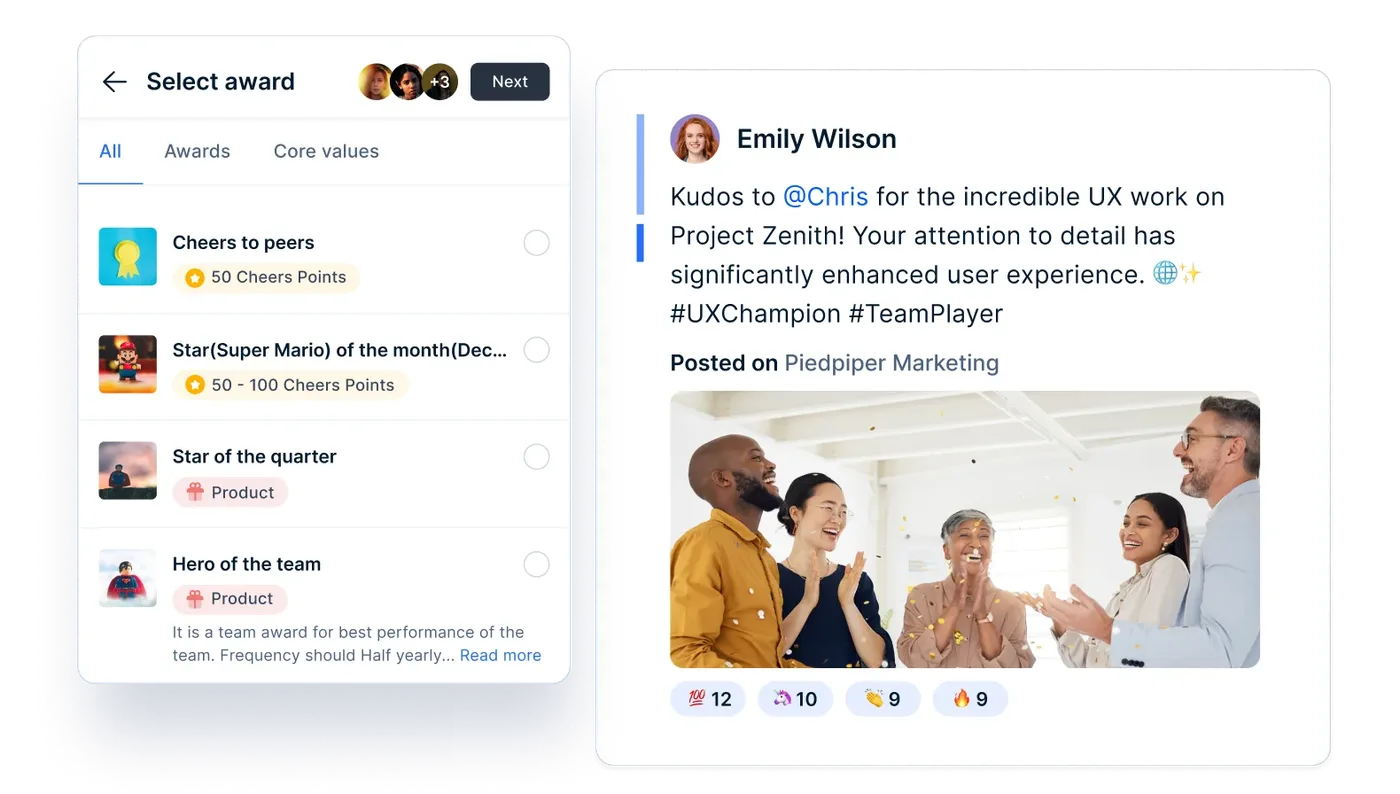
- Real-time appreciation: Employees give instant kudos, shout-outs and value-based badges, and spot awards let peers and managers add points in the moment.
- Recognition tied to core values: Every award can map to a company value, so appreciation reinforces the behaviors that matter most.
- AI recognition coach: Smart nudges suggest who might be overdue for appreciation and help people turn a rough thought into a specific, personal message.
- Rewards people choose: Points redeem for gift cards, experiences, merchandise and charity donations, with local options by country.
- Milestones on autopilot: Celebrations surface birthdays, work anniversaries and life events so peers never miss a moment.
- Analytics: Dashboards show participation, recognition frequency by team and value alignment, so you can spot gaps before they become disengagement.
Peer recognition becomes a culture when it is easy, specific and visible. Start small with shout-outs and a clear message format, add points and values once the habit forms, and measure who is being missed. For the wider program picture, read this guide to building an employee recognition program.
Book your Empuls demo
Frequently asked questions
A common example is a public shout-out such as "Thanks, Lena, for fixing the warehouse scanners in under an hour, night shift shipped every order." Other examples include handwritten notes, value-based badges, small point awards, nominating a colleague for a team award and celebrating a coworker's work anniversary. The best examples name the action and its impact.
Peers see everyday effort, collaboration and quiet help that managers often miss, so peer recognition reaches more people more often. It also builds trust and belonging between colleagues. Manager recognition still matters for direction and career signals, so the strongest programs combine both rather than choosing one over the other.
Start by defining what you want the program to change and tying recognition to your company values. Choose simple formats such as shout-outs and badges, add a small points budget, and make recognition easy to give in tools people already use. Have leaders model it at launch, then track participation and reach every quarter.
It can, but keep amounts small. A modest monthly points allowance that employees give to peers adds a tangible thank-you without turning recognition into trading. Many programs run mostly on free shout-outs and badges, with points as an extra. The message should always matter more than the reward attached to it.
Ask for specific messages tied to values, cap how often the same two people can exchange points and review recognition data by team, role and location. If support, remote or frontline staff are rarely recognized, prompt managers and peers to notice their work. Visible leadership participation also keeps recognition focused on contribution rather than popularity.
There is no fixed quota, but weekly recognition is a good target for most teams. Gallup research links frequent, high-quality recognition with higher engagement and retention. Building a short shout-out slot into weekly team meetings and making recognition quick to give in chat tools helps teams reach that rhythm without it feeling forced.
Peer recognition software is a platform that lets employees thank and reward colleagues publicly, usually through a social feed, badges tied to company values and points redeemable for rewards. Good tools integrate with Slack, Microsoft Teams and HR systems, work on mobile for deskless staff and include analytics on participation and reach.





































































































































































































































































































































































































































































































































































