Key Takeaways
A loan officer incentive plan must reward disbursals while protecting credit quality, because the value of a loan is only known after it is disbursed.
Build rules from four dimensions, product, geography, tenure and amount, and check with compliance before paying on loan terms such as tenure.
Pair tiers and threshold buffers with clawbacks and quality gates so the plan pays generously for good loans and not for bad ones.
Run plan changes, earnings and payouts through maker-checker approvals with an audit trail, and handle disputes as tracked tickets.
Simulate plans on historical data and measure ROI on profitable, quality-adjusted lending rather than disbursal volume alone.
A loan officer incentive plan pays loan sales teams for disbursals, but unlike most sales plans it has to price in what happens after the sale: whether the borrower repays, whether the product suited them and whether the plan itself follows conduct rules. Banks and NBFCs that get this right write rules by product, geography, tenure and ticket size, pair every volume reward with a quality guardrail and run changes and payouts through approvals that leave an audit trail.
This guide is for sales heads, incentive and compensation teams and finance leaders who design or run incentives for loan officers, relationship managers, branch teams and direct selling agents. It walks through the building blocks of a loan sales incentive structure, a worked example, tiers and thresholds, clawbacks, maker-checker approvals, disputes, dashboards, simulation and ROI. If you are looking for the case for automating commissions in banking overall, read our guide to sales commission automation in banking; this post goes deeper into plan design and day-to-day plan operations for lending teams.
Why loan sales incentives need different rules
Loan sales incentives need different rules because the value of a loan is only known months or years after it is disbursed, and regulators treat the way lenders pay their sales staff as part of consumer protection. A software sale that closes is usually a good sale; a loan that disburses can still turn into an early default, a complaint or a mis-selling case.
Three forces shape every bank sales incentive plan in lending:
- Credit risk: A loan officer who is paid only on disbursal volume has every reason to push borderline files through. The lender keeps the credit risk long after the incentive is paid, so the plan has to keep some of the officer's reward tied to how the loan performs, especially in the first few months.
- Early default and mis-selling: Early delinquency is often a sign of weak underwriting, poor documentation or a product sold to the wrong customer. Complaints are a lagging signal too. The RBI Ombudsman annual report for 2024-25 found that loans and advances were the largest category of complaints received by the Ombudsman offices, at 29.25 per cent, ahead of every other product group.
- Regulation: In India, the RBI issued amendment directions on advertising, marketing and sale of financial products on June 15, 2026, for banks, NBFCs and housing finance companies, effective January 1, 2027. Coverage in Outlook Money reports that the rules still allow lenders to offer incentives to their own employees, but such structures should not result in pressure selling or mis-selling, and third parties cannot pay incentives directly to a lender's employees. In the US, Regulation Z's loan originator compensation rule bars mortgage originator pay based on a term of the transaction, or on a factor that acts as a proxy for one, other than the amount of credit extended.
None of this means lenders should stop paying for performance. It means an NBFC sales incentive scheme or bank plan needs more structure than a flat commission: clear rules, a quality layer, controlled changes and evidence of how every rupee or dollar was calculated.
Building blocks of a loan officer incentive plan
Every loan officer incentive plan is a set of rules that combine four dimensions: product, geography, tenure and amount. Getting these right is what lets one plan reward a home loan in a metro branch differently from a two-wheeler loan in a rural branch without building a separate spreadsheet for each.
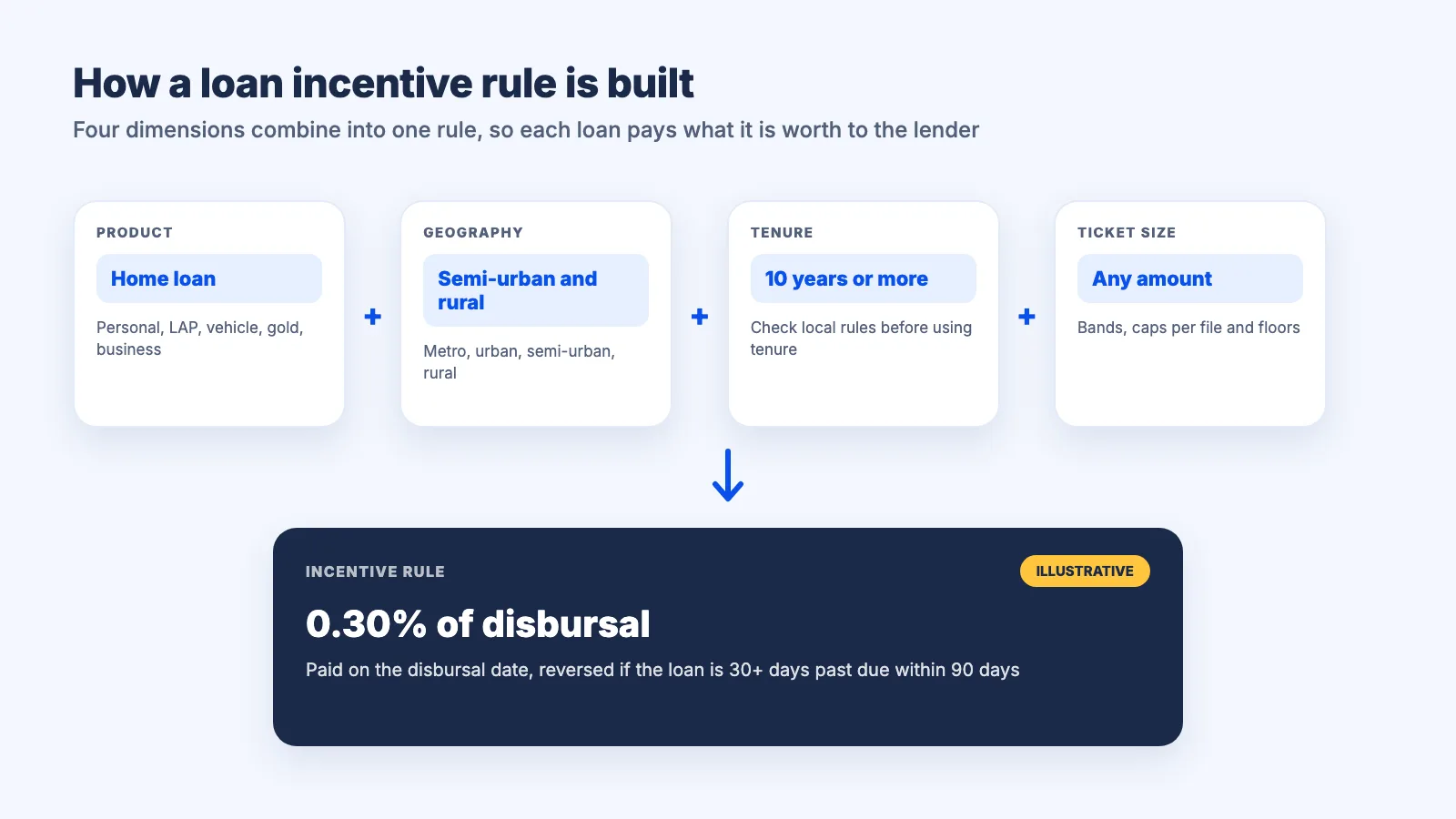
- Product: Home loans, loans against property, personal loans, business loans, vehicle loans and gold loans have very different margins, risk profiles and sales cycles. Most lenders set a separate rate or per-file amount for each product, and often a product mix target so officers do not chase only the easiest product.
- Geography: Ticket sizes and effort differ by region. A rural or semi-urban branch may get a higher percentage or a per-file payout to reflect smaller loans and longer travel, while metro branches get a lower rate on larger tickets.
- Tenure: In many markets, longer tenure loans earn more interest over their life, so lenders weight them more. Treat this carefully: where a rule like Regulation Z applies to mortgage originators, pay based on loan terms such as tenure or rate can be prohibited, so tenure should only drive pay where your compliance team has cleared it.
- Amount: Ticket size bands stop a plan from overpaying on very large files and underpaying on small ones. Caps per file and floors for minimum ticket size are common.
The table below shows a sample rule matrix for an Indian lender. The rates are illustrative only, to show how the dimensions combine, not a benchmark to copy.
| Product | Geography | Tenure | Ticket size | Incentive rule |
|---|---|---|---|---|
| Home loan | Metro and urban | 10 years or more | ₹25 lakh and above | 0.20% of disbursal |
| Home loan | Semi-urban and rural | 10 years or more | Any | 0.30% of disbursal |
| Personal loan | All | 12 to 60 months | ₹1 lakh to ₹10 lakh | 1.0% of disbursal, capped at ₹5,000 per file |
| Two-wheeler loan | Rural | 12 to 36 months | Any | ₹400 per disbursed file |
| Loan against property | All | 5 years or more | ₹10 lakh and above | 0.35% of disbursal |
Now apply it to one loan officer in a month. She disburses two metro home loans of ₹40 lakh and ₹30 lakh, six personal loans of ₹4 lakh each and ten rural two-wheeler loans.
| Line | Calculation | Amount |
|---|---|---|
| Home loans | ₹70 lakh × 0.20% | ₹14,000 |
| Personal loans | 6 files × (₹4 lakh × 1.0% = ₹4,000, under the cap) | ₹24,000 |
| Two-wheeler loans | 10 files × ₹400 | ₹4,000 |
| Base incentive | ₹14,000 + ₹24,000 + ₹4,000 | ₹42,000 |
| Tier multiplier | Attainment of 108% falls in the 1.1x band | ₹46,200 |
| Quality adjustment | One personal loan is 30+ days past due within 90 days: reverse ₹4,000 × 1.1 | minus ₹4,400 |
| Payable this cycle | ₹46,200 minus ₹4,400 | ₹41,800 |
Two details make this work in practice. First, the transaction date that decides which period a loan belongs to should be the disbursal date, not the login or sanction date, so files cannot be counted twice. Second, the quality adjustment has to be written into the plan before the period starts; otherwise it reads to the officer as a deduction made up after the fact. For more formulas, see how to calculate sales incentives.
Quotas, tiers and threshold bump-ups
Quotas set the bar, tiers decide how much more an officer earns for beating it and thresholds decide what happens just below a boundary. Together they are the most motivating and the most expensive part of a loan sales incentive structure, so they deserve the most care.
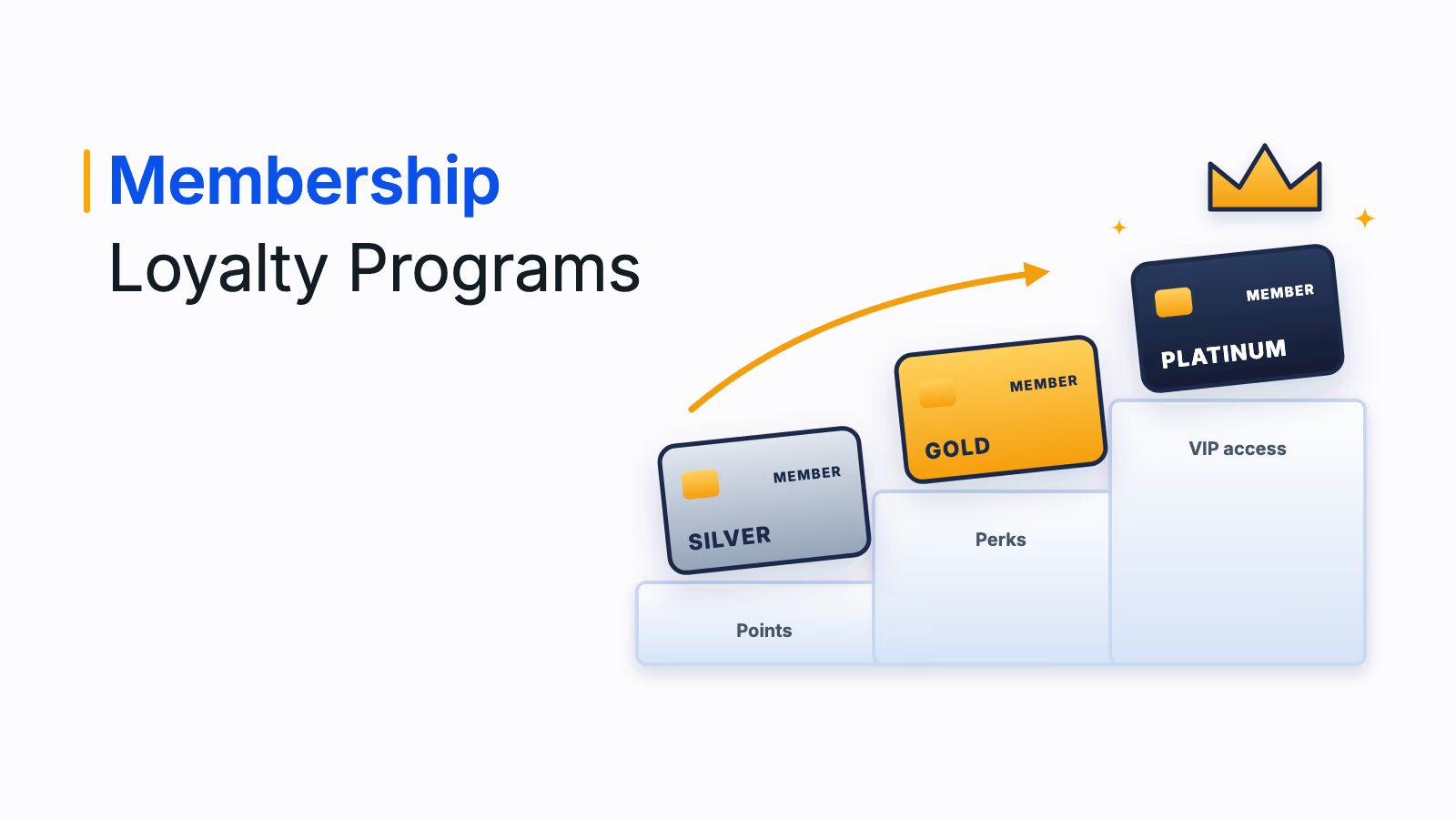
A common pattern is an entry gate, then accelerating bands, then a cap:
| Quota attainment | Multiplier on base incentive | Purpose |
|---|---|---|
| Below 80% | 0x (no incentive) | Entry gate, so incentives go to officers who meet a minimum standard |
| 80% to 99% | 1.0x | Pays for solid performance |
| 100% to 119% | 1.1x | Rewards beating target |
| 120% and above | 1.25x, capped | Rewards top performers while limiting cost and gaming risk |
Thresholds are where plans quietly create unfairness. An officer at 99.4% of quota who misses a tier because one file slipped to the next day feels cheated, and managers end up approving manual exceptions. A threshold buffer, for example treating 98% as 100%, settles that in the rule itself. Some lenders also allow a bump-up: a manager can move a team or an officer to the next tier based on defined criteria, such as a branch opening late or a product being withdrawn. Bump-ups should always go through an approval and be logged, or they become a backdoor for favoritism.
Quotas themselves need care too. Set them from historical disbursals by branch and product, adjust for local demand and give quota relief for leave, transfers and new joiners on ramp. A target that nobody can reach does not motivate; it pushes people toward the files they should not be sourcing.
Run loan incentive plans without spreadsheets
Build rules by product and region, apply clawbacks and approve every payout with an audit trail in Empuls Sales Incentives.
Talk to our ExpertTrusted by 5,000+ companies
Quality guardrails: clawbacks and mis-selling controls
Quality guardrails are the rules that reduce or recover incentives when a loan turns out badly, and they are what separate responsible loan disbursal incentives from a pure volume push. The most common are clawbacks, deferrals and quality gates.
- Clawbacks: Recover part or all of the incentive if a loan becomes delinquent within a set window, is cancelled, is prepaid within a short period or is found to have documentation errors. Define the trigger, the window and the amount clearly, and decide whether recovery comes from future earnings or as a direct deduction. Our guide to clawback provisions covers the design choices in more depth.
- Quality gates: Make part of the payout conditional on file quality metrics such as first-time-right documentation, credit approval rate or early delinquency rate for the officer's portfolio.
- Product mix and suitability controls: Avoid contests that pay a large bonus for selling one specific product in a short window, and avoid paying extra for add-ons such as bundled insurance. Track complaints per officer alongside disbursals.
- Agent and partner controls: For direct selling agents and connectors, pair disbursal-linked commission with rejection rates, fraud flags and compliance breaches.
The point is not to punish officers. Clear guardrails let you pay generously for good loans because you are not paying for bad ones, and they give compliance a direct answer when a regulator or auditor asks how your incentives discourage mis-selling.
Approvals and maker-checker for plan changes and payouts
Maker-checker means that one person sets up or changes something and a different person reviews and approves it before it takes effect. Applied to incentives, it covers three moments: launching or changing a plan, approving calculated earnings and releasing payouts.
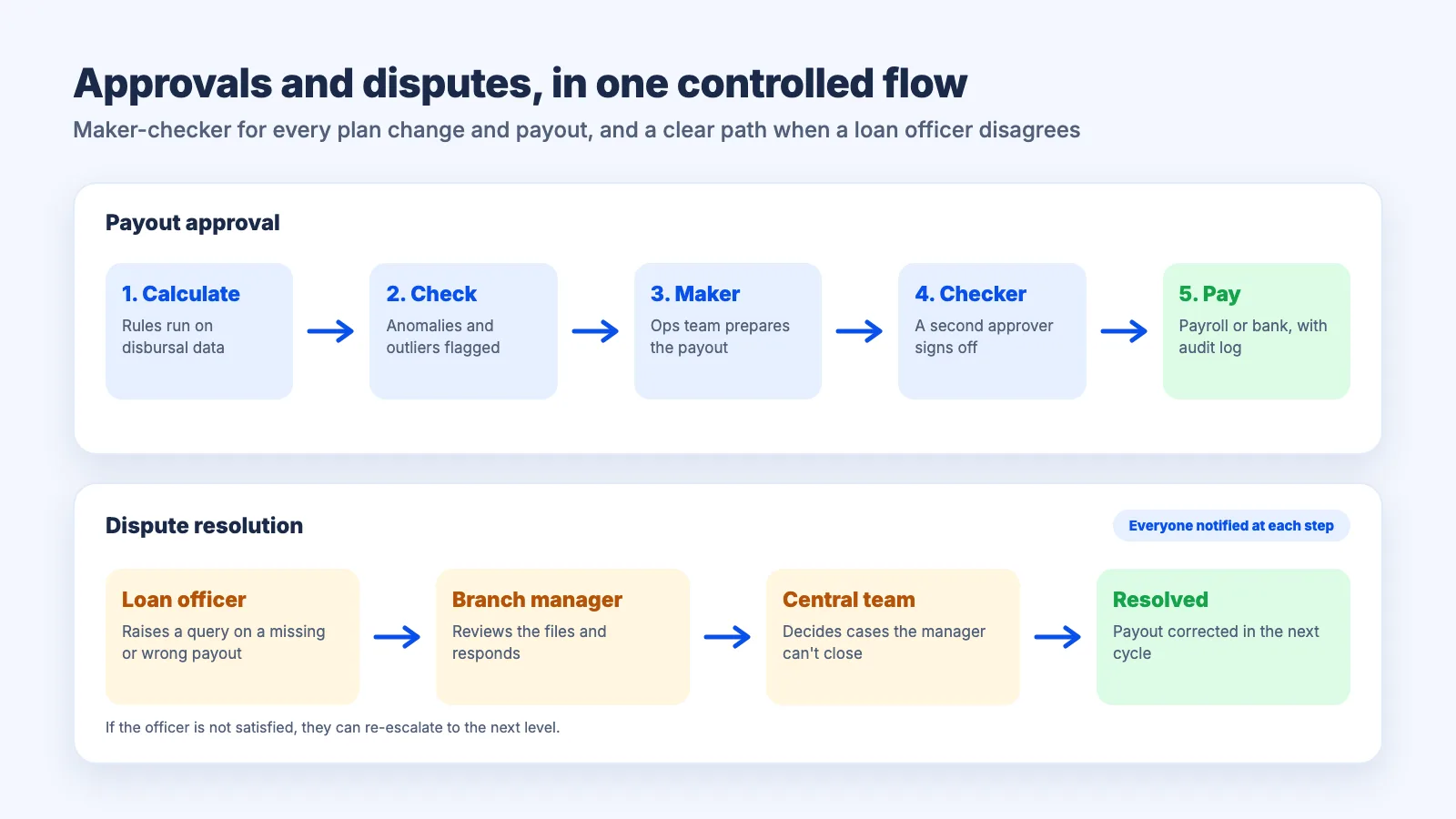
- Plan activation: The incentive team builds or edits the plan, and a sales head plus finance or compliance approve it before it goes live. Changes to rates, tiers or clawback rules follow the same path.
- Earnings review: At the end of the cycle, calculated earnings are reviewed by branch or zonal managers, who can approve, adjust with a reason, or flag an exception.
- Payout release: Finance gives the final sign-off before payouts reach payroll or bank accounts, ideally after automated checks for unusual payouts.
- Escalation: If an approval sits too long, it moves to the next level, so a single absent approver does not delay payouts for a whole branch.
Every approval, adjustment and override should be logged with who did it, when and why. That log is what makes a bank sales incentive plan defensible in an internal audit, and it removes the late-night email threads that usually surround payout week.
Handling disputes without spreadsheets
Disputes are best handled as structured tickets tied to the specific plan, period and transaction, not as emails and phone calls to the incentive team. When an officer can see exactly which loans were counted and how, most disputes never start.
The most common loan incentive disputes are a disbursal credited to the wrong officer, a file missing because the data arrived late, a tier missed by a small margin and a clawback the officer does not recognize. A good process has four parts: transparency, so officers see a line-by-line breakdown of each loan and rule applied; a clear way to raise a query against a specific line; a defined route through the branch manager to the central incentive team; and a record of the outcome, so the same issue can be fixed in the rule rather than resolved again next month. If your team is still reconciling these in workbooks, our guide on replacing Excel for commissions shows where the time goes.
Dashboards for branch, zonal and product heads
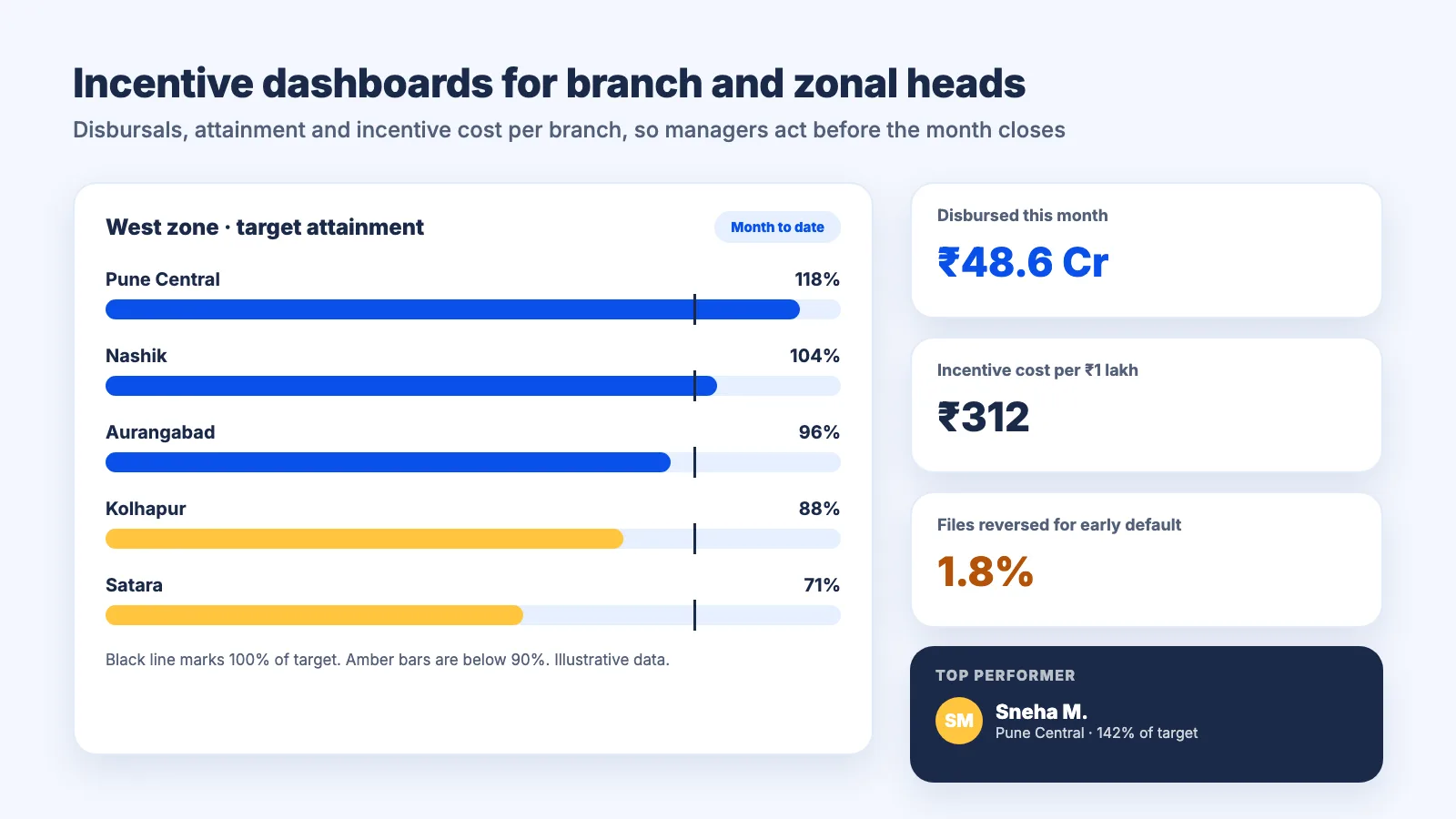
Each role in a lending sales organization needs a different view of the same incentive data. Dashboards work when they answer that role's daily question in seconds.
| Role | What they need to see |
|---|---|
| Loan officer or relationship manager | Disbursals against target by product, current tier, distance to the next tier, expected earnings and any pending clawbacks |
| Branch manager | Team attainment, officers off pace, product mix, quality flags and pending exceptions |
| Zonal or regional head | Branch roll-ups, attainment distribution, incentive cost by branch and early delinquency by branch |
| Product head | Disbursals and incentive spend by product, mix shifts after plan changes and portfolio quality by product |
| Finance and compliance | Payout totals, approvals, overrides, clawbacks and the audit trail |
Live visibility also changes behavior. An officer who can see that two more files will move her into the next band acts on it this week, not after the cycle closes. Leaderboards by branch or region add healthy competition, as long as they run on the same validated data that pays the incentive. For ideas, see our guide to sales gamification.
Simulate before you roll out
Simulation means running a proposed plan or change on your own historical data to see what it would have paid, before anyone is committed to it. For lenders with thousands of officers, a small change to a rate or a tier boundary can move incentive cost by a large amount.
A practical simulation routine looks like this:
- Pick a baseline: Use the last two or three cycles of disbursal, quality and attainment data.
- Run the new plan on that data: Compare total payout, payout by branch and product and the share of officers in each tier against the current plan.
- Look for skew: Check whether payouts concentrate in one region or product, whether a cap is hit too often and whether any rule creates an easy loophole, such as splitting one loan into two files.
- Test the guardrails: Apply the clawback and quality rules to past delinquencies to see how much would have been recovered.
- Approve and publish: Send the final plan through maker-checker approval and track results against the old plan from the first cycle.
Measuring incentive ROI for loan sales teams
Incentive ROI for loan sales compares what you spend on incentives with the profitable lending it produced, not just the disbursal volume. A plan that grows disbursals while early delinquency rises may be destroying value.
Track a small set of measures plan by plan and cycle by cycle:
- Incentive cost per ₹1 crore disbursed: Total incentive spend divided by disbursal value, by product and branch.
- Incremental disbursals: Disbursals compared with a baseline period or a comparable region where the plan did not change.
- Unit profitability: Expected net interest income and fees per loan, less credit cost and incentive cost, by product.
- Quality-adjusted volume: Disbursals that stay current past the early delinquency window.
- Clawback and dispute rates: High rates point to rules that are unclear or to sourcing problems.
- Payout accuracy and cycle time: How many payouts needed manual correction and how many days from period close to payout.
Compare plans side by side over time. If a new tier structure lifted disbursals but most of the lift came from one low-margin product, adjust the mix weights in the next cycle rather than waiting a year for a plan redesign.
How Empuls Sales Incentives runs loan incentive plans
Empuls Sales Incentives is Xoxoday's platform for calculating, approving and paying commissions and incentives, used by large sales organizations including lenders. Here is how it supports the practices in this guide:
- Plan rules for every product: A no-code plan builder supports slabs, tiers, lookups and plans by role, region or department, with metrics such as disbursement percentage or product mix and a transaction date field that decides which period each record belongs to.
- Tiers and thresholds: Cascading plans, roll-ups through the management hierarchy, override commissions, threshold buffers and quota relief are configured in the same engine.
- Clawbacks: Link a completed plan to a new one and the platform calculates the clawback from incentives already paid; admins approve or deny it.
- Approvals by stage: Payout controls let you set approvals separately for plan activation, plan reports, plan earnings and escalations, with automatic escalation when an approval stalls, pre-payout anomaly checks and a full audit trail of every change.
- Disputes and exceptions: Managers get an exception and dispute log, and exceptions route to the right owner and are tracked to resolution.
- Role-based dashboards and simulation: Sales intelligence shows attainment by team, region and plan, off-pace alerts and incentive spend next to the revenue and attainment it produced, and lets you run a changed plan on your own data before it goes live.
- Payouts: Approved incentives go to payroll, or by bank transfer, UPI or rewards where payroll is not the route.
Mahindra Finance moved incentives for 20,000+ sales professionals across 12 lines of business onto the platform in a phased rollout, with live dashboards and mobile notifications. It reported 99% faster incentive processing, 85% fewer incentive queries to finance and HR, a 96.2% increase in payout adoption and a 30% boost in sales performance. Xoxoday is SOC 2 Type II and ISO 27001:2022 certified, and most enterprise teams go live in 4 to 8 weeks, running the new plans alongside their spreadsheet before the first live payout. See the banking and fintech solutions page for the wider set of programs for lenders.
Getting your loan officer incentive plan right
A strong loan officer incentive plan rewards the loans you actually want: the right product, for the right customer, that keeps performing. Write rules by product, geography, tenure and amount; add tiers with fair thresholds; protect quality with clawbacks and gates; and run every change and payout through approvals. Then measure ROI on profitable lending, not volume alone, and use simulation to improve the plan each cycle. Done this way, incentives stay motivating for your sales teams and defensible for your compliance and finance teams.
Book your Empuls demo
Frequently asked questions
A loan officer incentive plan is the set of rules a bank or NBFC uses to pay variable pay to loan sales staff. It usually combines rates by product, region, tenure and ticket size with quota tiers, and adds quality guardrails such as clawbacks for early default, so officers are rewarded for loans that keep performing, not just for disbursal volume.
Most lenders pay either a percentage of the disbursed amount or a fixed amount per disbursed file, with different rates by product and region. The base amount is then multiplied by a tier based on quota attainment, capped where needed, and reduced by any clawbacks or quality adjustments defined in the plan before the cycle started.
Clawbacks link the incentive to the quality of the loan. If a loan becomes delinquent within a set window, is cancelled or has documentation errors, part or all of the incentive is recovered. This discourages pushing weak files through, protects the lender from paying for bad loans and gives compliance evidence that incentives do not encourage mis-selling.
It depends on the market and product. In the US, Regulation Z bars mortgage loan originator pay based on a term of the transaction, or a proxy for one, other than the amount of credit extended, and tenure and rate are terms. Other markets and products may allow it. Always confirm with your compliance team before using tenure or rate.
Maker-checker is a control where one person creates or changes something and a different person reviews and approves it. In incentive management it applies to launching or editing a plan, approving calculated earnings and releasing payouts. Every step is logged with who acted and when, which keeps payouts accurate and makes the plan easy to audit.
Compare incentive spend with the profitable lending it produced. Useful measures include incentive cost per unit of disbursal, incremental disbursals against a baseline, unit profitability after credit and incentive costs, disbursals that stay current past the early default window, and clawback and dispute rates. Review these by plan, product and branch every cycle.